
Best Board Games for Family Game Nights
A curated mix of new releases and modern classics, sorted by age range and play length, for households where an eight-year-old, a teenager and a couple of grandparents all want a seat at the same table.
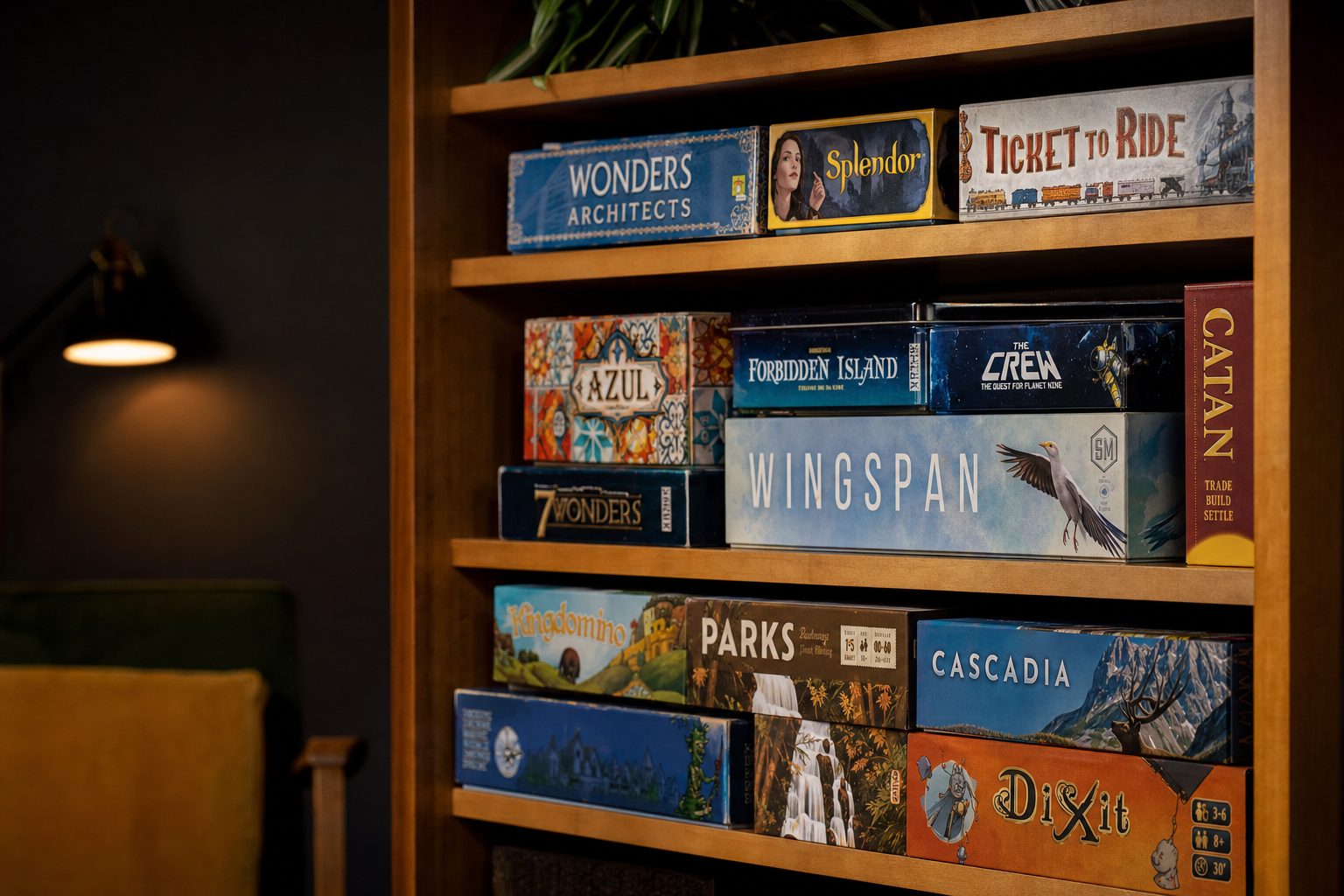
A well-stocked shelf of modern-classic and brand-new family games — the mix that keeps mixed-age game nights running smoothly.
Getting a genuinely mixed-age family around one table is harder than it looks. The little ones want colour and quick wins, the teenagers want a bit of strategy they can actually chew on, and the grown-ups want something that doesn't feel like babysitting. Over dozens of family evenings — some triumphant, some derailed by a toppled tower and a sulk — I've narrowed things down to a shortlist that genuinely earns its shelf space.
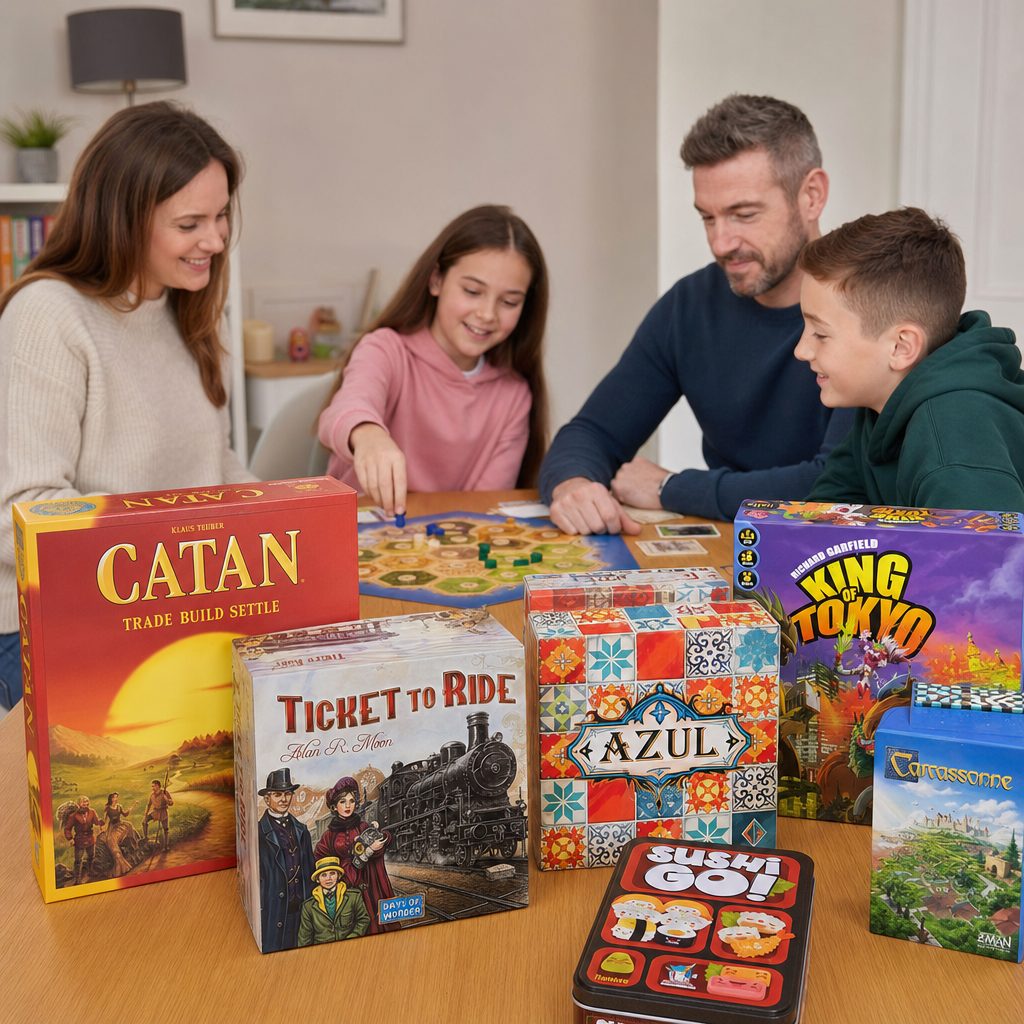
Matching the game to the evening — a quick filler on a school night, a deeper strategy game at the weekend — is what keeps families coming back to the table.
This guide is organised around two things that matter more than anything else on a real family game night: age range and play length. A brilliant game that takes ninety minutes is useless at 7pm on a school night, and a five-minute filler won't hold a Saturday-evening crowd. Below I've ranked fifteen titles, given each its own pros and cons or key specs, pulled everything together into one big comparison table, and finished with clear "who should buy what" cards. Let's get to it.
How I picked these
Every title here is either currently in print and easy to buy in the UK, or a modern classic that's stayed on shelves for years. I've weighted my rankings towards games that scale across ages, teach quickly, and pack down without hassle — because a game that stays in the cupboard because it's a faff to set up is no game at all.
Quick Snapshot: The Range at a Glance
Before the deep dives, here's the lie of the land. These are the numbers that actually shape whether a game works for your household — the minimum age, the player count, and how long you'll realistically be sat down.
1. Ticket to Ride (2025 Refresh) — Best Gateway Game for Mixed Ages
If I could only recommend one game to a family that's never really played "proper" board games, it would be this. Alan R. Moon's route-building classic has been the go-to gateway game for two decades, and the 2025 Refresh from Days of Wonder — which arrived on 27 June 2025 — tidied up the art, refined the presentation and folded in a handful of gameplay tweaks that came straight out of family playtesting feedback.
The rules take about five minutes to explain: collect coloured train cards, claim railway routes between cities, and complete the secret destination tickets in your hand. That's it. Yet there's just enough tension — do you grab that route now or gamble that no one else wants it? — to keep a teenager or an adult genuinely engaged. It plays 2 to 5, suits ages 8 and up, and lands comfortably in the 30 to 60 minute window that suits a school-night crowd.
Pros
- Learnable in five minutes, genuinely fun for adults too
- Chunky plastic train miniatures feel great in the hand
- Refreshed art and presentation look lovely on the table
- Scales cleanly from 2 up to 5 players
Cons
- Route-blocking can frustrate very young or sensitive players
- At 5 players the map gets crowded fast
- Not much variety in the base box once you've played a dozen times
Check the latest price and any current bundles on Amazon.
2. Wingspan — Best for Families Who Want More Depth
When your youngest hits ten or so and the family's ready to step up, Wingspan is where I'd send them. Elizabeth Hargrave's engine-builder first flew onto shelves on 8 March 2019 and has since shifted more than 2.6 million copies, been translated into 27 languages, and picked up a devoted following well beyond hardcore hobbyists.
You're attracting birds to a wildlife reserve, each bird triggering a chain of powers that build on one another. The 170-plus bird cards use real species with accurate wingspan and habitat data, so there's a genuinely educational layer under the strategy — my own kids started reciting facts about the northern cardinal without realising they were learning. The birdfeeder-shaped dice tower and little egg miniatures are a lovely tactile touch too.
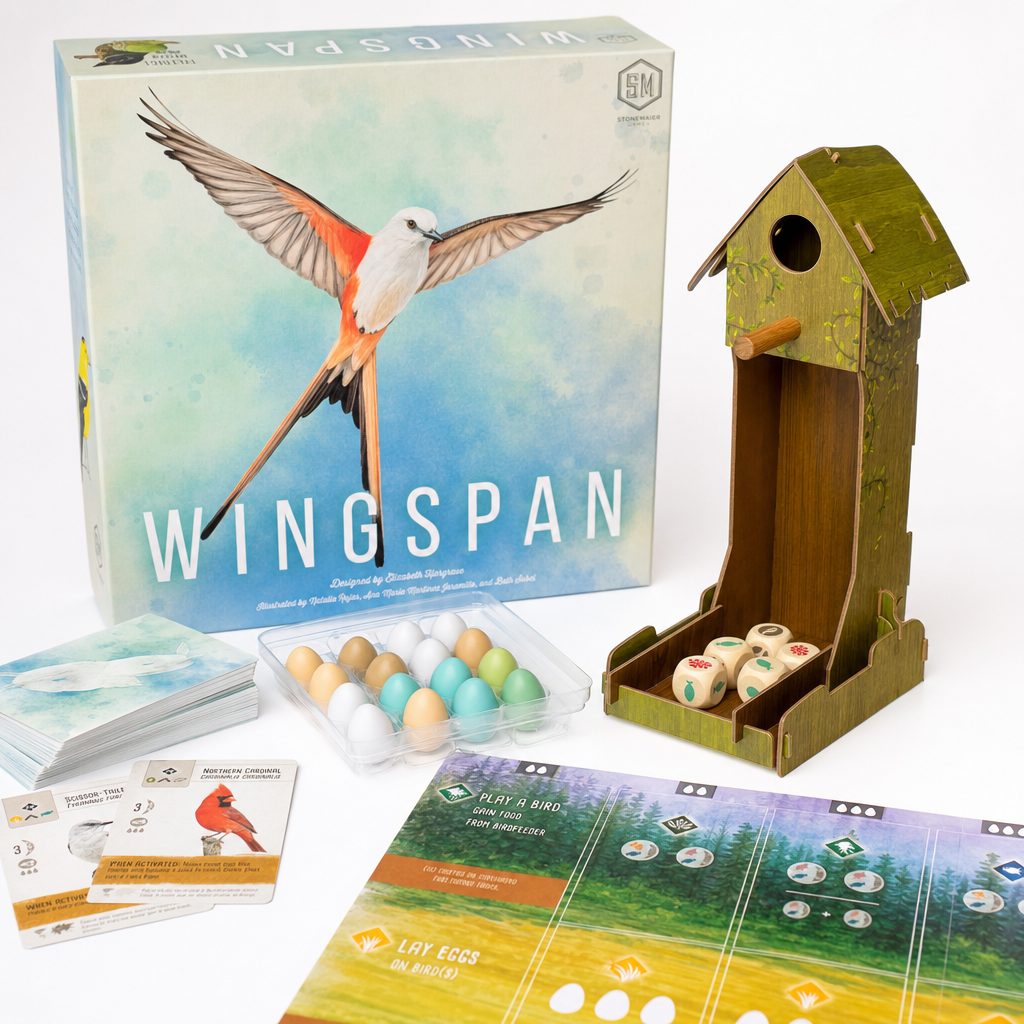
Wingspan's birdfeeder dice tower and egg tokens turn an engine-builder into something tactile enough to win over reluctant players.
A word of warning: your first game will run 90 minutes or more whilst everyone learns the icons. After that it settles into a comfortable rhythm. There's also a solid solo mode using the Automa system, and the Americas expansion arrived in February 2026, adding 85 new birds if the base game has hooked you.
Check the latest price and any current bundles on Amazon.
3. Codenames — Best Party Game for Bigger Gatherings
For a full house — birthdays, Christmas, that awkward gathering where three generations need something to break the ice — Codenames is close to unbeatable. Vlaada Chvátil's word-association classic won the 2016 Spiel des Jahres (the industry's Game of the Year), has sold over 15 million copies globally, and is translated into 46-plus languages. There's even a free online version at codenames.game pulling around 10 million monthly players.
Two teams, two spymasters, one grid of word cards. Each spymaster gives a one-word clue to steer their team towards their agents whilst avoiding the assassin. It's simple to explain and endlessly re-playable. The recent relaunch across 2025 and 2026 brought a revised word list, streamlined rulebook and a smarter box insert — small changes, but they make the setup faster and the play cleaner.
Pros
- Handles big, loud groups better than almost anything
- 200 double-sided cards mean 400 codenames and huge variety
- Loads of variants — Pictures, Duet, plus Disney and Marvel editions
- Rounds are 15–30 minutes, so easy to slot in
Cons
- The 14+ word list can stump younger players
- Needs at least four people to really sing
- A weak spymaster can make a round frustrating
If your household skews younger, the picture-based Codenames: Pictures edition works from around age 4, whilst the standard word game is pitched at 14+. Mixed-age families often keep both.
Check the latest price and any current bundles on Amazon.
4. Catan (6th Edition) — Best for Trading and Negotiation
The late Klaus Teuber's Catan practically invented the modern hobby-game boom when it first appeared in 1995, and it won Germany's Spiel des Jahres in 2004. The 6th Edition keeps everything that made it a landmark — the modular hexagonal board that randomises every game, the frantic resource trading, the settlements creeping across the island — whilst freshening the components.
What sets Catan apart on a family night is the negotiation. You're constantly haggling: two wheat for a brick, anyone? That back-and-forth is where the laughter lives, and it's brilliant for teaching kids to bargain and read a table. It plays 3 to 4 out of the box, suits ages 10 and up, and runs 60 to 90 minutes.
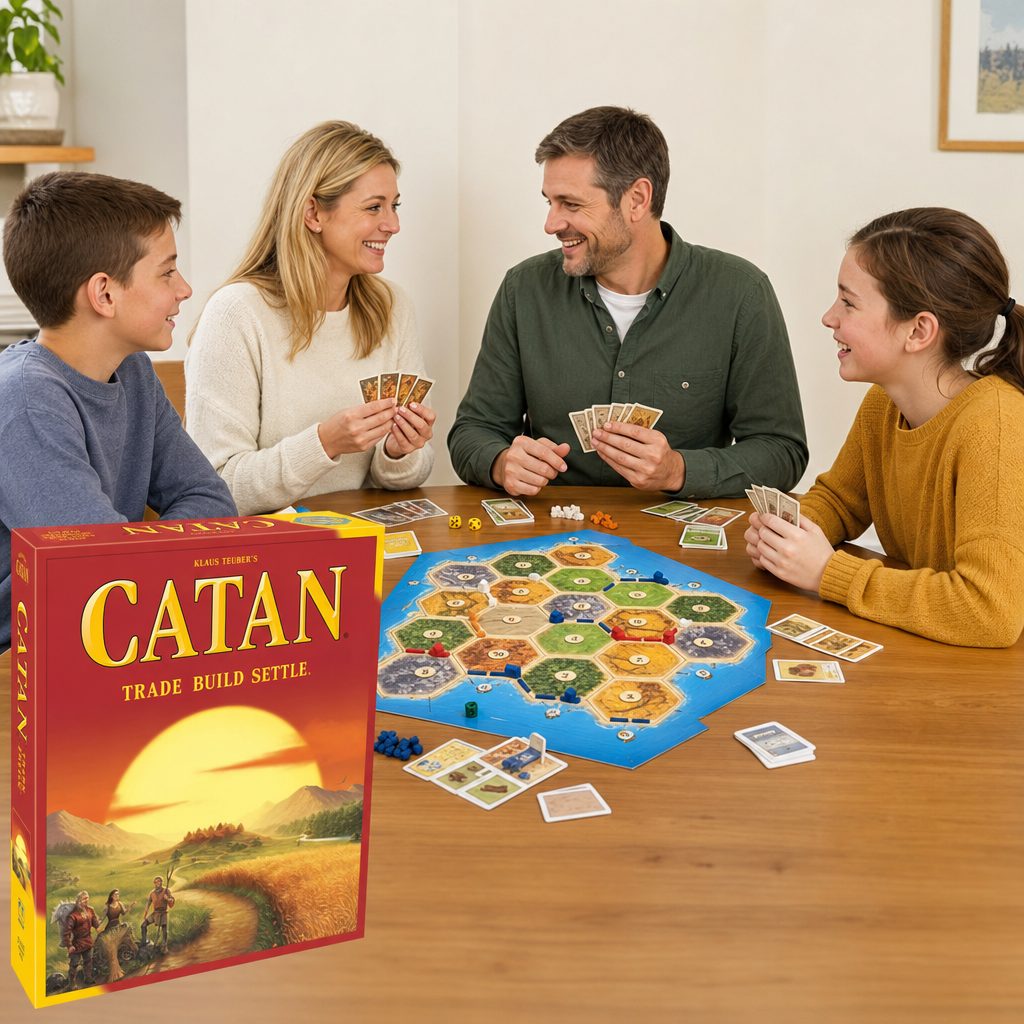
Catan's modular hex board means no two games play the same — and the trading table is where mixed-age families really come alive.
Pro Tip: taming the dice
Catan's fortunes hinge on dice rolls, which can leave a younger player starved of resources and grumpy. Many families use a "dice mitigation" house rule — drawing from a shuffled deck of number cards instead — to smooth out the luck. It's a small change that keeps the peace.
Check the latest price and any current bundles on Amazon.
5. Cascadia Junior — Best Relaxed Game for Younger Players
Released in 2025, Cascadia Junior takes the cosy, award-winning tile-laying of the original Cascadia and simplifies it for ages 8 and up. You're building habitats and matching animal tokens to create your own little ecosystem, and crucially there's no direct conflict — nobody's blocking anybody or knocking anything down. For families with a sensitive youngster who melts at competitive games, that low-stakes, puzzly feel is gold.
It plays 2 to 4 and runs a tidy 30 to 40 minutes, quicker than the base game. The visual, tactile mechanics make it genuinely calming — I've used it as a wind-down game on nights when the kids were already overtired and anything cut-throat would have ended in tears.
Pros
- Gentle, no-conflict gameplay ideal for younger or anxious players
- Beautiful nature theme and satisfying tiles
- Quicker than the original Cascadia at 30–40 minutes
- A natural stepping stone to the full game later
Cons
- Less strategic bite for older teens and adults
- Can feel a touch samey over repeat plays
Check the latest price and any current bundles on Amazon.
6. Kingdomino — Best Quick Tile-Layer
Kingdomino is the game I reach for when we've got twenty minutes and want something with real thought behind it. You draft oversized domino tiles and lay them to build a 5×5 kingdom, matching terrain types and racking up points for connected regions crowned with, well, crowns. It plays 2 to 4, suits ages 8 and up, and there's a My First Kingdomino edition that drops the entry age to 4.
The clever bit is the drafting order: pick a high-scoring tile now and you'll choose last next round. That tiny tension elevates it well above a simple children's game, which is why it works across ages. It's also fast to set up and pack away — no small thing when bedtime's looming.
Domino drafting
Choose your tile and your turn order in one decision — simple to grasp, deceptively tactical.
Crown scoring
Connected terrain multiplied by crowns rewards planning without heavy maths.
Grows with the family
My First Kingdomino covers age 4; the standard game keeps teens and adults engaged.
Check the latest price and any current bundles on Amazon.
7. Dixit — Best Storytelling Game for All Ages
Dixit is the great equaliser. Because it runs on imagination rather than reading age or arithmetic, a seven-year-old can genuinely out-think a grown-up. One player gives a cryptic clue about their dreamlike illustrated card; everyone submits a card of their own; then all guess which was the original. Too obvious a clue and everyone scores off you; too obscure and nobody guesses. Finding that sweet spot is the whole delightful game.
The artwork is stunning and there's no "right" answer, so it sparks proper conversation. For truly mixed-age tables, this is one of my top two recommendations alongside Codenames — and unlike Codenames, it works with the little ones from the off.
Check the latest price and any current bundles on Amazon.
8. Cozy Stickerville — Best New Release for 2026
Fresh for 2026, Cozy Stickerville leans right into the "cosy games" trend that's swept the hobby. It's a sticker-placement village builder — you're literally decorating and growing a little town — and it's designed to be low-pressure and warm rather than competitive. For families who found even Cascadia Junior a touch too structured, this is about as gentle and inviting as a table game gets.
It's a lovely choice for wind-down evenings and for younger children who just want to make something look nice. If your family's game nights are more about togetherness than triumph, put this one on the shortlist.
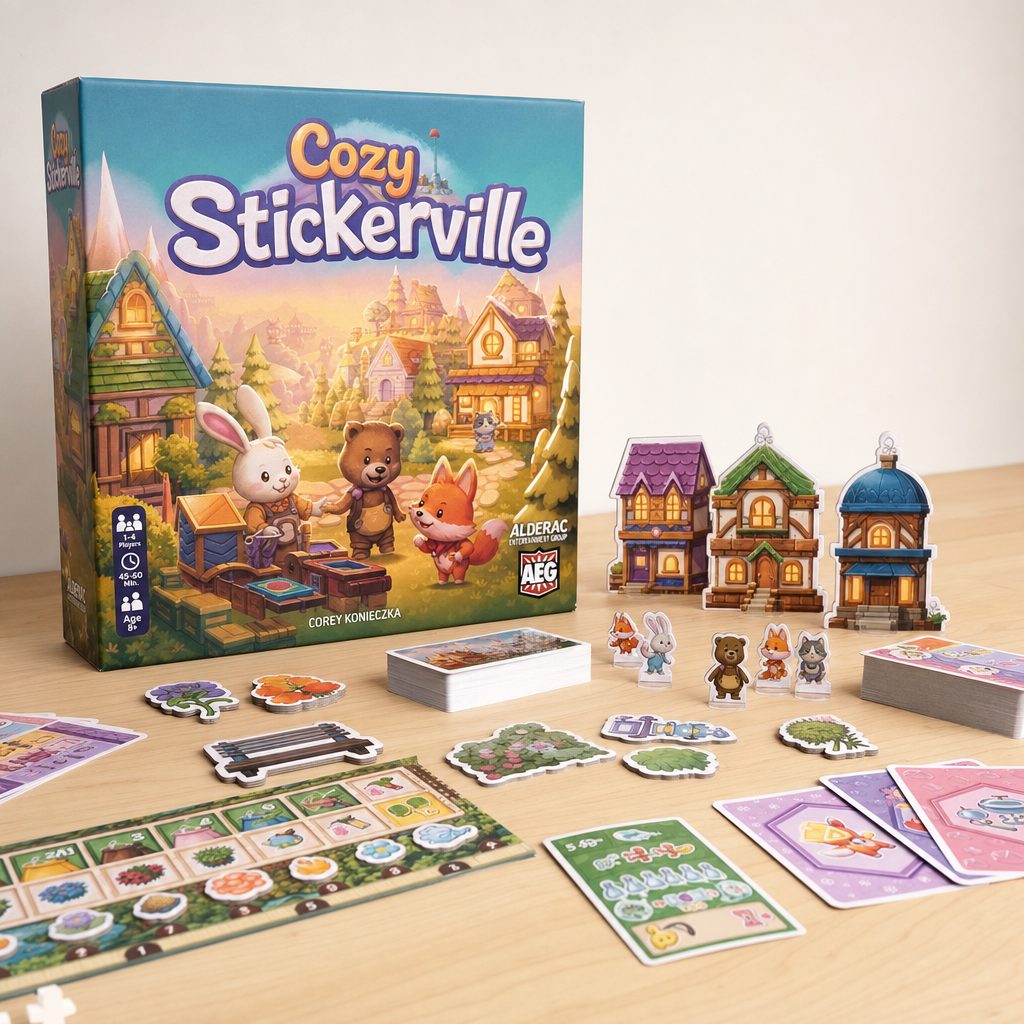
Cozy Stickerville rides the cosy-games wave — a warm, low-pressure builder that suits families who play for togetherness rather than victory.
Check the latest price and any current bundles on Amazon.
9. 7 Wonders — Best for Larger, Older Groups
Once your family's comfortable with a bit of strategy, 7 Wonders delivers real depth without dragging on. It's a simultaneous card-drafting civilisation builder for ages 10 and up: everyone picks a card and passes their hand at the same time, so it barely gets slower with more players. That's its trick — it handles bigger groups in roughly the same time a smaller game would take.
There's genuine strategy in balancing military, science, commerce and monuments across three ages of play. It's the most "serious" pick on this list for a reason, and it rewards families who've already got a few gateway games under their belt.
Pros
- Simultaneous play keeps things fast even at high player counts
- Deep, satisfying strategy across three ages
- Excellent for older kids and adults together
Cons
- Icon-heavy — a steeper learning curve than most picks here
- Under-eights will struggle without a lot of help
Check the latest price and any current bundles on Amazon.
10. Carcassonne — Best Tile-Laying Map Builder
Carcassonne is a modern classic for good reason: you draw and place a tile each turn, building a medieval landscape of roads, cities, monasteries and fields, then deploy your little wooden "meeples" to claim them. It suits ages 7 and up — one of the more accessible entry points on this list — and the shared, growing map means everyone stays involved even when it isn't their turn.
The gentle interaction (you can share a city, or sneak in and steal it) makes it a great teaching game for reading a board and thinking a move ahead. It's earned its place as a fixture in family collections for over two decades.
Check the latest price and any current bundles on Amazon.
11. Just One — Best Cooperative Party Game
Just One flips the party-game formula: instead of competing, you're all working together. One player tries to guess a mystery word; everyone else secretly writes a one-word clue. Here's the twist — any duplicate clues get cancelled before the guesser sees them. So you're trying to be helpful but original, which produces wonderful groans and laughter around the table.
It's genuinely mixed-age friendly, plays quickly, and because it's cooperative there are no sore losers. For families who bristle at competition, Just One and Cozy Stickerville make a lovely one-two punch.
Check the latest price and any current bundles on Amazon.
12. The Two Towers: Trick-Taking Game — Best New Card Game for 2026
Another 2026 arrival, The Two Towers: Trick-Taking Game brings the classic card-game mechanic of "tricks" — winning rounds by playing the right card at the right time — dressed in a rich Middle-earth theme. Trick-takers have quietly become one of the trendiest corners of the hobby, and this one's an accessible way in for a family that already enjoys card games like UNO but wants a step up in cunning.
Check the latest price and any current bundles on Amazon.
13. Splendor — Best Engine-Builder for Beginners
Splendor is the game I recommend to families who like the sound of Wingspan's "one thing leads to another" satisfaction but want something they can teach in three minutes. You collect gem tokens, buy development cards, and those cards make future cards cheaper — a lovely little snowball. It suits ages 10 and up and never overstays its welcome. Quiet, quick and quietly addictive.
Check the latest price and any current bundles on Amazon.
14. Sushi Go! — Best Fast Filler
When you've got fifteen minutes and small children, Sushi Go! is my default. It's card-drafting boiled down to its purest, most charming form — pass your hand, grab the tastiest cards, try to collect sets of sushi. The art is adorable, the rules are trivial, and yet there's a real "should I take this or deny it to my sibling?" decision on every turn. It suits ages 8 and up and is the shortest proper game on this list.
Check the latest price and any current bundles on Amazon.
15. UNO — Best Simple Classic Everyone Knows
No family game roundup is honest without UNO. It's the great common denominator — everyone already knows it, or learns it in one round. Match colours and numbers, dump your hand, and enjoy the theatre of a well-timed "reverse, draw four." There's even a colour-blind-accessible edition now, which is a genuinely thoughtful touch for inclusive game nights. It won't stretch a strategist, but as the game that gets everyone laughing when nothing else will do, it's irreplaceable.
Check the latest price and any current bundles on Amazon.
Full Comparison Table
Here's every pick side by side. Sort by whatever matters most to your household tonight — age, player count or how much time you've actually got.
| Game | Players | Age | Play Time | Type | Best For |
|---|---|---|---|---|---|
| Ticket to Ride (2025 Refresh) | 2–5 | 8+ | 30–60 min | Route-building | Gateway game |
| Wingspan | 1–5 | 10+ | 40–90 min | Engine-builder | More depth |
| Codenames | 4–8 | 14+ / 4+ | 15–30 min | Word party | Big groups |
| Catan (6th Edition) | 3–4 | 10+ | 60–90 min | Trading/strategy | Negotiation |
| Cascadia Junior | 2–4 | 8+ | 30–40 min | Tile-laying | Relaxed play |
| Kingdomino | 2–4 | 8+ (4+ variant) | ~15 min | Tile-laying | Quick thinking |
| Dixit | Mixed | Mixed | ~30 min | Storytelling | All ages |
| Cozy Stickerville | Family | Younger | Relaxed | Sticker-builder | New in 2026 |
| 7 Wonders | Up to 7 | 10+ | ~30 min | Card drafting | Larger older groups |
| Carcassonne | 2–5 | 7+ | ~35 min | Tile-laying | Map building |
| Just One | Group | Mixed | ~20 min | Co-op party | No sore losers |
| The Two Towers | Small group | Family | Short | Trick-taking | New card game |
| Splendor | 2–4 | 10+ | ~30 min | Engine-builder | Easy engine |
| Sushi Go! | 2–5 | 8+ | ~15 min | Card drafting | Fast filler |
| UNO | 2–10 | 7+ | ~15 min | Card matching | Everyone knows it |
How the Top Picks Stack Up on "Family Fit"
Specs only tell you so much. What really matters is how a game lands with a real mixed-age table. Here's my own rough scoring — based on how reliably each game keeps everyone from age 8 to grandparent engaged in a single sitting.
The pattern's clear: the games that don't lean on reading age or arithmetic — Ticket to Ride, Dixit, Codenames — flex furthest across a mixed table. The deeper strategy titles score lower here not because they're worse games, but because they demand more from the youngest players.
Matching Games to the Night You've Actually Got
The single biggest reason a game night goes wrong isn't a bad game — it's the wrong game for the time and mood. Here's how I think about it in practice.
School night, 20 minutes before bed
Reach for Sushi Go!, Kingdomino or UNO. Quick to teach, quick to finish, no meltdowns over bedtime.
Cosy weekend wind-down
Cozy Stickerville, Cascadia Junior or Just One — gentle, cooperative or non-confrontational, perfect for tired players.
Big gathering, lots of people
Codenames and 7 Wonders shine with a crowd; Dixit brings everyone into the conversation.
A proper strategy evening
Give Catan, Wingspan or Splendor the time they deserve — 60 to 90 minutes with older kids and adults.
Who Should Buy What
The complete beginner family
Start with Ticket to Ride (2025 Refresh). Five-minute rules, universal appeal, and it grows with you.
Households with under-8s
Go for Cozy Stickerville or Kingdomino (My First edition covers age 4), plus UNO for guaranteed laughs.
The truly mixed-age table
Dixit and Codenames: Pictures level the playing field so a child can genuinely beat a grown-up.
Ready for real strategy
Wingspan and Catan (6th Edition) reward families who've outgrown gateway games.
The party crowd
Codenames for competition, Just One for cooperation — both handle a full, noisy room.
The keen card gamers
Sushi Go! for speed, 7 Wonders for depth, and The Two Towers if you fancy a trick-taker.
Frequently Asked Questions
The Bottom Line
There's no single "best" family game — the right pick depends on the ages at your table and the evening you've actually got. But if I had to build a mixed-age collection from scratch, I'd start with Ticket to Ride (2025 Refresh) as the gateway everyone can enjoy, add Dixit and Codenames for larger, more varied groups, and keep Sushi Go! or UNO on hand for the nights when there's barely time to play at all.
When your family's ready for more, Wingspan and Catan (6th Edition) deliver proper strategy, whilst 2026's Cozy Stickerville proves the loveliest game nights aren't always the most competitive ones. Buy for the players you've got, not the players you wish you had — and you'll find the box coming off the shelf far more often.