
E-flite UMX Timber X Review: The Tiny Aerobatic Plane With Huge Personality
The E-flite UMX Timber X takes the friendly bush-plane outline of the Timber family and gives it a rather excitable 3S brushless heart. It can cruise around a local flying field at a civilised pace, then suddenly hang on the prop and start behaving like it has something to prove. Brilliant fun, yes. Entirely beginner-proof, absolutely not.

The UMX Timber X is small enough to travel easily, but its oversized control surfaces make it look every inch the little troublemaker it is.
What the E-flite UMX Timber X actually is
The UMX Timber X BNF Basic is an ultra-micro radio-controlled aeroplane, built for pilots who want a properly capable little model rather than a decorative first step into the hobby. It is the compact descendant of the larger Timber X concept: a high-wing, rough-field-flavoured aeroplane with Short Take-Off and Landing manners, but with control surfaces enlarged enough to support full-on 3D aerobatics.
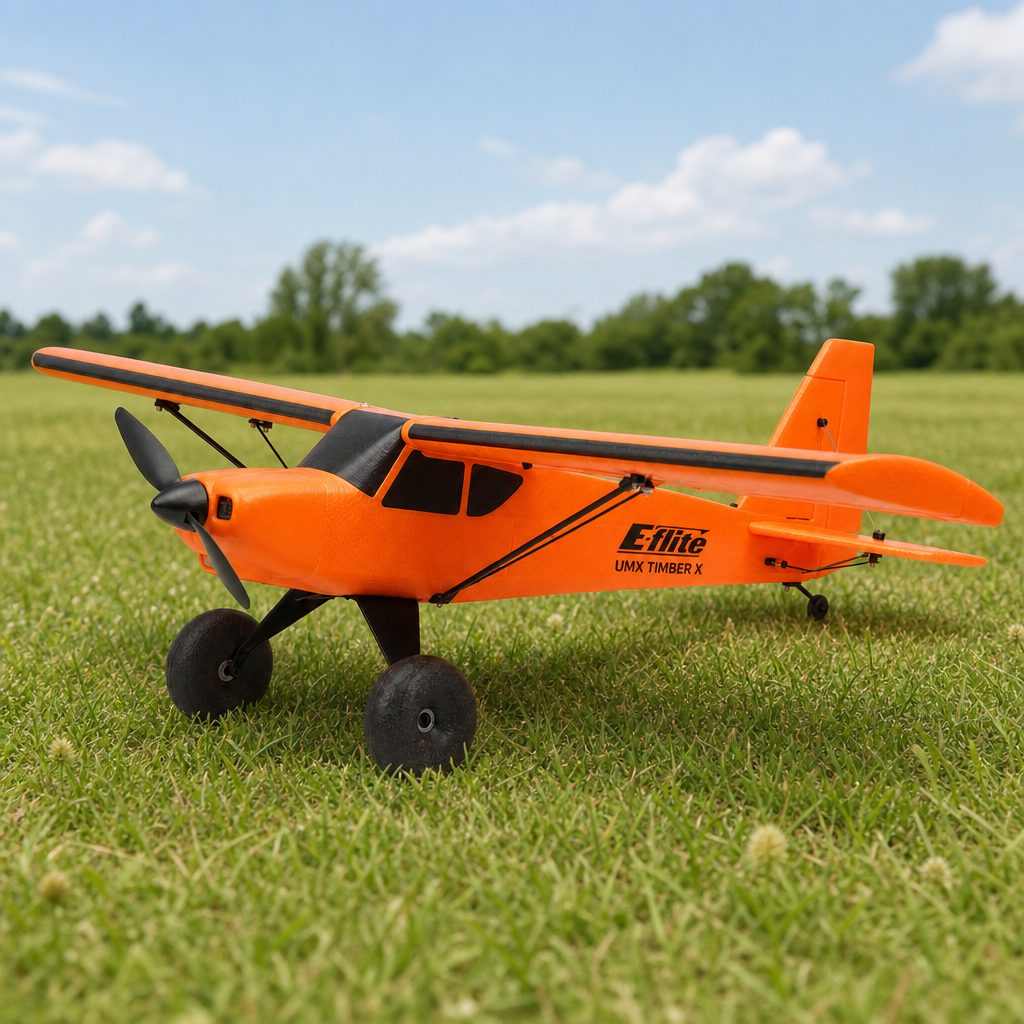
At its best, the E-flite UMX Timber X feels like a compact flying companion that can turn an ordinary field session into a miniature aerobatic display.
That combination is the entire point. Plenty of small RC planes are pleasant enough when pootling around overhead, but begin to protest if you ask for a steep climb, a slow high-alpha pass or a cheeky hover. The Timber X was designed to welcome those requests. With low control rates it can be restrained and approachable; on high rates, it becomes a far livelier proposition. Think of it as a sensible hiking boot fitted with roller-skate wheels. It will get you there, but it may also encourage poor decisions.
It arrived factory-assembled with its Spektrum receiver/ESC combination, four linear servos and brushless power system in place. "Bind-N-Fly Basic" still matters, though: there is no transmitter in the box, and you need a compatible Spektrum DSMX or DSM2 radio with at least five channels. That is a sensible arrangement for an established pilot with a suitable transmitter, but it is not a grab-it-from-the-shelf family toy in the way a self-contained starter model can be.
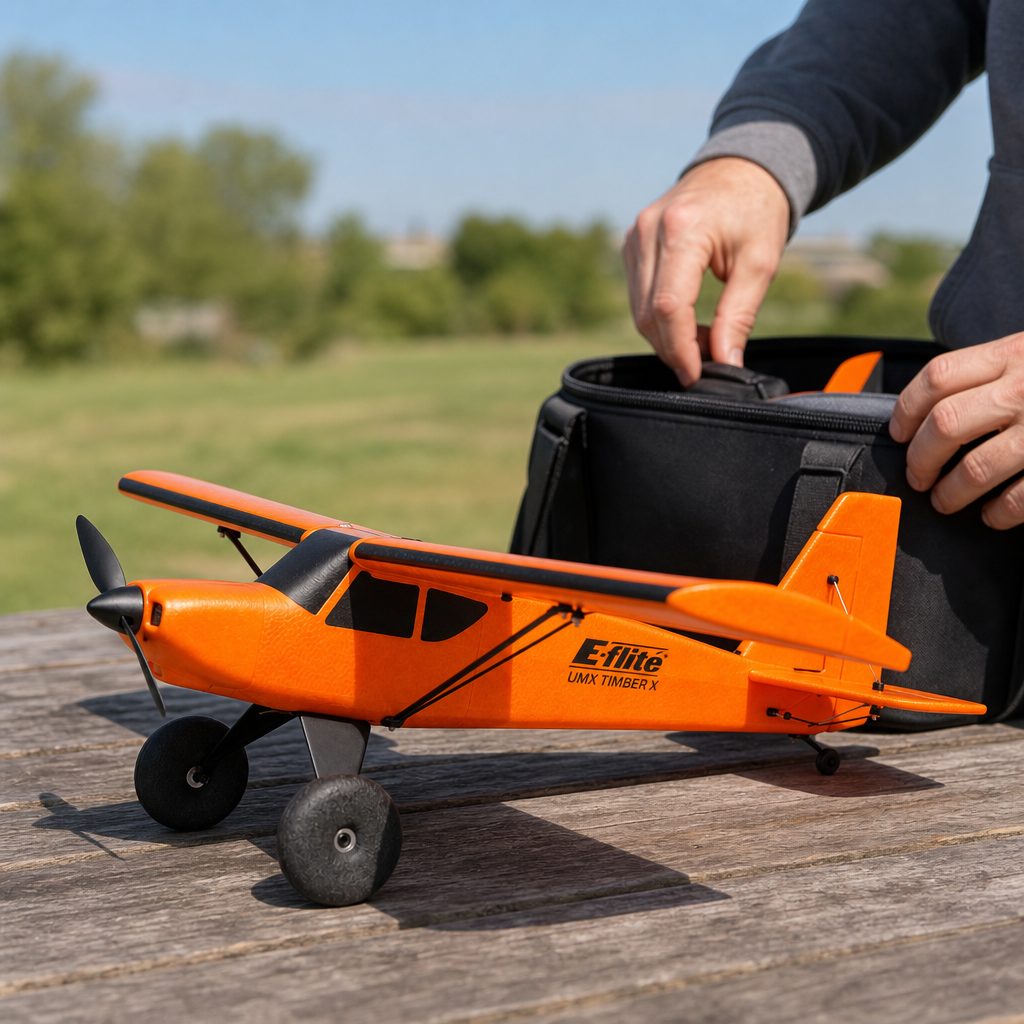
Its 570mm wingspan makes the Timber X genuinely transportable, whilst still leaving enough wing and control authority for outdoor flying.
Design and build: a tiny aircraft with a purposeful stance
The airframe used advanced EPS foam, which is exactly the pragmatic material choice for this sort of model. It keeps weight down, takes the minor indignities of transport reasonably well and is much less intimidating than a beautifully finished balsa aeroplane when a landing goes a touch agricultural. At 137g without a flight battery, this is a featherweight machine. You can understand why it responds so eagerly to power.
It also has a surprisingly assertive look. The wing is shorter than earlier ultra-micro Timber designs, and the ailerons, elevator and rudder are unusually large for its scale. Those surfaces are not styling flourishes. They are a clear warning label, expressed in foam: this plane was made to rotate, tumble and recover rather than merely trace large, polite circuits.
AS3X stabilisation
AS3X helps the small airframe track more cleanly in turbulent air, which is especially welcome when a breeze decides that your garden flying session needs a plot twist.
SAFE flight support
SAFE provides selectable assistance for pilots who want a calmer path into the model's considerable performance envelope.
Full-span ailerons
The ailerons can be used as flaperons, helping slow-flight and STOL behaviour without adding separate conventional flaps.
Factory LED lighting
Landing, navigation and simulated strobe lights add visibility and make the model more enjoyable during those later-day flying sessions.
Setup is quick, but this is not a no-thinking-required toy
One of the great pleasures of the UMX format is that there is no evening of glue, sanding or measuring hinge throws before the first flight. Bind the aircraft to a compatible transmitter, install a suitable 3S pack, confirm everything moves in the correct direction and you are close to the runway. Or close to the grass patch. Or, in the grandest possible sense of the word, close to a runway.
However, "ready to bind" should not be mistaken for "ready for a seven-year-old with a vague interest in Top Gun". The Timber X has power, sharp control response and a short flight window. It rewards basic radio discipline: checking control direction every outing, choosing appropriate rates, making a deliberate battery decision and carrying out a proper range and surface inspection. The small size removes some logistical faff; it does not remove the need to fly responsibly.
The supplied electronics include real-time flight battery voltage telemetry when used with compatible Spektrum AirWare transmitters, including the DX6e, DX8e, DX9, NX and iX series. For a model with brief, energetic flights, that is genuinely useful rather than merely a nice line on the box.
How the E-flite UMX Timber X flies
This is where the little Timber earns its X. The 1208–1900Kv, 10-pole brushless outrunner motor runs on a 3S 11.1V LiPo system, producing a thrust-to-weight relationship that comfortably exceeds the 1:1 threshold needed to hold a vertical hover. In plain English, it has more than enough urge to climb vertically. You do not need to nurse it upwards and hope for the best. Open the throttle and it goes.
That generous power changes the personality of the aircraft. A conventional micro high-wing model often asks you to plan ahead: retain enough speed for the turn, make a clean approach, keep the nose sensible. The UMX Timber X still benefits from good judgement, but its motor gives it an escape route. A mistake in a slow manoeuvre can often be turned into a climb rather than an embarrassing walk across the field. That is not a substitute for skill, of course. It is merely a very useful friend.
On lower rates, the model can be smooth and docile enough for relaxed circuits, touch-and-go practice and slower passes. Switch to high rates and the oversized surfaces become the stars of the show. The plane can perform the sort of expressive, low-speed aerobatics that make experienced club pilots grin and make spectators quietly wonder whether it is supposed to be doing that.
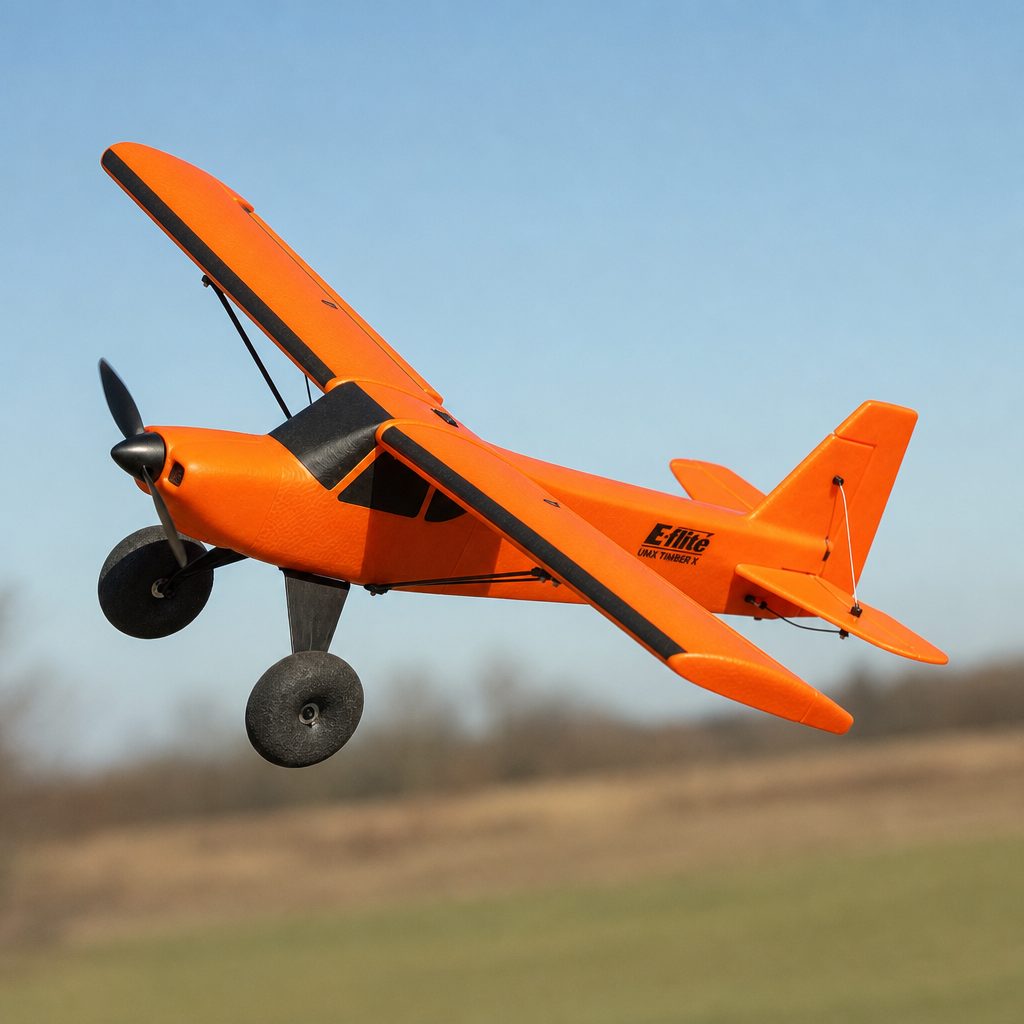
The UMX Timber X's high-wing layout and oversized surfaces support both slow STOL-style passes and much more energetic aerobatic flying.
Flying tip: start calm
Use low rates until you know how the UMX Timber X reacts at your usual field. Its high-rate setting exists because the airframe can do dramatic things, not because every first take-off needs to become a tiny airshow finale.
STOL manners, flaperons and landing reality
The Timber X's STOL credentials are more than marketing decoration. The full-span ailerons can be configured as flaperons, helping the aircraft slow down and fly at steeper angles. It will not turn a postage stamp into a certified runway, but it does make the model flexible in smaller outdoor spaces where a long, fast landing run would be unhelpful.
There is a catch, and it is an important one. The wire landing gear is undamped. On soft grass it is broadly in keeping with the aircraft's bush-plane vibe, but hard-surface landings can produce energetic bouncing. This is not a plane that politely absorbs a firm arrival and rolls away pretending nothing happened. A rushed touchdown can become a sequence of increasingly awkward hops, each one doing absolutely nothing for your dignity.
The answer is straightforward: land with intention. Carry the right amount of energy, keep the flare gentle and favour a forgiving grass strip wherever possible. It is also worth treating the landing gear as an area to inspect after heavy sessions. The UMX Timber X is durable for its weight, but durability and invulnerability are not the same thing. Ask any parent who has found a supposedly "unbreakable" toy under the sofa.
Battery life and everyday flying routine
The recommended battery range is a 3S 280–350mAh LiPo with a JST-RCY connector, although pilots chasing the strongest 3D performance should keep to a 300mAh capacity limit. With that sort of pack, aggressive flying delivered approximately four to six minutes of flight time depending on throttle management. That may sound brief to somebody used to a toy drone's quoted numbers, but it is normal for a small, powerful aerobatic aeroplane.
More importantly, those four to six minutes are busy. Hovering, climbing vertically, practising slow flight and repeatedly punching out of manoeuvres all consume energy quickly. A gentle circuit uses less. The lesson is not to stretch the final minute in the hope that the model will somehow become more economical through optimism. It will not. The voltage telemetry is there to help you avoid a dead-stick landing, so use it.
For real family use, I would regard multiple charged packs as part of the experience rather than an optional luxury. One battery provides an entertaining demonstration. Several batteries provide an afternoon. The compact format makes this manageable: the model itself is easy to carry, and spare packs do not demand a large flight bag. The routine is simple once established, but LiPo batteries still require the care and charging practices expected of the RC hobby.
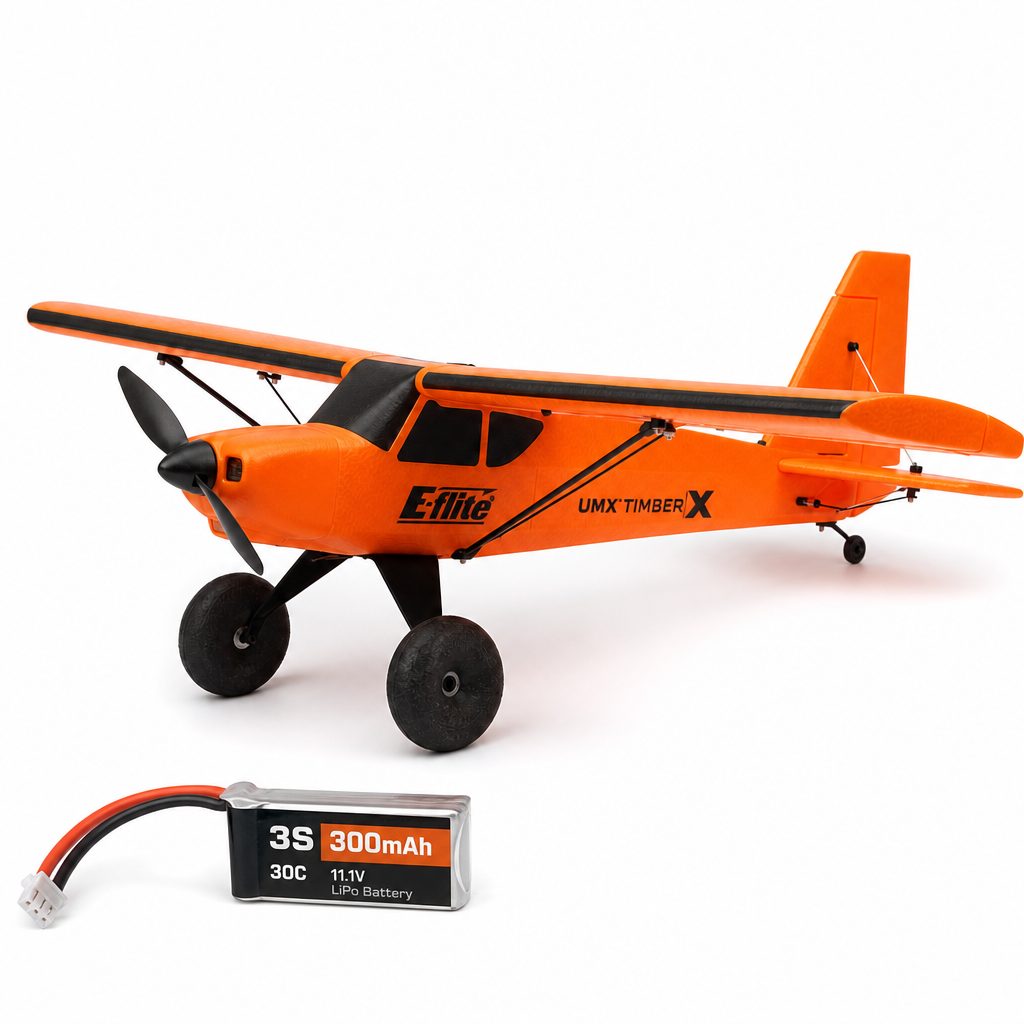
A 3S 280–350mAh LiPo powers the UMX Timber X, with 300mAh packs preferred when the priority is aggressive 3D performance.
Noise, wind and the less glamorous bits
No review should pretend the UMX Timber X is effortless perfection. The high-Kv brushless motor and linear servos create a loud, whiny acoustic profile. It is not the sort of noise that makes a large petrol model intimidating, but it is noticeable and rather mechanical. In a quiet park, it announces itself. This is one reason a suitable flying site is more important than the tiny dimensions might suggest.
The AS3X stabilisation deserves real credit here. Small foam models can look vulnerable in disturbed air, as though every gust has been personally appointed to rearrange the flight plan. AS3X helps the Timber X resist that twitchiness and gives it a more planted, larger-model feel. Still, it cannot repeal physics. A 570mm wingspan and 137g airframe should not be sent out into conditions that would make the trees complain.
Mechanical maintenance is also part of ownership. In particular, the linear elevator servo can suffer mechanical lockout under sustained axial stress, creating a serious risk of losing control. That is not a minor cosmetic annoyance. Check the elevator's movement, look for any binding and do not ignore odd resistance or inconsistent travel. A micro model is inexpensive compared with a giant-scale aircraft, perhaps, but it is still a fast moving object with a propeller and a considerable amount of personality.
Optional floats broaden the fun
One especially charming aspect of the Timber X design is that it can accept optional EFLUA1190 floats. With them installed, suitable ponds, lakes and larger pools become potential flying locations. It is a lovely extension of the model's back-country character, and water take-offs are among the hobby's most satisfying little spectacles.
That said, floats are best viewed as a bonus for a confident pilot rather than a reason to buy the aircraft. Water removes the friendly forgiveness of grass, retrieval can become complicated quickly and all of the usual electrical caution applies. But for an owner who already has a safe venue and understands the extra demands, the option adds meaningful variety rather than being a gimmick that will live in a drawer.
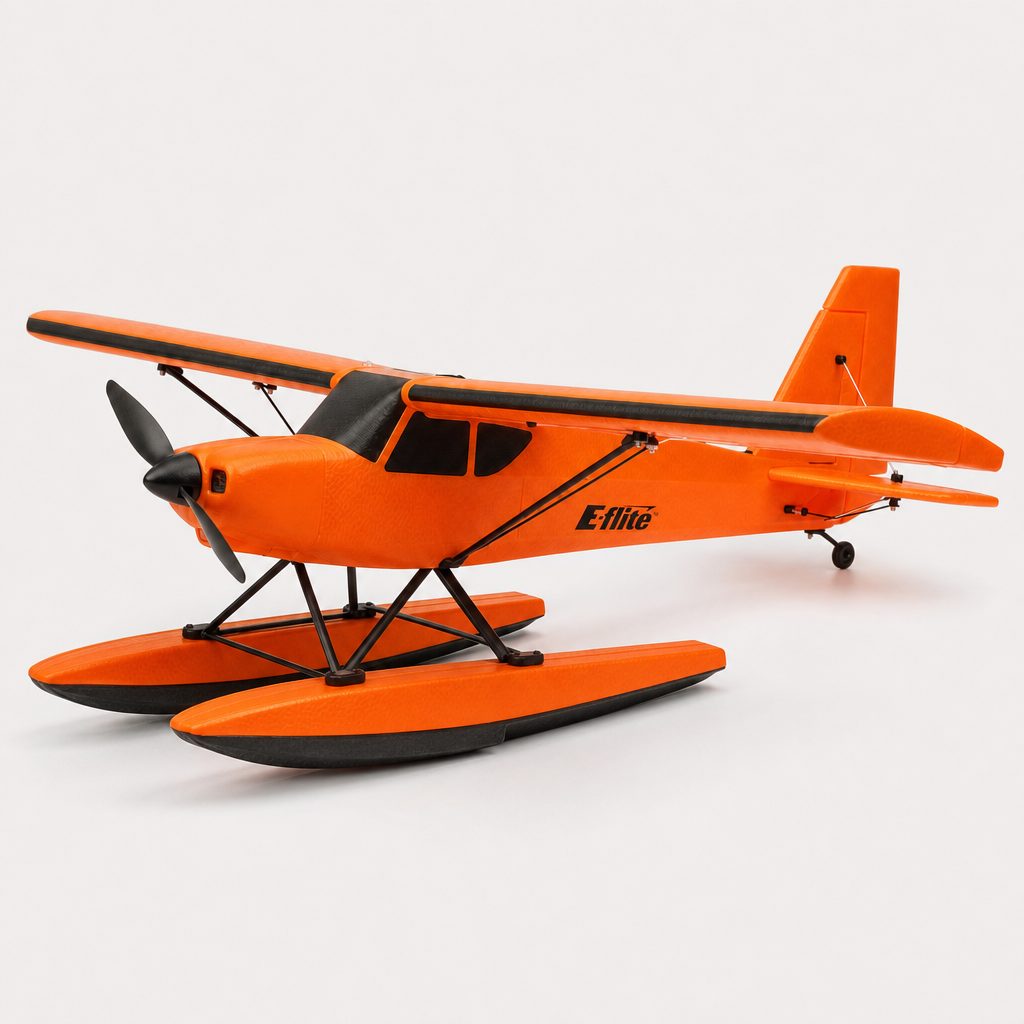
Optional EFLUA1190 floats allow the little Timber X to move from grass-field sorties to carefully chosen water-flying sessions.
What it does better than a conventional ultra-micro
The UMX Timber X is not simply a smaller aeroplane. It is a smaller aeroplane that feels like it has been given permission to be ambitious. Its shortened wing, enlarged surfaces, 3S brushless system and flaperon capability make it unusually broad in character. You can practise slow approaches one flight and explore vertical manoeuvres on the next, all without changing airframes or loading the car like you are relocating.
Its closest in-house alternative is the E-flite UMX Turbo Timber Evolution. Both belong to the same broad family of small, practical, Timber-inspired models, but the UMX Timber X is the one to choose when the specific appeal is extreme aerobatic authority alongside STOL behaviour. The X is less about simply getting airborne from a short patch and more about what you choose to do once you are there.
Pros
- Powerful 3S brushless system gives genuine vertical performance.
- Low and high rates make the aircraft unusually versatile.
- AS3X helps the tiny airframe cope more confidently with turbulence.
- Flaperons support slow flight and short-field landings.
- Factory LED lights and voltage telemetry add real everyday usefulness.
- Optional floats add another enjoyable way to use the airframe.
Cons
- Four-to-six-minute energetic flights demand spare battery planning.
- The motor and linear servos produce a distinctly whiny sound.
- Undamped wire gear can bounce sharply on hard landings.
- The elevator servo needs proactive inspection for binding or lockout.
- A compatible five-channel-plus Spektrum DSMX/DSM2 transmitter is required.
Price and value in the UK
A listed UK price of £382.69 including VAT placed the E-flite UMX Timber X in surprisingly serious territory for such a small aeroplane. That figure needs to be considered in context. This was never a basic toy-shop foam flyer: it included brushless power, stabilisation technology, SAFE support, telemetry capability, lighting and a fully assembled airframe. Even so, it is a premium ask for a micro model, particularly when a compatible transmitter, batteries and charging equipment may already be on the shopping list.
E-flite UMX Timber X BNF Basic
Listed UK price including VAT
Value therefore depends heavily on where you are in the hobby. For a Spektrum-owning pilot who wants a compact, capable aircraft that can cover calm cruising, STOL practice and vigorous aerobatics, the specification makes more sense. For a family beginning from scratch, it is a substantial investment before you have even reached the field. The right question is not "is it tiny?" but "will we actually use what makes it special?"
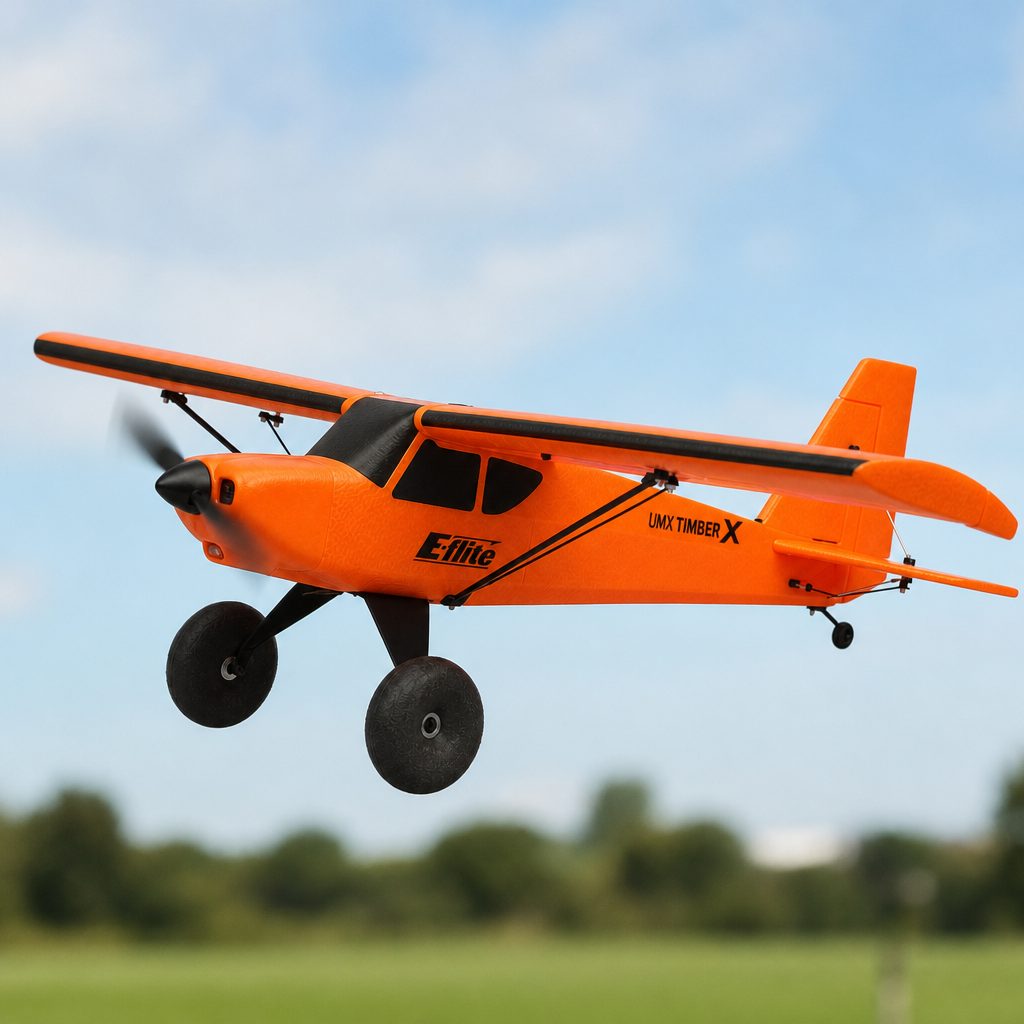
The UMX Timber X makes the most sense for pilots who will use its stabilisation, telemetry and aerobatic ability rather than treating it as a simple occasional park flyer.
Who should buy the E-flite UMX Timber X?
Best for experienced pilots
Buy it if you already fly with a compatible Spektrum transmitter and want a portable second model with real 3D capability. This is the natural audience.
Best for small-field flying
The flaperon-supported slow-flight character and compact footprint suit pilots with access to a sensible grass patch rather than a vast runway.
Best for supervised family sessions
It can be a fantastic shared hobby aircraft when an experienced adult handles setup, safety and early flights. It is not a casual unsupervised garden toy.
Best for variety seekers
Choose it if the prospect of grass, slow flight, aerobatics and optional float flying appeals more than owning several narrowly focused micro models.
I would not recommend it as a first-ever RC aircraft for a young child or an adult who has never handled a hobby-grade transmitter. SAFE can make the experience more manageable, but it cannot teach situational awareness, battery care, orientation or sensible throttle control by magic. Start with a genuinely beginner-focused trainer, then come back to the Timber X when its talents will be enjoyed rather than merely survived.
Our E-flite UMX Timber X rating
The UMX Timber X is a specialised little machine, but it is specialised in a wonderfully broad way. It does not have the longest flight time, quietest drivetrain or softest landing gear. What it has is character, power and an impressive ability to switch between relaxed and ridiculous according to the rates you select.
Frequently asked questions
It is better suited to pilots with some experience. SAFE assistance and low rates can make it calmer, but its powerful 3S setup, aerobatic control authority and maintenance demands mean it is not the easiest first hobby-grade aircraft.
You need a DSMX or DSM2 compatible Spektrum transmitter with at least five channels. The aircraft is supplied as BNF Basic, so a transmitter is not included.
With aggressive flying and a 300mAh battery, expect approximately four to six minutes depending on throttle use. Spare charged packs are strongly recommended for a satisfying session.
Yes. Its brushless 3S power system produces more than a 1:1 thrust-to-weight relationship, giving it the power needed to maintain vertical hovering when flown by a suitably experienced pilot.
Yes, and grass is generally the more forgiving surface for its undamped wire landing gear. The model's flaperon capability also helps with slower take-offs and landings in suitable short-field environments.
No. Instead, its full-span ailerons can be used as flaperons to improve slow-flight and STOL performance.
It can be fitted with optional EFLUA1190 floats for flying from suitable pools, ponds and lakes. Water flying adds complexity, so it is best reserved for confident pilots with a safe flying location.
Inspect the control surfaces and especially the linear elevator servo for smooth, consistent movement. Mechanical lockout under sustained axial stress can create a serious loss-of-control risk, so binding should never be ignored.
Final verdict: huge personality, small margin for complacency
The E-flite UMX Timber X is a terrific ultra-micro for the right pilot. It combined STOL-style flexibility, flaperons, LED lighting, telemetry support and impressively muscular 3S performance in an aircraft small enough to bring along without turning every family outing into a logistical operation.
Its compromises are real: flights are short, the drivetrain is noisy, hard landings can bounce and the elevator servo deserves regular attention. But none of those issues erase the central appeal. This is a compact aircraft that can feel calm, capable and playful one moment, then transform into a tiny aerobatic hooligan the next. For experienced RC families and hobbyists with compatible gear, that huge personality is precisely why it remains so appealing.