Nintendo Switch 2 vs Steam Deck OLED: The Handheld Face-Off
Nintendo Switch 2 and Steam Deck OLED both let you take proper games away from the television, but they are not really chasing the same player. Here is the honest, numbers-led comparison for handheld-first buyers deciding between Nintendo's new hybrid console and Valve's wonderfully flexible OLED PC.
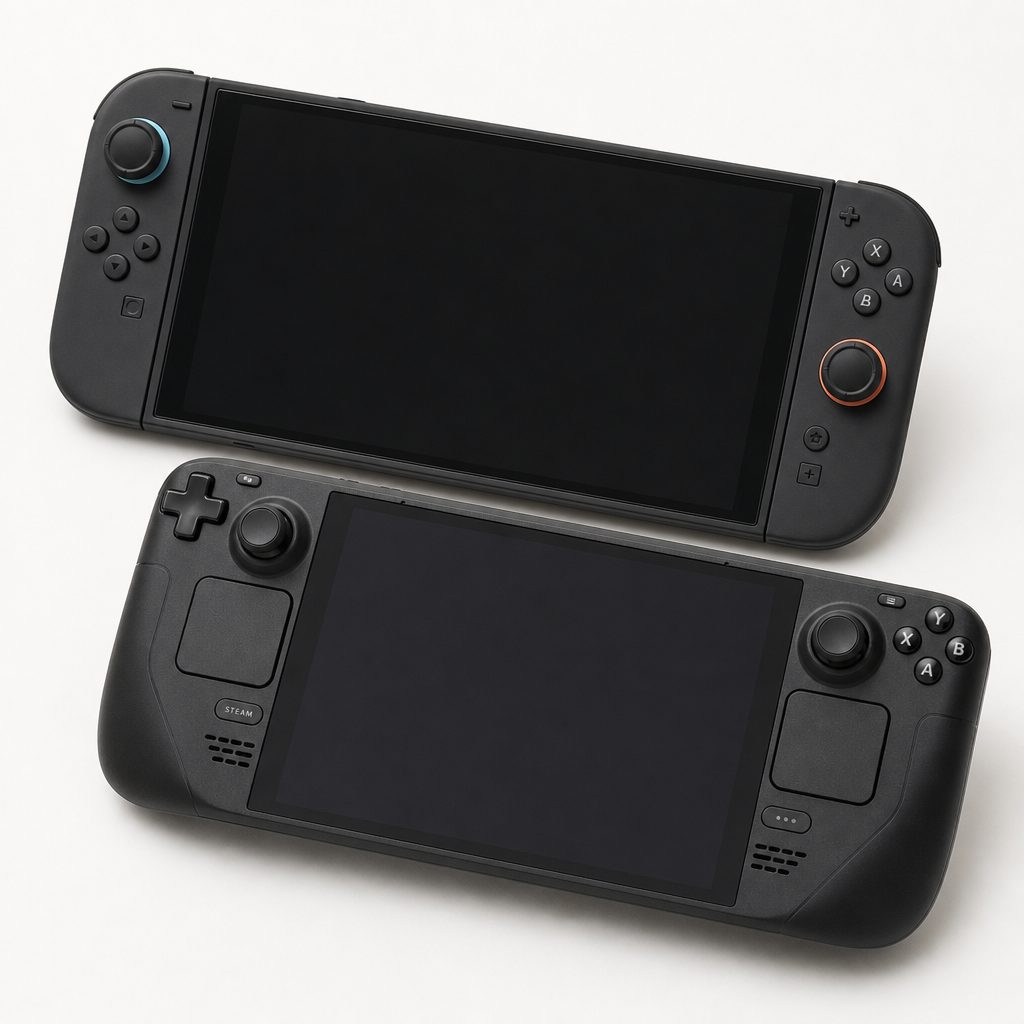
The Switch 2's 7.9-inch panel is physically larger and sharper, whilst Steam Deck OLED's smaller screen delivers the contrast and colour depth only OLED can provide.
The short version: two excellent ideas of "handheld"
The Nintendo Switch 2 and Steam Deck OLED sit in the same bag, broadly speaking, yet they bring very different personalities to the journey. Nintendo's machine is a hybrid console first: pick it up for handheld play, drop it into its dock for the television, attach or detach its magnetic Joy-Con controllers, and get on with it. It is designed to feel immediate. You turn it on, choose a game and, ideally, nobody asks you what a graphics preset is.
Steam Deck OLED is the more PC-like proposition. It has a larger internal battery than its older LCD sibling, a glorious 7.4-inch OLED display, substantial storage options and a set of extra controls that can make fiddly PC games much more comfortable. It is also the heavier device by a fair margin. This is not necessarily bad; a Steam Deck OLED feels reassuringly solid. But if your idea of portable gaming involves holding a console one-handed whilst attempting to locate a train ticket with the other, the difference matters.
For a household that wants a modern Nintendo console, family-friendly sofa play and a straightforward route to Mario Kart World, Switch 2 makes immediate sense. For someone who already has a Steam library, enjoys tweaking settings or wants the PC gaming world in a handheld form, Steam Deck OLED remains a deeply persuasive machine. There is no single knockout winner. There is, however, a winner for you.
The crucial choice is ecosystem, not just silicon. Switch 2 is the cleaner console experience, with GameChat and detachable controllers built into its identity. Steam Deck OLED offers a more open, PC-oriented approach, larger SSD options and an OLED panel that remains one of its standout advantages.
Nintendo Switch 2 vs Steam Deck OLED: key specifications
Before getting into the small details that become surprisingly important after a fortnight of ownership, here is the headline hardware picture. Switch 2 has the bigger and sharper built-in panel, higher maximum refresh rate, less internal storage and a lower weight. Steam Deck OLED counters with more memory, significantly more storage on its standard configurations, a 90Hz OLED screen and a larger battery.
| Feature | Nintendo Switch 2 | Steam Deck OLED |
|---|---|---|
| Processor | Custom Nvidia T239 with 8-core ARM Cortex-A78C CPU | 6nm AMD APU with four Zen 2 CPU cores |
| Graphics | 1,536 CUDA cores; 1,008MHz docked and 561MHz handheld GPU clocks | RDNA 2-based GPU with 512 shader cores at 1–1.6GHz |
| Memory | 12GB LPDDR5X | 16GB RAM |
| Built-in display | 7.9in, 1,920 x 1,080 LCD, HDR10, VRR, up to 120Hz | 7.4in, 1,280 x 800 HDR OLED, 90Hz |
| Internal storage | 256GB | 512GB or 1TB NVMe SSD |
| Expansion | microSD Express, up to 2TB | microSD card slot |
| Weight | 535g | 640g |
| Rated battery range | Approximately 2–6.5 hours | Approximately 3–12 hours |
| Television output | Up to 4K at 60fps; 1080p or 1440p at 120fps | USB-C connection |
Display: Nintendo Switch 2 sharpness versus Steam Deck OLED magic
This is the category where a simple list of specifications does not quite tell the whole story. Switch 2's 7.9-inch 1080p LCD is the larger panel, and it is also much higher resolution than the Steam Deck OLED's 1,280 x 800 screen. Text, interface elements and fine environmental details benefit from that extra pixel density. It supports HDR10, variable refresh rate and refresh rates up to 120Hz too. On paper, it is an impressively ambitious portable display.
Steam Deck OLED plays a different card, and it is a very good card. Its 7.4-inch HDR OLED panel covers 110% of the P3 colour space, reaches 600 nits in standard mode and can reach 1,000 nits with HDR content. OLED's pixel-level contrast gives darker scenes a depth that LCD simply cannot reproduce in quite the same way. Space games, moody adventures and any title with dramatic night scenes look properly special here. The 90Hz refresh rate is lower than Switch 2's 120Hz ceiling, but it remains a welcome step above traditional 60Hz handheld play.
There is no dishonest way to call this one a rout. For pure panel technology, black levels and colour impact, Steam Deck OLED wins. For screen size, resolution and the possibility of 120Hz portable output, Switch 2 wins. If you mostly play in a dim room after everyone else has gone to bed, I would put real weight on the Deck's OLED advantage. If you notice fuzzy text more than you notice imperfect blacks, the Switch 2 display is likely to be more satisfying.
Steam Deck OLED: richer contrast
The OLED panel, HDR support, 110% P3 coverage and 1,000-nit HDR peak give compatible games a genuinely premium visual punch.
Nintendo Switch 2: more pixels
A 7.9-inch 1,920 x 1,080 screen gives Switch 2 a substantial resolution advantage for handheld menus, detail and clarity.
Nintendo Switch 2: 120Hz ceiling
Variable refresh rate and up to 120Hz support give Nintendo's machine the higher maximum refresh-rate capability.
Steam Deck OLED: improved touch and haptics
Valve improved touchscreen responsiveness and fidelity, whilst the haptics became more consistent and higher fidelity than before.
Performance: efficiency matters more than bragging rights
Handheld performance is always a slightly awkward subject because raw specifications do not translate neatly across different software ecosystems. These are not two versions of the same console running a neat row of identical games. What is more useful is considering the way each machine balances power, heat, battery use and the visual targets its games are built around.
Switch 2 uses Nvidia's T239 processor, with eight ARM Cortex-A78C CPU cores and 1,536 CUDA cores. In docked operation its GPU runs at 1,008MHz; in handheld mode it runs at 561MHz. Its 12GB of LPDDR5X memory operates at 6,400 MT/s while docked and 4,266 MT/s undocked. It is a considerably more modern-feeling foundation than the original Switch, and the machine is designed to move gracefully between the handheld screen and a television.
Steam Deck OLED uses a 6nm APU with four Zen 2 cores running between 2.4GHz and 3.5GHz, alongside a 512-shader RDNA 2 GPU at 1–1.6GHz. Its 16GB of RAM gives it more system memory, and PC games can demand very different compromises depending on their configuration. Deck ownership rewards somebody happy to adjust settings and choose a sensible performance target. That is part of its charm for some players and part of the homework for others.
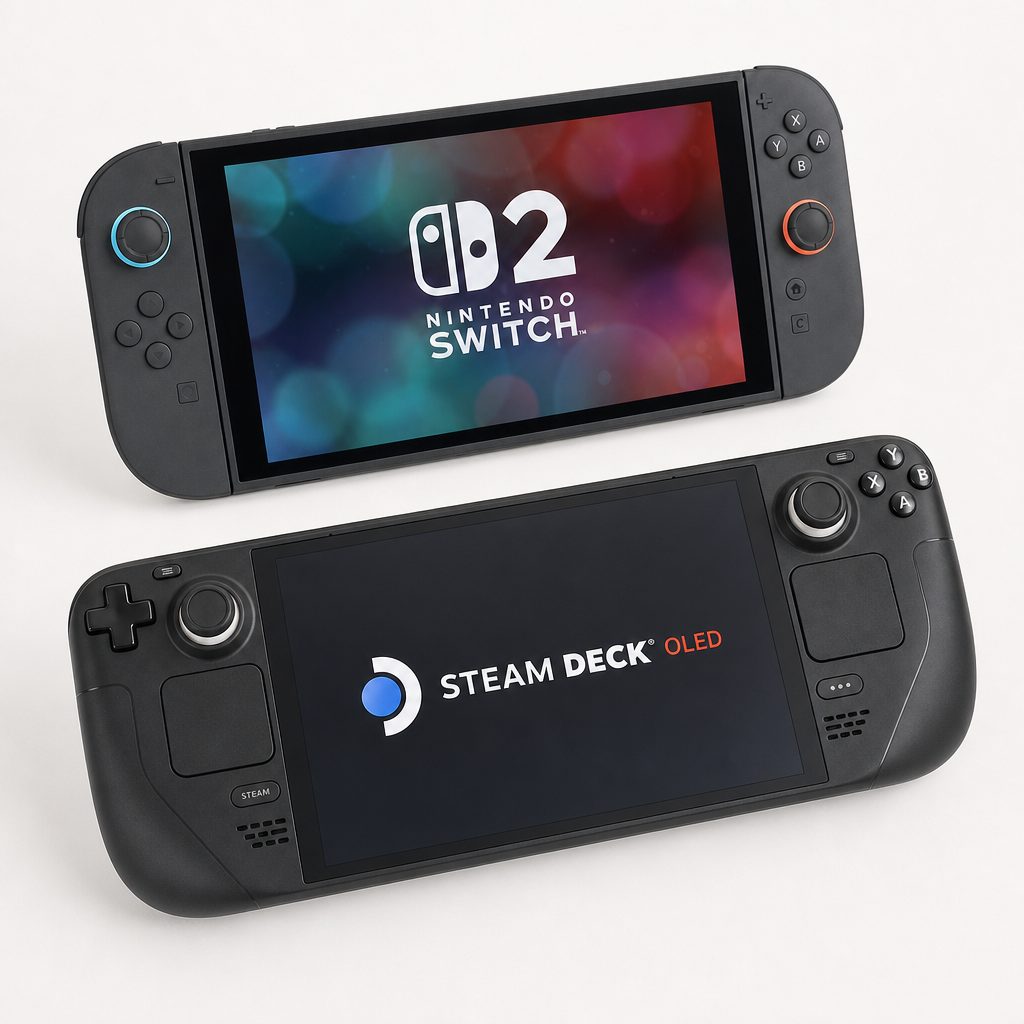
The performance story is not just about component counts: Switch 2 targets a tightly controlled console environment, while Steam Deck OLED gives PC players far more settings to balance.
One particularly revealing comparison came from No Man's Sky, where Switch 2 delivered 2.5 times more frames per second at an 8.6W TDP than Steam Deck OLED at 24W. That does not mean Switch 2 automatically outperforms Deck OLED in every game. It does demonstrate the benefit of efficiency and software tailored to fixed hardware. Nintendo's handheld power draw has been measured at roughly 8–10W, compared with 15W for Steam Deck OLED in the cited comparison.
The performance lesson
Do not buy either handheld solely because one has more RAM or a more familiar PC architecture. Switch 2's advantage is a controlled, console-style platform and excellent efficiency. Steam Deck OLED's advantage is flexibility: you can work with a broad PC library and tailor settings to your own priorities.
Battery life: Steam Deck OLED lasts longer, but settings change everything
Battery life is the less glamorous half of every handheld buying decision. A spectacular screen is wonderful until the low-battery warning appears before the second train stop. Both devices have variable runtimes because game demands, brightness, wireless use and system settings all make a difference. The important thing is to understand the realistic lower end as well as the optimistic headline figure.
Nintendo quoted approximately two to 6.5 hours from the Switch 2's 5,220mAh battery. In heavier real-world testing, the machine generally delivered closer to two to 2.5 hours with demanding AAA games, around 2.5 to 3.5 hours in moderate 3D titles and four to 6.5 hours with lighter 2D games. Mario Kart World and No Man's Sky each ran for exactly 2.5 hours in one demanding test from full charge to empty. Other testing produced just over two hours and 10 minutes for Mario Kart World, two hours and 13 minutes for Fortnite at medium brightness and volume with wireless internet, and two hours and one minute for Cyberpunk 2077 at 80% brightness.
That is not disastrous; it is simply the reality of a modern handheld pushing current games. Still, it means Switch 2 owners should be realistic about long flights or a whole afternoon away from a socket. Charging takes around three hours in Sleep mode, so it is sensible to make a habit of topping it up whenever the opportunity presents itself.
Steam Deck OLED's 6,470mAh battery has a broader claimed range of three to 12 hours. Valve's OLED revision achieved around 30–50% more battery life than the earlier LCD Steam Deck through the larger battery, more efficient APU and lower display draw. The upper end is for lighter work; the lower end matters when the game is demanding. Even so, the Deck OLED has the stronger battery case overall, particularly for players prepared to tune their settings rather than insist every game runs at maximum visual ambition. A handheld has limits. Pretending otherwise is how you end up playing the battery indicator instead of the game.
Portability and controls: Switch 2 travels better, Deck OLED gives you more inputs
At 535g, Switch 2 is 105g lighter than Steam Deck OLED at 640g. Numbers on a specification sheet can sound trifling, but weight becomes very obvious after forty minutes with elbows tucked in and wrists doing their best. Switch 2 is the better choice for children, commuters and anyone who regards handheld gaming as something done in short bursts on the sofa rather than an evening-long event.
Its magnetic Joy-Con attachment system also reinforces the hybrid idea. You can use the machine as a conventional handheld, then detach the controllers when playing on a television. This is a practical, sociable advantage. There is something rather lovely about a console that can turn from "my quiet game" into "pass a controller to your sibling" without a pile of extra equipment appearing from the cupboard.
Steam Deck OLED is larger in the hand and considerably more controller-like. Its quad customisable grip buttons, operated with ring fingers or pinkies, are a real asset for PC games with expansive control schemes. The single USB-C port, microSD slot, 3.5mm audio jack and stereo speakers cover the essential physical connections, while Wi-Fi 6E offers increased bandwidth and lower latency. It also has a 180Hz polling rate for improved responsiveness.
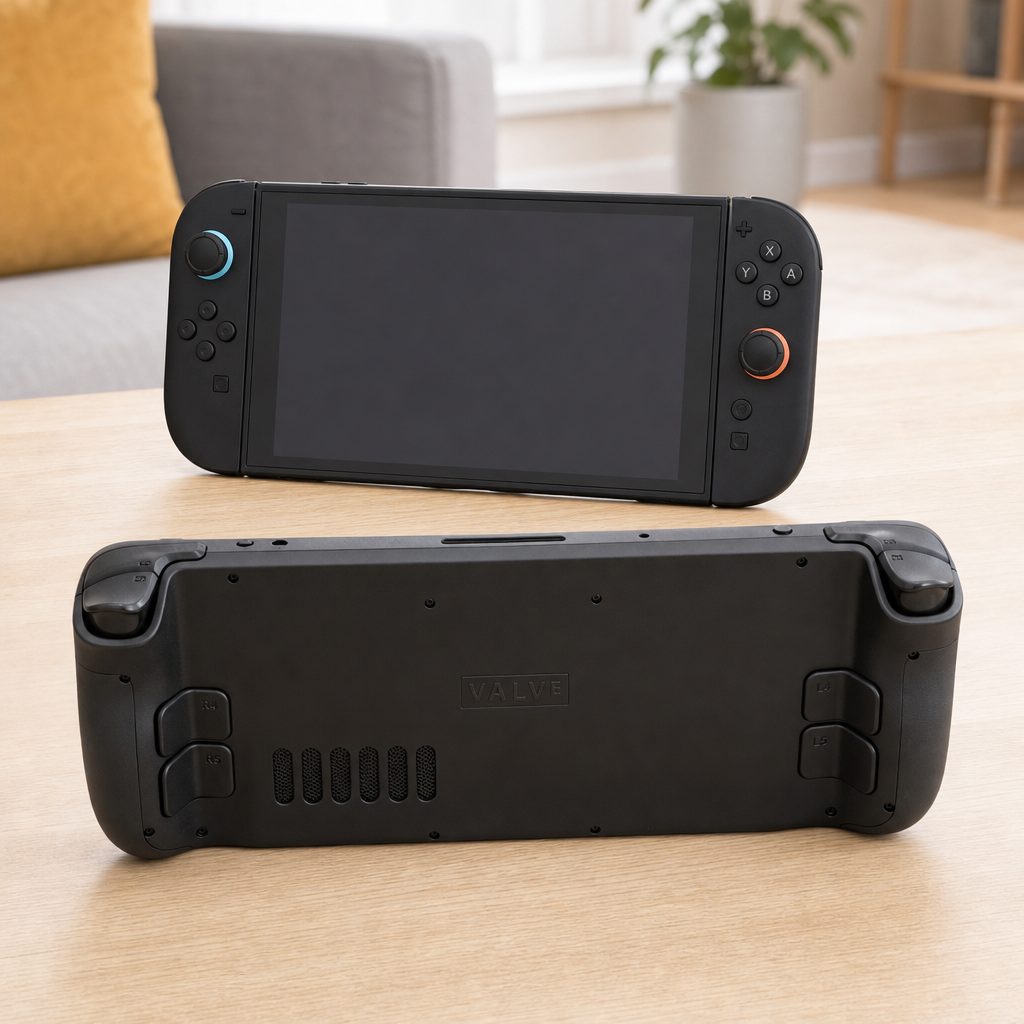
Steam Deck OLED's rear grip buttons and PC-style control layout favour players who want more commands under their fingers, while Switch 2's detachable Joy-Con concept is built for quick shared play.
Nintendo Switch 2 strengths
- Lighter 535g design is easier to carry and hold for extended handheld sessions.
- 7.9-inch 1080p display has the larger panel and higher resolution.
- Magnetic Joy-Con controllers support its effortless handheld-to-television identity.
- GameChat supports voice chat and screen sharing for up to four people.
Nintendo Switch 2 limitations
- Demanding games commonly fall close to the two-hour battery mark.
- 256GB internal storage is much smaller than either Steam Deck OLED SSD option.
- The LCD display cannot match the OLED Deck for deep blacks and contrast.
- Storage expansion requires microSD Express cards rather than standard microSD.
Living-room gaming: Nintendo Switch 2 is the natural television companion
Shop Nintendo Switch 2 on Amazon UK
This category is perhaps Switch 2's clearest practical victory. The docked experience is not a bonus feature bolted onto a handheld; it is central to the product. In TV mode, Switch 2 supports 4K output at 60fps or 1080p and 1440p at up to 120fps. It also supports linear PCM 5.1-channel output via HDMI. For a family television setup, those are the sort of details that turn a small handheld into a proper lounge console.
The benefit is mostly about friction. You do not need to mentally separate "portable games" from "television games". The same machine moves between both places, and the Joy-Con design makes local shared play feel like a natural part of the package. If you are buying one device for a family room, a bedroom and occasional travel, that flexibility carries serious value.
Steam Deck OLED can absolutely be used beyond its own screen through its USB-C connection, but it is not as purpose-built around the television moment. Its central appeal is still the personal PC gaming experience in your hands. That does not make it inferior; it simply makes it less neat for households looking for one friendly, communal device. Switch 2 is the better living-room machine because Nintendo designed it to be exactly that.
Games and libraries: choose the world you actually want to play in
Every console comparison eventually arrives at the same important truth: hardware is a delivery system for games. The library and the way you buy into it should matter more than a tiny screen-size difference or a few extra gigabytes of storage. Nintendo Switch 2 accepts both Nintendo Switch 2 game cards and Nintendo Switch game cards, which gives existing Nintendo households an immediate reason to pay attention.
It also gives Switch 2 a clear sense of continuity. If your family already owns Switch games, the ability to insert those cards is much less exciting than a new processor when you read it online, but much more exciting once you realise the games are already waiting on a shelf. Mario Kart World is also a useful shorthand for what Switch 2 does particularly well: accessible, recognisable games that invite other people into the room rather than merely occupying it.
Steam Deck OLED lives in the PC gaming world. Its strength is access to a Steam library and the freedom that comes with PC-style ownership and settings. For a player with years of Steam purchases, the Deck can feel less like buying a new console and more like unlocking a portable version of games they already own. The customisable rear buttons are particularly useful when a game has more actions than a conventional console controller can comfortably accommodate.
There is a trade-off. Switch 2 offers a curated, consistent console path. Steam Deck OLED asks more of you: checking game behaviour, choosing settings and accepting that portable PC gaming can occasionally require patience. Some buyers find that endlessly appealing. Others want to press one button and be racing within a minute. Neither preference is shallow. They are simply different ways to enjoy games.
Price and storage value in August 2026
Price changes had made this comparison much more complicated by August 2026. In the United States, Nintendo Switch 2 cost $450 at the time of writing. Its price was due to rise to $499.99 from 1 September 2026. A $500 bundle including a digital copy of Mario Kart World was also available until autumn. In Europe, Switch 2 launched at €469.99, with a rise to €499.99 due from 1 September 2026. Its UK launch price was £395.99, and a UK increase had been confirmed.
Steam Deck OLED had become far more expensive after the May 2026 increases. The 512GB model cost $789 in the US, £649 in the UK and €779 in Europe. The 1TB model cost $949, £779 and €919 respectively. That is a serious premium, however you slice it. The Deck does include far more storage, especially in 1TB form, but the price gap cannot be brushed off with a cheerful "it is basically a PC". Your bank account may not find that argument entirely persuasive.
Nintendo Switch 2
US price on 11 August 2026; due to rise to $499.99 from 1 September 2026. 256GB internal storage.
Steam Deck OLED 512GB
Also £649 in the UK and €779 in Europe. 512GB NVMe SSD.
Steam Deck OLED 1TB
Also £779 in the UK and €919 in Europe. 1TB NVMe SSD.
Refurbished Deck OLED
Certified refurbished US pricing started at $439; UK refurbished pricing started at £389.
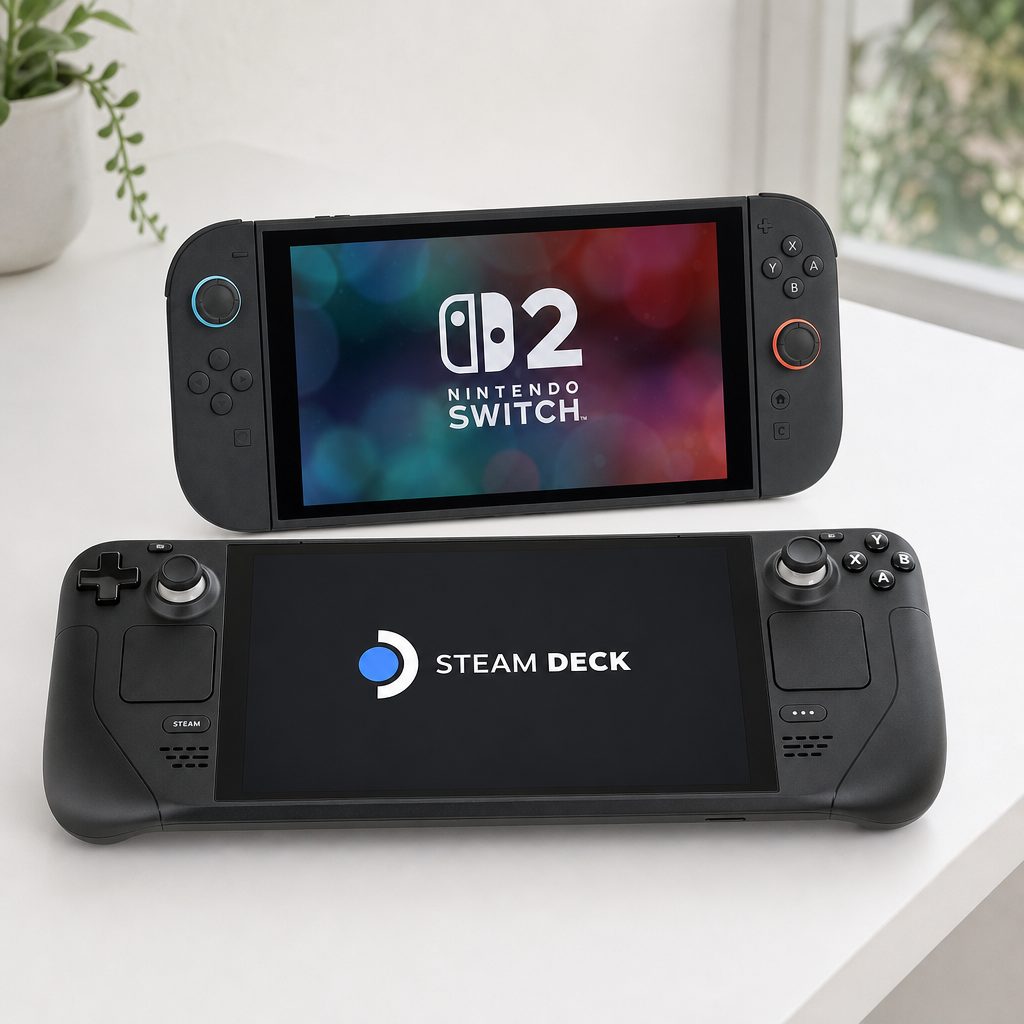
Storage is part of the value calculation: Switch 2 starts with 256GB, while Steam Deck OLED arrives with either 512GB or 1TB of NVMe storage.
For outright new-hardware value, Switch 2 is the less costly route. It also includes the docked console concept as standard, rather than making you think in terms of accessories and configuration. Steam Deck OLED's strongest value argument is for someone with an established Steam library, particularly if a certified refurbished model is available at the lower starting price. That option changes the maths substantially.
Best for different buyers
A sensible verdict should not pretend that every buyer has identical priorities. A parent choosing a shared family console is making a different decision from a PC enthusiast with several hundred Steam games, and both are making a different decision from someone desperate to play on a daily commute. Here is the quick answer before we get to the longer final judgement.
Best for families and television play
Nintendo Switch 2Its docked 4K/60 and 120Hz output options, detachable magnetic Joy-Con controllers and GameChat features make it the more naturally communal machine.
Best for travel and lighter hands
Nintendo Switch 2At 535g, it is 105g lighter than Steam Deck OLED, with a bigger 7.9-inch screen in a more travel-friendly proposition.
Best for existing PC players
Steam Deck OLEDIt is the obvious fit for players who want a portable extension of a Steam-based PC gaming collection and appreciate PC-style flexibility.
Best premium handheld display
Steam Deck OLEDIts HDR OLED panel, 110% P3 coverage, 600-nit standard brightness and 1,000-nit HDR peak deliver the prettier image.
Best on a tighter budget
Nintendo Switch 2The $450 US price on 11 August 2026 undercut the new 512GB Steam Deck OLED by a very large margin, although refurbished Deck OLED models were more competitive.
Best for control customisation
Steam Deck OLEDIts four rear grip buttons, touchscreen improvements and PC-oriented layout offer more ways to make complex controls fit your hands.
Nintendo Switch 2 and Steam Deck OLED ratings
These are not scientific scores, and I would never suggest a decimal point can capture how much you might adore a particular game. They are useful, though, as a quick expression of the trade-offs. Switch 2 scores highest for convenience, portability and living-room usefulness. Steam Deck OLED scores highest for display quality, battery potential and flexibility for the player who enjoys a little tinkering.
FAQ: Nintendo Switch 2 vs Steam Deck OLED
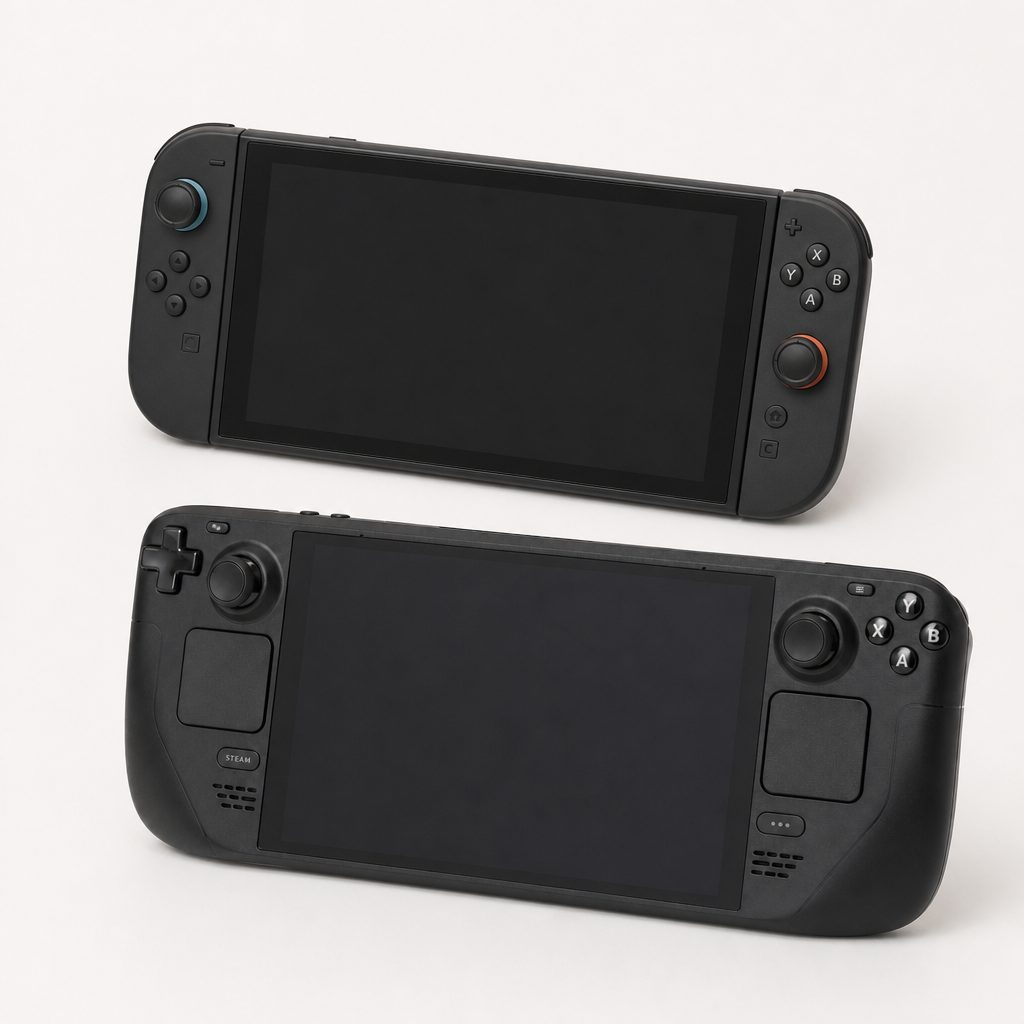
For handheld-first buyers, the final decision comes down to personality: Switch 2 is the polished hybrid for home and travel, while Steam Deck OLED is the flexible PC machine with the screen that makes you stop and stare.
Final verdict: buy the handheld that fits your gaming life
Buy Nintendo Switch 2 if you want the best all-round hybrid console for family play, commuting, television gaming and a simple Nintendo-first experience. It is lighter, its 7.9-inch 1080p screen is larger and sharper, it has strong efficiency, and it moves from handheld to television use with very little fuss. Its $450 US price on 11 August 2026 also made it dramatically easier to recommend as a new purchase than Steam Deck OLED.
Buy Steam Deck OLED if you are a PC player who values your Steam library, richer OLED image quality, more storage, stronger battery potential and deeper control customisation. It is heavier, more expensive and more demanding of your patience, but it offers a wonderfully personal version of portable PC gaming. The 1TB model is a premium indulgence; a certified refurbished 512GB unit can be the cleverer route if available.
The neatest summary is this: Switch 2 is the better console for most households; Steam Deck OLED is the better handheld PC for the right enthusiast. Decide whether you want joyful console convenience or flexible PC freedom, and the choice becomes much less mysterious. There will still be some agonising over the OLED screen, naturally. That is what comparison articles are for.