Splatoon Raiders vs Splatoon 3: Which Should You Play First?
One is a fresh, story-led single-player roguelite for Nintendo Switch 2. The other is the 2022 mainline game built around competitive multiplayer, with a later expansion that gave solo players more to chew on. Both can be a brilliant introduction to Splatoon. The right first pick depends rather less on "which is newer?" and much more on how you actually like to play.
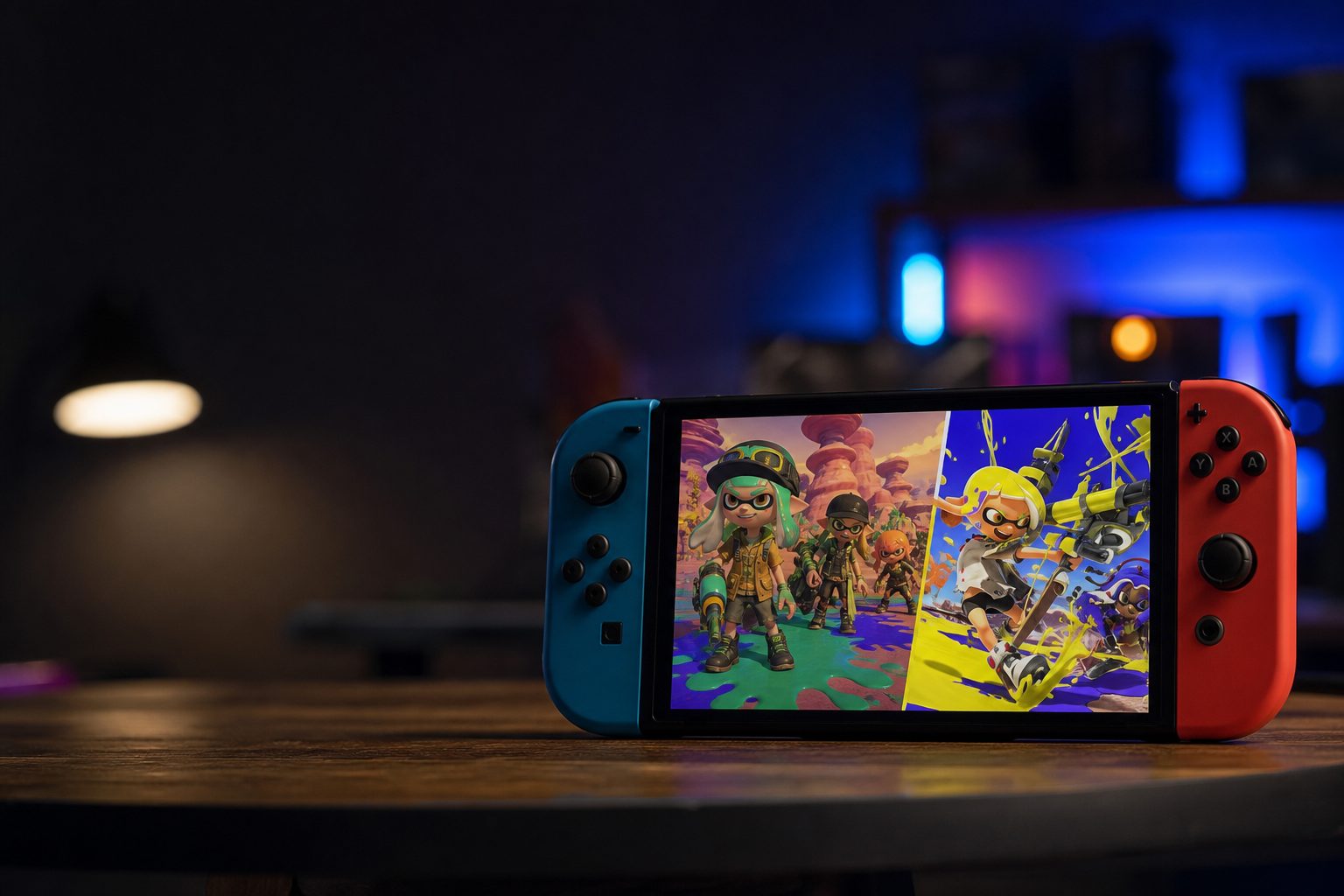
Splatoon Raiders and Splatoon 3 share Nintendo's exuberant ink-splashed identity, but they offered very different first steps into the series.
1. The short answer for new Splatoon players
Splatoon had always been a slightly unusual Nintendo series. It looked like a Saturday-morning cartoon had fallen into a paint factory, yet underneath the bright colours sat fast, tactical shooter play with a wonderfully odd sense of humour. That core personality remained intact in both of these games. The important difference was where they put the emphasis.
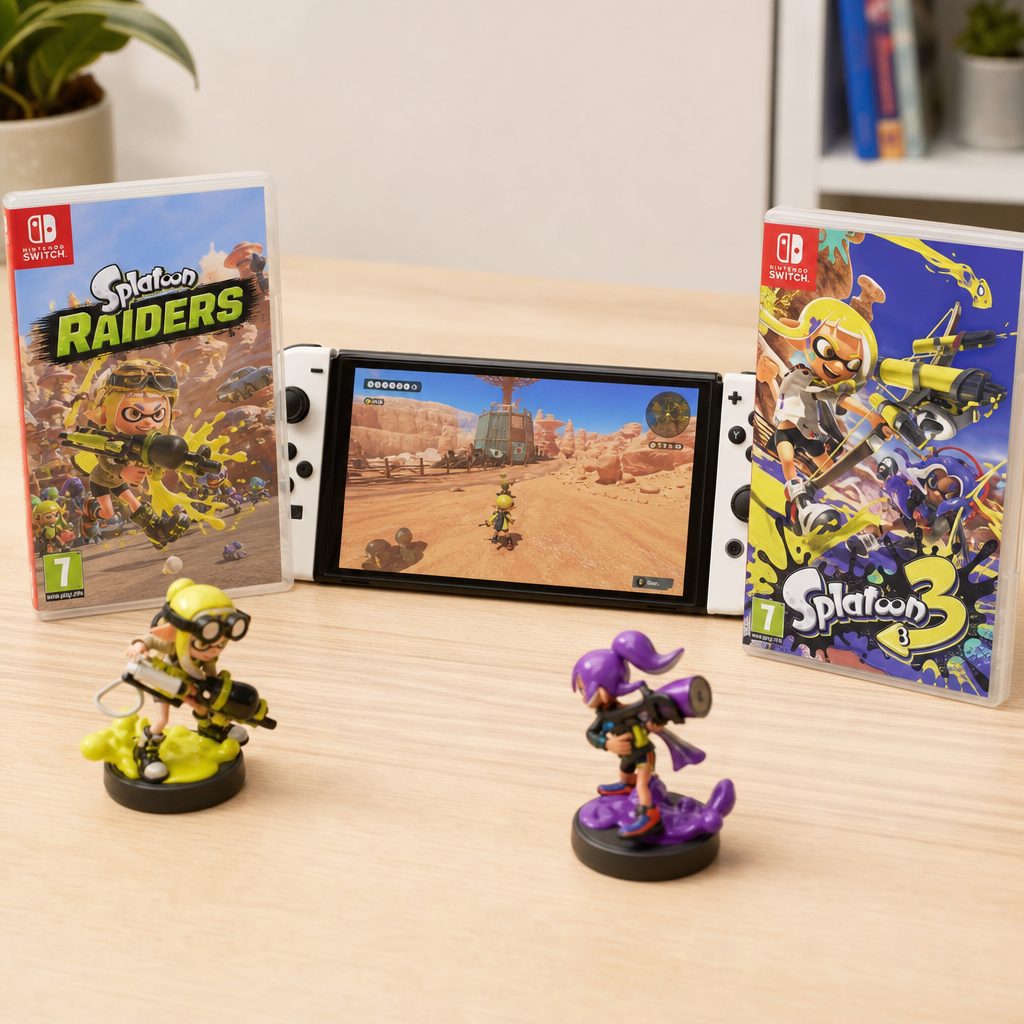
A first choice between these games is also a choice between a focused solo adventure and the multiplayer-first rhythm of a mainline Splatoon entry.
Splatoon Raiders, released for Nintendo Switch 2 on 23 July 2026, was the series' first spin-off. It was primarily a single-player, story-focused roguelite extraction shooter. That makes it the tidier recommendation for somebody who wants to learn at their own pace, follow a campaign, and have a complete evening's entertainment without immediately measuring themselves against strangers who appear to have been born holding a controller.
Splatoon 3 arrived on 9 September 2022 as a mainline Splatoon game. Its identity was fundamentally multiplayer-led, and that matters. It is the better starting point for the newcomer who wants the full competitive Splatoon atmosphere: the bustle, the rivalries, the repeated matches and the pleasure of gradually finding a weapon and approach that feels like yours.
Neither answer is universally "better". Raiders is the gentler front door. Splatoon 3 is the broader introduction to why people fell in love with Splatoon as a series. If you have ever bought a game because the box art made you grin, then discovered you preferred a quiet solo campaign to the loud bit everyone discussed online, Raiders is likely your game. If you hear "multiplayer shooter" and think "excellent, where are my trainers?", start with Splatoon 3.
2. Splatoon Raiders vs Splatoon 3 at a glance
Before getting lost in the weeds, here is the clean version. There are only a few hard facts to absorb, which is rather refreshing. No storage configurations, no premium controller tiers, no chart full of tiny print that makes you feel you ought to have brought a calculator. The major split is game design and platform.
| Feature | Splatoon Raiders | Splatoon 3 |
|---|---|---|
| Release date | 23 July 2026 | 9 September 2022 |
| Platform | Nintendo Switch 2 | Nintendo Switch |
| Place in the series | First Splatoon spin-off | Mainline Splatoon game |
| Primary emphasis | Single-player and story-focused | Multiplayer-focused |
| Core structure | Roguelite extraction shooter | Competitive shooter experience |
| Additional solo release | Built around a single-player focus | Side Order expansion released 22 February 2024 |
The table also highlights the one decision that can make everything else irrelevant: hardware. Raiders was a Nintendo Switch 2 game. Splatoon 3 was released for Nintendo Switch. If your household already had one of those systems and not the other, that practical detail could settle the matter before you have even had time to debate roguelite loops over a cup of tea.
Worth separating the two questions: "Which game suits me?" and "Which platform do I have?" are not quite the same thing. Raiders offered the more solo-led route into Splatoon, but it specifically required Nintendo Switch 2. Splatoon 3 remained the mainline option for Nintendo Switch players.
3. Splatoon Raiders: the case for beginning with the spin-off
Normally, recommending a spin-off before a numbered entry feels a little backwards. It is a bit like starting a film series with the strange side character's holiday special. Sometimes that is charming. Sometimes it leaves you wondering why everyone seems so invested in a talking lobster. Splatoon Raiders was different because its single-player, story-centred design answered a real newcomer problem: lots of people loved Splatoon's look but did not necessarily want their first hour to be a competitive multiplayer experience.
A roguelite extraction shooter has a naturally repeatable shape. You head out, make decisions during a run, and deal with the changing consequences of those decisions. That sort of structure can be particularly inviting when you are still becoming comfortable with a game's movement, aiming, weapons and visual language. You are not merely studying a tutorial because somebody told you to. You are learning by returning to the action, trying again and gradually recognising what works.
Raiders' story focus is the other important bit. Splatoon's world had never lacked character. Its tone made room for silly fashion, squelchy sound effects and playful attitude, but it also had a proper setting rather than just a collection of colourful arenas. A dedicated story-led game gives a newcomer a clearer reason to care about the place and people around the ink. You are not expected to arrive already fluent in the series' many oddities. You can simply follow the adventure.
A more directed first session
Raiders' story emphasis makes it a natural fit for players who prefer a game to give them a destination, rather than asking them to create their own long-term competitive goal.
Roguelite replayability
The roguelite extraction structure was built around repeat attempts and changing runs, which suits players who enjoy learning through practice rather than one fixed path.
Solo-first appeal
Because Raiders was primarily single-player, it made sense for players whose ideal gaming night involved a campaign, headphones and absolutely no pressure to keep up with a lobby.
A distinct Splatoon flavour
It was not simply "Splatoon but fewer people". As the series' first spin-off, Raiders offered a different structure and a different reason to come to this colourful world.
There is also something to be said for choosing the game that matches the way you actually finish games. We all know somebody who buys vast competitive titles, plays three matches, then quietly disappears into a 40-hour single-player adventure. That is not a failure of taste. It is useful self-knowledge. If you like narrative momentum and prefer success or failure to rest mainly on your own decisions, Raiders had the cleaner proposition.
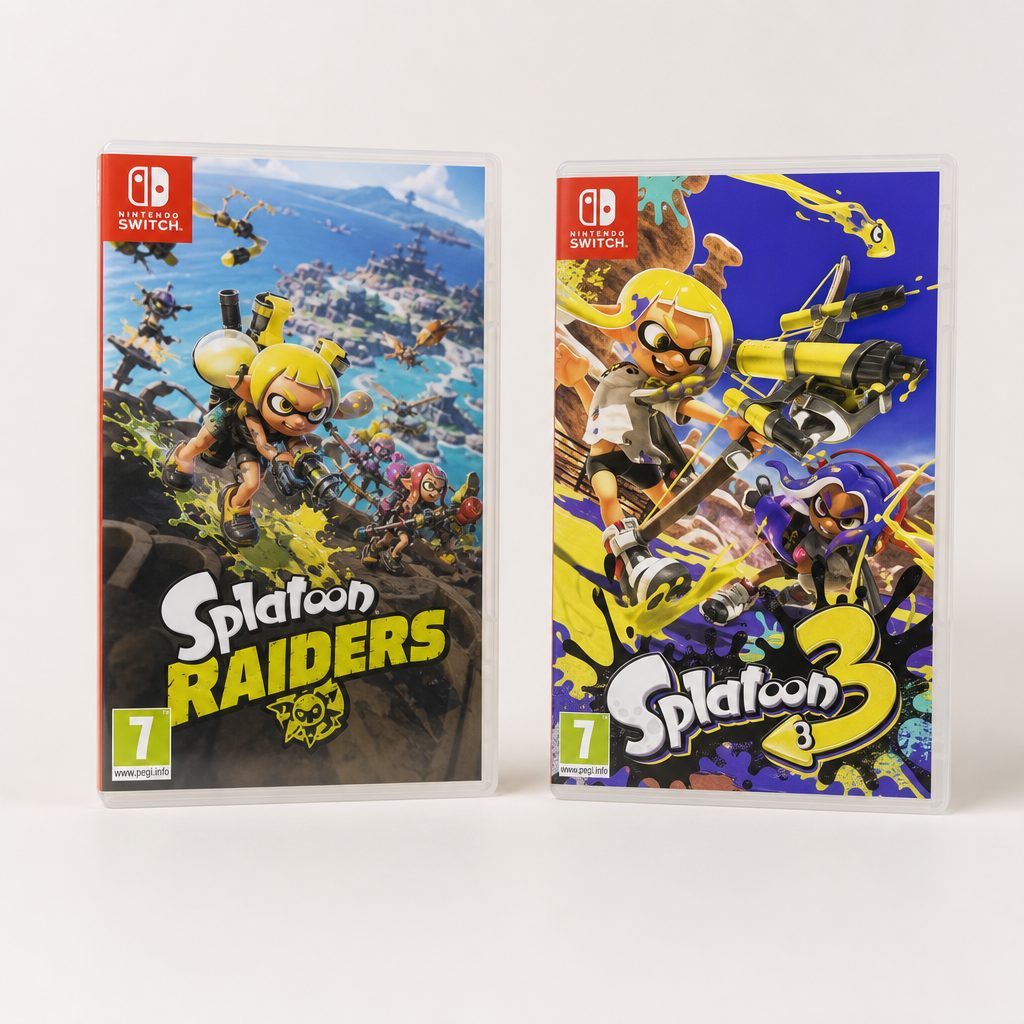
Splatoon Raiders was designed as the series' first spin-off, using a roguelite extraction format rather than the multiplayer-first formula of the numbered games.
4. Splatoon 3: the case for starting with the mainline game
Splatoon 3 made a compelling counterargument: why not begin with the version that represented the mainline series? There is a certain confidence in that choice. You go to the source, learn the central rhythm, and decide whether this distinctly Nintendo take on a shooter is your sort of thing. For players who were curious about Splatoon because they had seen its multiplayer energy rather than because they wanted a solo campaign, Splatoon 3 was the obvious first stop.
Multiplayer games are not just about winning. At their best, they are about developing a small personal language of habits. You discover whether you like taking risks, supporting a team, experimenting with approaches, or simply having one more go after a match that went spectacularly sideways. Competitive play is unpredictable because people are unpredictable. That can be daunting, yes, but it can also be the whole point.
Splatoon 3 had another advantage in this comparison: it had history. By 2026 it was not a new release trying to prove itself. It was a 2022 game with a place in the series and an expansion, Side Order, which released on 22 February 2024. For a newcomer who preferred buying into an established mainline chapter rather than a newly released spin-off, that maturity had appeal. You knew exactly what lane it occupied.
Side Order also complicated the simple "Splatoon 3 equals multiplayer" shorthand in a useful way. Its existence meant that solo-minded players could still look at Splatoon 3 without feeling they were choosing a game that had nothing for them beyond competitive play. It did not change the game's primary multiplayer identity, but it broadened the conversation. Mainline Splatoon and solo content did not have to be mutually exclusive.
Why Splatoon 3 works first
- It was the mainline entry, making it the most direct introduction to the core Splatoon identity.
- Its multiplayer focus suited players who wanted competition, repeat matches and a social gaming rhythm.
- It released for Nintendo Switch on 9 September 2022, so it was the relevant choice for that platform.
- Side Order, released on 22 February 2024, added another single-player consideration for campaign-minded players.
Why it may not be first
- A multiplayer-first game is not always the most comfortable place for a complete newcomer to learn.
- Players seeking a story-led experience from the outset may find Raiders' basic premise more immediately aligned with their tastes.
- Its central appeal depends on enjoying the repeated, competitive side of a shooter rather than a primarily solo progression loop.
- It was designed for Nintendo Switch, whereas Raiders was specifically released for Nintendo Switch 2.
5. Solo play, story and the question of pressure
This is the category where the divide becomes easiest to explain. It is not really about ability. Plenty of very skilled players prefer solitary games, and plenty of people who describe themselves as "not good at games" become terrifyingly committed once there is a leaderboard involved. It is about what you want the game to ask of you after a long day.
Raiders placed its primary emphasis on single-player, story-focused play. That means its basic invitation was personal: enter the world, take on the challenge, deal with its roguelite extraction structure, and continue the adventure. You could enjoy the game as a self-contained activity. There was no need for a group chat, no need to convince a friend to join, and no need to pretend you were not bothered by somebody with a much more alarming level of confidence.
Splatoon 3 put multiplayer first. For the right player, this was not pressure at all. It was momentum. You play a match, decide what you might do differently next time, and stay because the next round could be the one where everything clicks. It is a format that rewards curiosity and a willingness to accept that occasionally the universe will fling ink at your plans. Not everything needs to be solemnly narrated. Sometimes you just want a game that makes you sit up a little straighter.
Side Order gave Splatoon 3 a meaningful extra solo point. Since it released on 22 February 2024, it was part of the game's longer story rather than a future promise. However, the framing still matters. If your main requirement was "I want a Splatoon game principally designed around playing alone", Raiders was purpose-built for that conversation. If your requirement was "I want the mainline game, but I value solo content too", Splatoon 3 had a stronger case than its multiplayer label initially suggested.
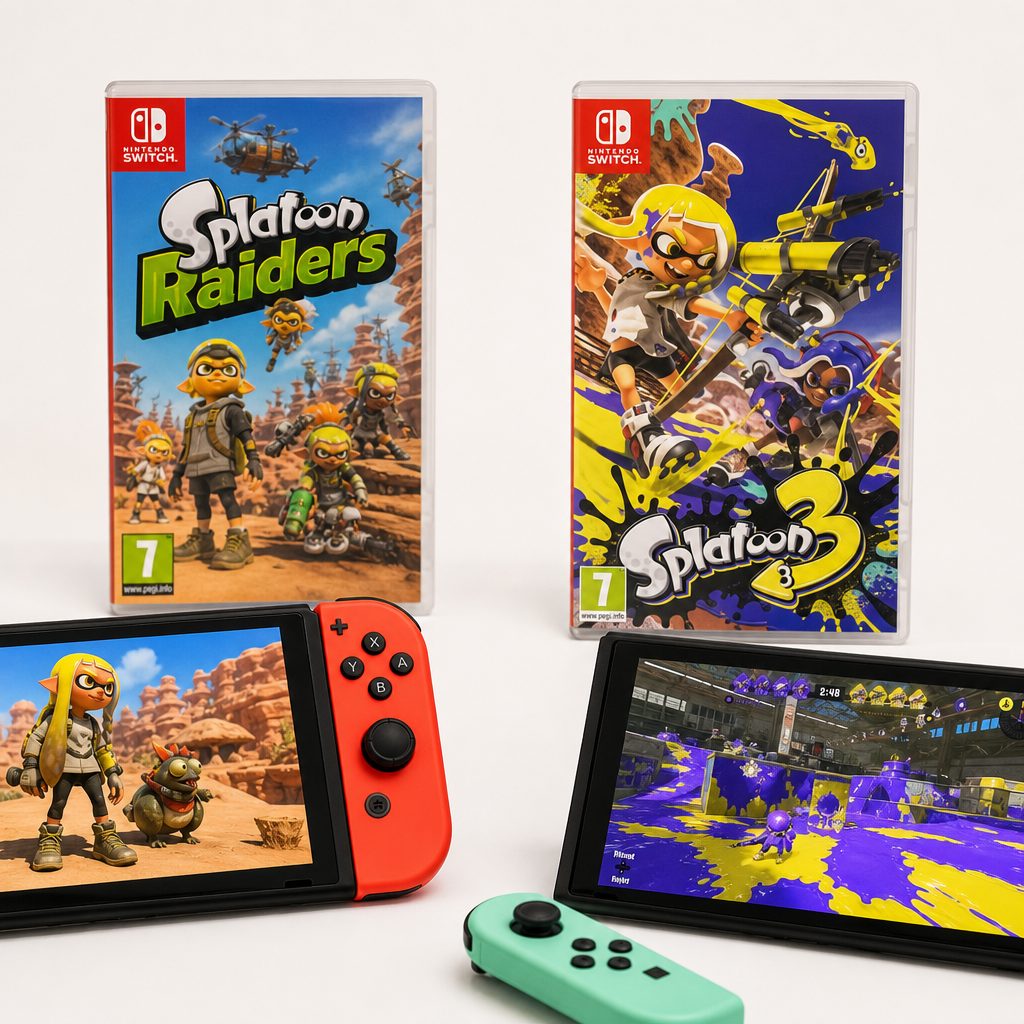
For a solo player, the key difference is simple: Raiders was primarily story-led from the start, whilst Splatoon 3's main identity remained multiplayer despite Side Order's 2024 arrival.
The easiest way to choose
Imagine your first three evenings with the game. If you picture settling in to follow a story and improving through repeat solo runs, choose Splatoon Raiders. If you picture jumping into competitive matches and learning by playing against other people, choose Splatoon 3. Your honest answer is more useful than any feature checklist.
6. Roguelite runs versus multiplayer matches
These games also delivered their replayability in different ways. Raiders used roguelite extraction design. The attraction there is the run itself: you enter, adapt, make do with what happens, and return with a little more understanding than you had before. The loop naturally lends itself to the "just one more attempt" feeling. This is usually a lie, of course. A very pleasant lie, but still a lie.
Splatoon 3's multiplayer focus created a different kind of repeatability. The variable was other players. One game could feel controlled and clever; another could turn into cheerful chaos before you had fully processed what happened. That unpredictability is difficult to reproduce in a solo game, because people bring their own strategies, mistakes and flashes of inspiration to every match.
Neither structure automatically offers more lasting value. A player who likes refining a personal run can find almost endless satisfaction in a roguelite framework. A player who thrives on changing competition can find solo repetition a little too enclosed. The smart choice is not to ask which loop is deeper in the abstract. Ask which one has historically pulled you through a game's opening hours and then kept you there.
The little timeline above is not a scorecard. It is simply useful context. Splatoon 3 had been around since 2022, Side Order followed in 2024, and Raiders arrived in July 2026 as a fresh spin-off. That order matters because the two games did not exist to replace one another. Raiders widened the kind of Splatoon experience Nintendo offered. Splatoon 3 remained the mainline multiplayer entry.
7. Nintendo Switch 2 versus Nintendo Switch
There is no getting around the platform divide. Splatoon Raiders released on Nintendo Switch 2. Splatoon 3 released on Nintendo Switch. This is not glamorous analysis, but it is the sort that saves you from having an extremely passionate debate about the wrong thing.
For an established Nintendo Switch household, Splatoon 3 was the clear relevant option in this comparison. It was the mainline game released for that system. If you had been looking for your first taste of Splatoon without moving to a different platform, the decision had a practical neatness to it.
For Nintendo Switch 2 owners, Raiders was the new dedicated spin-off route. That alone did not make it inherently superior. Newer hardware is not a magic wand and a spin-off is not a compulsory starting chapter. But it did make Raiders the choice for players who specifically wanted the single-player roguelite extraction concept on Nintendo's newer system.
Families should pay particular attention here. "Which should we play first?" sometimes means "which game will be passed around in the living room?" and sometimes means "which one belongs on the console already connected to the television?" Those are different questions. It is perfectly sensible to choose Splatoon 3 because it fits the Nintendo Switch you already use, or Raiders because the Nintendo Switch 2 and solo design suit the person who will be playing it. Sensible is underrated. It prevents expensive cupboard ornaments.
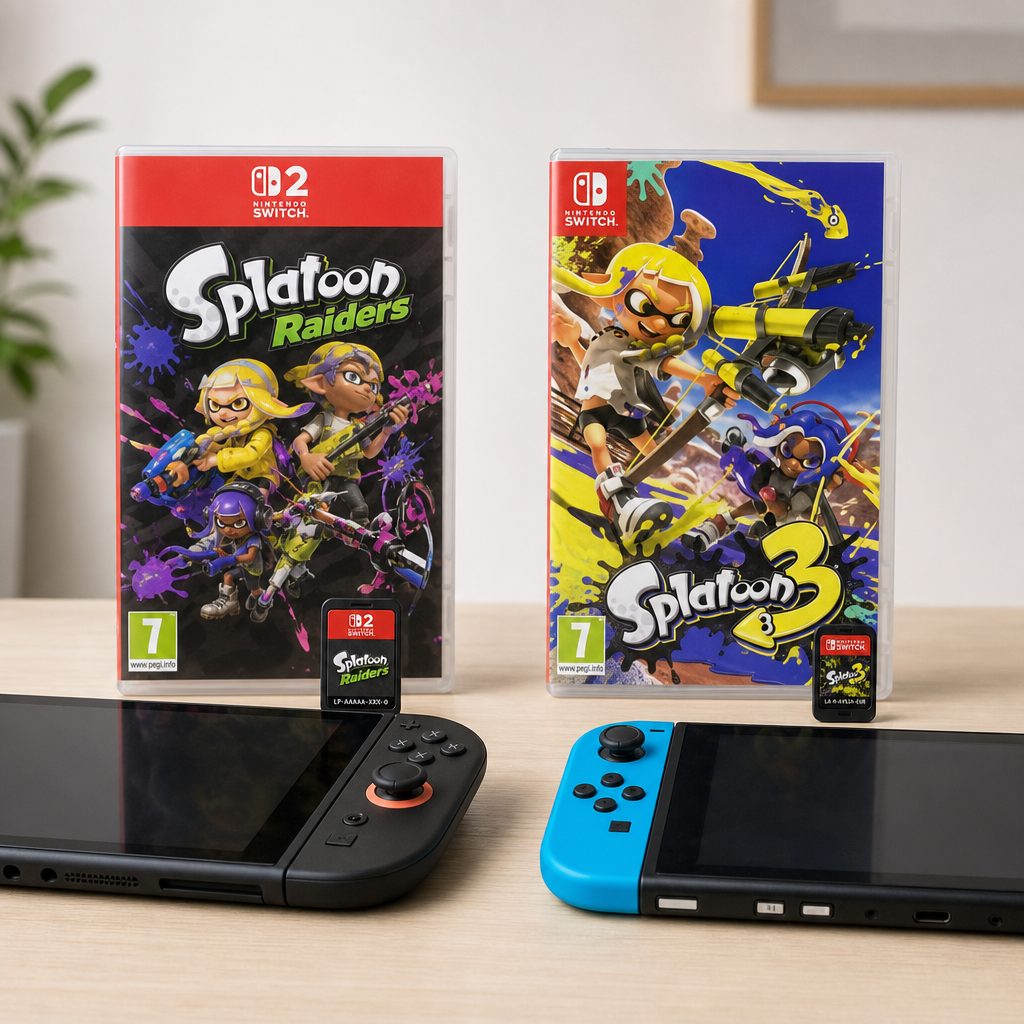
Platform remains the practical divider: Splatoon Raiders released for Nintendo Switch 2, while Splatoon 3 was released for Nintendo Switch.
8. Which game best suits each type of player?
A straight head-to-head needs a winner in each category, but the useful winners are human ones. "Best for the person who plays after school with a sibling nearby" is much more helpful than pretending every player has identical needs and a suspiciously unlimited amount of free time.
Best for story-first newcomers
Raiders was primarily single-player and story-focused, making it the more natural first game for someone who wants a directed adventure before competitive play.
Best for competitive players
As the multiplayer-led mainline entry, Splatoon 3 was the better fit for players coming to the series for repeated competitive matches.
Best for roguelite fans
The roguelite extraction shooter structure was the defining reason to choose Raiders if repeat runs and adaptation are your favourite kind of game loop.
Best for Nintendo Switch owners
Splatoon 3 released for Nintendo Switch, so it was the straightforward place to begin for players using that system.
Best for Nintendo Switch 2 owners
Raiders released for Nintendo Switch 2 and offered the newer spin-off direction for players with access to that platform.
Best mainline-plus-solo compromise
Players who wanted the mainline multiplayer game but also valued later solo content could consider Splatoon 3 alongside Side Order, released in 2024.
There is a useful pattern here. Raiders won when the player's preference was about format: solo play, story, runs and roguelite structure. Splatoon 3 won when the preference was about series identity: mainline Splatoon, multiplayer and the Nintendo Switch platform. Neither result should be read as a dismissal of the other. They were solving different problems for different people.
9. Is Splatoon Raiders or Splatoon 3 better for children and families?
Parents and gift-buyers often get handed a question that sounds easy but is not: "Which one is the proper Splatoon?" The honest answer is that both belong to the same series, but they ask for different things. The better question is, "What kind of player is receiving it?"
For a child who enjoys stories, likes progressing through a game independently, or gets frustrated when a competitive match becomes too hectic, Raiders' single-player focus may be more comfortable. Its roguelite extraction premise also makes it suited to a player who does not mind trying again, learning from an attempt and adjusting. Some children love that. Others feel that repeating a run is the gaming equivalent of being asked to tidy their room twice. Know your audience.
For a child who plays games socially, enjoys competition, and talks excitedly about beating someone fairly, Splatoon 3's multiplayer-first character makes more sense. Its mainline status also gives it the advantage for a youngster who has encountered Splatoon through friends, clips or the wider cultural buzz around competitive play. They may not want the gentle on-ramp. They may want to get involved.
In a mixed household, the answer can be different for each person. One sibling may get far more from Raiders, another from Splatoon 3. That is not wasteful duplication; it is simply recognising that "video games" is too broad a category to describe how people relax. One person wants a story, another wants a challenge, and somebody else only wants to press buttons until something funny happens. All legitimate.
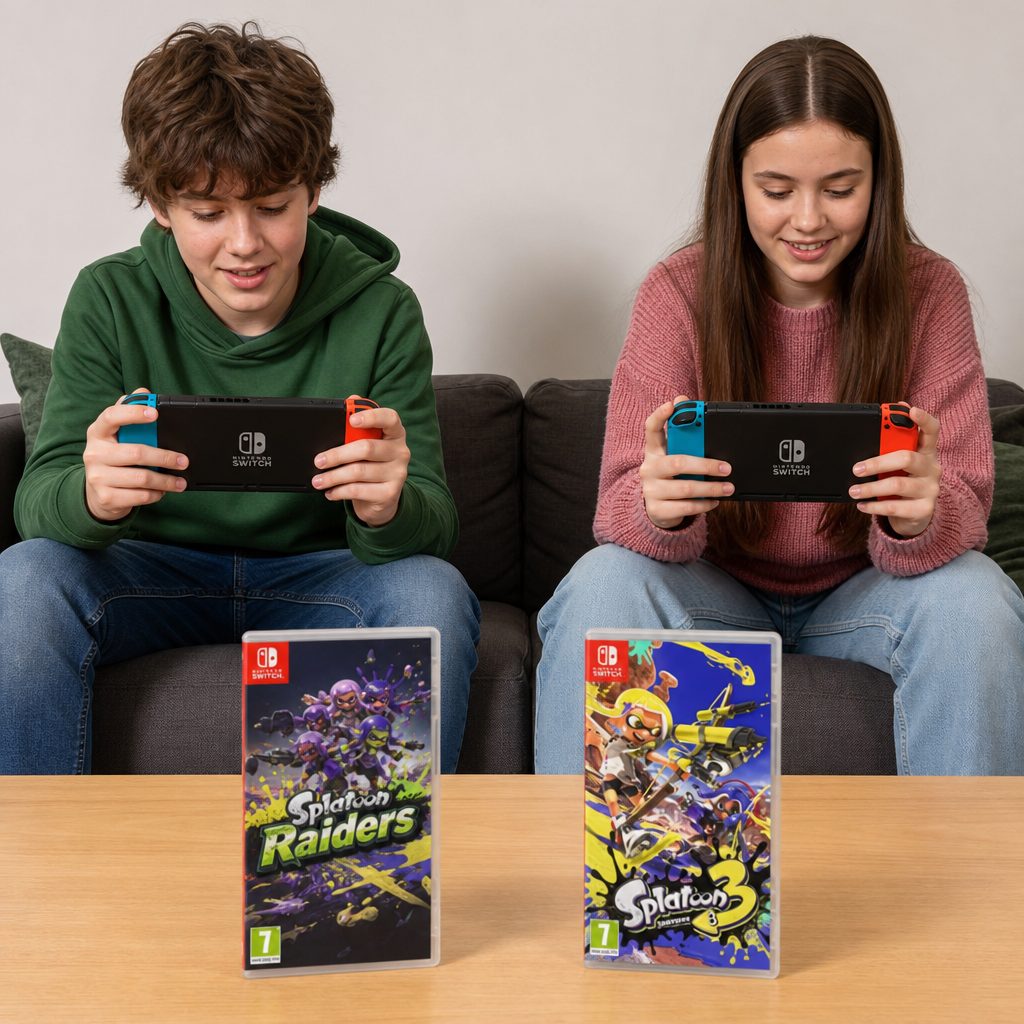
A family choice should follow the player's habits: solo story and repeat runs point towards Raiders, while a love of competitive multiplayer points towards Splatoon 3.
10. The sensible order if you plan to play both
If you are fortunate enough to have access to the relevant hardware and expect to play both games eventually, there is a perfectly reasonable order: begin with the game whose structure sounds most inviting, not necessarily the one with the lower number in its title. That may sound obvious, but game series have trained us to treat chronology as a moral obligation. It usually is not.
Start with Splatoon Raiders if your goal is to learn the feel and character of Splatoon through a primarily single-player story. Its roguelite extraction structure gives you a focused relationship with the game. Then move to Splatoon 3 when you want to see how those colourful ideas translate into a mainline multiplayer setting. That sequence works especially well for somebody who needs confidence before they want competition.
Start with Splatoon 3 if what intrigued you was Splatoon's multiplayer reputation in the first place. You will encounter the mainline game directly, then Raiders can feel like a fresh change of pace: a spin-off that applies the series' personality to a single-player roguelite extraction format. That sequence suits someone who enjoys variety and wants the newer solo game after spending time with the competitive heart of the series.
There is no obligation to "graduate" from one to the other. Raiders is not merely practice for Splatoon 3, and Splatoon 3 is not merely a compulsory history lesson before Raiders. They are companion choices. The right order is the one that gets you playing rather than researching for another month and accidentally developing a spreadsheet. We have all been there.
11. Frequently asked questions
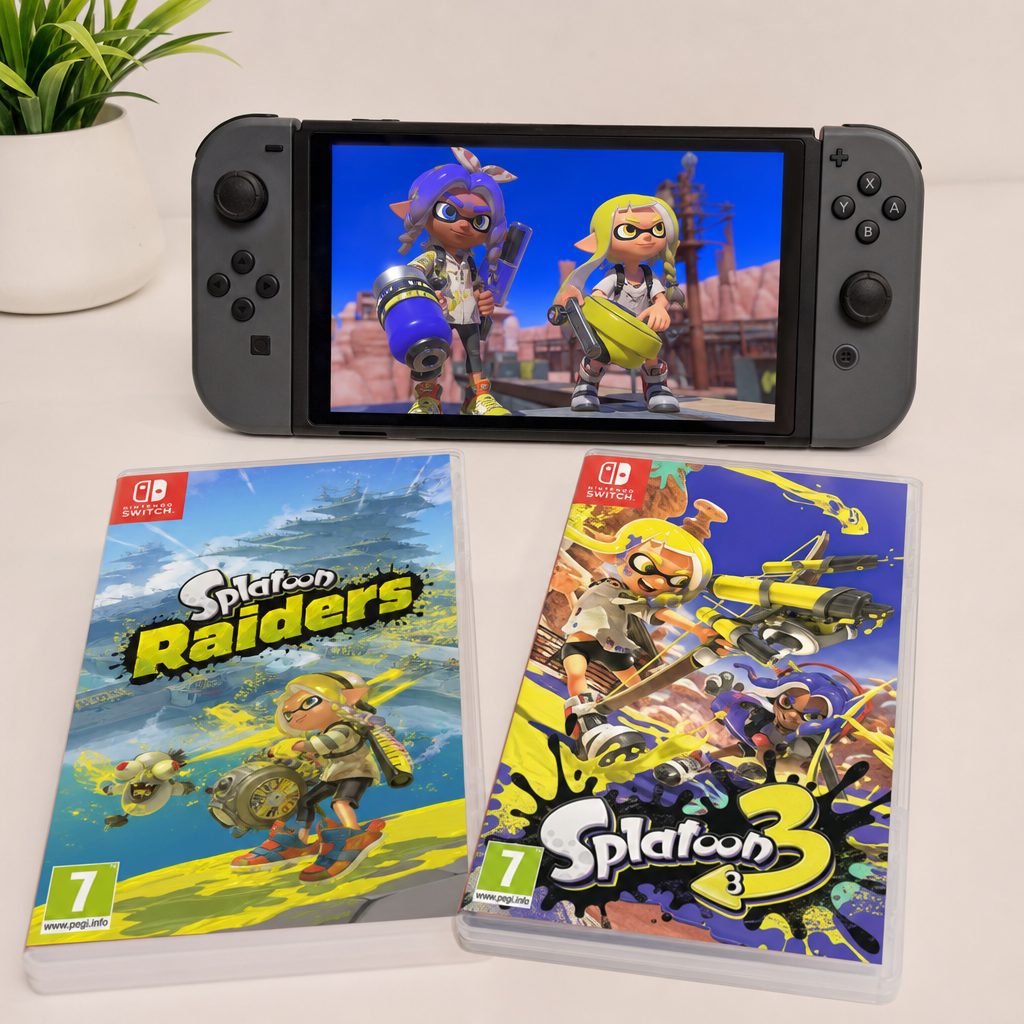
The best first Splatoon game is not determined by title order: it is determined by whether you want a solo roguelite adventure or a mainline multiplayer experience.
Verdict: pick the Splatoon game that matches your play style
Splatoon Raiders is the better first pick for solo players, story fans, roguelite enthusiasts and Nintendo Switch 2 owners. Its 23 July 2026 release introduced a new spin-off route for the series: primarily single-player, story-focused and built around roguelite extraction play. It is the more welcoming option when you want Splatoon's world without making competitive multiplayer the centre of your evening.
Splatoon 3 is the better first pick for multiplayer fans, competitive players and Nintendo Switch owners. Released on 9 September 2022, it remained the mainline entry in this head-to-head and the clearest route to Splatoon's multiplayer-first identity. Side Order, released on 22 February 2024, also gave it an extra point of interest for players who wanted solo content alongside that mainline focus.
The cleanest bottom line is this: choose Raiders for a personal adventure; choose Splatoon 3 for the shared competitive spirit of the series. Both can make a memorable first impression. One just asks whether you would rather face the next run yourself, whilst the other asks whether you fancy seeing what happens when everybody else turns up carrying a paint cannon.