Best Toys and Games for a Rainy-Day Family Night
When the weather has cancelled the grand outdoor plan, these board games, movement toys and console favourites turn a long evening indoors into something everybody can join. No elaborate preparation. No pretending the drizzle is "actually quite refreshing".
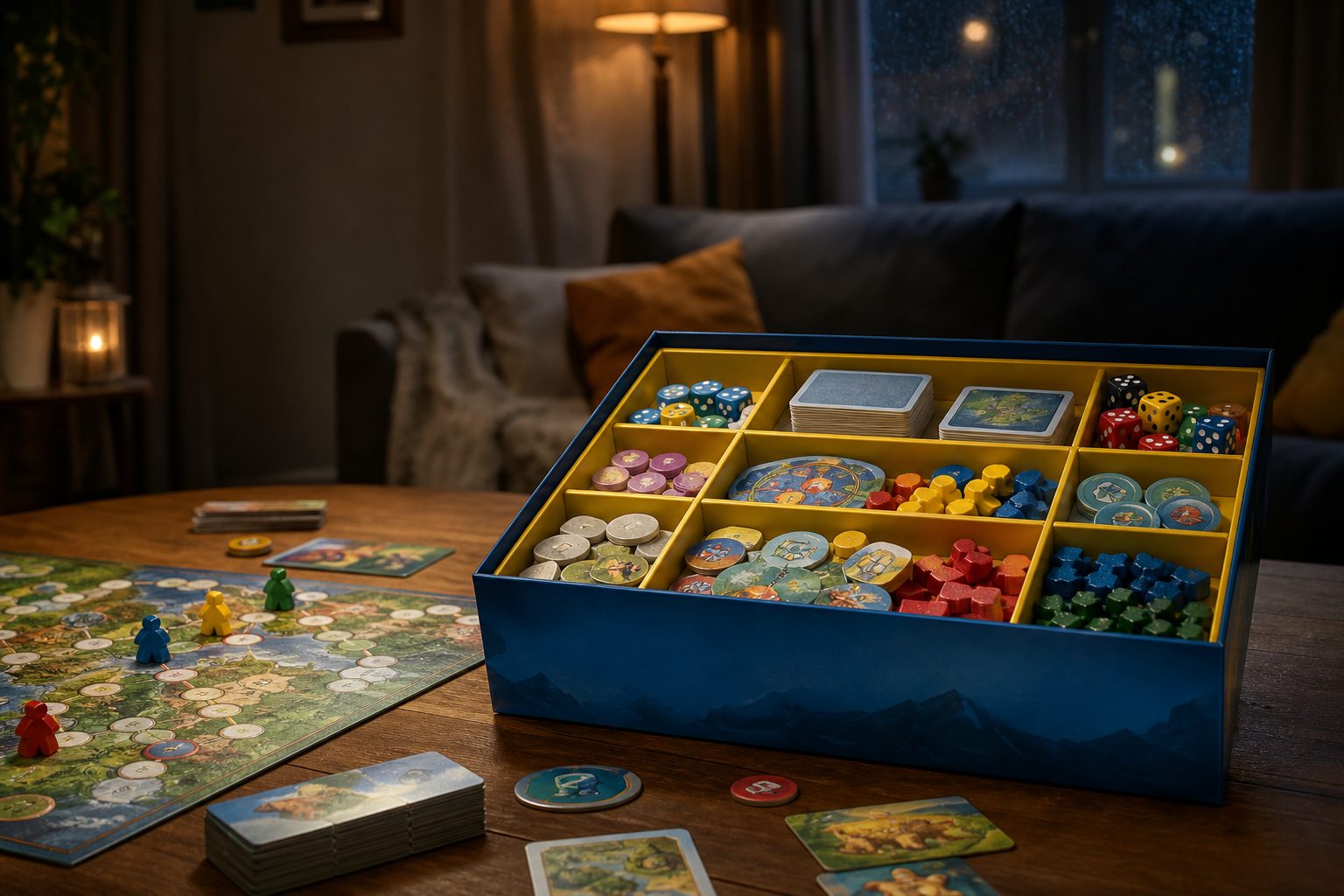
A proper rainy-night line-up needs more than one board game: the best evenings move from the table to the living room and back again.
Why a mixed family-night cupboard wins
A rainy-day family night can go wrong in a very specific way. Somebody chooses a game with rules that need a small legal team to interpret. A younger child is eliminated five minutes in. An adult gets too invested in a plastic hotel empire. By 8pm, everyone is technically in the same room but emotionally several postcodes apart.
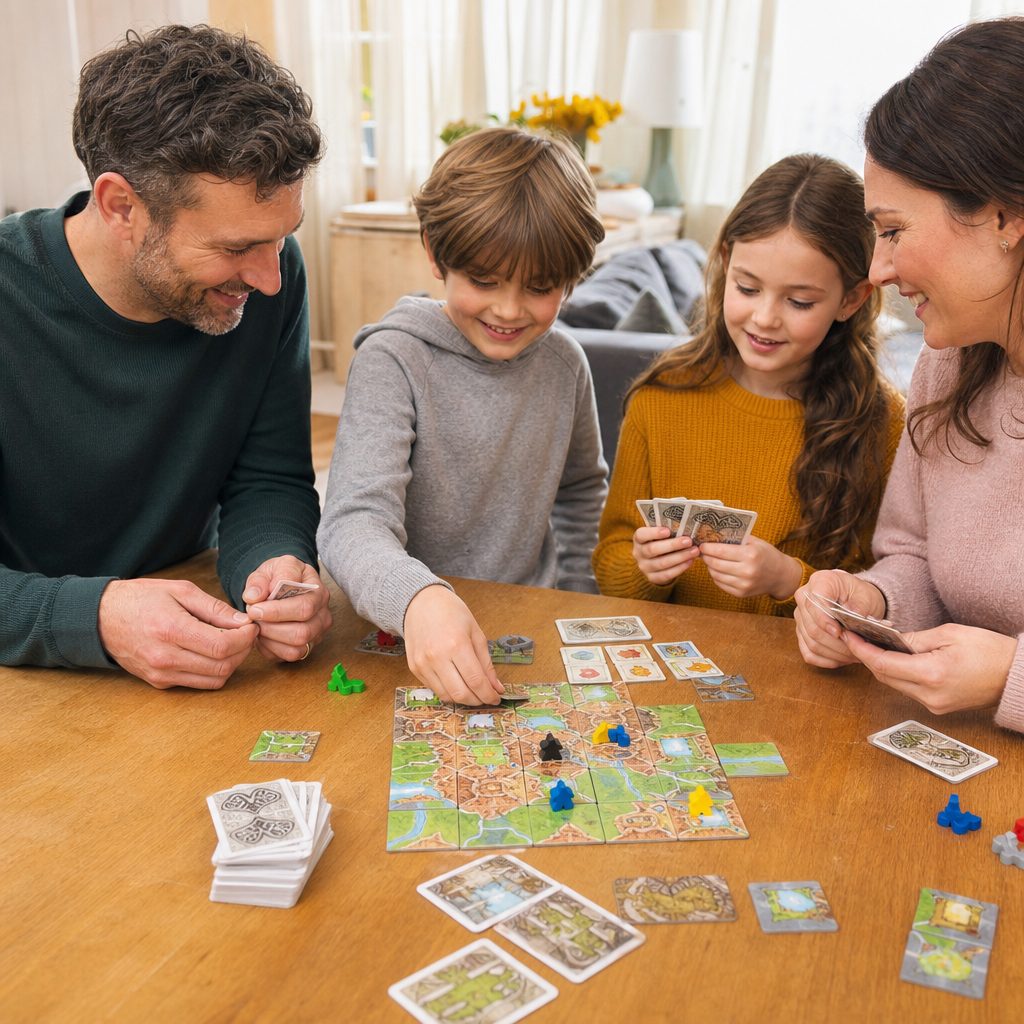
A card-and-tile game gives the evening a calm centre before the dancing and racing begin.
The answer is variety. A genuinely useful cupboard has a fast game for the post-dinner lull, a thinking game for the people who like a plan, something physical for restless bodies, and a screen option for when you want music, colour and very little explanation. The picks below do different jobs brilliantly; that is rather the point.
How I ranked these rainy-night picks
I have favoured games that get to the good bit quickly, give different ages something meaningful to do, and still feel worthwhile after the first novelty has worn off. That last point matters. A toy can be exciting for six minutes; an excellent family-night pick prompts the dangerous question: "One more round?"
There is no single winner for every household. Codenames is superb when you have enough readers for teams. Catan Junior gives younger children a friendly route into strategy. Just Dance 2026 Edition is the obvious rescue plan when sitting still has ceased to be an option. Think of this as a menu, not an instruction.
The simple running order
Start with a 15-to-30-minute table game whilst everyone is settling in, switch to a movement pick before the energy turns feral, then finish with racing or rhythm. It is easier than asking children to remain politely seated for an entire 45-minute strategy session.
At-a-glance price landmarks
Prices move around, especially on enduring games with different printings and retailer promotions. These confirmed figures are useful reference points rather than a promise of what will be on a shelf this afternoon. Mario Kart 8 Deluxe costs considerably more than a card game, naturally, but it can serve four local players on one Nintendo Switch.
Codenames
A strong entry point for a team game that supports up to eight players.
Qwirkle
A longer 2–4-player tile game for households that enjoy a quieter tactical challenge.
Mario Kart 8 Deluxe
The Nintendo Switch racing option, with local multiplayer for up to four.
The ranked rainy-day family-night picks
1. Codenames — Best for the whole family round the table
Codenames remains my all-round recommendation because it makes a group feel like a group. Players split into teams, a spymaster gives a one-word clue, and everyone tries to connect that clue to the right words on the table. Simple. Except that "beach, mouse, jam" may apparently all be connected in Uncle Mark's mind, which is where the evening gets interesting.
The original game had been in print since its September 2015 release and it has earned that longevity. It accommodates 2–8 players and typically takes around 15–30 minutes, so it is unusually good at filling the gap between food and a film without becoming the whole event. Two players can play, but it is more animated with teams and a mix of ages.
Pros
- Works with up to eight players, making it the broadest tabletop choice here.
- Short rounds invite rematches rather than a commitment to an all-evening campaign.
- Team discussion lets confident readers help younger or quieter players.
Cons
- Its wordplay is a better fit for readers than pre-reading children.
- A clue that seems perfectly sensible to the spymaster can be baffling to everyone else. That is also the joke.
2. Catan Junior — Best for young strategists
Catan Junior is the pick for children who have started asking for "a proper game", but are not ready for an evening of dense rules and fragile negotiations about commodities. It keeps the appealing build-and-trade shape of Catan while simplifying the building rules and using child-oriented trading. The Ghost Captain takes the place of the original game's robber, which is a welcome tonal adjustment for younger players.
It is designed for 2–4 players aged 6 and over, with a stated 15–30-minute playing time. That is the sweet spot for a rainy evening: enough time to make choices and feel clever, not enough time for attention to evaporate halfway through the treasure hunt.
3. Qwirkle — Best for calm, screen-free strategy
Qwirkle is a wonderfully quiet counterweight to a noisy household. Players build lines from tiles by matching colours or shapes, looking for opportunities to use more tiles at once. There is strategy here, but it is visible strategy. Nobody needs to remember an elaborate fictional history or announce a special power in a dramatic voice.
For 2–4 players aged 6+, its 45-minute playing time makes it one of the more substantial tabletop options in this roundup. Choose it when the children can stay with a longer game, or when the grown-ups enjoy a puzzle but do not fancy a confrontation disguised as recreation. It is less naturally chatty than Codenames, but it rewards concentration beautifully.
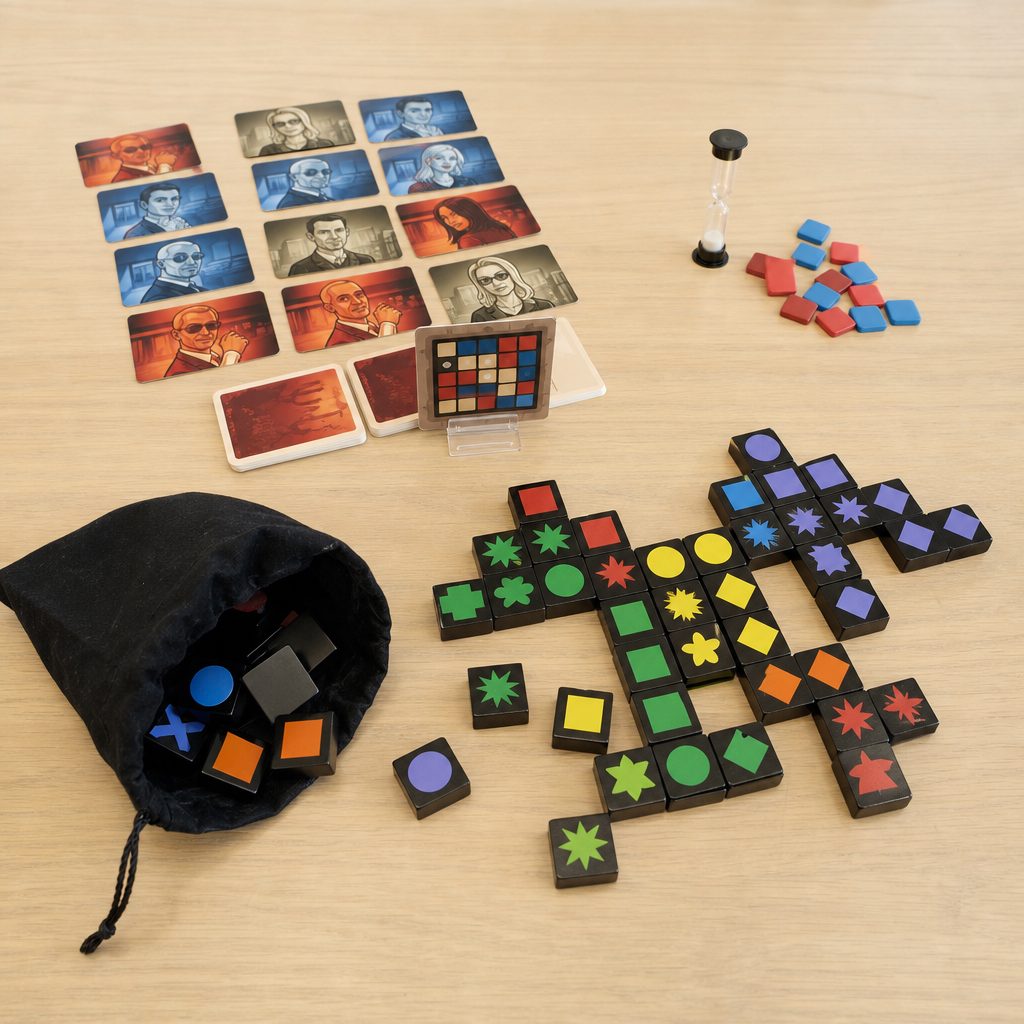
Codenames thrives on team chatter, whilst Qwirkle gives thoughtful players a satisfying pattern puzzle to solve.
4. Connect 4 — Best for instant one-to-one competition
Connect 4 earns its place because not every rainy evening needs a full production. It is a direct two-player game that is easy to learn for anyone over six, with the satisfying physical business of dropping counters into place and the immediate agony of seeing an opponent set up a winning line.
It is excellent for a child and parent pairing whilst dinner is finishing, or for settling the question of who gets first choice of the console. The limitation is obvious: only two people play at a time. Make that a feature rather than a flaw by holding a small winner-stays-on tournament. Manual dexterity gets a little workout too, although victory will still be blamed on "luck" by the person who missed the diagonal.
5. Hedbanz — Best for getting shy players laughing
Hedbanz is a useful antidote to the awkward first ten minutes of a family gathering. The guessing-game format is silly in the best way: players ask questions to work out what they are, and the whole group gets to enjoy the moment somebody takes a wildly unhelpful route towards the answer.
It is recommended for ages 7 and up and suits a party-minded family night far better than an intensely tactical one. If your group enjoys charades, impressions and the general comedy of watching a relative fail to identify something plainly written in front of them, it has a very good chance of landing.
6. Flybar Pogo Jumper — Best for indoor energy breaks
The Flybar Pogo Jumper is not a sit-down game, which is precisely why it belongs here. A burst of bouncing between board-game rounds can stop the room becoming a pressure cooker. Its bungee and squeaker system support children up to 250lb, and the squeak delivers instant feedback with every jump. No scoreboard required; the noise is apparently proof enough.
Use it as an active interval rather than a competitive endurance event. Clear a suitable space first, decide where the jumper is allowed to land, and give everyone a turn. It is especially helpful when one child is too wriggly for Qwirkle but still wants to be included in the family plan.
7. Unicorn Dance Mat — Best for a colourful movement challenge
The Unicorn Dance Mat turns the living-room floor into an active game zone, with LED lights that synchronise with movement across five game modes. For children who respond to lights, music and the prospect of being asked to step very quickly in a particular direction, it can be a far better rainy-day answer than another episode of something.
It is an easy pick to bring out between quieter activities because the rules are read through the body rather than a rulebook. Keep enough floor space clear and accept that spectators will soon start offering extremely unhelpful dance advice. That is family night. Nobody said it had to be dignified.
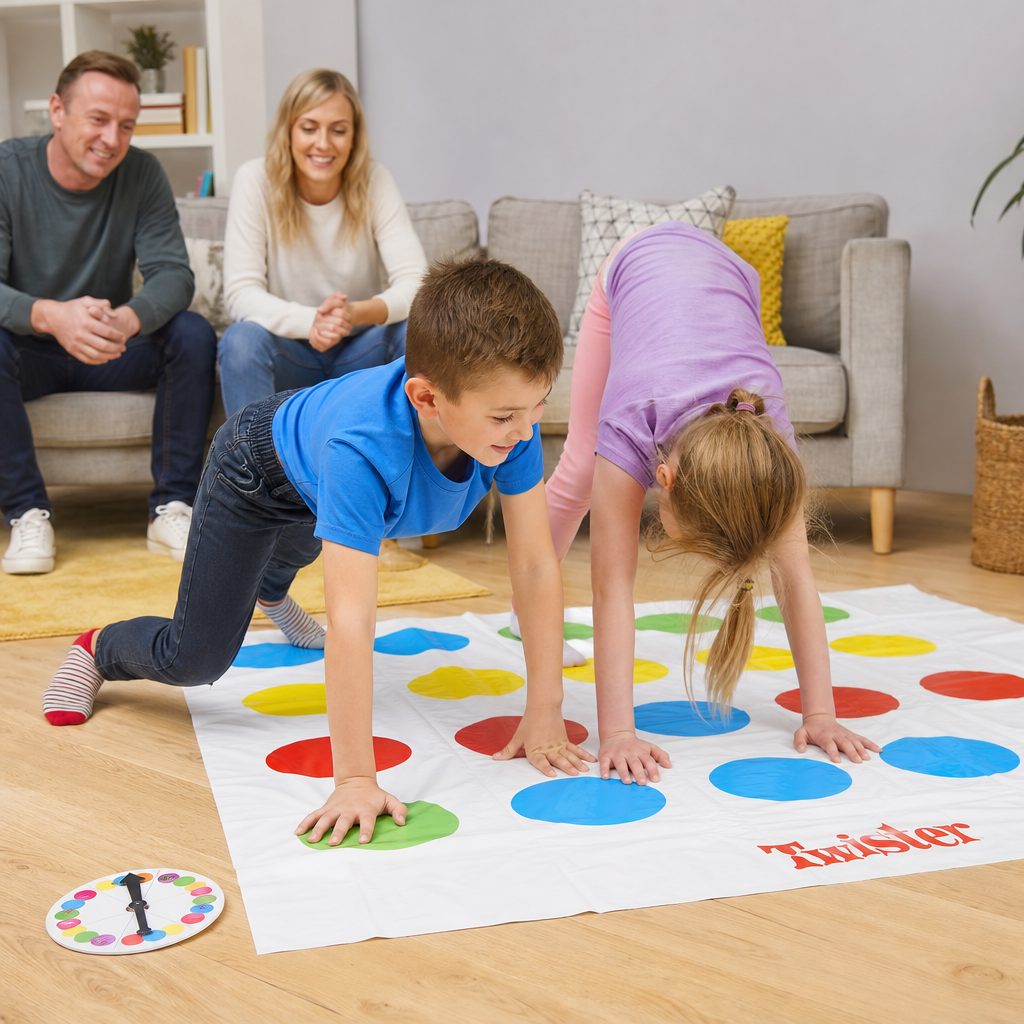
Movement toys break up a long indoor evening and give restless children a reason to put the cards down for a while.
8. Ubisoft Just Dance 2026 Edition — Best for a big-group living-room finale
Just Dance 2026 Edition, released on 14 October 2025, is the strongest console choice here when the room needs lifting. It is a dance-controlled rhythm game available for Nintendo Switch, PlayStation 5 and Xbox Series X/S, with both single-player and multiplayer modes. Crucially, it asks very little of a newcomer beyond a willingness to move.
This is the game I would choose when grandparents, teenagers and younger children all need an activity that can be understood by watching for ten seconds. Scoring matters just enough to be entertaining, but the real appeal is collective participation. It can get noisy and needs clear living-room space, so it is best treated as a finale rather than something running in the background whilst somebody tries to explain Catan Junior.
9. Nintendo Mario Kart 8 Deluxe — Best for reliable four-player racing
Shop Nintendo Mario Kart 8 Deluxe on Amazon UK
Mario Kart 8 Deluxe is the dependable "just one race" choice that routinely becomes several races. It supports up to four local players on Nintendo Switch and carries a 4.8-star rating from 76,000 reviews. Those numbers explain the enduring pull: it is familiar, colourful, easy to understand from the starting line and reliably capable of turning a quiet sibling rivalry into a championship season.
It costs £48.99, so this is a purchase best suited to a household that already has a Nintendo Switch and expects to revisit it often. It is not a replacement for face-to-face table games; the focus shifts to the screen. Yet for a rainy night, its quick reset between races and four-player local option make it one of the safest crowd-pleasers in the cupboard.
Every pick compared in one place
These are not like-for-like products, and forcing them into one score would be daft. The useful comparison is what each one asks of the family: people, time, reading, movement or hardware. The table below covers every ranked pick using the figures and practical strengths that matter most when you are choosing at 6.30pm rather than researching for a fortnight.
| Pick | Best role | Confirmed group or age detail | Confirmed time, modes or platform |
|---|---|---|---|
| Codenames | Team wordplay | 2–8 players | 15–30 minutes |
| Catan Junior | First strategy game | 2–4 players, ages 6+ | 15–30 minutes |
| Qwirkle | Calm tile strategy | 2–4 players, ages 6+ | 45 minutes |
| Connect 4 | Head-to-head challenge | Two players, over six | Quick turn-based play |
| Hedbanz | Group laughter | Ages 7+ | Guessing-game format |
| Flybar Pogo Jumper | Active interval | Supports up to 250lb | Bungee and squeaker system |
| Unicorn Dance Mat | Movement game | Family turn-taking | 5 game modes with LED lights |
| Just Dance 2026 Edition | Dance finale | Single-player and multiplayer | Switch, PS5, Xbox Series X/S |
| Mario Kart 8 Deluxe | Local racing | Up to 4 local players | Nintendo Switch |
Playing-time reality check
There is a difference between a game's stated duration and how long it occupies the household. Codenames and Catan Junior both sit in the 15–30-minute range, but either can spark a rematch. Qwirkle's 45-minute session is a more deliberate commitment. That makes it excellent after a relaxed meal, but less ideal when bedtime is close and someone has already misplaced a sock.
Plan for a change of pace. A 45-minute tile game is not "better" than a 15-minute word game. It simply asks more of the room. For mixed ages, pairing one shorter tabletop pick with a physical break is usually the more forgiving plan.
Build a rainy-night routine that actually works
Start before snacks become a distraction
Choose Codenames, Connect 4 or Hedbanz first. Their quick premise gets everyone participating before the biscuits become the main event.
Use strategy while attention is strongest
Catan Junior and Qwirkle reward a calmer table. Put them earlier than the noisy console finale if you want children to stay focused.
Schedule movement, do not negotiate it
Bring out the Pogo Jumper or Dance Mat as a planned reset. It feels much fairer than suddenly stopping a game because someone is bouncing off the sofa.
End with an obvious finish line
One Mario Kart cup or a short Just Dance session provides a satisfying close, rather than an argument about whether another board-game round is possible.
Best picks by household and budget
If you only buy one thing, buy for the people you actually have at home rather than the imaginary perfect family in the catalogue. A four-player household with a Nintendo Switch has a different answer from a large family who love wordplay. Here are the shortcuts.
Best lower-cost all-rounder
Codenames. At £15.99, its 2–8-player range and 15–30-minute playtime offer broad family-night mileage.
Best premium repeat-play pick
Nintendo Mario Kart 8 Deluxe. £48.99 is a bigger outlay, but up to four local players can return to it again and again.
Best for younger children
Catan Junior. Its 6+ guidance, 2–4-player format and simplified building make strategy approachable.
Best rainy-night energy release
Unicorn Dance Mat. Five LED-led game modes give a restless room a purposeful outlet.
Best calm table choice
Qwirkle. Choose it for 2–4 players who would rather build patterns than shout clues.
Best large-room finale
Just Dance 2026 Edition. Multiplayer rhythm action is ideal when the group wants to finish on a high.
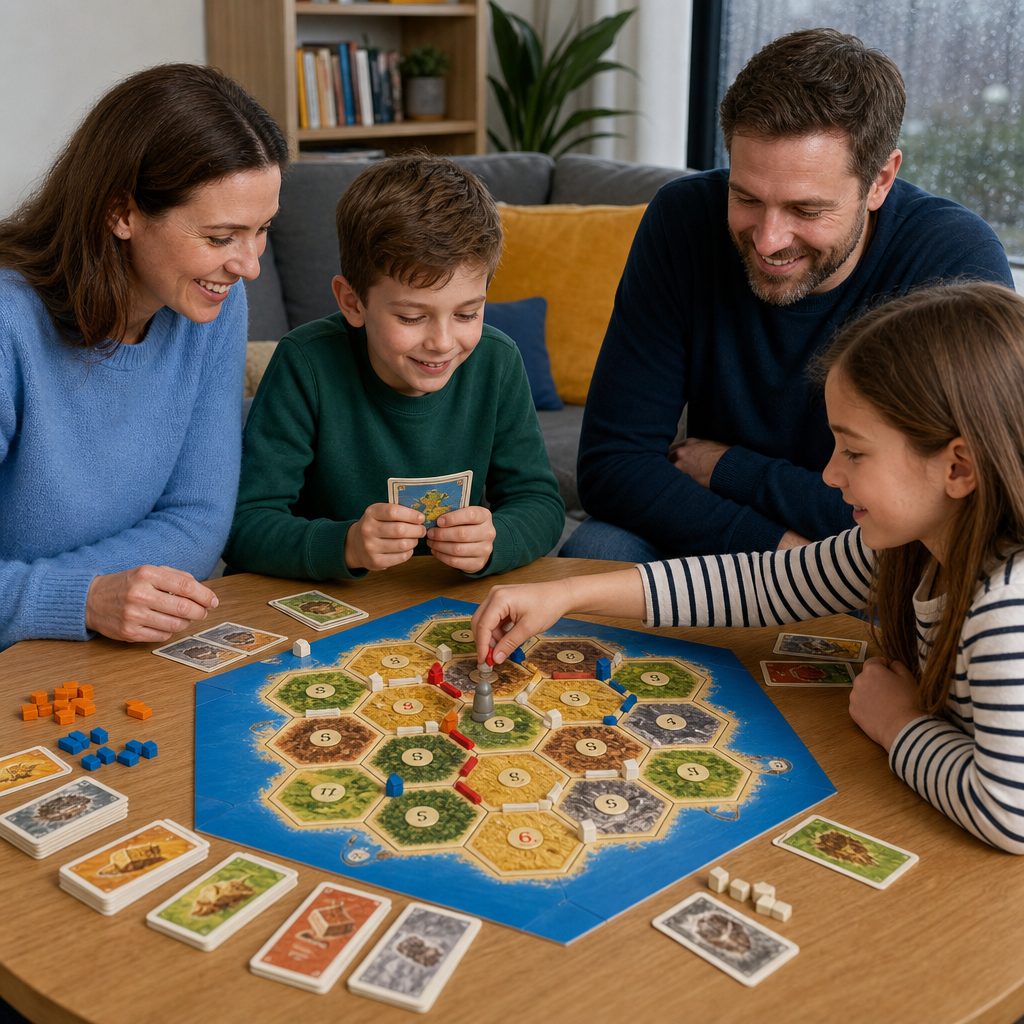
The best choice depends on the room: a quiet 2–4-player table game and a noisy group dance game can both be exactly right.
What not to overlook before buying
First, check the shape of your evening. Codenames is technically playable by two, but teams bring out its best character. Connect 4 is excellent precisely because it is a two-player contest, but it will not occupy six people at once. Qwirkle's age guidance begins at 6+, yet its 45-minute runtime still requires a child who is happy to engage for that stretch.
Second, make room. The active options need it. The Flybar Pogo Jumper and Unicorn Dance Mat work best when furniture, drinks and the household's least forgiving ornament have been moved away. Just Dance deserves similar consideration. It is more enjoyable when players can commit to the ridiculous arm movement instead of worrying about the coffee table.
Finally, consider what hardware is already in the house. Just Dance 2026 Edition supports Nintendo Switch, PlayStation 5 and Xbox Series X/S. Mario Kart 8 Deluxe is for Nintendo Switch. A console game is a brilliant addition if you own the compatible machine; it is not a bargain rainy-day solution if it sends you shopping for an entire setup.
Frequently asked questions
Codenames is the best broad choice when you have enough readers to form teams. Its 2–8-player range and 15–30-minute sessions make it flexible, while adults can support younger players through the discussion.
Catan Junior and Qwirkle both have guidance for ages 6+. Catan Junior is the more thematic introduction to building and trading, whilst Qwirkle is the calmer visual puzzle. Connect 4 is also easy to learn for players over six.
The Unicorn Dance Mat is the clearer game-like movement choice, with LED lights synchronised to movement across five modes. The Flybar Pogo Jumper is useful as an active break and supports children up to 250lb.
It is a strong fit if you already own a Nintendo Switch and regularly have up to four local players. At £48.99 it costs more than the tabletop games here, but its fast races and 4.8-star rating from 76,000 reviews show why it remains such a reliable family favourite.
Connect 4 is the uncomplicated answer for a direct head-to-head match. Qwirkle also works with two players if you want a longer, more thoughtful game, while Codenames can be played by two but is generally livelier with teams.
A pair of short games plus an active break is often enough. Codenames and Catan Junior each sit at around 15–30 minutes, whereas Qwirkle is a 45-minute choice. Ending while everyone still wants another round is better than stretching the plan until it becomes a negotiation.
No. Just Dance 2026 Edition is available for Nintendo Switch, PlayStation 5 and Xbox Series X/S. It was released on 14 October 2025 and includes both single-player and multiplayer modes.
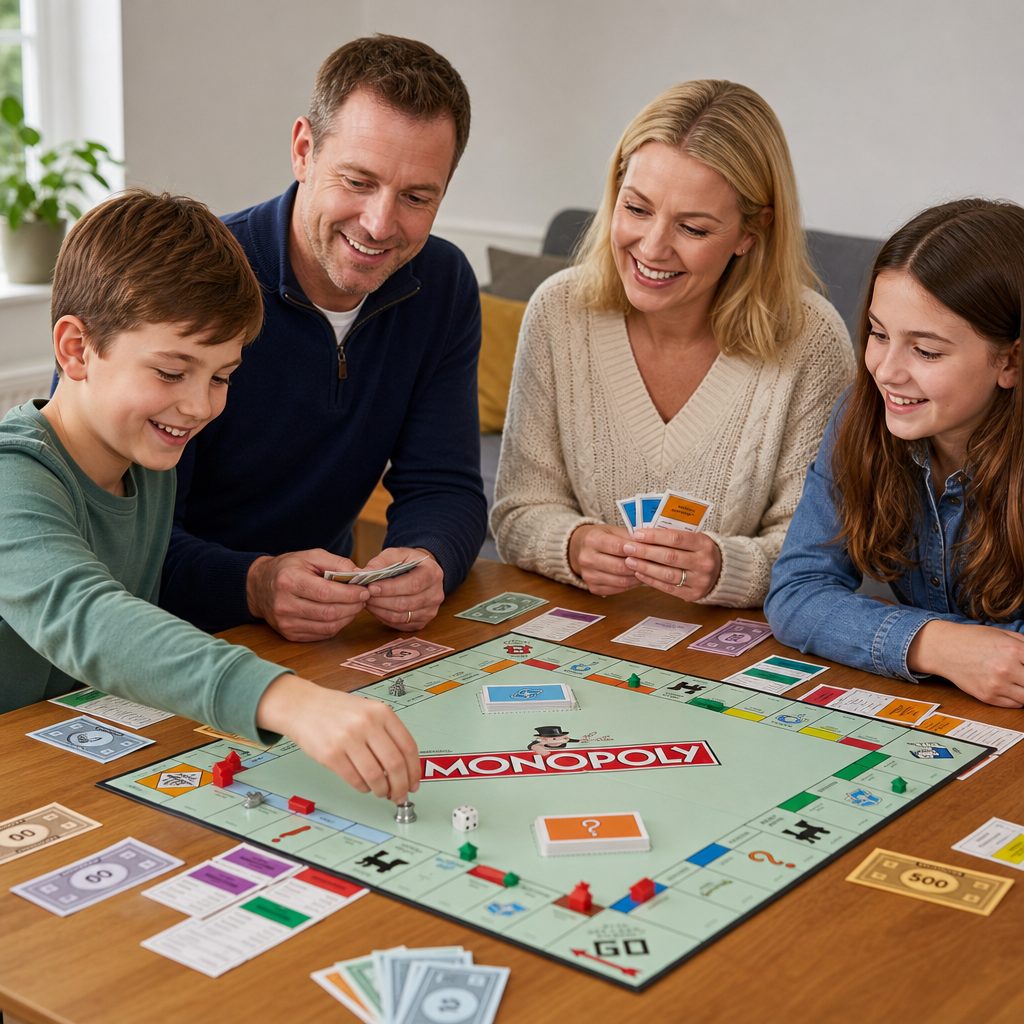
The winning rainy-night formula is simple: give everyone a turn to choose, then save one lively favourite for the finish.
The bottom line
Codenames is the best all-round rainy-day family-night buy because it is sociable, quick to bring out and works with the broadest group size here. Pair it with Catan Junior for younger strategists or Qwirkle for a more thoughtful table, then keep the Unicorn Dance Mat or Just Dance 2026 Edition ready for the inevitable moment when sitting down stops being an achievable group activity.
The real secret is not finding one perfect game. It is having two or three different kinds of fun available. Rain can do whatever it likes outside. Inside, you have a tournament to run.