
LEGO Technic Aston Martin Aramco AMR25 F1 Car Review: A Step Backwards for the Series?

The 1:8-scale LEGO Technic Aston Martin Aramco AMR25 is undeniably dramatic at 61cm long, even if its green is not quite Aston Martin Racing Green.
LEGO's fifth large-scale Technic Formula 1 car brought Aston Martin's 2025 challenger to the shelf in 1,547 pieces. It had the gearbox, suspension and headline-grabbing DRS feature that fans expected. It also had a rather compromised shade of green, giant-looking tyres and proportions that made this otherwise clever model feel less resolved than the best cars in the range.
LEGO Technic Aston Martin Aramco AMR25 F1 Car at a glance
The LEGO Technic Aston Martin Aramco AMR25 F1 Car, set number 42240, arrived on 1 July 2026 as the fifth entry in LEGO's modern 1:8 Technic Formula 1 line. That gives it a particular problem from the outset. This was not the first time LEGO had built a very large F1 car with a V6, suspension, steering and a gearbox. The novelty had gone. By this point, buyers were entitled to look beyond the badge and ask whether the shape, functions and finish justified another sizeable slab of shelf space.
There is plenty here to admire. At 61cm long, the AMR25 has real presence. The front and rear push-rod suspension works, the steering works, the differential works, and the two-speed gearbox drives a V6 alongside a simulated electric engine. Select high gear and the rear-wing DRS opens. That is exactly the sort of interlinked mechanism that makes a Technic build more satisfying than a very handsome plastic model kit.
But this is also a set caught between its engineering ambitions and its visual limitations. The real AMR25 wore a subtle Aston Martin Racing Green, while the LEGO car used regular green with bright lime accents. It is recognisably an Aston Martin once your eye has found the sponsor graphics and the overall silhouette. From a distance, though, it can look surprisingly close to a green-and-lime car from another team. For a £199.99 display model, that is not a tiny quibble. Colour is the whole mood.
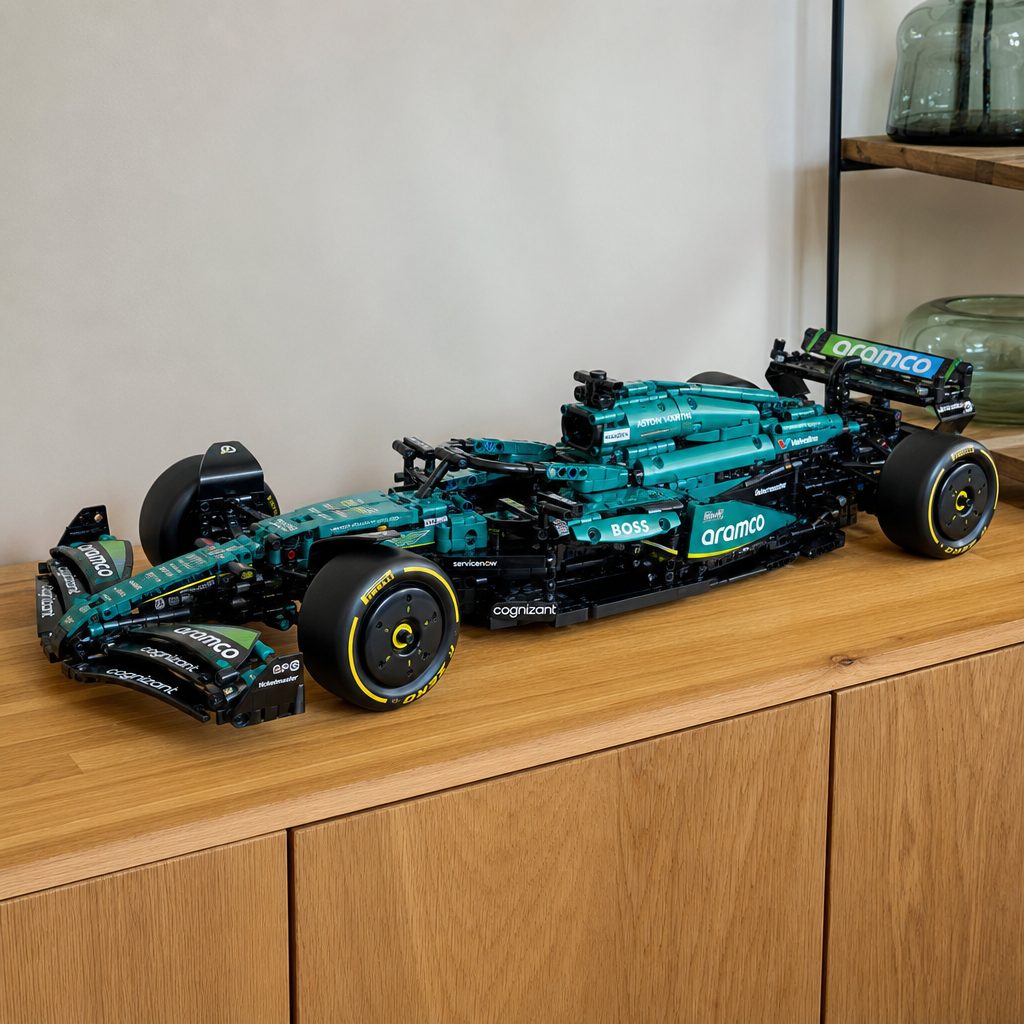
The AMR25's sprawling front wing and long bodywork make it a proper centrepiece, but it needs far more room than a typical LEGO display set.
This is a static display-focused Technic model rather than a powered RC car. Its working systems are there to explore by hand during and after the build, not to send it charging around the living-room floor. Frankly, at 61cm long, your skirting boards will be grateful.
Design: the green that started the argument
Let's deal with the obvious bit: the colour. LEGO did not have a perfect match for Aston Martin Racing Green in its Technic palette, and the solution was regular green bodywork with bright lime green highlights. The lime detailing has a purpose. It breaks up the large panels, gives the sponsor-heavy livery some energy and makes certain aerodynamic surfaces easier to read. Close up, it is bold and rather fun.
The issue is that Aston Martin's identity is built on a specific kind of understated confidence. The real car's deeper, more mint-leaning racing green has a premium quality. The LEGO approximation is much flatter and more saturated. It looks like LEGO green first and Aston Martin green second. Some builders will not care one jot, especially once the car is displayed alongside red, blue and silver Technic F1 models. Others will see it every time they walk into the room. Both reactions are fair.
That colour decision feeds into a broader feeling that the AMR25 is slightly less harmonious than it ought to be. The stickers do a lot of work in tying the car to the team, appearing across the front wing, sidepods and engine cover. They are necessary, and most are visually effective, but this is still an expensive adult model with a substantial sticker burden. Printed tyres are welcome at this scale, yet the number of stickers means the livery depends heavily on careful application. One crooked sponsor logo can turn a sleek sidepod into a small personal tragedy.
The car's outline remains impressive. The low nose, elaborate front wing, tightly sculpted central bodywork and tall rear wing give it the unmistakable stance of a current-era Formula 1 machine. It photographs well from its strongest angles. Look at it head-on or in a three-quarter pose and the model has real theatre. It is when you step back and study the wheel-to-body relationship that the visual confidence starts to wobble.
Display tip
Give the AMR25 a shelf deep enough for the full 26cm width and enough clearance to view it from slightly above. At eye level, the tyres and busy wing surfaces become more dominant; from a higher angle, the elegant central bodywork reads much better.
Those oversized tyres and awkward proportions
The tyres are the source of the other big debate. At this scale, large wheels can look superb: they give a Technic car weight and help sell the mechanical complexity underneath. On the AMR25, however, the visual relationship between tyres, wheel arches and bodywork is not always convincing. The rear wheels are also too narrow, a recurring issue in this particular LEGO F1 family. It is consistent, certainly. Consistency is not the same thing as accuracy.
There is an awkward contradiction here. The tyre diameter has enough visual heft to feel oversized in relation to the body, whilst the rear width lacks the planted, muscular look that you expect from a modern F1 car. The result can make the car appear a little perched rather than hunkered down. It is not a catastrophe. Nobody entering the room will mistake it for anything other than a Formula 1 car. Yet at 1:8 scale, proportions are not background detail; they are the model.
The McLaren Formula 1 Race Car from 2022 had its own compromises, but it benefitted from being the first big expression of this template. The Mercedes-AMG F1 W14 E Performance then showed how much refinement was possible in a team-specific interpretation. By the time the AMR25 landed, fans had already seen Ferrari, Red Bull and McLaren variations built around broadly similar technical foundations. The Aston Martin needed to be especially crisp visually to stand apart. Instead, its most distinctive visual traits were the ones that divided people.
Pros
- Huge 61cm display model with genuine shelf presence.
- Complex working drivetrain, differential, steering and suspension.
- DRS linked to high gear is a clever, memorable Technic feature.
- Printed tyres add polish where printed details matter most.
- Regular green and lime make the model visually lively in a collection.
Cons
- Regular green is a poor substitute for Aston Martin Racing Green.
- Rear tyres remain too narrow and upset the car's proportions.
- Large sticker count asks for patience and a steady hand.
- It occupies a great deal of horizontal display space.
- The formula was beginning to feel repetitive by the fifth car.
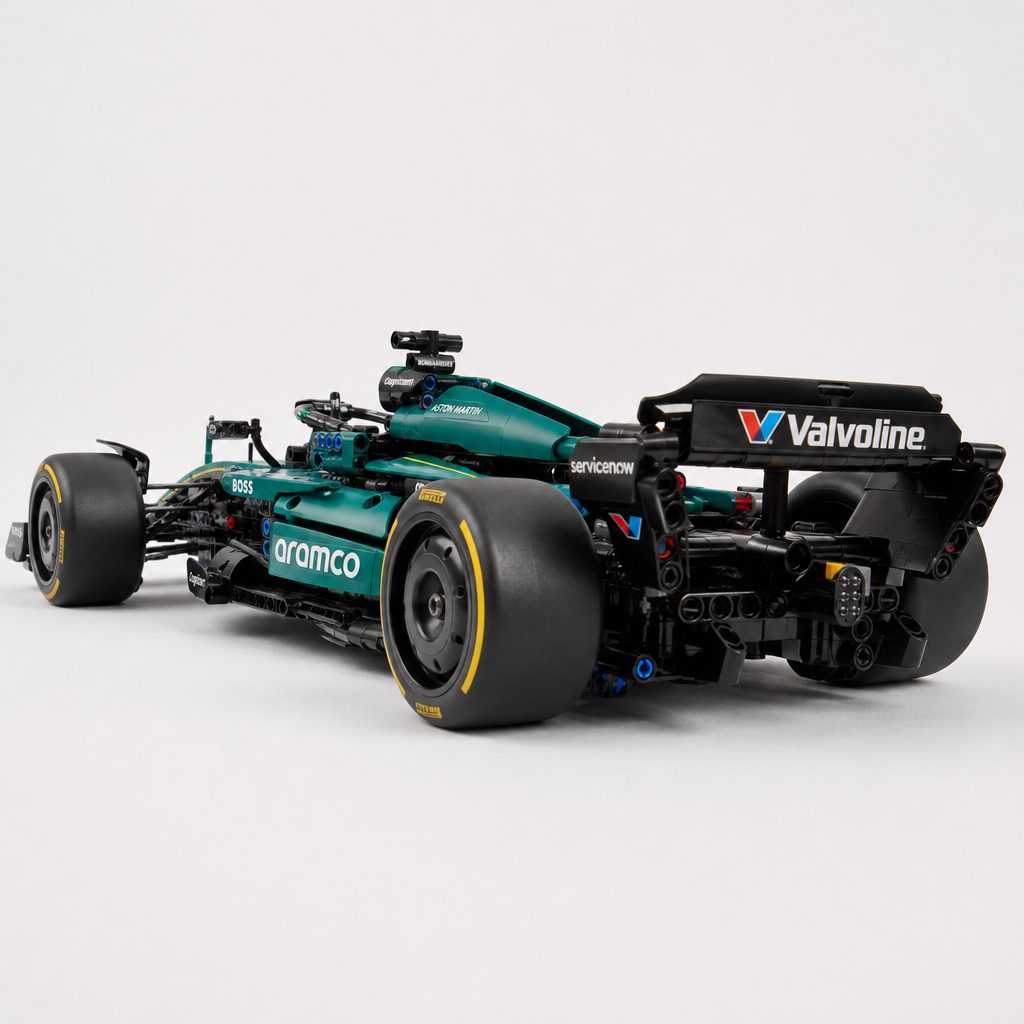
The large tyres create a dramatic silhouette, although the narrow rear-wheel treatment does not quite deliver the planted stance of the real AMR25.
Build experience: still properly Technic
If you buy LEGO Technic to understand how a machine fits together, rather than simply to own a recognisable object, the AMR25 has the right instincts. It does not skimp on engineering. Beneath the body panels is a functional core of steering, suspension, drivetrain and gearbox components that rewards careful assembly. There is always something satisfying about seeing a sparse chassis gradually become recognisable as a car. With an F1 model, that transformation is particularly dramatic because so much of the finished machine looks impossibly thin.
The build has a good sense of cause and effect. You are not merely attaching decorative plates to a rolling frame. As the drivetrain develops, the differential and V6 become part of one connected story. Add the suspension, then the steering, then the bodywork that wraps around it, and the car feels earned. This is the chief defence of the range repeating itself: F1 cars are mechanically fascinating, and there is value in building those fundamentals in a new livery.
Still, anyone who had already built the Mercedes, Ferrari, Red Bull or McLaren should know what they were signing up for. These are not five radically different engineering experiences. They share a common educational language: build the central structure, add the functional running gear, cover it in increasingly elaborate aerodynamics, apply a fleet of stickers and find somewhere enormous to put it. If that sounds comforting, excellent. If it sounds like déjà vu with sponsor logos, the AMR25 will not change your mind.
Functional steering
The steering mechanism gives the finished car a proper interactive point beyond simply admiring it on a shelf.
Push-rod suspension
Front and rear push-rod suspension reflects the technical character of a contemporary Formula 1 chassis.
Working differential
The drivetrain is not purely decorative, with a differential integrated into the rear mechanical layout.
V6 and simulated electric engine
The internal powertrain gives the build more to investigate once the bodywork is finally in place.
Mechanisms and DRS: the AMR25's best party trick
The two-speed gearbox is the key feature. It changes the RPM of the built V6 and, in high gear, raises the rear-wing spoiler to simulate DRS. This is not the most faithful representation of how Formula 1 DRS is operated in reality, of course. The real system is not activated by selecting high gear. But as a LEGO mechanism it is a neat bit of theatre, linking an action you can perform to a visible aerodynamic response.
That relationship matters. A working feature should tell you something, even in simplified form. Turn the car's systems by hand and you can see why the model is Technic rather than Creator Expert or Speed Champions. The engineering is not hidden away merely to justify an 18+ label. It gives the finished object a small amount of life.
It is also the AMR25's strongest argument against accusations that the whole range had become a bodywork swap. The core components may be familiar, but a gearbox-linked DRS mechanism is an entertaining thing to show somebody who has not watched the build. It turns an otherwise static rear wing into a talking point. The trick will last all of ten seconds with a non-LEGO person, admittedly. With another Technic fan, it can easily become a ten-minute discussion about gears, linkages and whether the wing should have been independently operated. This is our hobby. We accept this.
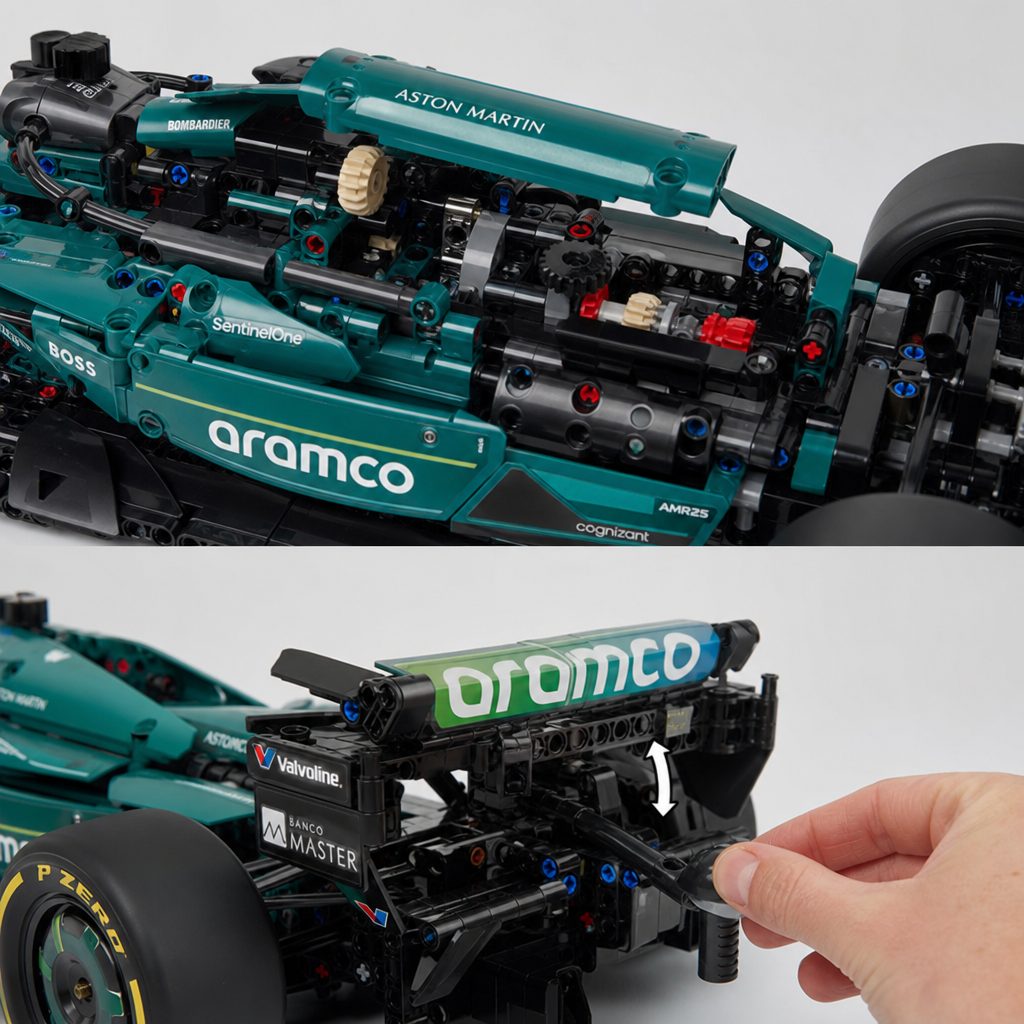
The two-speed gearbox and DRS-linked rear wing are the AMR25's mechanical highlights, giving the static display car a useful dose of interaction.
Daily ownership: shelf space, dust and sticker patience
"Daily use" sounds a little odd for a model F1 car, but ownership is where this set's compromises become most practical. The AMR25 measures 13cm high, 61cm long and 26cm wide. That is not something you pop on the end of a bookcase beside a photo frame. It needs a dedicated shelf, a sideboard, a desk with serious spare room or a display cabinet. Put it flat on a table and it dominates the surface immediately.
It is also a dust magnet. Technic cars have exposed gaps around the chassis, suspension and aerodynamic surfaces, and the AMR25 has plenty of intricate areas where dust can settle. A quick wipe deals with the broad bodywork, but dust lodged among gears and suspension arms is another matter. This is the sort of model that benefits from a regular soft brush and a home where it is not directly below an open window. If that sounds fussy, it is. Large LEGO display models are a little fussy by nature.
There is no battery, charging routine or app to worry about, which is a relief. Nothing becomes obsolete because a companion application disappeared or a proprietary battery stopped holding a charge. The AMR25 is refreshingly analogue. It will function exactly as it did in 2026 as long as the pieces remain intact and the rubber elements are looked after. For collectors, that straightforwardness is a real virtue.
The more immediate care point is the sticker sheet. Take your time. Build in strong light. Use the edges of the underlying elements as guides rather than trusting the apparent centre of a decal. The sponsor graphics make a huge difference to the final impression, especially because the underlying green does not fully carry the Aston Martin identity on its own. This is not a set to rush through after midnight because you "only wanted to finish the sidepods". That sentence has led many people astray.
LEGO Technic Aston Martin Aramco AMR25 F1 Car price and value
Search Amazon UK for LEGO Technic Aston Martin Aramco AMR25 F1 Car price and value
The AMR25 launched at £199.99 in the UK, $229.99 in the US and €229.99 in Europe. Canadian pricing was CA$299.99, while the Australian recommended price was AU$349.99. In a vacuum, 1,547 pieces for £199.99 is not a bargain-bin ratio. It works out to a premium display-model proposition, not a box of general-purpose parts bought purely for volume.
That said, price-per-piece is a blunt instrument for Technic. Large tyres, specialised transmission components, suspension parts, printed tyre details and big structural elements cost more to produce than a tub of tiny plates. The AMR25 also delivers an unusually large finished object. You are not paying for 1,547 anonymous pieces. You are paying for a 61cm licensed F1 replica with real mechanisms underneath its livery.
The harder value question is whether it offers enough improvement over the other big Technic F1 cars. The Ferrari SF-24 and Oracle Red Bull Racing RB20 both had $230 price tags despite containing 1,361 and 1,639 pieces respectively. The Mercedes-AMG F1 W14 E Performance arrived at $220 with 1,642 pieces. Meanwhile, 2022's McLaren Formula 1 Race Car had 1,432 pieces at $200. Against that backdrop, the AMR25's positioning is familiar rather than outrageous. But it is not an easy recommendation at full price for anyone who already owns one or two similar cars.
United Kingdom
Recommended retail price
United States
Recommended retail price
Europe
Recommended retail price
Canada / Australia
Regional recommended prices
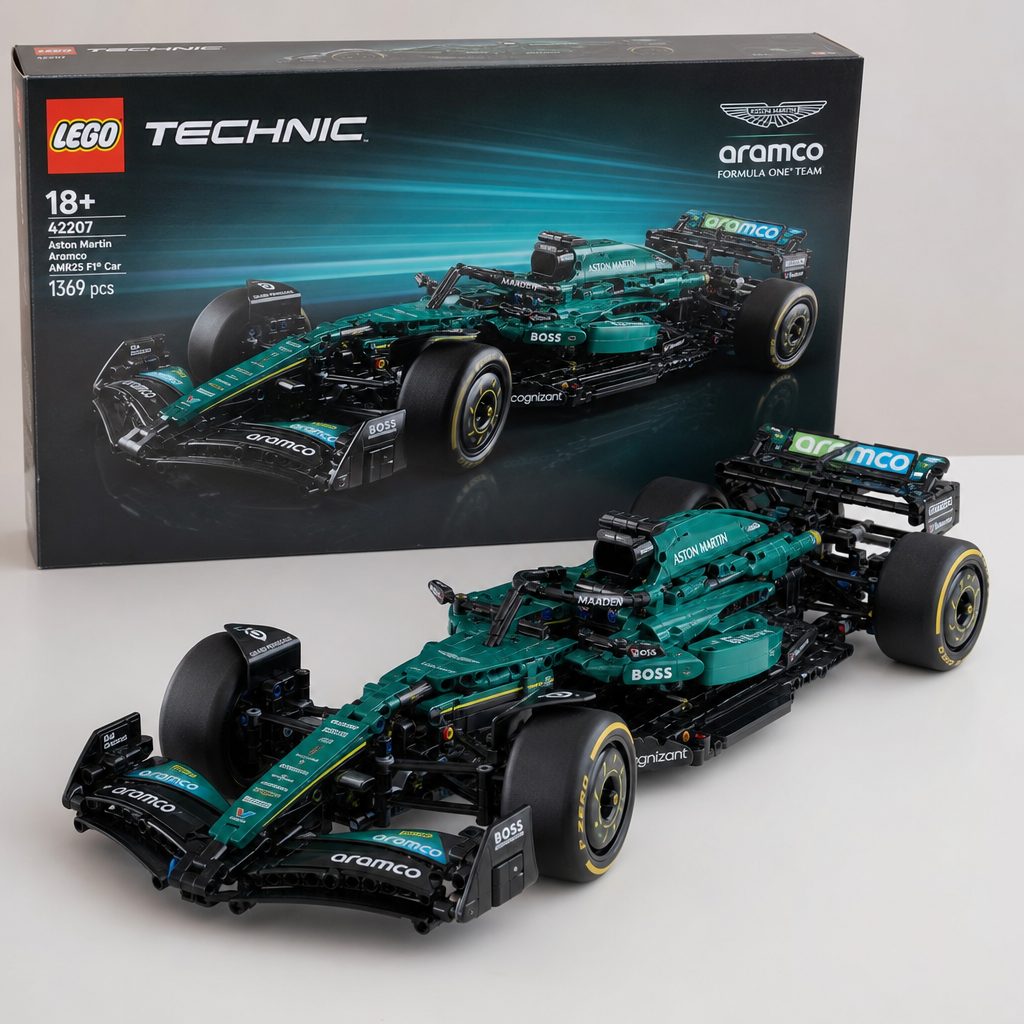
The AMR25 carries a premium display-model price, so the final decision comes down to whether you want this specific Aston Martin livery and its mechanical features.
How the AMR25 compared with the Technic F1 cars before it
The AMR25 sat in a crowded little niche of LEGO's own making. Its closest rivals were not traditional competitors from another brand, but the large Technic F1 cars already occupying shelves and display cabinets. That is the reason "a step backwards" became a reasonable question rather than empty provocation. The set had to compete with its own family history.
It was not the smallest, nor was it the most expensive in dollar terms. It actually contained more pieces than the Ferrari SF-24 and the older McLaren Formula 1 Race Car. Yet piece count does not settle the question of refinement. The Mercedes and Red Bull both used more pieces, while the Aston Martin's colour compromise and rear-wheel proportions were more visible than a difference of a few dozen parts.
| Feature | Aston Martin AMR25 (42240) | Mercedes-AMG F1 W14 (42171) | Ferrari SF-24 (42207) | Red Bull RB20 (42206) |
|---|---|---|---|---|
| Release year | 2026 | 2024 | 2025 | 2025 |
| Piece count | 1,547 | 1,642 | 1,361 | 1,639 |
| US recommended price | $229.99 | $220 | $230 | $230 |
| Scale | 1:8 | 1:8 Technic F1 range | 1:8 Technic F1 range | 1:8 Technic F1 range |
| Series position | Fifth modern large-scale F1 car | Second in the modern run | Third in the modern run | Fourth in the modern run |
The 2026 McLaren F1 Team MCL39, set 42228, had arrived earlier in March 2026, reinforcing the sense that LEGO was moving rapidly through the grid. For a first-time buyer, that breadth is good news: choose the team and colour scheme you love. For a collector, it makes individual flaws harder to overlook because there is always another 1:8 car nearby to compare against it.
Who should buy LEGO Technic Aston Martin Aramco AMR25 F1 Car?
This is not a universal recommendation, and that is fine. A specialised adult LEGO set should be allowed to be specialised. The trick is being honest about which kind of buyer will enjoy the AMR25 most, and who should either choose a different F1 car or wait until the price better reflects their enthusiasm.
Best for Aston Martin supporters
If Aston Martin is your team, the colour approximation is easier to forgive. The livery, mechanical detail and sheer size make it the natural LEGO centrepiece for that fandom.
Best for Technic mechanism fans
Buy it for the two-speed gearbox, V6, differential, push-rod suspension and DRS linkage. The engineering earns more enthusiasm than the colour match.
Best for first large F1 build
It works well if you do not already own another 1:8 Technic F1 car. The repeated series formula only becomes an issue once you have experienced it before.
Best avoided by value hunters
If your priority is the most accurate display replica or the most distinct build for the money, compare the other teams carefully before committing.

For dedicated Aston Martin fans, the AMR25 remains an imposing team-branded display piece despite the controversial regular-green bodywork.
Is this really a step backwards?
Mechanically, no. The AMR25 was not a lazy reduction in features. LEGO gave it functional steering, front and rear push-rod suspension, a differential, a two-speed gearbox, a V6 with simulated electric engine and DRS that opened in high gear. That is an ambitious checklist. It feels like a serious Technic set, and there is no sense that Aston Martin received a cheaper or watered-down version of the concept.
Aesthetically, though, the answer is less comfortable. The real car's signature colour was one of the reasons many people wanted an Aston Martin model in the first place. Using standard LEGO green was understandable from a parts-production perspective, but it resulted in a model that did not have the distinctively premium, deep-green visual identity fans expected. Combine that with the recurring narrow rear tyres and the AMR25 could look less settled than its price and scale demanded.
There is also a series problem. The first enormous Technic F1 car felt like an event. By the fifth, the basic recipe had become familiar enough that bodywork accuracy mattered more than ever. A new livery alone was no longer sufficient. In that light, the AMR25 was a competent continuation rather than a decisive step forward. It had a clever DRS mechanism, certainly, but it did not resolve the family's visual weaknesses. That is why the criticism stuck.
None of this makes it a bad set. It makes it a set for the right buyer. LEGO collectors can be oddly binary about these things: masterpiece or disaster, buy now or boycott forever. The truth is more ordinary. The AMR25 is an enjoyable, impressively engineered F1 build that happens to be less visually convincing than it should have been. There is room for both those thoughts in the same display cabinet.
ToyScout rating
The AMR25 scores well because its core construction and functionality are robust. The lower design score is not punishment for LEGO failing to reproduce every millimetre of an F1 car; that would be unreasonable. It reflects the fact that this particular subject depends so heavily on a signature shade of green, and the finished model does not quite capture it.

The finished AMR25 looks strongest as a dedicated display model, where its intricate engineering and long, low silhouette can take centre stage.
Frequently asked questions
LEGO Technic Aston Martin Aramco AMR25 F1 Car contains 1,547 pieces. It is an 18+ set and does not include minifigures, as the focus is entirely on the large-scale vehicle build.
The completed car measures 13cm high, 61cm long and 26cm wide. Before buying, measure the intended shelf or cabinet rather than assuming it will fit beside ordinary LEGO sets.
Yes. The rear spoiler raises to represent DRS when high gear is selected through the model's two-speed gearbox. It is one of the set's most enjoyable and distinctive functional features.
No. It is a static Technic display model with hand-operated mechanical functions including steering, suspension, a differential, gearbox and rear-wing DRS action.
The model used regular LEGO green rather than a close match for the mint-leaning Aston Martin Racing Green seen on the real car. Bright lime accents help the livery stand out, but they do not completely solve that mismatch for accuracy-minded fans.
That depends mainly on your favourite team and how much you value visual accuracy. The AMR25 has 1,547 pieces, versus 1,361 for the Ferrari SF-24 and 1,639 for the Red Bull RB20. Its functional engineering is strong, but its colour and tyre proportions make it less of an automatic display pick.
It is labelled 18+ and makes most sense for experienced teenage or adult builders who enjoy complex Technic mechanisms, careful sticker placement and display models. It is not designed as a robust toy for hard play.
The UK recommended retail price was £199.99. It launched on 1 July 2026 and was not an exclusive set, so it could be stocked by a range of retailers.
Final verdict: buy the engineering, not the paint match
The LEGO Technic Aston Martin Aramco AMR25 F1 Car was a clever, substantial and properly mechanical addition to LEGO's 1:8 F1 series. Its gearbox-linked DRS, functioning drivetrain, push-rod suspension and 61cm display presence gave it plenty to offer builders who wanted more than a decorative shell.
Yet it was also the point where the range's repetition and proportional compromises became difficult to ignore. The regular green bodywork missed the defining character of Aston Martin Racing Green, while the oversized-looking tyre treatment and narrow rear wheels kept the model from having the planted, polished stance it needed.
Buy it if Aston Martin is your team or if the mechanical build is the main attraction. If you simply want the most convincing-looking Technic F1 car for a premium display shelf, compare the other teams first. This was not a disaster. It was a good set that should have been great.