
LEGO Technic Aston Martin AMR25 vs McLaren F1 Set: Which Display Car Wins?
The LEGO Technic 42240 Aston Martin Aramco AMR25 F1 Car and LEGO Technic 42228 McLaren MCL39 F1 Car share the same enormous 1:8-scale ambition, but they make rather different cases for space on your shelf. One leans into mechanical completeness and a clever DRS-linked gearbox; the other brings championship-winning pedigree, a superbly translated livery and more pieces. Here is the properly nerdy head-to-head for builders who care about what their F1 car looks like after the last axle has clicked into place.

Two 1:8-scale Technic F1 cars, two very different identities: Aston Martin's regular LEGO green sits beside McLaren's instantly recognisable papaya-and-black scheme.
The short version: two serious Technic display cars
There was a time when a LEGO Formula 1 car was a fairly cheerful thing with a big wing, a few stickers and wheels that looked as though they had been borrowed from a go-kart. These two are not that. The Aston Martin AMR25 and McLaren MCL39 are full-fat 1:8-scale LEGO Technic display models, both 61cm long, both packed with drivetrain hardware, and both large enough to turn a perfectly normal bookcase into a pit lane.

At 61cm long, neither Technic car is a modest desktop ornament. Measure the shelf before building, not after discovering that the front wing now lives over the edge.
That shared scale matters. Neither car is intended to be flicked across the kitchen floor, raced into the skirting board or left to negotiate a toddler's construction site. They are build-and-display projects first, with working mechanisms there to reward curiosity rather than to make either car a toy in the traditional sense. You build slowly, admire the internal engineering, fiddle with the steering a little too often, then find a suitably dust-resistant place to park it.
The Aston Martin arrived on 1 July 2026, whilst the McLaren had been on shelves since 1 March 2026. That makes the AMR25 the newer release, but it does not automatically make it the better one. McLaren's MCL39 had a head start in translating the current-generation F1 shape into Technic form, and it carried the extra aura of the team's 2025 Constructors' and Drivers' Championship success. The Aston, meanwhile, had the advantage of being a later interpretation with a notably integrated DRS function.
The essential choice: pick the McLaren if colour fidelity, visual recognition and championship-story appeal are foremost. Pick the Aston Martin if you value a more function-led build and want a car whose DRS operation feels woven into the model rather than added at the end.
LEGO Technic Aston Martin AMR25 vs McLaren MCL39: the numbers
On paper, this is a remarkably even contest. Both models sit at 1:8 scale, measure 13cm tall and stretch to 61cm in length. In other words, there is no sensible "I bought the smaller one to save room" argument here. The McLaren is 1cm narrower at 25cm against the Aston Martin's 26cm, but that is not the sort of difference that rescues a crowded shelf.
The meaningful numerical distinction is the part count. The McLaren includes 1,675 pieces, a lead of 128 over the Aston Martin's 1,547. That does not prove the MCL39 is intrinsically the more satisfying build; a higher count can mean finer shaping, more structural detail or simply more small elements. It does, however, give the McLaren a modest edge for the builder who sees a flagship Technic set as an extended project and enjoys getting a little more build time for the same US list price.
| Specification | LEGO Technic 42240 Aston Martin AMR25 | LEGO Technic 42228 McLaren MCL39 |
|---|---|---|
| Release date | 1 July 2026 | 1 March 2026 |
| Scale | 1:8 | 1:8 |
| Piece count | 1,547 | 1,675 |
| Height | 13cm | 13cm |
| Length | 61cm | 61cm |
| Width | 26cm | 25cm |
| Suspension layout | Front and rear push-rod | Pull-rod front, push-rod rear |
| Drivetrain functions | V6 and simulated electric engine, differential, 2-speed gearbox | V6, differential, 2-speed gearbox |
| Rear-wing function | DRS linked to gearbox | DRS activator adjusts rear wing |
| US price | $229.99 | $229.99 |
It is also worth remembering where they sit in the wider Technic F1 family. The Ferrari SF-24 also spans 61cm, whilst the Red Bull RB20 stretches to 64cm. That makes the Aston Martin and McLaren substantial but not quite the maximum-length statement pieces in the theme. For an F1-loving collector, though, they have the more useful virtue of matching each other exactly in length. If you eventually decide that one is not enough, they will look intentional side by side rather than like two cars from unrelated scales.
Scale, stance and shelf presence
Because the headline dimensions are almost identical, shelf presence comes down to silhouette, colour blocking and how much visual drama each car creates at arm's length. The McLaren wins the instant-recognition contest. Papaya orange against black has an almost unfair advantage in a room full of mostly neutral furniture and dark Technic machinery. It catches the eye quickly, reads as McLaren from a doorway and still has enough contrast to make the aero surfaces legible once you are close up.
The Aston Martin makes a quieter first impression. That is not a criticism in itself. Its 26cm width gives it a slightly broader stated footprint, and the green bodywork makes a welcome change from the familiar red, white, blue and black of many display racing cars. On a shelf devoted to F1, it offers variation. On a shelf containing only one model, though, it does not command attention in the same immediate way as the McLaren. The MCL39 has more of that "what on earth is that?" pull when guests walk into the room.
There is a distinction here between being loud and being convincing. The McLaren's shape and livery work together to communicate speed even when it is completely stationary. The Aston Martin's dark, green-led approach has a more technical, restrained character. It asks you to inspect it. The McLaren announces itself. Neither approach is wrong; it simply depends on whether your display tastes run towards museum-piece subtlety or a proudly visible centrepiece.
Display tip
Allow more than the stated 61cm length when choosing a shelf. A display car looks far better with a little breathing room around its front wing and rear wing, particularly if you want to view the bodywork from an angle rather than straight on.
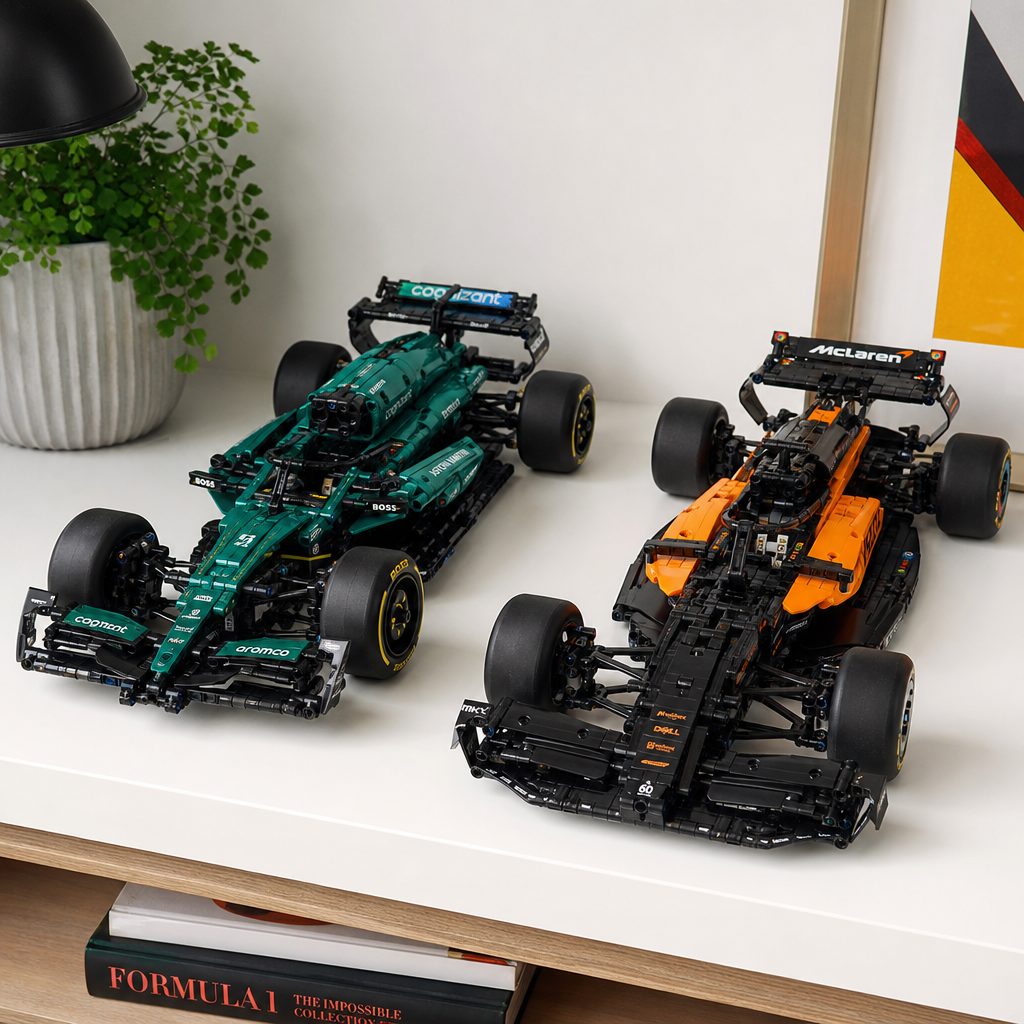
The MCL39's papaya-and-black bodywork gives the model strong visual contrast, helping the Technic panels and aero surfaces remain readable from across a room.
Colour accuracy: McLaren takes the cleaner victory
Colour is where this comparison stops being close. LEGO has done a strong job translating the McLaren's papaya-and-black identity into brick form. That livery is already graphic, high contrast and well suited to the language of Technic panels, pins and beams. The result is a model that looks confident without needing you to explain what it is looking at. For many F1 fans, that matters more than it sounds. A display model is partly a conversation piece, and the McLaren gives people a very easy visual route into the conversation.
The Aston Martin is hampered by a problem that is not really of its own making: the regular LEGO green used for the model differs noticeably from the mint-toned Aston Martin Racing Green associated with the real AMR25. LEGO's colour palette does not contain a direct match for that distinctive shade, so the set had to make a compromise. It is still recognisably an Aston Martin in broad terms, and plenty of collectors will welcome a green F1 car after several years of more familiar colours. But it is not the close colour match some buyers may have hoped for.
This is especially important if you are the sort of builder who studies reference photographs, enjoys knowing which sponsor stripe belongs where and wants a model to echo the original car as closely as the medium permits. In that situation, the McLaren is plainly safer. Its livery feels more natural in LEGO form. The Aston Martin is better viewed as an appealing Technic interpretation of the AMR25 rather than a colour-perfect miniature.
There is a small counterpoint. The Aston's green has a useful identity of its own in a larger collection. If your shelf already contains a red Ferrari, a blue-and-red Red Bull or a silver Mercedes, the green can make the line-up feel more varied. It may be less exact, but it is not invisible. That said, "it looks different from the other cars" is not quite the same as "it looks like the real car", and the McLaren deserves the point for fidelity.
Building experience and engineering interest
Both sets earn their Technic branding honestly. You are not merely assembling a shell around a rolling chassis. Each model has functional steering, a working differential, a two-speed gearbox, suspension and a V6 engine representation. That is the basic deal at this level: enough internal machinery to give the model a reason to exist beyond being a very large static ornament.
The Aston Martin's headline trick is the relationship between its DRS and gearbox. Rather than treating the rear-wing flap as a separate thing you lift by hand and then forget about, the AMR25 links the function to the two-speed gearbox. It is the sort of feature that gives a Technic build a proper moment of satisfaction. You can show it to someone who knows little about F1 and they will still understand that there is a mechanical idea at work. For an adult builder who wants the finished model to retain some post-build play value, this is the Aston's most persuasive advantage.
McLaren's DRS activator also adjusts the rear wing, so it is not short of functionality. The difference is one of integration and theatre. The MCL39's party piece is clear and relevant to the car, whilst the Aston makes the gearbox and DRS feel like parts of one broader system. That may sound like a very small distinction. It is, until you are the person who has spent an evening routing gears and wants a payoff more memorable than "yes, this little flap moves".
The MCL39 counters with its suspension layout. It uses pull-rod suspension at the front and push-rod suspension at the rear, echoing the asymmetric engineering arrangement of the real-world car. The Aston Martin has front and rear push-rod suspension instead. Neither choice makes one model dramatically more fun to push down a shelf, and neither changes the fact that these cars are chiefly for display. But for the builder interested in F1 technical detail, the McLaren's differing front and rear arrangements make it especially interesting to inspect during the build.
Aston Martin: linked DRS system
The AMR25's DRS is connected to its two-speed gearbox, creating a more integrated mechanism and a satisfying demonstration feature after the final build stage.
McLaren: asymmetric suspension
The MCL39 uses pull-rod front suspension and push-rod rear suspension, giving technically minded builders a more distinctive chassis arrangement to explore.
Both: proper drivetrain detail
Steering, a differential, a V6 engine and a two-speed gearbox mean neither model feels like a simplified shell on wheels.
Both: display-first proportions
At 61cm long, these are large-scale construction projects designed for an adult shelf, desk or dedicated LEGO display rather than casual floor play.

The Aston Martin's functional drivetrain and rear-wing system are the heart of its appeal: this is a model for builders who enjoy seeing the mechanical story behind the bodywork.
Suspension, steering and the satisfying bits you will actually use
Let us be candid: most owners will not spend their evenings cycling either two-speed gearbox like a miniature race engineer. You will probably do it when the build is complete, show a mate, perhaps revisit it six months later during a dusting session, and then put the car back exactly where it was. That is fine. The value of these functions is not only in how often they are operated. It is in the build journey and in the sense that the final car has a mechanical backbone.
The Aston Martin's consistent push-rod approach at both ends gives it a straightforward, coherent engineering story. Its steering, differential, V6 and simulated electric engine, suspension, gearbox and DRS make it functionally complete for the category. There is nothing obviously missing from the expected flagship Technic F1 checklist. If what you want is a model that feels packed with mechanisms from nose to diffuser, it delivers.
McLaren's pull-rod front and push-rod rear arrangement is arguably the more interesting detail for a fan who knows why those words matter. It gives the MCL39 a slightly more specific relationship with the architecture of its source car. Functional suspension travel reinforces that impression. There is a pleasing sense that the model's under-skin choices were not just chosen because a generic Technic F1 layout was available; there is some effort to reflect the McLaren's particular solution.
Neither car entirely escapes the limitations of Technic F1 tyre representation. The rear tyres remain less accurate than enthusiasts may want, and that is a shared shortcoming rather than an Aston Martin or McLaren-specific blunder. It is worth mentioning because tyres are visually dominant on an F1 car. From a few steps back, the overall proportions and bodywork win the battle. Up close, committed scale modellers may still notice that compromise.
Aston Martin AMR25 strengths
- Its DRS connection to the two-speed gearbox gives the model a particularly rewarding functional hook.
- Front and rear push-rod suspension, steering, differential and engine detail make it mechanically complete.
- The green colour scheme adds welcome variety to an F1-focused Technic collection.
- The 26cm width gives it a broad, planted display footprint.
Aston Martin AMR25 caveats
- Regular LEGO green differs noticeably from the AMR25's distinctive Aston Martin Racing Green.
- At 1,547 pieces, it contains 128 fewer pieces than the McLaren for the same US price.
- The rear tyre accuracy is still a compromise at this scale.
- Its more restrained colour treatment has less instant room-filling drama than papaya McLaren.
LEGO Technic 42228 McLaren MCL39 F1 Car: why its display appeal is so strong
Shop LEGO Technic 42228 McLaren MCL39 F1 Car on Amazon UK
The McLaren is the easier recommendation for somebody who says, "I want one enormous LEGO F1 car and I want it to look brilliant." That is not because the Aston is poor. It is because the MCL39 gets several high-visibility things right at once: the papaya-and-black colour scheme translates convincingly, the shaping benefits from the more advanced techniques that have helped McLaren and Red Bull stand out in this line, and the car carries the genuine narrative glow of McLaren's 2025 championship-winning season.
That championship context is not a mechanical feature, of course. It does not make the suspension travel farther or the gearbox more complicated. Yet collectable display models are not bought in a vacuum. The MCL39 represents a car from a season that ended with McLaren winning both championships, and that changes how it feels on a shelf. It is a tangible reminder of a genuinely successful campaign rather than simply a handsome replica of a current racer.
The 1,675-piece count helps too. Again, it is not a universal measure of quality, but it creates the impression of a dense, substantial flagship and gives builders more to do. At the identical $229.99 US price, the arithmetic comes out in McLaren's favour: roughly 14.4 cents per piece against the Aston Martin's 14.9 cents. That is not enough to make the Aston unreasonable, but it is enough that value-conscious collectors should notice.
There is another, more practical reason to choose McLaren. Its livery is forgiving under normal household lighting. The orange and black separate panels, wing elements and overall form very clearly. A dark green car can look wonderfully sophisticated, but it sometimes asks a little more of the display location. If the shelf is shaded or sits away from a window, the McLaren's contrast works harder for you.
LEGO Technic 42240 Aston Martin Aramco AMR25 F1 Car: the case for the newer car
Shop LEGO Technic 42240 Aston Martin Aramco AMR25 F1 Car on Amazon UK
The Aston Martin should not be dismissed as the choice for people who simply prefer green. It has a more unusual personality than that. Being the fifth model in the LEGO Technic F1 series, it arrived after LEGO had already worked through the Mercedes W14, Red Bull RB20, Ferrari SF-24 and McLaren MCL39. It benefits from that accumulated experience in the theme, and its full feature list suggests a set designed to make sure no serious Technic fan feels short-changed.
Its core strength is the relationship between visible display value and internal engineering. You still receive the 61cm, 1:8-scale silhouette expected from a flagship model, but the DRS-to-gearbox connection provides a more memorable reason to get hands-on with it after it has been displayed. For some builders, that matters much more than the relative precision of the body colour. They want the act of building to be about mechanisms, not just chasing a closer match to a reference photograph.
The AMR25 is also the better fit for a collector who already owns the brighter cars in the series. A shelf containing red, silver, dark blue and papaya models gains a different visual note from Aston Martin green. Even if it is not the exact minty racing shade of the real machine, it stops the collection becoming a parade of broadly similar warm-coloured race cars. That has value, particularly if your display is intended to show the breadth of F1 rather than just your favourite team.
Still, the Aston needs a more sympathetic buyer. You need to be comfortable with the colour interpretation, and you need to find the gearbox-linked DRS more compelling than the McLaren's sharper visual finish and extra 128 pieces. If that sounds like you, the newer AMR25 is not a compromise purchase at all. It is the more mechanically minded pick.
Price, piece value and buying with clear eyes
In the United States, both models carried a $229.99 price. That puts them in a very direct value contest. The McLaren's 1,675 pieces work out at approximately 14.4 cents per piece, whilst the Aston Martin's 1,547 pieces come to 14.9 cents per piece. Price per piece is never the whole story with Technic. Large panels, specialised tyres, gearbox components and carefully chosen shapes do not all cost or contribute equally. Still, where two similarly sized F1 cars share a price, the extra 128 McLaren pieces are a real advantage.
For UK buyers, the Aston Martin was priced at £199.99. That is firmly premium territory, as it should be for a 61cm licensed Technic build with a complex feature set. The sensible question is not whether £199.99 is a small amount of money; it plainly is not. The question is whether you want a long-form building project, a large display object and a functional F1 model in one box. If the answer is yes, it offers a clearer justification than a smaller, purely decorative model would.
LEGO Technic 42240 Aston Martin AMR25
UK price; 1,547 pieces; 61cm long.
LEGO Technic 42240 Aston Martin AMR25
US price; approximately 14.9 cents per piece.
LEGO Technic 42228 McLaren MCL39
US price; approximately 14.4 cents per piece.
Neither set is a budget choice, so I would resist buying purely on a vague fear of missing out. Both were in current retail circulation as of 28 July 2026. Take a moment to decide what you want the finished car to do for your room. If it needs to be an unmistakable centrepiece, the McLaren's visual confidence helps justify its place. If it needs to reward a Technic enthusiast every time they explain how the rear wing works, Aston Martin has a compelling answer.
Head-to-head scorecard: display versus engineering
Scores can make a comparison look more scientific than it really is, so treat these as a concise guide to the priorities explored above rather than laboratory results. Both cars are very capable flagship Technic F1 models. The separation is narrow because the underlying package is close: same scale, same length, same basic drivetrain checklist and the same desire to occupy an entire shelf with intent.
The result is not a blowout. McLaren wins the conventional "best display car" argument because it is easier to recognise, better matched in colour and slightly stronger on piece value at the shared US price. Aston Martin wins the niche that may matter most to a lifelong Technic fan: it has the more memorable mechanism, and it gives a display collection a welcome injection of green.
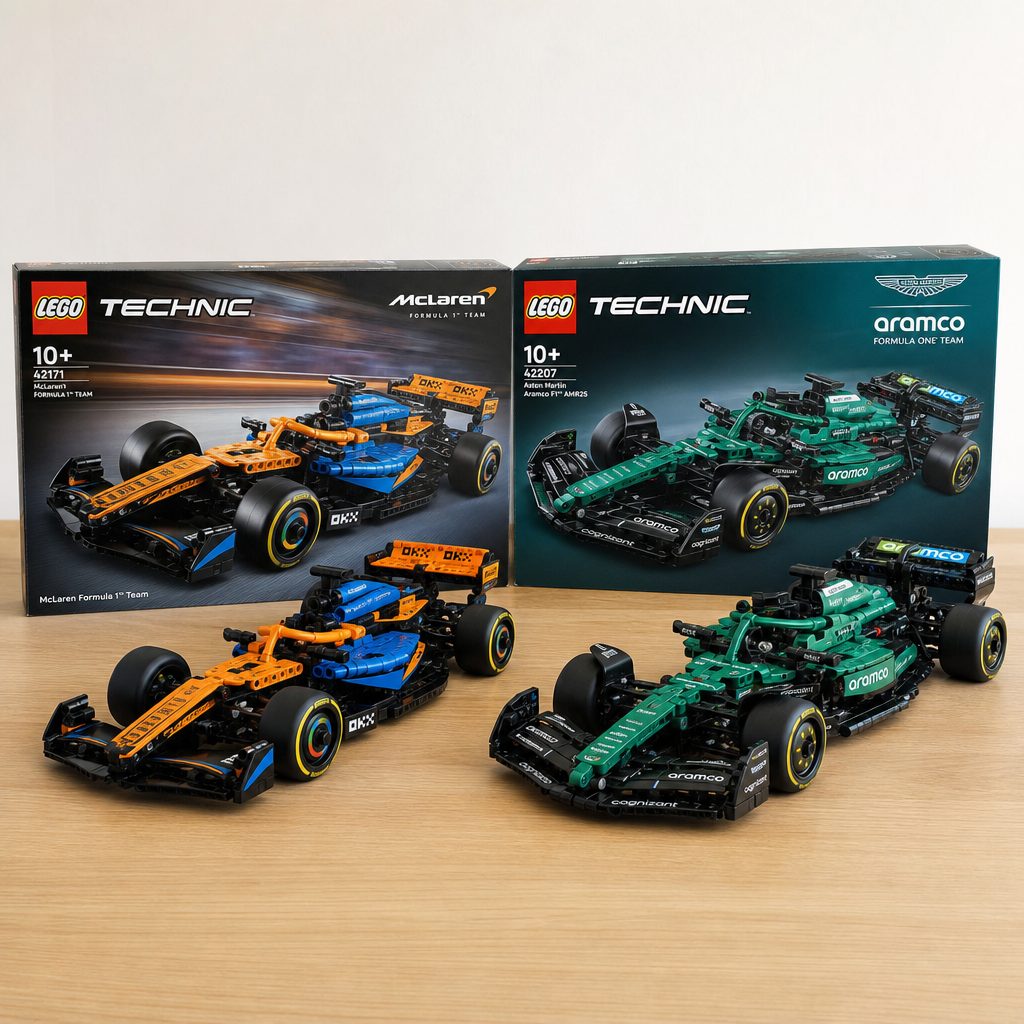
A side-by-side display makes the decision clearer: McLaren delivers the louder colour statement, whilst Aston Martin brings the more unusual green presence and a particularly satisfying integrated DRS mechanism.
Best for different F1-loving builders
There is no need to force a single overall champion if your own priorities point somewhere else. These are not two versions of the same set with different badges. Their similarities are substantial, but their appeals are distinct enough that the right answer changes with the buyer. That is rather refreshing, really. It would be a dull hobby if every question ended with "buy the one with 128 more pieces".
Best for display-first collectors: LEGO Technic 42228 McLaren MCL39 F1 Car
The papaya-and-black livery, polished shaping and 2025 championship heritage make the McLaren the stronger all-round shelf statement.
Best for Technic mechanics: LEGO Technic 42240 Aston Martin Aramco AMR25 F1 Car
Choose the Aston Martin for the DRS linked to its two-speed gearbox and its satisfyingly complete suite of working functions.
Best for colour accuracy: LEGO Technic 42228 McLaren MCL39 F1 Car
McLaren's papaya-and-black scheme translates more convincingly to LEGO elements than the Aston's regular-green interpretation.
Best for a varied F1 collection: LEGO Technic 42240 Aston Martin Aramco AMR25 F1 Car
The green bodywork brings a genuinely different visual flavour beside Ferrari, Mercedes, Red Bull or McLaren Technic cars.
Best US piece value: LEGO Technic 42228 McLaren MCL39 F1 Car
At $229.99, the McLaren's 1,675 pieces equate to around 14.4 cents per piece, ahead of the Aston's 14.9 cents.
Best one-car purchase: LEGO Technic 42228 McLaren MCL39 F1 Car
If you only intend to own one giant Technic F1 car, McLaren is the safer choice thanks to its immediate visual appeal and championship story.
Who should skip each set?
Skip both if you are mainly looking for an F1 toy that can cope with rough everyday play. Their scale, complexity and 61cm length make them awkward candidates for that job. They are for patient builders, older children with a real interest in Technic mechanisms, adult fans and collectors who are prepared to give the finished vehicle a proper home. A front wing this large deserves better than a trip under the sofa.
Skip the Aston Martin if a close colour match is non-negotiable. The regular LEGO green is the most obvious limitation of the model, and it is not something a few extra minutes spent rearranging stickers will change. Also skip it if your main objective is maximum visual drama per pound or dollar. The McLaren makes that job easier.
Skip the McLaren only if papaya does nothing for you, you already have a similarly coloured car in your collection, or the DRS-linked gearbox idea on the Aston genuinely lights up the part of your brain that loves Technic. The McLaren is a very rounded package, but it cannot replicate the AMR25's specific mechanical party trick. Some builders would rather explain a clever mechanism than own the more photogenic car, and that is a perfectly respectable position.

Both finished models reward a dedicated shelf rather than a crowded desk. Their shared 61cm length makes them easy to align in a wider LEGO Technic F1 display.
Frequently asked questions
Yes. Both are 1:8-scale LEGO Technic F1 cars. They also share the same 61cm length and 13cm height, so they look well matched if displayed together.
Neither is longer or taller: each measures 61cm long and 13cm high. The Aston Martin is 26cm wide, making it 1cm wider than the 25cm McLaren.
The LEGO Technic McLaren MCL39 has 1,675 pieces. The Aston Martin AMR25 has 1,547 pieces, so the McLaren has 128 more pieces.
Both do. The McLaren has a DRS activator that adjusts the rear wing. The Aston Martin goes further by linking its DRS function to the two-speed gearbox, making that mechanism a major part of its appeal.
The McLaren stands out because it uses pull-rod suspension at the front and push-rod suspension at the rear. The Aston Martin uses push-rod suspension at both front and rear. For fans fascinated by differing F1 suspension solutions, the McLaren offers the more distinctive layout.
For most people, the McLaren has the stronger immediate shelf presence. Its papaya-and-black livery is high contrast and translates convincingly into LEGO. The Aston Martin has a more restrained, unusual green look that may suit a larger collection better.
It is recognisably Aston Martin-inspired, but regular LEGO green differs noticeably from the mint-toned Aston Martin Racing Green of the original AMR25. Buyers seeking the closest colour translation should favour the McLaren.
Both were priced at $229.99, but the McLaren's 1,675 pieces work out at approximately 14.4 cents per piece, compared with about 14.9 cents per piece for the 1,547-piece Aston Martin. That gives McLaren a modest numerical value edge.
Final verdict: choose the car that matches your kind of fandom
The LEGO Technic 42228 McLaren MCL39 F1 Car is the better buy for most display-focused collectors. It has the stronger colour translation, 128 more pieces, excellent shelf visibility and the lasting appeal of representing McLaren's 2025 championship-winning car. If you want one enormous Technic F1 model that looks fantastic before anyone has even asked about the gearbox, buy the McLaren.
The LEGO Technic 42240 Aston Martin Aramco AMR25 F1 Car is the better buy for function-first Technic fans and collectors craving variety. Its gearbox-linked DRS is the more memorable engineering feature, its full suite of working mechanisms is properly satisfying, and its green bodywork stops an F1 display becoming visually predictable. Just go in with eyes open about the colour compromise.
So the display crown goes to McLaren, whilst the mechanical-interest crown goes to Aston Martin. Happily, whichever one you choose, you will end up with 61cm of Formula 1 on the shelf and a very good excuse to explain push-rods to anyone who makes the mistake of asking.
Search Amazon UK for LEGO Technic Aston Martin AMR25 vs McLaren F1 Set