
LEGO Technic Koenigsegg Sadair's Spear Megacar: The Ghost Mode Reveal Tested
LEGO's biggest Ultimate Car Concept set yet arrived with a 9-speed gearbox, Triplex suspension and a one-touch "Ghost Mode" transformation. It is a serious 4,104-piece commitment, but this is not merely another very large car with a badge on the bonnet.

LEGO Technic 42232 is the sixth Ultimate Car Concept model, and its dramatic bodywork is only half the story: the hidden mechanical systems are the real event.
LEGO Technic 42232 Koenigsegg Sadair's Spear at a glance
There are LEGO Technic cars you build because they look handsome on a shelf, and there are LEGO Technic cars you build because you want to see what on earth is going on underneath. The LEGO Technic Koenigsegg Sadair's Spear Megacar, set 42232, firmly belongs in the second camp.

The Koenigsegg joined a line that began with the 2016 Porsche 911 GT3 RS, but its 4,104 elements and 9-speed gearbox make it the series' biggest technical statement so far.
Released to LEGO Insiders on 1 July 2026 and generally released on 4 July 2026, it became the sixth entry in the Ultimate Car Concept series. That puts it in very particular company: the Porsche 911 GT3 RS, Bugatti Chiron, Lamborghini Sián FKP 37 and Ferrari Daytona SP3 had already established the formula. Big scale. Big box. Big ambition. And, usually, at least one moment where you stare at the instruction manual and wonder whether LEGO's designers have quietly become engineers.
The Koenigsegg takes that familiar 1:8-scale approach and gives it a more interactive centre. Its headline feature is Ghost Mode: a single movement raises the rear clamshell, opens the distinctive dihedral synchro-helix doors and front hood, and folds the mirrors. It is dramatic, slightly ridiculous, and exactly the sort of feature that makes even a display-focused Technic model difficult to leave alone.
This is a non-motorised display model. There is no battery to charge, no app-controlled driving mode and no need to keep another cable in the drawer. Its "performance" is mechanical: steering, suspension, opening panels, a V8 piston engine and a working gearbox.
Why this Ultimate Car Concept model matters
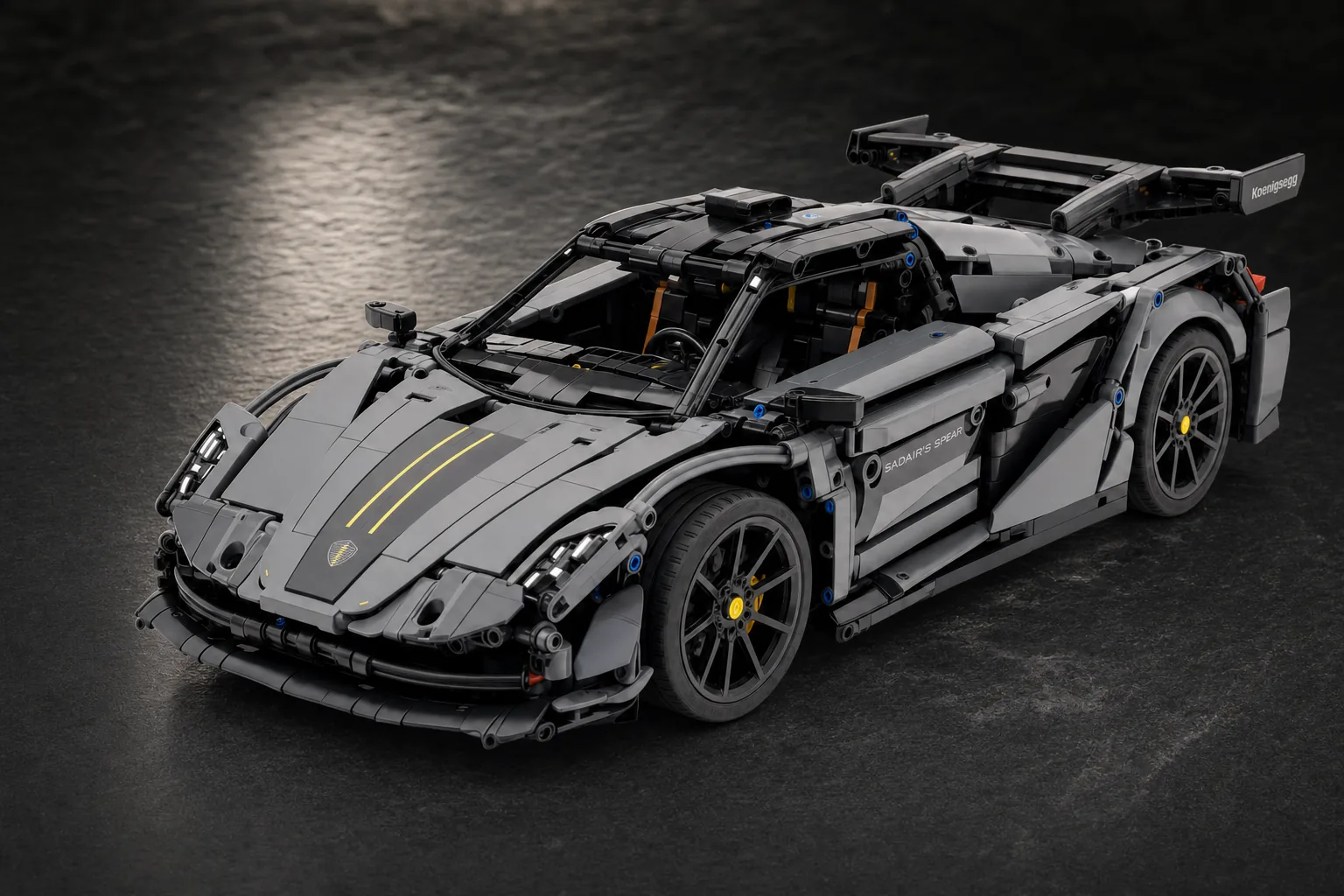
Calling something the largest model in a series can sound like marketing fluff, especially when the series in question has always favoured substantial boxes and occasionally alarming instruction-book thickness. Here, though, the growth tells a useful story. The 2016 Porsche 911 GT3 RS contained 2,704 pieces. The Bugatti Chiron rose to 3,599 in 2018. The 2020 Lamborghini Sián used 3,696, and the 2022 Ferrari Daytona SP3 reached 3,778.
At 4,104 pieces, the Koenigsegg did not just nudge past the Ferrari. It pushed the Ultimate Car Concept series into its most mechanically involved territory to date. The quantity is meaningful because it supports proper complexity rather than simply extra cosmetic filling. You are building a chassis around a 9-speed transmission, new suspension hardware and a body-opening mechanism that coordinates several moving panels.
That is the key distinction. Previous models had working gearboxes, but they could feel like a commendably complicated thing hidden inside a commendably pretty car. The Sadair's Spear gives you reasons to use its systems after the build. The paddle shifters are right there. The gear display is visible behind the driver's seat. Ghost Mode is not subtle. Nor should it be.
It still follows the long-standing Technic supercar pattern, mind. This is a project for someone who enjoys an extended build and then wants an imposing object to display. It is not a robust toy car intended for hard charging across the living-room carpet. Your skirting boards will survive. The model's dignity may not.

At 59cm long, the finished model needs a proper shelf or cabinet rather than a hopeful corner of a desk.
Design, scale and shelf presence

The finished Koenigsegg measures 59cm long, 28cm wide and 15cm tall. Those numbers are worth taking seriously before buying, because a 59cm model has moved beyond "nice thing beside the monitor" territory. It needs a meaningful stretch of shelf, a cabinet with enough depth, or a display surface where it is not constantly at risk from swinging coats, curious cats and people who say, "Can I have a go?"
Visually, this is a bold piece. The low roofline, wide stance and heavily sculpted rear all help it read as an exotic megacar rather than an oversized generic Technic coupe. LEGO's Ultimate Car models have always had to balance smooth bodywork against the practical reality of beams, pins and connectors. The Sadair's Spear does not make that tension vanish, but it uses its angular, technical subject well. The body feels engineered rather than merely decorated.
The removable roof also matters more than it first appears. It gives you a clearer view into the cabin and lets the interior feel like part of the model rather than a detail sealed away under panels forever. Combined with the opening doors, it makes the car more inviting to inspect. This is not just a set to admire from two metres away; it rewards a closer look.
I also like that the folding mirrors have been included as part of the overall transformation rather than treated as small separate details. They are the sort of thing that could easily have been omitted in a model this mechanically busy. Instead, they help Ghost Mode feel like a deliberate whole-car routine. It is the LEGO equivalent of a concept car revealing itself under a spotlight. A touch theatrical? Absolutely. But that is rather the point.
Display tip
Allow extra space around the model rather than measuring only its 59cm length. Ghost Mode opens the rear clam, doors and bonnet, so a cramped shelf robs one of the set's best visual moments. A display position where you can access the driver's side is especially useful for checking the gear indicator.
The Ghost Mode mechanism is the star
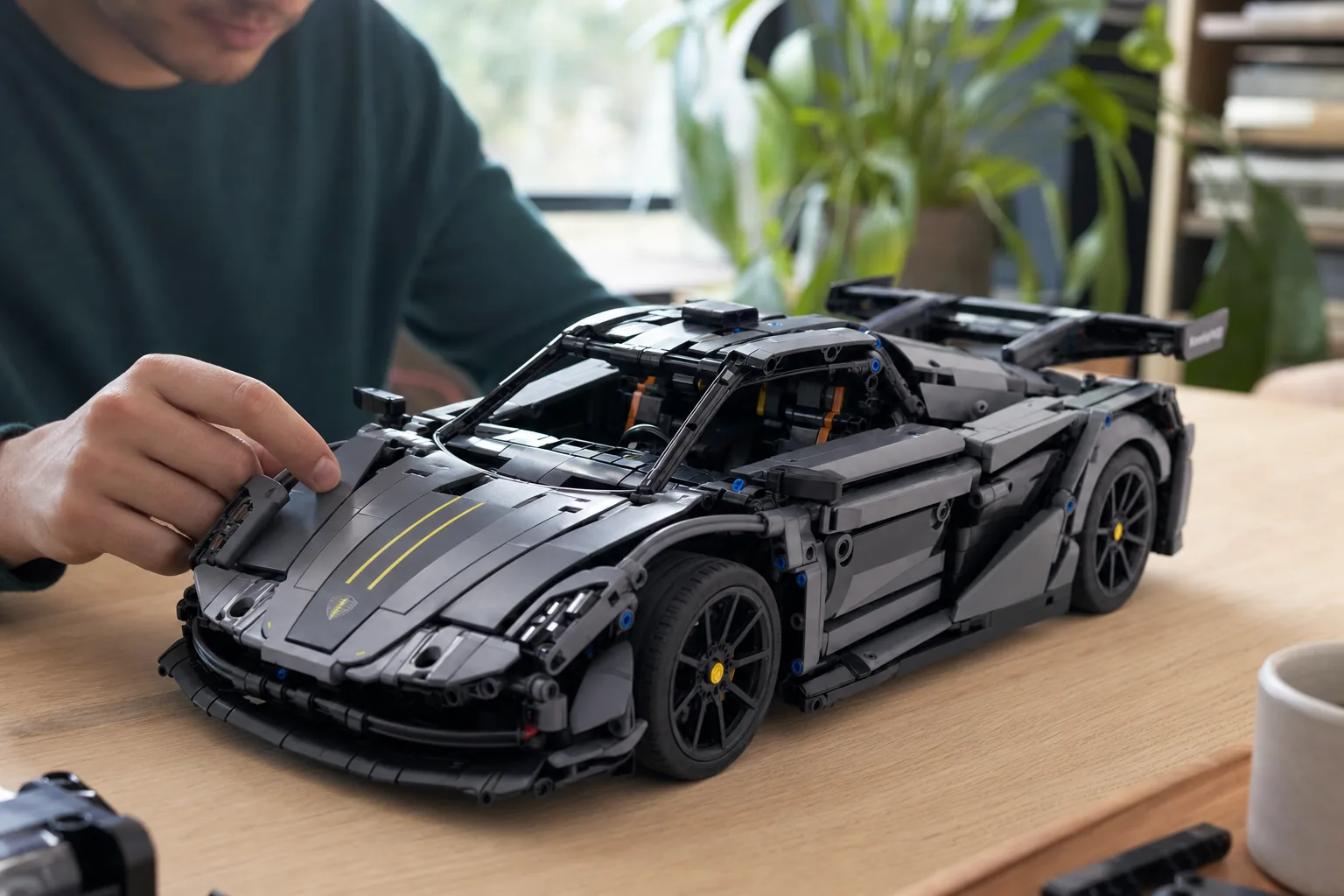
LEGO could have announced this set with a 9-speed gearbox alone and plenty of Technic fans would have paid attention. Instead, it gave the Sadair's Spear the sort of mechanical party trick that makes visitors stop mid-sentence. Ghost Mode links the rear clamshell, the doors, front hood and mirrors through one coordinated action.
Raise the rear clam and the internal linkage gets to work. The signature dihedral synchro-helix doors rotate open, the front hood opens and the mirrors fold. It is a wonderfully satisfying sequence because the model does not feel like a collection of unrelated panels. It feels connected. The action communicates the idea behind the real car's opening routine without needing motors, electronics or a separate display stand full of switches.
That last bit is important. There is an elegance to a purely mechanical model doing something this elaborate. You can see the result, understand that it is driven by linkages and gears inside, and then admire the fact that it all fits around suspension and transmission components. For a Technic enthusiast, that is the good stuff.
There is one significant caveat: Ghost Mode is not a one-touch closing feature. The doors, bonnet and mirrors need to be lowered and closed manually afterwards. That does not spoil the reveal, but it changes the wording I would use to describe it. This is a coordinated opening system rather than a fully automated transformation. If you expected to pull one lever and watch the entire car close itself with the same flourish, you will not get that.
In practice, I found that limitation easier to forgive than it sounds. Closing each element gives you another excuse to interact with the model, and the opening sequence is still the spectacular half of the equation. But it is worth knowing before purchase. LEGO has made something clever, not magic. Even a megacar made of bricks must occasionally be put away by hand.
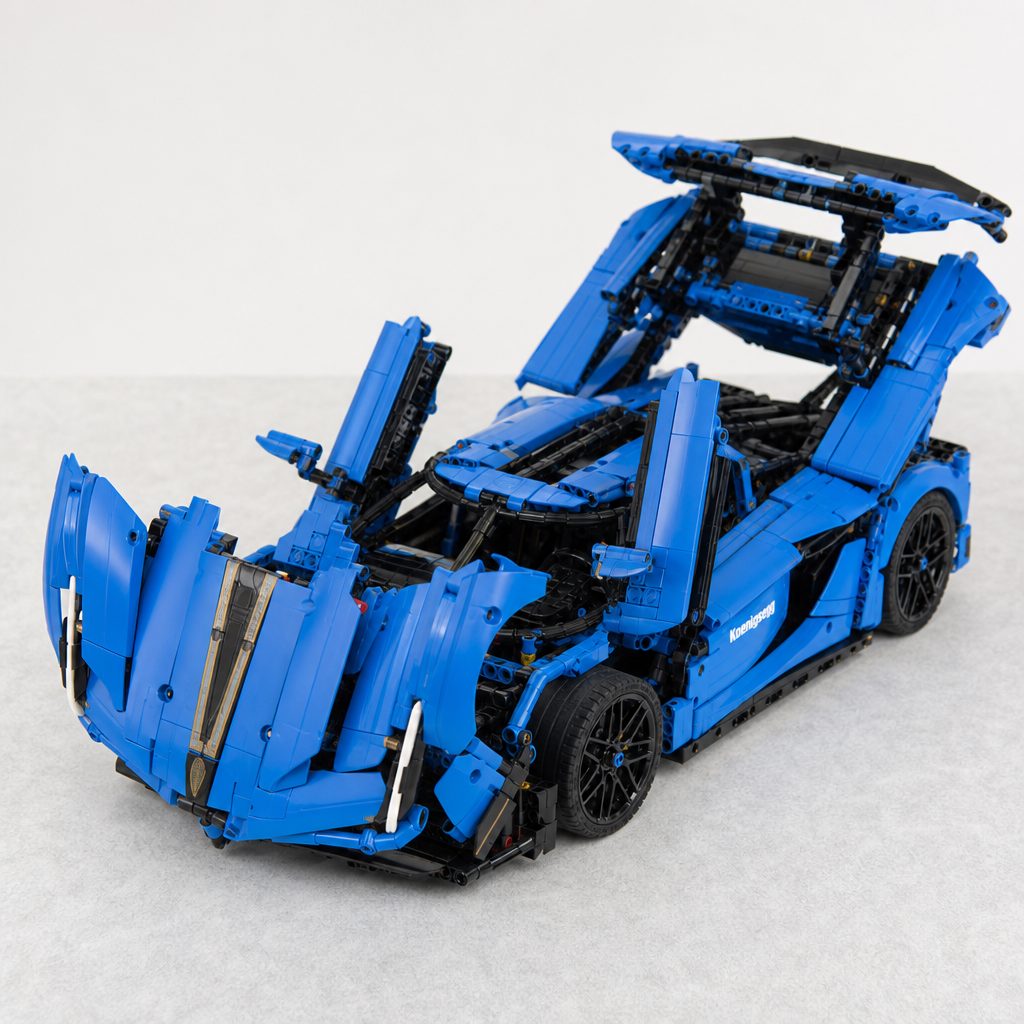
Ghost Mode links the rear clam, doors, mirrors and front hood in one theatrical opening sequence, but the individual panels are manually closed afterwards.
Coordinated opening routine
One movement raises the rear clam and triggers the Sadair's Spear's standout display feature: the multi-panel Ghost Mode reveal.
Synchro-helix doors
The distinctive doors are part of the linked mechanism, giving the model a properly dramatic silhouette when opened.
Rear clamshell access
The raised rear exposes the sense of packed-in mechanical complexity that makes this a Technic model rather than a static sculpture.
Folding mirrors
A small but welcome detail: the mirrors fold as part of Ghost Mode rather than being an afterthought you operate separately.
The 9-speed gearbox finally makes shifting readable
The other headline act is the 9-speed sequential gearbox. It is operated by paddle shifters behind the steering wheel and connected to a rotating gear indicator disc positioned behind the driver's seat. This last detail may sound modest, but it addresses one of the peculiar frustrations of large LEGO Technic cars: you could build a complex transmission, operate the paddles, and still have little idea which gear you were actually in.
Here, you can see it. Open the driver's door and the indicator makes the current gear legible. It turns the gearbox from a hidden technical achievement into something you can demonstrate. That may sound like a small distinction, but it changes how the model feels after completion. Rather than saying, "There is a gearbox in there somewhere," you can actually shift it, observe the outcome and explain what is happening.
The ninth ratio is also a series first. The Lamborghini Sián and Bugatti Chiron each used 8-speed gearboxes with movable paddle shifters. The Koenigsegg advances that formula by one gear, but it is the visibility and usability of the system that matter more than the number. A ninth gear is a lovely talking point. A functioning indicator is the feature that makes it enjoyable on an ordinary Tuesday evening when you have ten minutes spare and should probably be doing the washing-up.
As with any elaborate LEGO Technic transmission, calm use pays dividends. This is not a mechanism for frantic, repeated paddle flicking whilst holding the car in mid-air. Let the drivetrain settle, use the paddles deliberately and enjoy the physical process. The gearbox works best when treated as a miniature mechanical demonstration rather than a fidget toy.
Triplex suspension and the V8: the mechanical undercard is excellent
A lot of big Technic car sets include suspension. The Koenigsegg goes further with a recreation of the real car's Triplex suspension at both the front and rear. In simple terms, this uses a third spring element linking the left and right wheels at each axle. LEGO has recreated that system with newly designed wishbones and shock absorbers specifically for this set.
This is precisely the sort of feature that will delight the right builder and be almost invisible to the wrong one. If you only want a handsome LEGO car, it may never be the deciding factor. If you enjoy examining suspension geometry, though, it is a proper reason to choose this set over another expensive display build. The design gives the chassis a technical identity beyond the standard "independent suspension because supercars have it" routine.
The authentic V8 piston engine provides the familiar Technic visual cue when you explore the model's internals. Again, it is not about pretending you have built a running engine. It is about making the drivetrain feel connected, giving the gearbox somewhere meaningful to lead, and letting the model tell a mechanical story from paddles to pistons.
That coherence is this set's strongest quality. The gearbox is not an isolated box of gears. The suspension is not a decorative afterthought. Ghost Mode is not merely a few panels attached to hinges. There is a sense that each system earned its place in the package, which is more than can be said for some premium models that confuse quantity with substance.
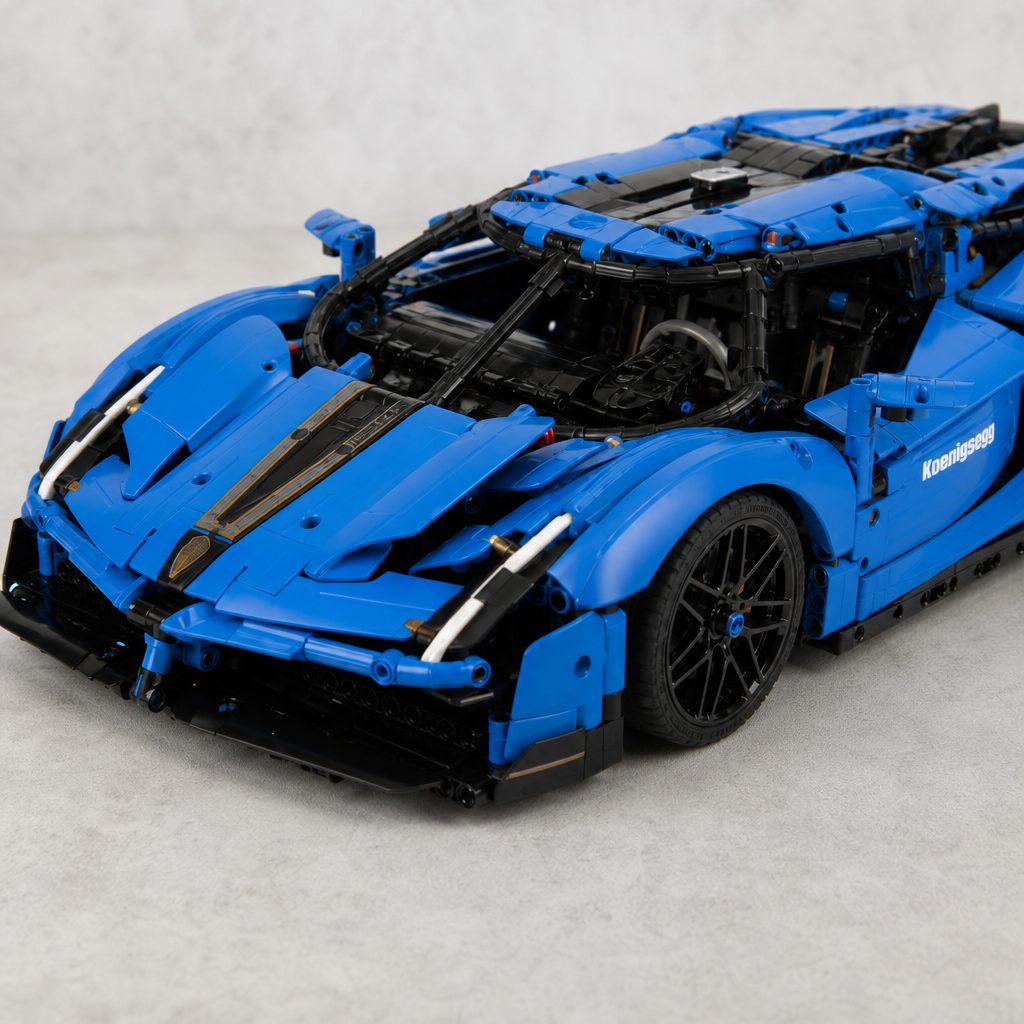
New wishbones and shock absorbers were created for the model's Triplex suspension, one of the details that separates this chassis from a standard Technic supercar build.
Building experience, instructions and daily ownership
With 4,104 pieces, the Sadair's Spear is not a quick weekend distraction unless you have a very clear weekend and unusually patient family members. It is best approached as a long, enjoyable project: the sort of build that benefits from a permanent table, decent lighting and the willingness to leave a partly completed transmission untouched until the next session.
The set supports the LEGO Builder app, which offers 3D instructions with zoom, rotate, save and progress-tracking functions. For a model this dense, the ability to rotate a section before committing to a connection is genuinely useful. Traditional instruction books remain part of the appeal for many adult builders, of course, and the premium presentation fits the Ultimate Car Concept character nicely. But the digital option is reassuring when you are trying to confirm the orientation of a small structural detail in a very large assembly.
Daily ownership is unusually straightforward because the set has no battery requirement. There is no charging routine, no rechargeable pack gradually losing capacity, no mobile app that might one day be abandoned, and no concern about motors being left under load. You build it, display it, occasionally operate the functions and dust it like any other substantial LEGO model.
That said, it is not maintenance-free in the normal sense. Any large display model gathers dust, and this one has enough openings, mechanical recesses and body contours to make a soft brush useful. It also benefits from being displayed somewhere stable. Its complex functions are a joy to demonstrate, but they are not an invitation to treat it like a remote-controlled Technic vehicle.
If you build with younger children nearby, I would be realistic about the arrangement. They may enjoy helping sort pieces, inspecting the finished car and operating the doors under supervision. But the 42232 is best considered an advanced solo project or a shared adult-and-older-teen build. It rewards patience. Rushing it would be like trying to assemble a watch whilst somebody keeps asking whether it can do wheelies.
LEGO Technic Koenigsegg Sadair's Spear versus Porsche, Bugatti, Lamborghini and Ferrari
The fairest competitors are not random LEGO cars; they are the five Ultimate Car Concept models that came before it. All are premium 1:8-scale Technic projects with real-world performance-car inspiration, detailed drivetrains and display ambitions. Yet they are not interchangeable.
The Porsche 911 GT3 RS remains historically important as the model that established the range in 2016, but its 2,704-piece count now makes it a markedly smaller undertaking. The Bugatti Chiron and Lamborghini Sián both offered 8-speed transmissions with movable paddle shifters, while the Ferrari Daytona SP3 raised the parts count to 3,778 and has a strong case as the previous generation's large-scale focal point.
The Koenigsegg has the largest part count, the only 9-speed transmission in the series and Ghost Mode as a practical point of difference. It is not automatically the best choice for everybody, because taste matters enormously with these cars. Some builders will prefer the visual identity of the Ferrari or Lamborghini. But on engineering theatre and post-build interaction, the Koenigsegg is the most ambitious package.
| Feature | Koenigsegg Sadair's Spear 42232 | Ferrari Daytona SP3 42143 | Lamborghini Sián FKP 37 42115 | Bugatti Chiron 42083 |
|---|---|---|---|---|
| Release year | 2026 | 2022 | 2020 | 2018 |
| Piece count | 4,104 | 3,778 | 3,696 | 3,599 |
| Transmission | 9-speed sequential | Not compared here | 8-speed with paddle shift | 8-speed with paddle shift |
| Gear indicator disc | Yes | Not compared here | Not listed | Not listed |
| Ghost Mode opening routine | Yes | Not listed | Not listed | Not listed |
Value, price and the premium LEGO question
In the UK, LEGO Technic 42232 carried a price of £399.99. It was $449.99 in the US and €449.99 in Europe. At 4,104 elements, that worked out at roughly 9.7p per piece in the UK and 11.0 cents per piece in the US and Europe.
Cost per piece is not a perfect measure of value. A bag full of tiny pins can make the maths look wonderful without making the set any more exciting. Equally, large bespoke pieces and complex mechanisms can lift the price without producing a dramatic piece-count figure. Here, though, the number is at least reassuring: the Sadair's Spear is expensive, but it is not a small set asking a large-set price.
What you are paying for is the overall proposition: a lengthy build, a large 1:8-scale display piece, the biggest piece count in the series, a 9-speed gearbox, gear indicator, V8, specialist suspension and Ghost Mode. That is a lot of model. Whether it is good value for you depends on whether those things are genuinely appealing rather than merely impressive in a product description.
The free 228-piece Koenigsegg Sadair's Spear Steering Wheel gift with purchase, set 40894, was offered between 1 and 6 July 2026 while stocks lasted. That promotion ended on 6 July, so it should not influence a buying decision now. The set itself was already in general circulation by 9 August 2026, while wider retail availability was due from 1 September 2026.
United Kingdom
4,104-piece LEGO Technic set
United States
4,104-piece LEGO Technic set
Europe
4,104-piece LEGO Technic set
What I liked, and what gives pause
The Sadair's Spear succeeds because its most impressive mechanisms are not buried entirely out of sight. You can shift the paddles. You can read the gear indicator. You can open Ghost Mode for an audience, even if that audience is mostly you after making a cup of tea. It feels special in a way a large static shell cannot quite manage.
Yet it is still a very expensive display-first model. Buyers wanting a driven Technic experience, a more conventional play pattern or a vehicle they can subject to repeated rough handling should look elsewhere. This is closer to a buildable mechanical sculpture than a toy car in the usual sense. It happens to be a sculpture with doors that do an entrance better than most people.
Pros
- Ghost Mode is a genuinely distinctive, linked opening mechanism rather than a collection of separate panels.
- The 9-speed sequential gearbox is the first of its kind in the Ultimate Car Concept series.
- The gear indicator disc makes shifting understandable and satisfying after the build is finished.
- Triplex suspension, new wishbones and bespoke shock absorbers give the chassis real technical interest.
- At 4,104 pieces, it is the largest Ultimate Car Concept model to date.
- No battery, charging routine or motorised system to maintain.
Cons
- Ghost Mode opens in one coordinated movement, but the doors, bonnet and mirrors must be closed manually.
- At £399.99, it is firmly a premium purchase rather than an impulse build.
- Much of the model's engineering remains enclosed once it is on display.
- Its 59cm length demands a serious amount of shelf space.
- Collectors seeking a more traditionally playable Technic vehicle may find it too display-led.
Who should buy LEGO Technic 42232 Koenigsegg Sadair's Spear?
This is not a universal recommendation simply because it is the newest and largest set in the Ultimate Car Concept line. It is a very good match for certain buyers, however, and a less sensible purchase for others. The important question is not "Is it impressive?" It plainly is. The question is whether its particular kind of impressiveness matches what you want from LEGO Technic.
Best for mechanical Technic fans
Choose the Koenigsegg if the gearbox, paddle shifters, indicator disc and Triplex suspension are the reason you build. This is the strongest pick for builders who enjoy mechanisms as much as bodywork.
Best for premium display collectors
Its 59cm length, elaborate body opening and imposing 1:8-scale presence make it ideal for a cabinet or dedicated LEGO display shelf with enough breathing room.
Best for the Ghost Mode reveal
No other Ultimate Car Concept model listed here has this linked rear clam, door, mirror and bonnet transformation. If that feature makes you grin, it is probably the one to buy.
Best avoided by play-first buyers
If you want a vehicle for heavy handling, racing around the floor or motorised action, this is the wrong kind of Technic set. Its strengths are patience, precision and display.
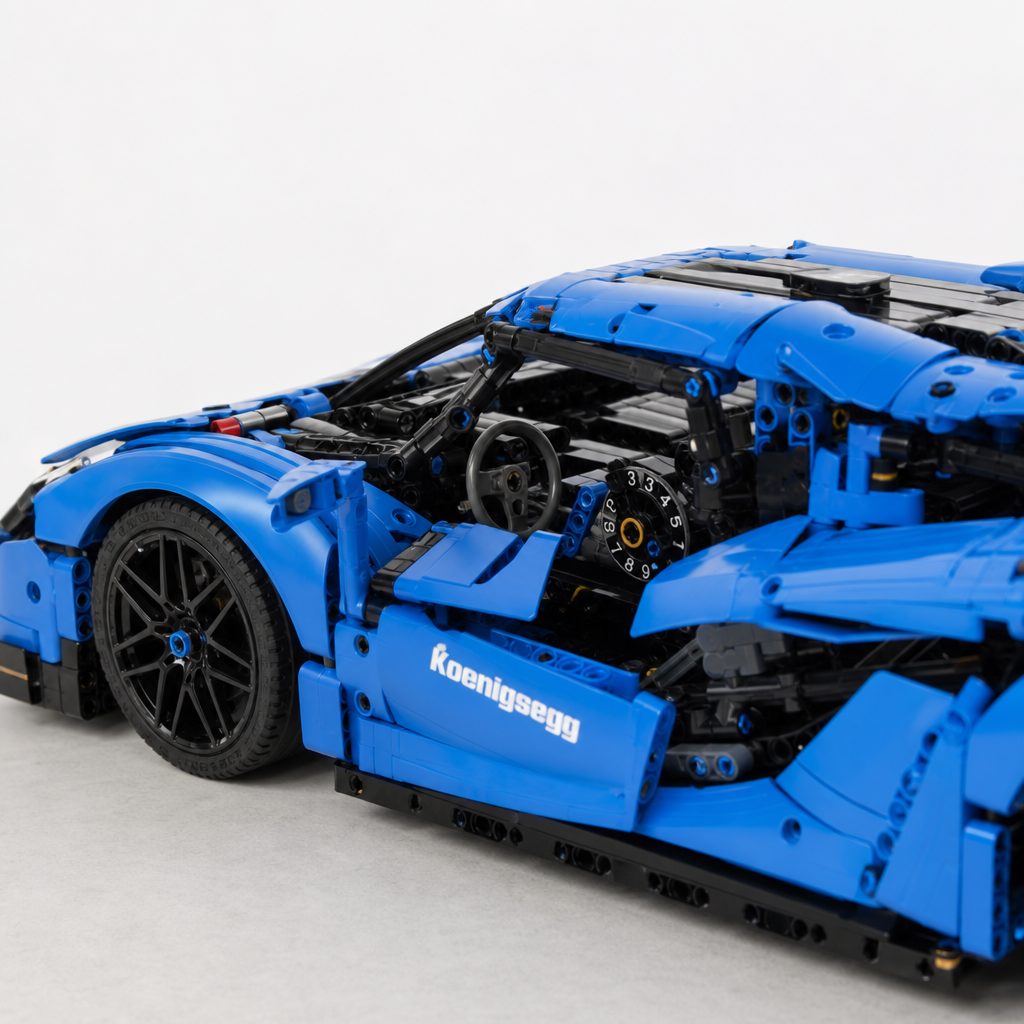
The driver's side gives the clearest view of the gear indicator disc, turning the 9-speed transmission into a feature you can actually show off.
Rating: an engineering-led flagship with real character
There is an easy way for a LEGO Technic flagship to become a numbers exercise: more pieces, bigger dimensions, higher price, finished. The Koenigsegg avoids that trap because it has a point of view. It wants to be opened. It wants you to use the paddles. It wants you to notice the suspension. It wants to be displayed with enough room around it to perform its little mechanical theatre routine.
The manual closing required after Ghost Mode prevents a perfect interaction score, and the price means it cannot be casually recommended to every car fan. But its engineering is meaningful, not cosmetic. That is why it feels like a genuine progression for the Ultimate Car Concept series rather than simply its biggest box.
Frequently asked questions
The set contains 4,104 elements. That made it the largest LEGO Technic Ultimate Car Concept model by piece count as of 9 August 2026, ahead of the 3,778-piece Ferrari Daytona SP3.
Ghost Mode is the model's linked opening mechanism. A single movement raises the rear clam and triggers the dihedral synchro-helix doors, front hood and folding mirrors. The opened sections must then be closed individually by hand.
Yes. It has a functional 9-speed sequential transmission operated by paddle shifters behind the steering wheel. A rotating indicator disc behind the driver's seat shows the selected gear.
No. It is a non-motorised model with mechanical functions, so there is no battery to charge or replace. Steering, suspension, opening panels, the V8 piston engine and gearbox are all manually operated.
The completed model measures 59cm long, 28cm wide and 15cm tall. It is substantial enough that buyers should plan its display position before building, especially if they want to show it with Ghost Mode opened.
It depends on what you value. The Koenigsegg is larger by piece count, has a 9-speed gearbox, a visible gear indicator and Ghost Mode. The Ferrari Daytona SP3 remains a major 3,778-piece Ultimate Car Concept build, but the Koenigsegg is the stronger choice for buyers prioritising interactive mechanical features.
LEGO Insiders access began on 1 July 2026, followed by general public release on 4 July 2026. Wider retail availability was due from 1 September 2026.
It is best approached as an advanced build for experienced older builders, adults or a patient shared project. It has interactive features, but its real strengths are intricate construction, mechanical detail and display rather than rough-and-ready play.
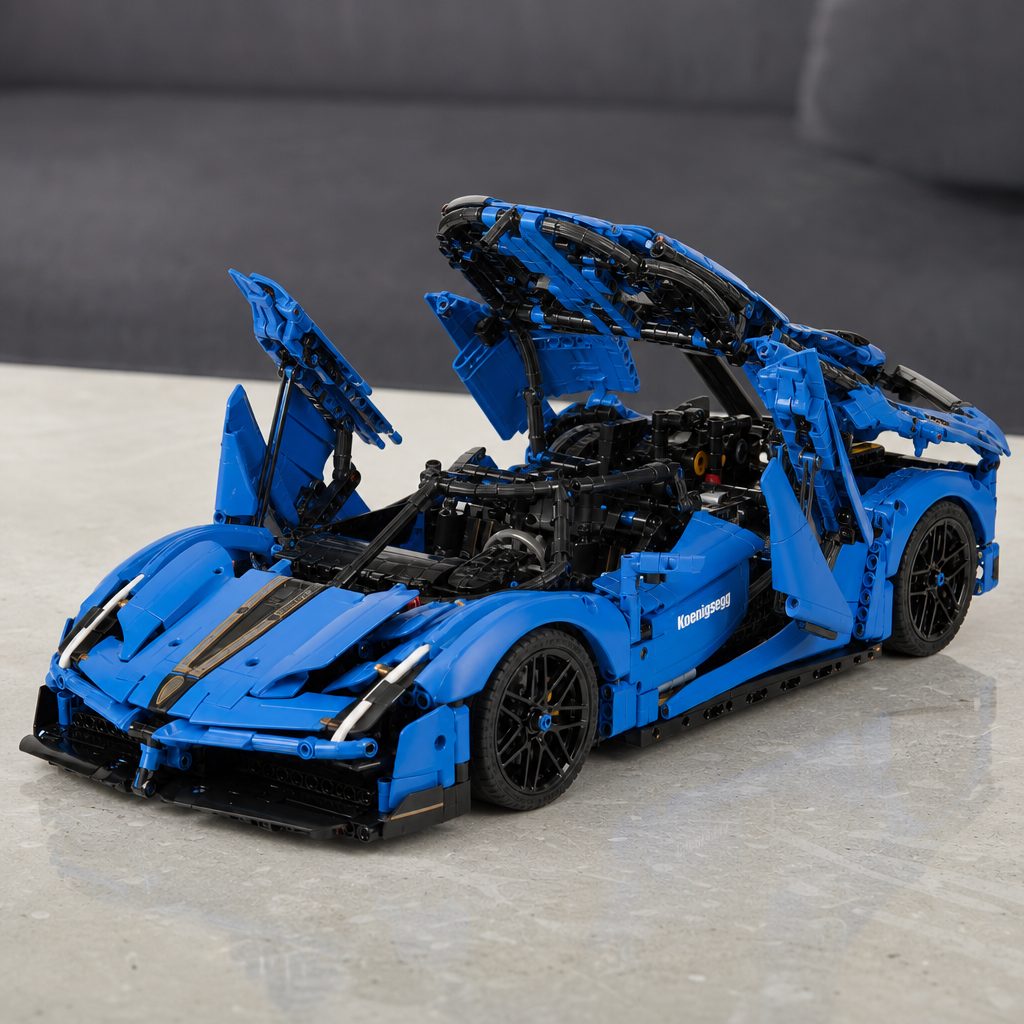
Opened up in Ghost Mode, the Sadair's Spear becomes a display piece with a proper sense of occasion rather than simply a large LEGO car.
Verdict: LEGO Technic's most theatrical Ultimate Car Concept set yet
LEGO Technic 42232 Koenigsegg Sadair's Spear Megacar is a superb premium build for the mechanically minded collector. The 4,104-piece count is impressive, but the reason to buy is what LEGO did with that scale: a working 9-speed gearbox with a readable indicator, specialist Triplex suspension and Ghost Mode, a linked opening routine that gives the finished car real personality.
It is expensive, huge and not intended for play-first buyers. The fact that its doors, mirrors and bonnet need manually closing after Ghost Mode is also a small but fair compromise. Even so, this is the Ultimate Car Concept model to choose if you want the most complex, demonstrable and conversation-starting engineering in the series. It does not just sit on a shelf looking fast. It has something to show you.