
Best Storage and Display Solutions for Your LEGO Collection
From a shelf of speed champions to a protected Pinball Machine that nobody is allowed to "just have a go on", the right storage can turn an impressive LEGO collection into a display worth stopping for. Here is how to choose cases, shelving and dust protection that suit the way you actually build, live and occasionally need to reclaim the dining table.
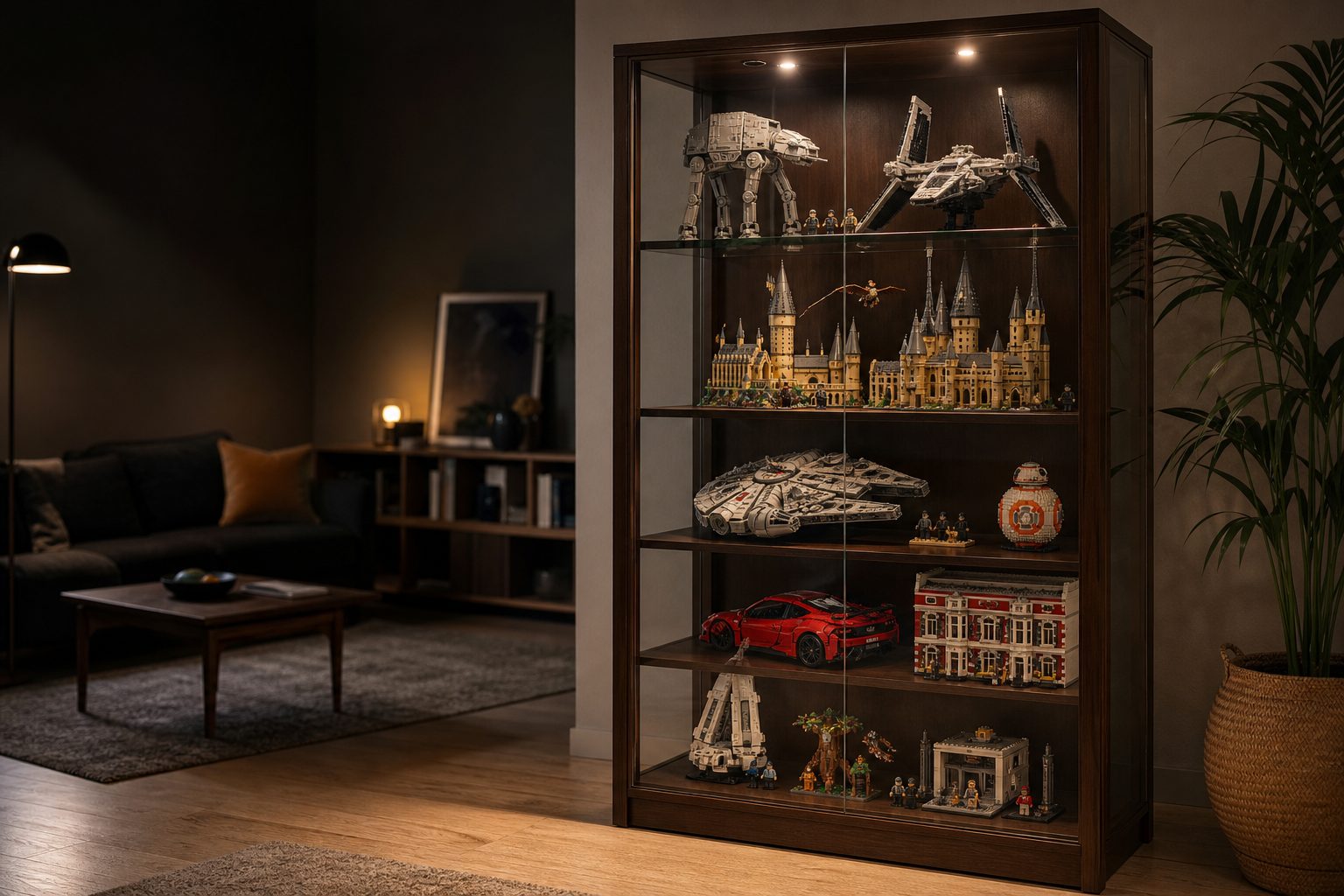
A well-planned LEGO display does more than look tidy: it gives large adult sets breathing room, keeps loose pieces under control and makes the collection feel like part of the home rather than an archaeological dig.
Why LEGO storage becomes a serious hobby surprisingly quickly
There is a moment in most adult LEGO collections when a simple bookcase stops being enough. It may happen when you finish a large vehicle and realise its wing, spoiler or steering wheel now projects into a busy walkway. It may happen when the Pinball Machine acquires a suspicious layer of household dust. Or it may happen when a family member asks whether every flat surface in the house is now "reserved for tiny plastic people". Fair question, frankly.
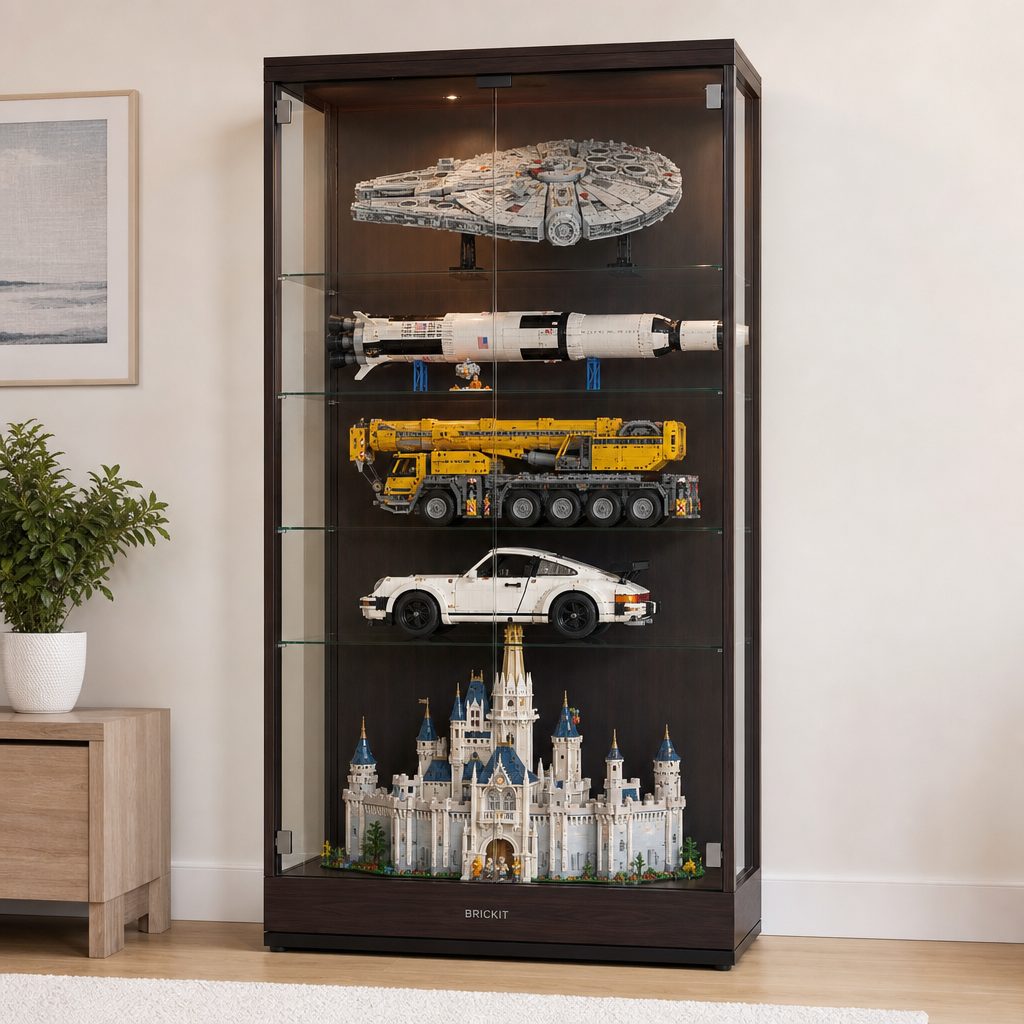
Large LEGO vehicles and mechanism-heavy display builds benefit from a dedicated zone, rather than being balanced between books, plants and whatever happened to be on sale at the homeware shop.
The best display solution is not automatically the biggest cabinet or the shiniest acrylic case. It is the one that protects the models you care about, makes them enjoyable to look at, accommodates the reality of cleaning day and does not turn future rearranging into a crisis involving two adults, a spirit level and a great deal of muttering.
Think of the collection in three groups. First, there are your centrepieces: the builds that took time, patience and possibly a small amount of emotional resilience. These deserve stable shelving, sensible clearances and, often, protection from dust and inquisitive hands. Second come regular favourites: sets you want visible and accessible, but not necessarily sealed away. Finally, there are spare elements, instructions, minifigures, in-progress projects and the inevitable "I'm definitely using those pieces later" assortment. They need storage that helps you find things rather than merely hiding them.
The useful rule before you buy anything
Measure the model, then measure the place it will live, then allow room around it. A display that fits only by squeezing in mirrors, removing a door or holding your breath is not a display solution. It is an elaborate warning.
What to consider before choosing a case, shelf or storage system
Start with the room. A collection in a dedicated hobby area has very different needs from one displayed in a lounge, bedroom or home office. In a low-traffic room, open shelves can be brilliant. In a busy family space, the protection offered by enclosed furniture or a fitted case matters much more. A model is easiest to enjoy when you are not constantly worried about someone knocking it with a coat, bag, football or elbow.
Then consider access. Some builders want every model preserved as a finished artefact. Others want to lift the Pinball Machine down, show visitors its workings and put it back afterwards. Neither approach is wrong, but they call for different solutions. A sealed display case gives a refined, museum-like finish. Open shelving makes reaching a model effortless. Deep drawers are wonderful for parts and dreadful for anything you want to admire.
Measure the complete footprint
Account for overhangs, open doors, raised masts, tall antennas and display stands. The base is not always the widest part of a LEGO build.
Read the light in the room
Strong daylight can make a display look marvellous, but it also means dust, fingerprints and fading concerns deserve more thought.
Plan for cleaning
If taking one model out requires dismantling half a shelf, dusting will become one of those jobs that mysteriously never happens.
Leave room to rotate
Collections change. A system with spare shelf space or adaptable storage is kinder to future you, who will almost certainly find another must-have set.
Before fixing anything to a wall, consider the wall itself, the load it will carry and whether the display sits above a bed, desk, sofa or area where people regularly pass. A beautiful LEGO display should never rely on optimism as its main structural material.
The ranked picks at a glance
These are not competing versions of the same object. They are different approaches for different kinds of collection. The sensible answer may be one solution for your large display sets, another for modular buildings and something altogether more practical for the loose pieces that seem to breed when the lights are off.
1. Enclosed Glass-Front Display Cabinet — Best for premium centrepiece sets
An enclosed glass-front cabinet is the most polished answer for an adult LEGO display that needs to look intentional in a shared living space. It works especially well for the builds you want guests to notice without needing an explanation of why the coffee table is currently unavailable. Large cars, architecture, elaborate scenes and mechanical display models all gain a sense of occasion behind doors.
The main advantage is obvious: it creates a physical boundary between your model and the rest of household life. Dust has fewer easy routes in, casual fingers have one more obstacle to overcome and the display feels curated rather than merely stored. The cabinet itself becomes part of the room, which is exactly what you want when the collection is no longer small.
Pros
- Offers a smart, furniture-like finish for adult display sets.
- Creates helpful separation from dust, pets and passing elbows.
- Makes a collection feel deliberately arranged rather than temporary.
Watch-outs
- Door frames and shelf edges can interrupt a wide sightline.
- Deep cabinets invite overcrowding if every shelf becomes a game of Tetris.
- Moving a cabinet full of LEGO is not a casual Saturday afternoon task.
2. Clear Acrylic Display Case — Best for dust-sensitive showpieces
A clear acrylic display case is the specialist choice for one model you want to protect and present properly. The appeal is that it keeps attention on the build. A well-chosen case does not compete with the model or turn it into an ornament trapped behind bulky furniture; it frames the set, keeps the silhouette easy to see and makes the whole thing feel finished.
This is the route I would take for an intricate build with exposed mechanisms, lots of fine detail or awkward cleaning points. The Pinball Machine is a prime example of the sort of model that rewards this treatment. There is plenty to inspect, plenty to accidentally disturb and plenty of nooks that do not welcome a hurried duster.
Cases are best treated as bespoke homes rather than general-purpose boxes. Give the set some visual breathing room. If the case leaves just enough room for the model to exist, it will look cramped and make removal fiddly. A little empty space is not wasted space; it is what lets the display read as a display.
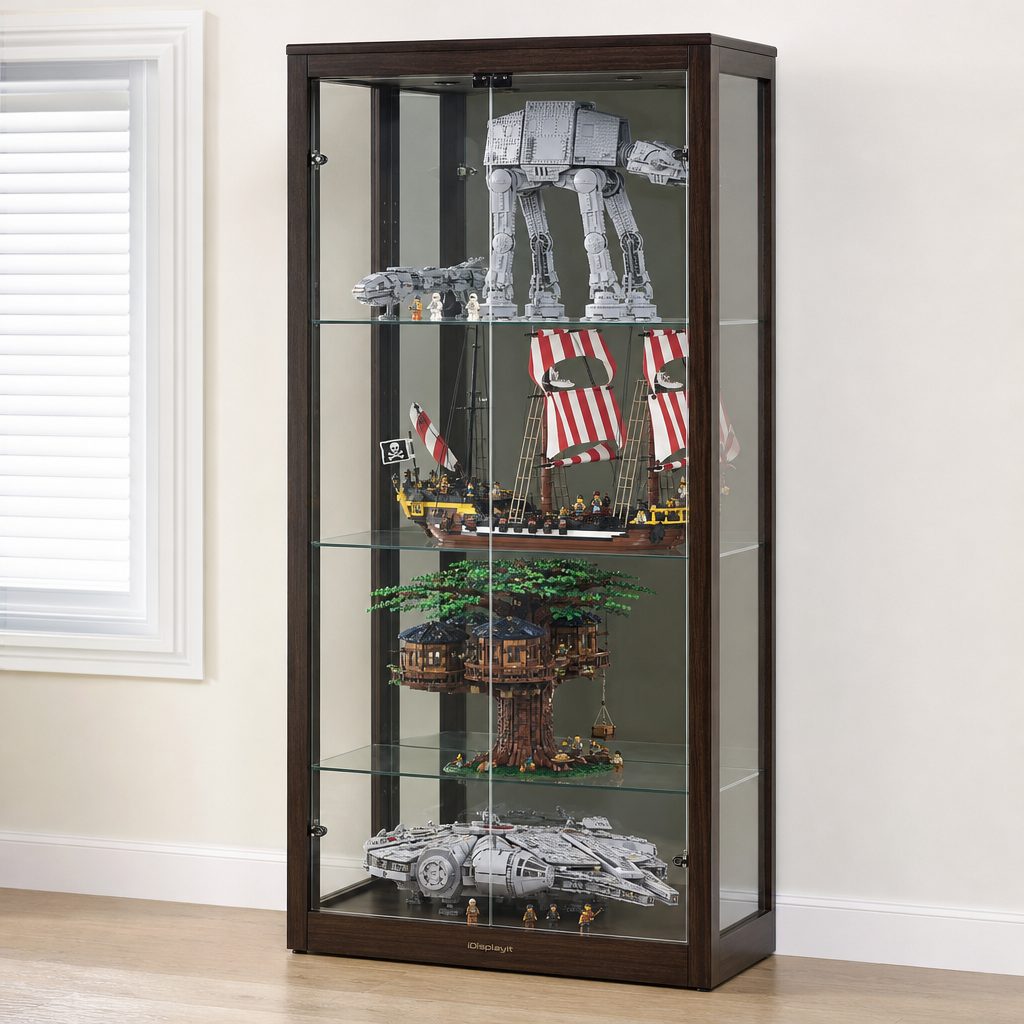
A clear case suits a mechanism-rich LEGO centrepiece because the model remains the focus whilst its delicate detail is easier to keep clean and undisturbed.
3. Adjustable Wall-Mounted Shelving — Best for a growing display wall
Adjustable wall-mounted shelving is the most flexible choice for collectors whose wish list is plainly longer than their available floor space. It turns unused vertical space into a gallery and allows you to alter the arrangement when a taller model, wider vehicle or new theme enters the collection. This matters more than it sounds. LEGO display needs change constantly because LEGO itself has an annoying habit of making exactly the set you were not planning to buy.
The benefit is visibility. A wall display can let every model have its own stage, with enough empty space between builds to stop them visually merging into one sprawling plastic metropolis. It can also make themed arrangements very satisfying: cars together, space sets together, buildings together, and the one sentimental childhood set somewhere nobody can "borrow" it.
The limitation is exposure. Open shelves collect dust, and a wall-mounted solution asks you to take installation seriously. Placement matters as much as strength. Avoid putting a prized model where it will be brushed by curtains, caught by a door or baked in harsh direct light every afternoon.
4. Deep Cube Shelving Unit — Best for themed collections and modular layouts
Cube shelving is a wonderfully simple framework for builders who enjoy grouping models into clear themes. Each compartment can become its own small world: a vehicle bay, a city block, a fantasy scene, a place for minifigure displays or a home for one larger model that deserves not to share.
The structure helps less confident decorators, too. Instead of facing one huge shelf and wondering how to make it look good, you are arranging several smaller stages. That naturally encourages restraint. One or two models per compartment, a thoughtful height choice and a little negative space can look far more impressive than packing every available surface until it resembles a toyshop after a power cut.
Pros
- Easy to divide by theme, scale or era without visual clutter.
- Provides natural boundaries that help small displays look intentional.
- Can combine display sections with boxes or baskets for support items.
Watch-outs
- Fixed compartments can be restrictive for unusually tall or wide models.
- Open cubes still need a realistic dusting routine.
- Uniform storage can look busy if every compartment is filled to the edge.
5. Lidded Transparent Storage Boxes — Best for sorted loose bricks and works in progress
Not every LEGO storage solution should be glamorous. Lidded transparent boxes are the workhorses of a sensible collection: practical for spare elements, partly built sections, replacement pieces, small accessories and projects waiting for their next session. They are particularly useful when you have a build spread across a table but need the table back for something unreasonable, such as eating.
Transparency is valuable because it removes one of the great frustrations of generic storage: opening five identical boxes to find the one containing the thing you need. You do not need to sort every element by colour, shape and emotional backstory. A simple system based on project, theme or rough part type is already a major improvement over the traditional "all loose LEGO in a heroic tub" method.
For display collectors, these boxes are also the quiet companion to the impressive shelves. They keep the visual side uncluttered by giving instruction booklets, spare pieces and repair materials somewhere else to live. That distinction is important. Your display should show the models. Your storage should support the hobby.
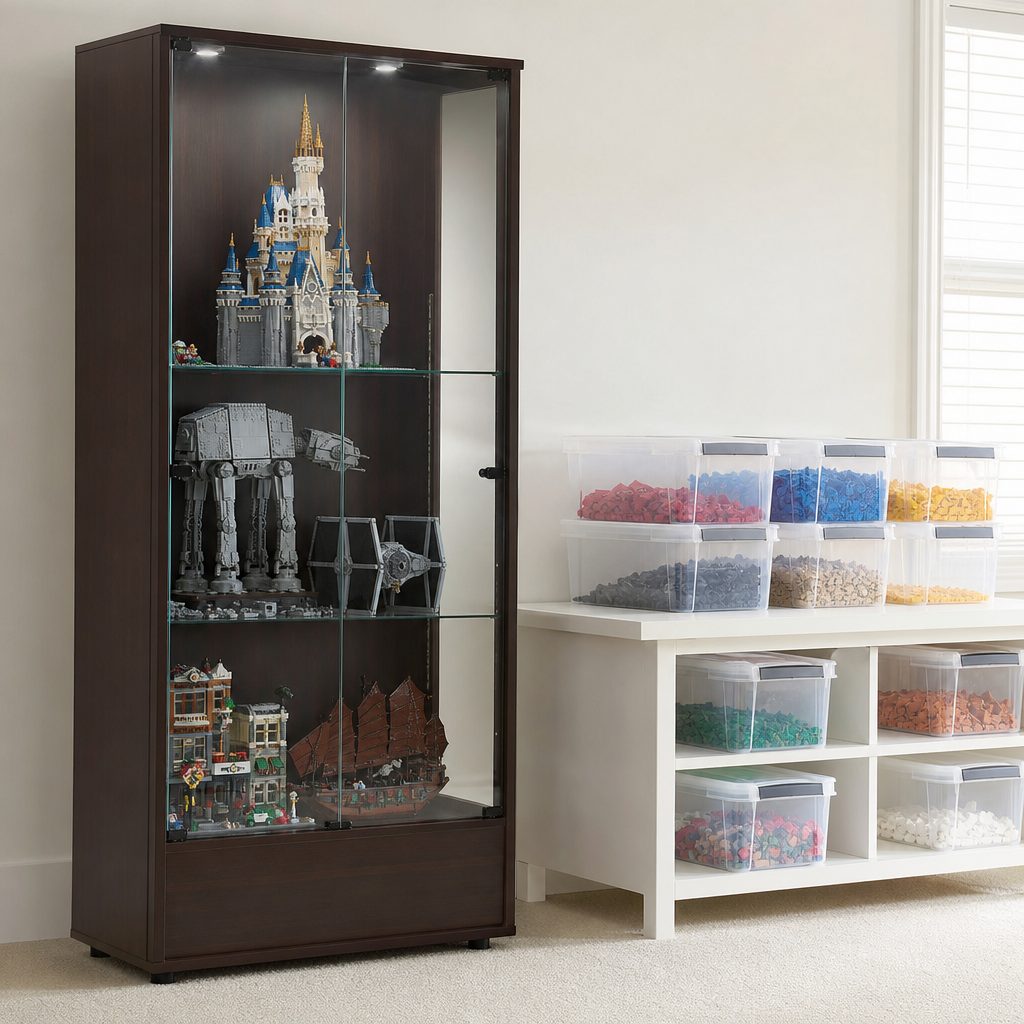
Transparent lidded boxes make a sensible backstage system for loose LEGO, spare elements and paused projects, leaving display shelves free for the finished builds.
6. Shallow Drawer Organiser — Best for minifigures, accessories and tiny elements
A shallow drawer organiser earns its place when the collection includes lots of smaller pieces that are too easy to lose and too annoying to hunt for later. Minifigure accessories, printed elements, small tools, decorative parts and delicate extras all benefit from compartments that stop them becoming one large rattle at the bottom of a box.
This is not the answer for a whole collection of bricks. It is the answer for the fiddly supporting cast. Use it for pieces you genuinely want to retrieve, compare or keep protected. It is also handy for a display builder who periodically adjusts scenes, swaps minifigures or wants a tidy place for accessories removed from models during cleaning.
Resist the temptation to make the categorisation system too clever. A drawer labelled "small accessories" that you actually use is better than twelve microscopic categories that you abandon after one week. The aim is frictionless retrieval, not a degree in warehouse management.
7. Under-Bed Storage Container — Best for keeping the hobby out of sight between builds
Under-bed storage is the unglamorous hero for collectors with limited room. It is not where your prized display model should spend its life, but it is excellent for sealed boxes, instructions, older projects awaiting a rebuild, parts collections and the storage overflow that comes with being a person who has enjoyed LEGO for more than about five minutes.
The key is to avoid treating it as a dumping ground. A container under the bed can be organised by theme, project or season, and it can preserve valuable room elsewhere for the models you want to see every day. It is particularly useful in flats, student accommodation and shared homes where the display area needs to be selective rather than all-consuming.
Choose the items you store here with intention. If something is frequently accessed, it belongs closer to hand. If it is retained for rebuilding, sorting or sentiment, under-bed storage makes far more sense. Think of it as an archive, not exile.
8. Dust Cover Cloth and Soft Cleaning Kit — Best for open-shelf collectors
A dust cover cloth and soft cleaning kit are not a replacement for a cabinet or case, but they are the most realistic answer for collectors who love open shelving. Plenty of displays look better in the open. The room feels lighter, the models are easier to photograph, and you can appreciate every angle without opening a door first. The trade-off is that you must have a dust strategy.
For many collections, the answer is not to cover every model permanently. That rather defeats the point. Instead, use a soft cover while you are away for an extended period, decorating, moving furniture or doing jobs likely to create dust. A gentle cleaning routine then deals with ordinary household build-up without turning maintenance into a military operation.
Be patient around delicate antennae, flags, vines, thin railings and elements held by a single stud. Big dramatic gestures are for unveiling a finished set, not cleaning it. Slow and careful wins.
Comparison table: which storage style suits your collection?
No single solution wins every category because the problems are different. The table below compares all eight ranked approaches by their intended role, the level of visible display they offer and the practical compromise each one asks you to make.
| Ranked solution | Best use | Display style | Protection approach | Main compromise |
|---|---|---|---|---|
| 1. Enclosed Glass-Front Display Cabinet | Premium centrepiece sets | Furniture-led gallery display | Door-separated display space | Less immediate access |
| 2. Clear Acrylic Display Case | Dust-sensitive showpieces | Model-first presentation | Full clear enclosure | Best suited to dedicated models |
| 3. Adjustable Wall-Mounted Shelving | Growing display walls | Open, flexible arrangement | Positioning and careful upkeep | Requires installation and dusting |
| 4. Deep Cube Shelving Unit | Themed collections | Compartment-by-compartment display | Protected by placement rather than enclosure | Fixed compartment shapes |
| 5. Lidded Transparent Storage Boxes | Loose bricks and projects | Backstage organisation | Lids keep contents contained | Not a display solution for finished builds |
| 6. Shallow Drawer Organiser | Small parts and accessories | Hidden, accessible organisation | Separated compartments | Limited to smaller items |
| 7. Under-Bed Storage Container | Space-saving archives | Out-of-sight storage | Protected by contained storage | Less convenient for regular use |
| 8. Dust Cover Cloth and Soft Cleaning Kit | Open-shelf displays | Maintains an open display | Temporary covering and careful cleaning | Needs regular attention |
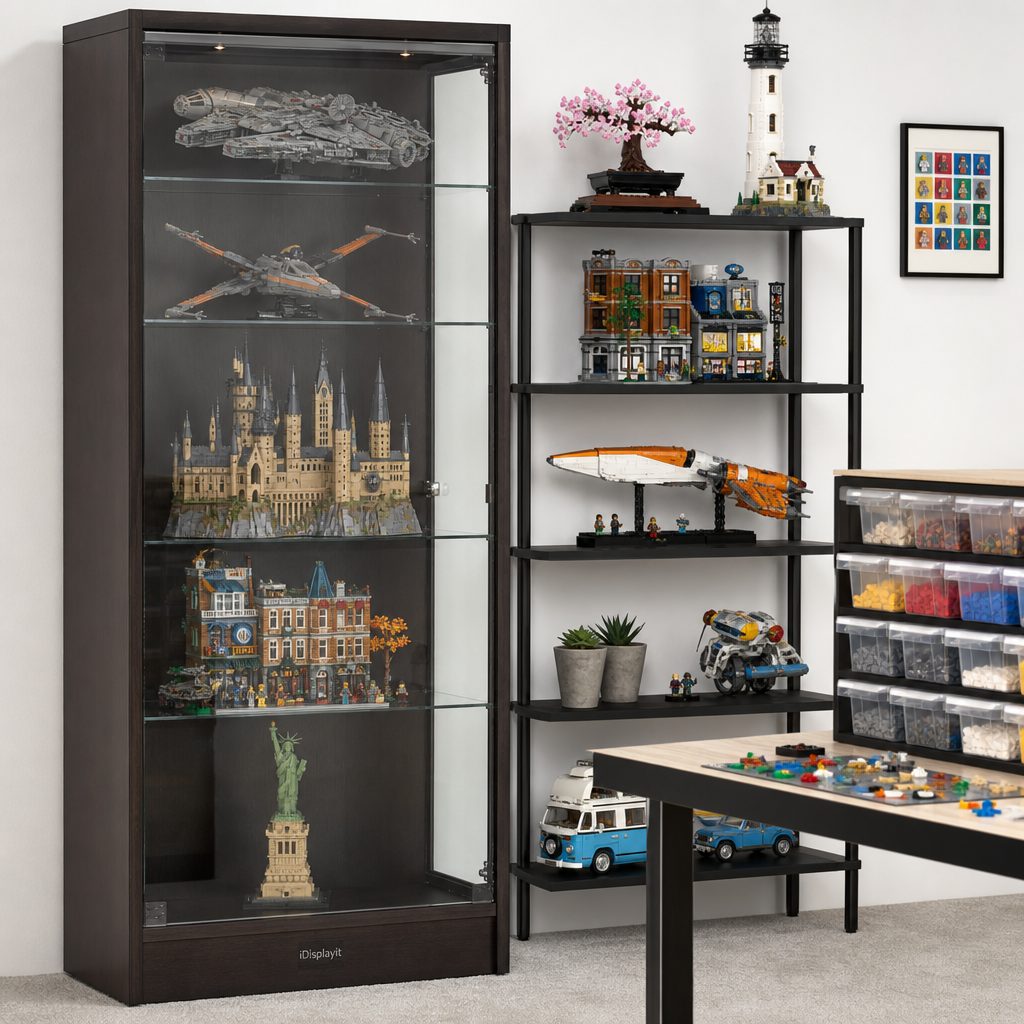
A mixed approach is usually the most successful: protected cases for headline models, open shelves for everyday favourites and organised storage for everything that supports the hobby.
How to build a display that looks collected, not crowded
It is tempting to fill every shelf as soon as you have it. LEGO is colourful, detailed and inherently cheerful, so surely more is more? Sometimes. More often, though, a packed display hides the very details that made you want to show the sets in the first place.
Start by identifying visual anchors. A large car, a towering building, a major scene or a mechanism-heavy model can hold a shelf on its own. Smaller builds then work around it as supporting pieces rather than competitors. Try not to put every model facing exactly the same way. A slight angle can reveal shape, depth and detail, especially with vehicles.
Use height thoughtfully. The tallest model does not always belong on the highest shelf. Eye-level placement is usually where you will enjoy the most intricate or emotionally important build. Higher spaces suit models that read well from a distance, while lower shelves can work for broader scenes that invite a closer look.
Quick display-layout checklist
- Give the largest model a shelf or zone that does not feel borrowed from something else.
- Leave gaps around headline builds so their outlines remain visible.
- Keep fragile or treasured models away from doors, chair backs and busy routes.
- Group related sets together when the connection adds a story.
- Store manuals, spare pieces and cleaning tools nearby but out of the display itself.
- Photograph the arrangement before changing it if you think you may want to return to it.
Give yourself permission to rotate
You do not have to display every finished LEGO set all year. Rotating models keeps the room fresh, gives overlooked builds another moment in the spotlight and stops the shelves becoming a permanent exercise in maximum occupancy.
Dust, light and cleaning: the unglamorous details that protect great builds
Dust is the reason many collectors eventually move from open shelves to cases. It settles on exposed surfaces, works its way into detailed areas and is particularly noticeable on darker elements and transparent pieces. But dust protection does not need to mean sealing every model forever. It means matching the level of protection to how much you value visibility, access and ease of care.
Open shelves demand regular, gentle attention. A soft approach is vital because LEGO builds often rely on delicate connections, particularly around decorative elements. Do not attack a complex display with the sort of vigour normally reserved for cleaning the skirting boards before guests arrive. You will regret it.
Light deserves thought as well. A display near a window can look spectacular in a photograph, but direct sunlight is a different matter. Consider how the light shifts through the day and through the year. Curtains, blinds, distance from the glass and shelf position can all influence how comfortable you feel leaving a valued set in place long term.
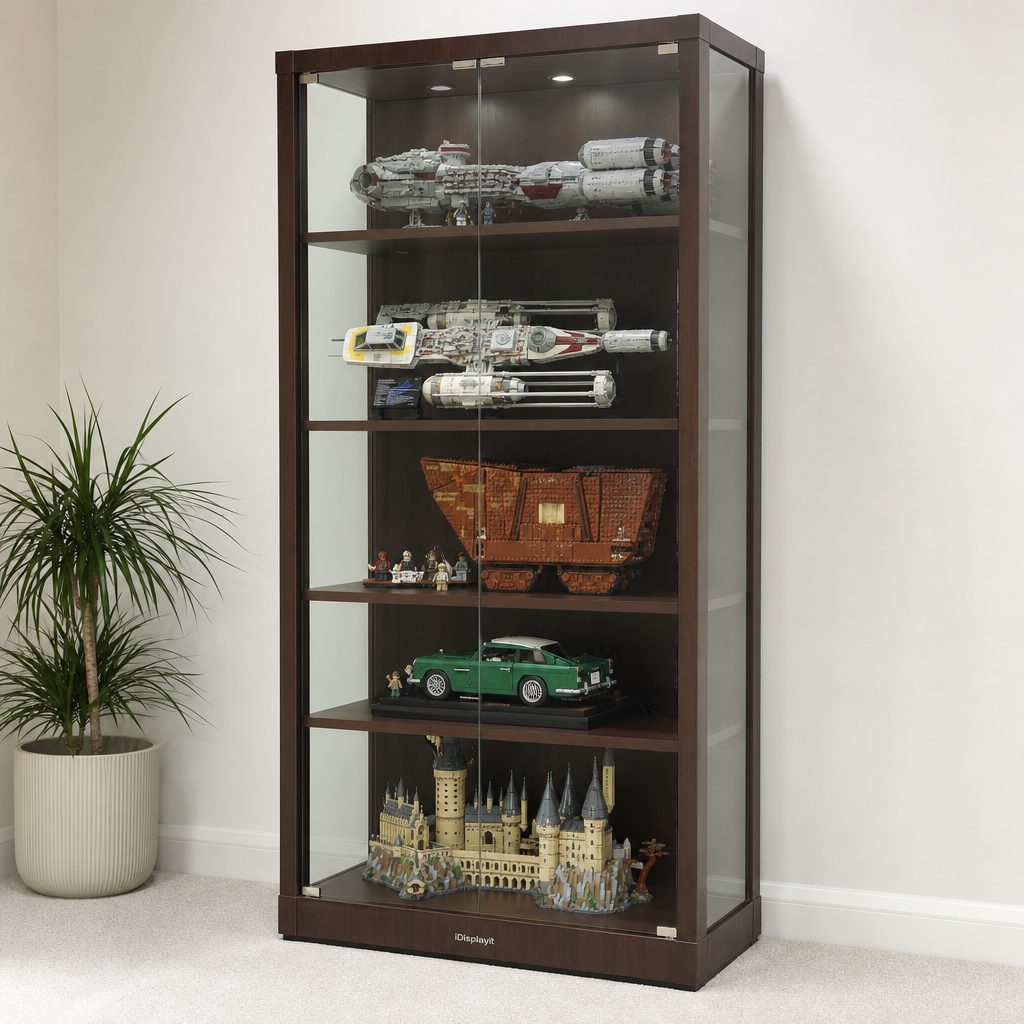
Open shelving offers the clearest view of a collection, but it works best when models are positioned away from everyday knocks and maintained with a calm, careful cleaning routine.
Storage for builders who rebuild, part out and create their own models
Display collectors and active builders often overlap, but their storage needs can be almost opposite. If you rebuild regularly, a pristine cabinet is only part of the answer. You also need a workspace system that makes starting and stopping easy. This is where lidded boxes, drawer organisers and labelled containers quietly do the heavy lifting.
Organise according to your habits, not somebody else's impressive sorting video. Some people naturally think by colour. Others think by part family, project or era. The "best" system is simply the one that helps you locate a piece without emptying every container onto the floor. Cambridge Dictionary defined best as being of the highest quality or the most suitable, and the second half matters here. A majestic storage arrangement that you never maintain is not the best arrangement for you. It is just very photogenic.
For in-progress builds, keep the project contained but visible enough that it does not vanish from your mental list. A clearly separated box or tray lets you pause without losing pieces to the wider household. Keep instructions with the project where practical, and give spare elements a designated home. That tiny discipline makes returning to a build much more pleasant.
Best-for awards: the quick answer for different LEGO collectors
If you only want the short version, these are the strongest matches for common collection styles. The right choice depends less on whether a solution looks impressive online and more on what happens around your LEGO between one building session and the next.
Best premium display
Enclosed Glass-Front Display Cabinet. Choose this for treasured centrepieces that deserve a furniture-like home in a lounge, office or dedicated hobby room.
Best for delicate showpieces
Clear Acrylic Display Case. The strongest fit for a single intricate model where clear viewing and a more enclosed presentation are the priority.
Best all-rounder
Adjustable Wall-Mounted Shelving. Ideal when the collection changes often and you want an adaptable gallery rather than a fixed arrangement.
Best low-fuss organiser
Lidded Transparent Storage Boxes. A practical place to begin for loose pieces, paused builds and the support gear that should not live on display shelves.
Best for shared family space
Deep Cube Shelving Unit. Compartmentalised display makes it easier to give models clear zones and combine visible LEGO with more ordinary household storage.
Best for custom builders
Shallow Drawer Organiser. Keep small elements, accessories and frequently retrieved parts separated so creative sessions begin with less rummaging.
Common mistakes when storing display LEGO
The first mistake is buying storage before deciding what you are actually trying to protect. If the real problem is dust, more open shelving will not solve it. If the real problem is lack of floor space, a larger cabinet may make the room feel worse. If the real problem is loose parts everywhere, a display case solves absolutely nothing beyond giving the parts something else to fall behind.
The second is underestimating access. A beautiful display that makes cleaning, rearranging or retrieving a model absurdly difficult can become frustrating surprisingly fast. Think about the front, sides and top of the arrangement. Can you reach what you need to reach? Can you lift a model safely? Can you clean without taking down half the collection?
The third is forgetting the collection will evolve. You do not need to buy storage for every possible future set, but leaving a little flexibility is wise. Empty shelf space may look extravagant for approximately three days. Then it becomes the place where your next favourite build can go without triggering a complete room redesign.
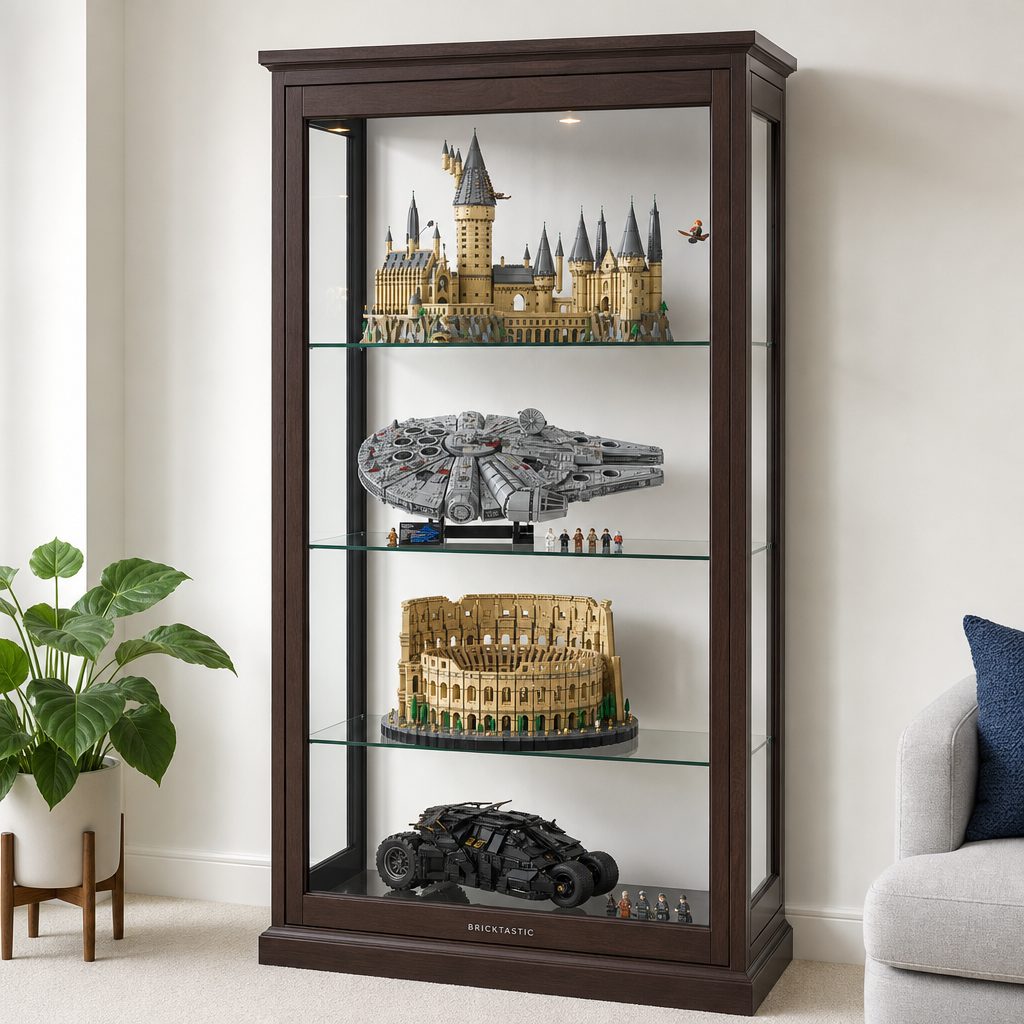
A successful collection display has a little empty space on purpose. It lets individual models stand out and makes future additions much easier to accommodate.
FAQ: LEGO storage and display questions answered
No. Cases are most worthwhile for the models that are intricate, difficult to clean, especially meaningful or displayed in a busy area. Open shelves remain an excellent choice for robust builds you want to access easily. A mixed display is often more practical and more attractive than trying to enclose absolutely everything.
Not at all. Open shelving gives the clearest view and the easiest access, which is why many collectors prefer it. The compromise is dust and exposure to everyday knocks. Position shelves thoughtfully, avoid crowded walkways and establish a gentle maintenance routine rather than expecting the display to remain immaculate by magic.
Keep loose elements, spare parts, instruction booklets, accessories, in-progress projects and cleaning supplies in their own organised storage. Separating the support equipment from the finished display makes the collection look calmer and reduces the risk of a small loose piece ending up where it should not.
Use vertical space first. Adjustable wall-mounted shelving can turn a blank wall into a focused display, while under-bed containers can hold the archive: boxes, instructions and sets you are not currently showing. Be selective about what stays out. A smaller rotating display often looks better than every set squeezed into one room.
Give larger models breathing room, group sets with a genuine visual link and avoid filling every compartment simply because it is empty. Vary height and angle, keep spare pieces off the display shelves and allow a few quieter spaces. The empty areas are what let the detailed models do their job.
They are useful for much more: paused builds, dismantled sets awaiting rebuilding, accessories, replacement parts and project-specific materials. Their strength is quick identification. When you can see the broad contents at a glance, you spend less time opening containers and more time building.
Choose a stable location away from doors, chair backs, pets, direct handling and busy routes through the room. Eye-level can be excellent for appreciation, provided the location is not exposed to constant traffic. A clear acrylic display case is particularly useful when the model needs to remain visible but deserves an extra layer of separation.
That depends on your priorities. If the box has sentimental, collector or resale importance to you, store it cleanly and flat where possible. If space is limited and the box does not add value to your enjoyment, it may be the first thing to reconsider. Your home does not need to become a cardboard warehouse to prove you are a proper fan.
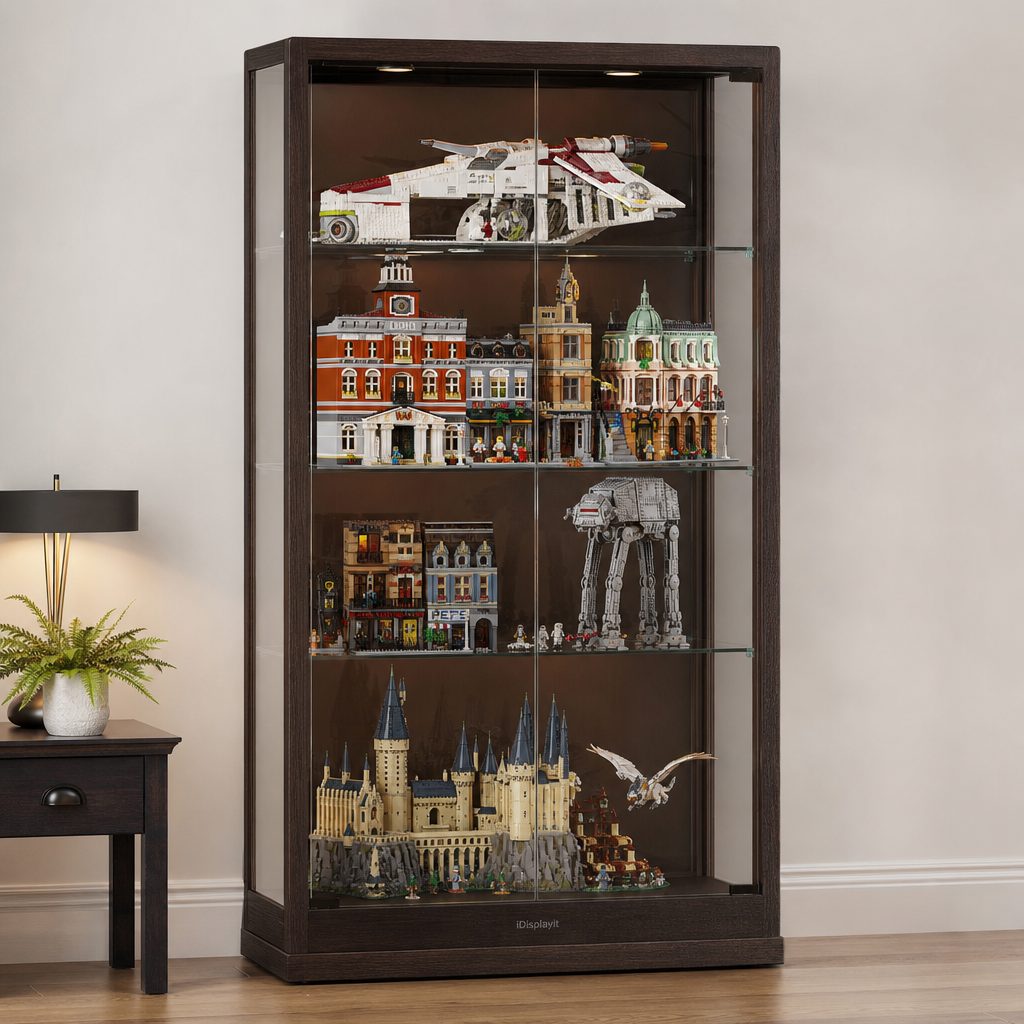
The finished goal is simple: a LEGO collection that feels protected, easy to enjoy and properly yours, whether it occupies one shelf or has quietly taken over an entire room.
The bottom line
The best storage and display solution for your LEGO collection is rarely one purchase. An enclosed glass-front display cabinet is the standout for premium centrepieces in a shared room, while a clear acrylic display case gives intricate showpieces a clean, focused home. For a collection that keeps expanding, adjustable wall-mounted shelving offers the most adaptable long-term display.
Pair any visible display with transparent boxes, drawer organisers or under-bed storage for the parts of the hobby that do not need to be on show. Give your favourite sets room, protect the ones that matter most and leave yourself enough flexibility for the inevitable next build. Because there is always a next build. You know it. I know it. The shelf probably knows it too.