Switch 2 vs PS5 Pro: Portable Powerhouse or Living-Room Beast?
Nintendo Switch 2 and PlayStation 5 Pro were built for wildly different versions of the same hobby. One slips into a bag and turns a train journey into a proper gaming session. The other sits beneath a television and throws enormous, ray-traced worlds at a 4K screen. This is not really a fight. It is a question of where, how and with whom you want to play.
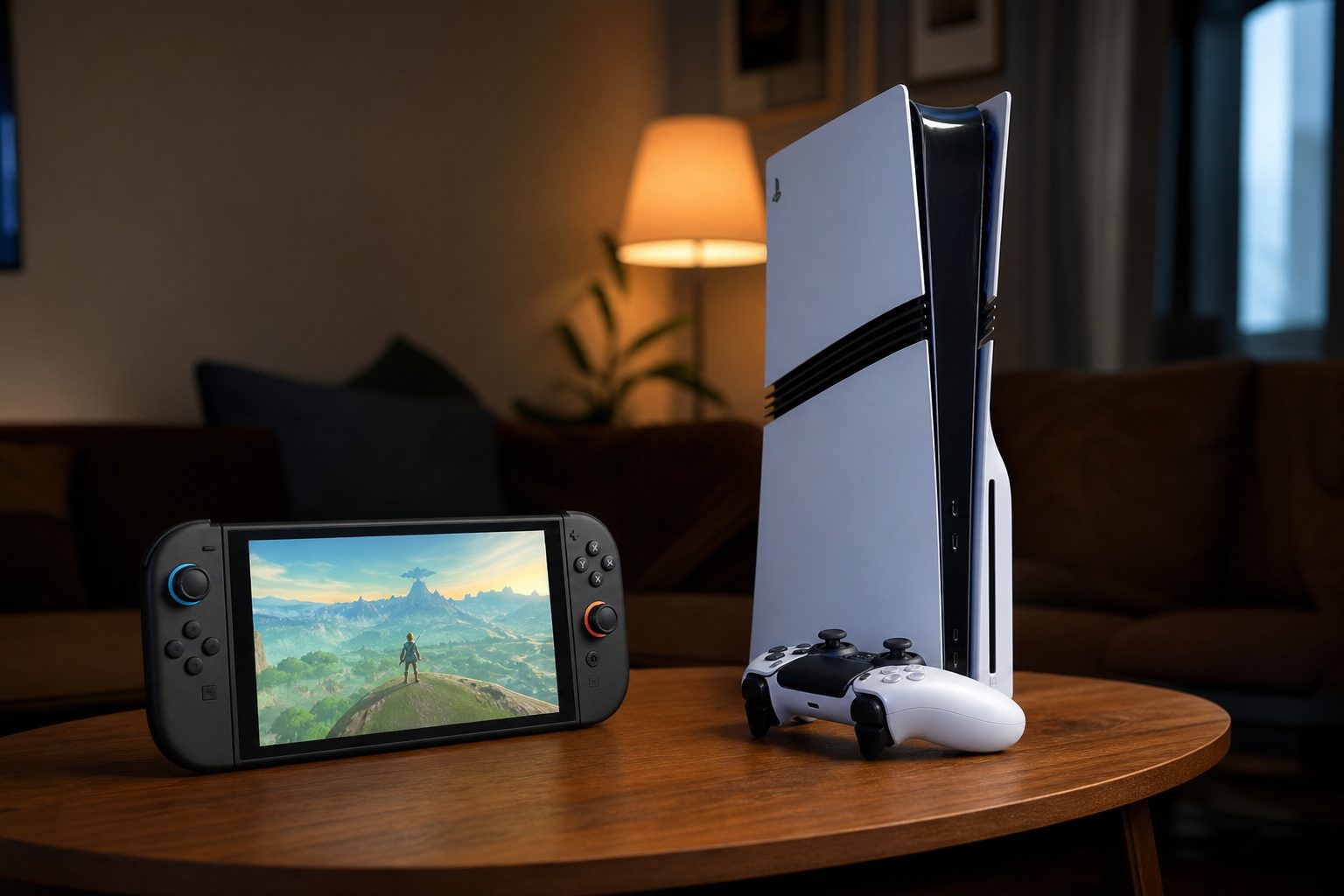
Nintendo Switch 2 and PlayStation 5 Pro represent two very different ideas of premium console gaming: flexibility on one side, towering living-room performance on the other.
1. The short answer: choose your gaming life
There is a temptation with console comparisons to line up teraflops, declare a winner and go home for tea. That approach does neither of these machines much justice. The PS5 Pro was unquestionably the more powerful console. Its 16.7-teraflop AMD GPU, enhanced ray tracing and PlayStation Spectral Super Resolution gave it the muscle to run supported games at resolutions and frame rates that a portable device simply could not target.
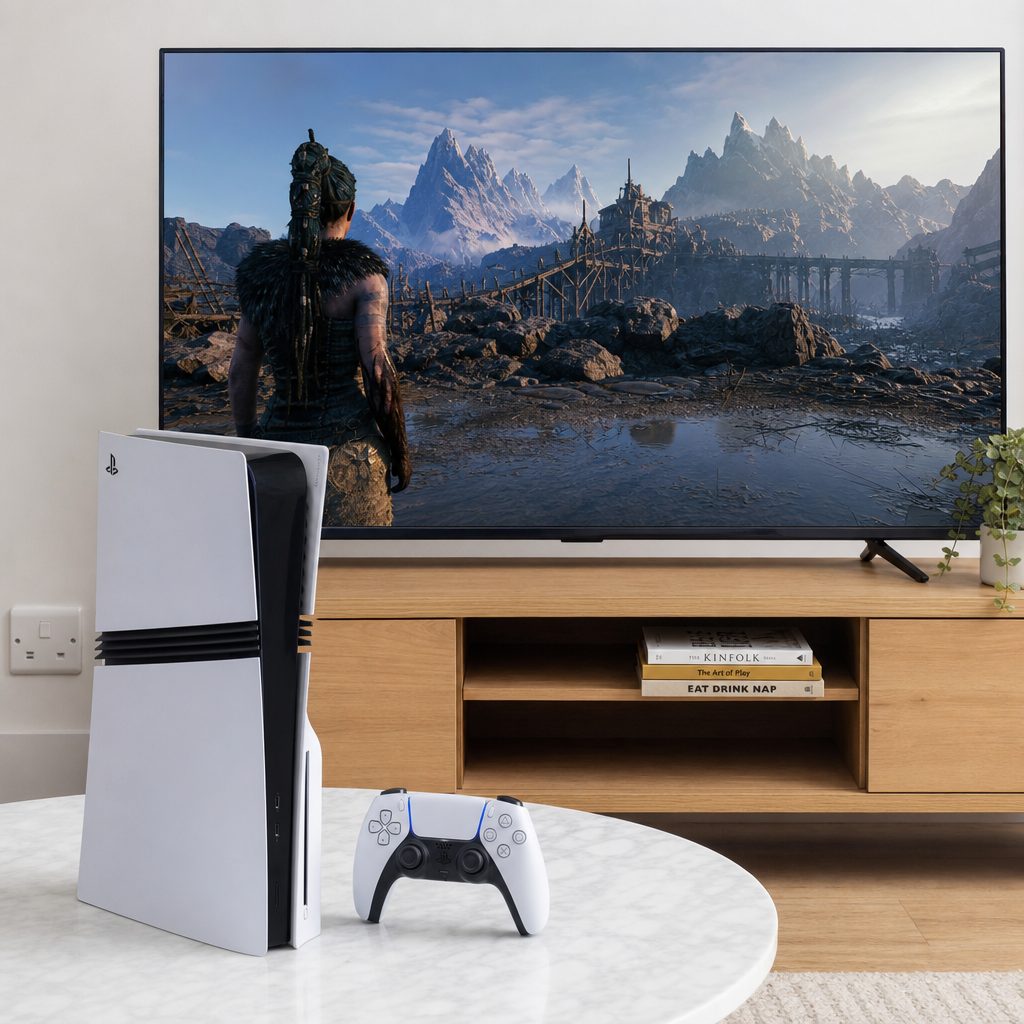
PS5 Pro's appeal was clearest on a large 4K television, where improved ray tracing, PSSR upscaling and high frame-rate output had room to show off.
But the Switch 2 was not trying to be a smaller PS5 Pro with detachable controllers. It was the machine for the person who wanted to continue a game on the sofa, in bed, at a friend's house or while somebody else commandeered the television for a programme you had allegedly agreed to watch. Its 7.9-inch 1080p screen, 120Hz capability, HDR10, VRR and Nvidia DLSS made it far more capable than the original Switch, whilst still preserving the wonderfully uncomplicated pick-up-and-play nature of Nintendo hardware.
Put plainly: the PS5 Pro was the living-room beast. Switch 2 was the portable powerhouse. The best one for you depended less on which specification looked bigger on a chart and more on whether the television was reliably yours.
Start here: if handheld play is central to your routine, Switch 2 had an advantage the PS5 Pro could not imitate. If your dream is huge games on a large 4K display with advanced lighting and high frame rates, PS5 Pro was in a different performance class.
2. Nintendo Switch 2 vs PlayStation 5 Pro at a glance
| Feature | Nintendo Switch 2 | PlayStation 5 Pro |
|---|---|---|
| Core design | Hybrid handheld and docked console | Digital-only home console |
| Graphics throughput | 3.072 TFLOPS docked; 1.71 TFLOPS undocked | 16.7 TFLOPS |
| Internal storage | 256GB UFS 3.1 | 2TB SSD |
| Display / output | 7.9-inch 1080p LCD; up to 120Hz, HDR10 and VRR | Up to 4K at 120Hz |
| Docked TV output | 720p, 1080p or 1440p up to 120Hz; 4K at 60Hz | Up to 4K at 120Hz |
| Battery | 5,220mAh / 19.74Wh; approximately 2–6.5 hours | Not applicable |
| Wireless | Wi-Fi 6 and Bluetooth | Wi-Fi 7 and Bluetooth |
| Physical approach | 534g with Joy-Con 2 attached | TV-focused console without disc drive or stand |
| Backward compatibility | Nintendo Switch games | PS5 backward compatibility remained unchanged |
The table explains the central divide rather neatly. Switch 2 gave you a screen, battery and controls in one 534g package. PS5 Pro devoted its considerable resources to graphics hardware and a generous 2TB SSD. One was designed to leave the house. The other was designed to make leaving the house feel like an unnecessary interruption.
3. Switch 2 wins on freedom to play
Shop Switch 2 wins on freedom to play on Amazon UK
The case for Switch 2 began with a simple fact: it travelled. That sounds obvious, but it changed the kind of gaming you actually did. A powerful home console can be magnificent for a planned evening. A hybrid console can fit into the awkward gaps of a day: forty minutes before school pick-up, a quiet Sunday morning, a hotel room, or that bit of the family holiday when everyone has politely run out of things to say.
The Switch 2's 7.9-inch LCD ran at 1080p and supported up to 120Hz, HDR10 and VRR. For a handheld screen, that was a meaningful step up in potential smoothness and responsiveness. VRR matters because it can help a display adapt to changing frame rates, reducing the visual ugliness that can occur when a game cannot hold one perfectly fixed performance target. It is not magic. It does not turn a demanding game into a locked 120fps marvel. But it helps the machine make intelligent use of the capability it has.
It also remained a proper television console when you were home. Docked output covered 720p, 1080p and 1440p at up to 120Hz, plus 4K at 60Hz via HDMI. The dock included Gigabit Ethernet, HDMI 2.1 and two USB 2.0 ports, so Nintendo had not treated docking as an afterthought. This was one console with two genuinely useful personalities, rather than a compromise nobody quite loved.
A complete handheld
The screen, speakers, controls, touchscreen and battery came together in one device. There was no second display to buy and no television required.
A capable docked system
Up to 120Hz at 720p, 1080p or 1440p, and 4K at 60Hz, gave Switch 2 sensible options for modern televisions.
Flexible controls
Joy-Con 2, the Switch 2 Pro Controller, touchscreen input and a noise-cancelling microphone supported both solo and social play.
More ways to connect
The Nintendo Switch 2 Camera expanded the system's social possibilities without changing the familiar hybrid formula.
4. PS5 Pro wins on raw performance and visual ambition
PS5 Pro took the opposite route. It was not interested in fitting into a backpack. It wanted to make the most demanding versions of games look more convincing on a proper television. Its GPU delivered 16.7 teraflops, with roughly 67% more compute units than the original PS5 and around 45% faster rasterisation performance. More importantly than any one headline number, it brought the GPU headroom to pursue cleaner images, higher frame rates and more ambitious ray tracing at the same time.
That last bit is key. For years, console players were often presented with the familiar "quality or performance" decision. Do you want prettier lighting and sharper visuals, or do you want smoother motion? PS5 Pro's strongest supported games aimed to narrow that gap. Its ray-tracing throughput was up to two to three times that of the original model, while PSSR used AI-powered upscaling to improve clarity at near-4K resolutions.
In real-world testing, PS5 Pro consistently delivered 4K gameplay at 60 to 120fps with ray tracing enabled in demanding games where the original PS5 had struggled to combine those targets. That was the reason to buy it. Not because every game suddenly became photorealistic, and not because every title automatically received an upgrade, but because supported games could look cleaner and run more fluidly without quite so much visual sacrifice.
That chart is deliberately blunt. Teraflops are not a universal "fun score", and different GPU architectures make simplistic comparisons imperfect. Still, the size of the gap tells the correct story: PS5 Pro had substantially more graphics horsepower. Switch 2 made clever use of its power; PS5 Pro had far more of it to begin with.
The important performance distinction
Switch 2's DLSS helped demanding games look far better than its compact hardware might suggest. PS5 Pro's PSSR and stronger GPU helped supported games chase a higher visual baseline on a 4K television. Both used smart upscaling; only one was designed around native living-room scale.
5. Cyberpunk 2077 showed the difference clearly
Cyberpunk 2077 was a useful reality check because it was exactly the sort of game that would have seemed implausible on Nintendo hardware a generation earlier. On Switch 2, it ran at 1080p and 30fps in Quality mode through DLSS. That was an impressive achievement for a handheld hybrid, and it spoke volumes about the Nvidia T239 chip and the value of the DLSS pipeline.
There was a caveat, naturally. Performance was unlocked rather than rigidly held at 60fps. Dense areas could fall into the 40s, while less demanding interiors reached the high 50s and occasional 60fps. That does not make it unplayable; it makes it a portable compromise, one many people would happily accept for the privilege of playing a game like that in handheld form.
On PS5, Cyberpunk 2077 achieved native 1440p at 30fps with ray tracing. PS5 Pro sat above the base PS5 in the broader picture because its upgraded GPU and PSSR were designed to offer stronger ray tracing and performance in enhanced titles. The detail worth remembering is that PS5 Pro's advantage was not merely a number in a technical briefing. It was visible in the form of more ambitious lighting, crisper output and a greater ability to preserve smooth movement.
Neither result invalidated the other. I would rather play a technically compromised version in my hands than not play at all during a long trip. I would rather play the most visually rich version available when I had a large television, a good pair of headphones and a free evening. Different moods. Different machines.
6. Display, sound and the room around you
Switch 2's screen deserved more respect than the old "handheld display versus television" shorthand allows. At 7.9 inches and 279ppi, it offered a crisp, dense image in the space where you actually held it. A 1080p panel at that size looks sharp, and 120Hz, HDR10 and VRR gave developers a much more modern canvas than the original Switch had enjoyed.
PS5 Pro did not include a display because it did not need to. Its experience depended heavily on the television you connected. That sounds like a drawback, but for households with a capable 4K 120Hz set, it was the point. PS5 Pro could output up to 4K at 120Hz, putting it in the right territory for a cinematic single-player game one night and a fast competitive game the next.
Audio followed the same philosophy. Switch 2 handled Linear PCM 2.0-channel stereo through its handheld speakers, with 3D audio effects, and Linear PCM 5.1-channel sound when docked. It also kept the humble headphone jack, which felt like a small victory for people who own perfectly good wired headphones and would prefer not to charge one more thing. PS5 Pro was the more natural fit for a full lounge audio setup, but Switch 2 made private, spontaneous play wonderfully straightforward.
Nintendo Switch 2 strengths
- Its 7.9-inch 1080p screen, HDR10, VRR and up-to-120Hz support made handheld gaming feel properly current.
- Handheld, tabletop and docked use came from one system rather than a separate ecosystem.
- The headphone jack and portable speakers suited quiet, personal sessions.
Nintendo Switch 2 limits
Shop Nintendo Switch 2 limits on Amazon UK
- The LCD display did not replace the sheer scale of a good 4K television.
- Demanding games could show variable performance rather than a fixed 60fps target.
- Battery life depended heavily on the game being played.
PlayStation 5 Pro strengths
- Up to 4K at 120Hz offered a formidable ceiling for a suitable television.
- Enhanced ray tracing and PSSR supported brighter, clearer, more detailed images in supported games.
- 2TB of internal SSD storage gave it far more built-in space.
PlayStation 5 Pro limits
Shop PlayStation 5 Pro limits on Amazon UK
- It was tied to a television and mains power, which made it less flexible by design.
- It shipped without a disc drive and without a stand.
- Its extra graphical potential depended on games making use of PS5 Pro enhancements.
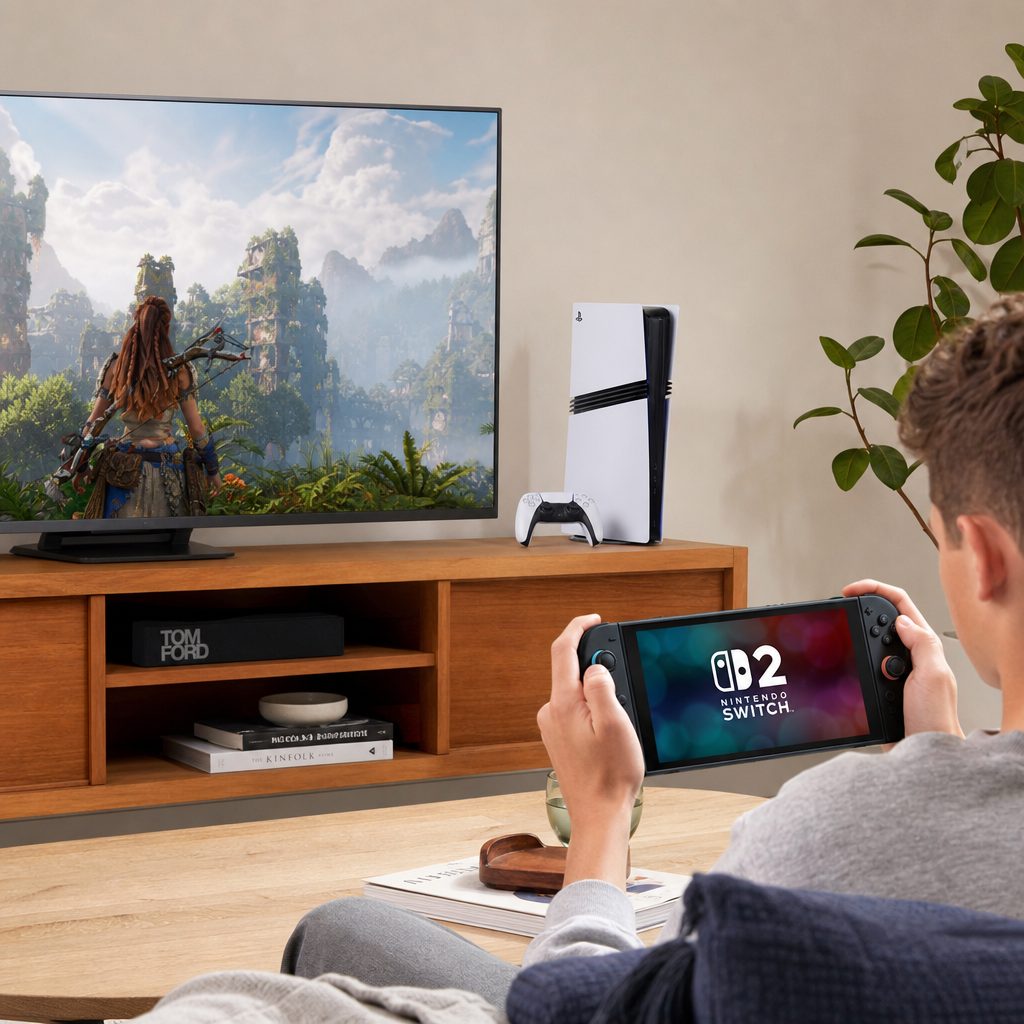
A proper 4K television unlocked the PS5 Pro's natural habitat, whilst Switch 2 remained the easier console to enjoy wherever the household happened to be.
7. Battery, heat and noise: the everyday practicalities
Portable hardware has to make peace with physics. Switch 2 packed a 5,220mAh, 19.74Wh lithium-ion battery into its body and delivered approximately two to 6.5 hours of play depending on workload. That is not a number to gloss over. A lighter indie game and a graphically intense open world were never going to ask the same amount of a battery, so buyers should plan around the lower end if they intend to play demanding modern releases away from a socket.
Charging took approximately three hours in Sleep mode. That was sensible for overnight use or topping up between sessions, although it did mean that a long day of portable gaming still benefited from a plan. A USB-C charging routine is not glamorous, but neither is a dead battery just as the boss fight gets interesting.
Thermally, the Switch 2's low-power design was a real advantage. Its T239 chip balanced performance with portability, and its revised vent placement and efficiency improvements helped it avoid excessive heat in handheld and docked play. In docked testing, even Cyberpunk 2077 and Fortnite made it practically inaudible, measuring around one dBA above the test environment's noise floor. That is excellent behaviour for a console likely to sit close to you on a desk or beside a television.
PS5 Pro naturally had a more demanding cooling job. It used improved ventilation and heat dissipation to keep itself cool over extended sessions, with quieter fans than the original PS5 reported. Informal user measurements placed it at around 32.1dBA on the main menu and approximately 42.4dBA while running around in Final Fantasy VII Rebirth, with one test recording 44.8dBA immediately after startup. Those figures were not lab-standard console benchmarks, but they painted a useful picture: audible under load, not absurdly loud, and rather less intrusive than the older "console is preparing for take-off" stereotype.
8. Storage, downloads and the question of discs
Storage is one category where PS5 Pro had a thoroughly straightforward win. Its 2TB internal SSD was spacious from the start, especially compared with Switch 2's 256GB UFS 3.1 storage. Modern games can be greedy creatures. A large internal drive means less time choosing which enormous game must make way for the next enormous game.
That does not leave Switch 2 stuck, though. It supported microSD Express cards up to 2TB, which gave buyers a clear expansion route. The crucial word is Express: this was not a case of assuming any old microSD card lying in a drawer would necessarily be the right fit. It was worth buying storage with the actual console specification in mind rather than discovering that lesson after opening the packaging.
PS5 Pro could also be expanded through its PCIe Gen4 x4 M.2 NVMe slot. Its complication was media, not capacity. The console shipped digital-only, without a disc drive, although a disc drive was sold separately for $79.99. That was a significant practical consideration for anyone with a physical PS5 collection, anyone who liked lending games to friends, or anyone who still enjoyed browsing the second-hand shelves in a game shop. Digital convenience was lovely right up until you wanted to use a disc you already owned.
Disc collection check: PS5 Pro did not include a disc drive in the box. If physical games mattered to your household, factor the separate drive into the decision rather than treating it as a small footnote after purchase.
9. Backward compatibility and the games you already own
Console buying is never only about the games you hope to play next. It is also about the pile you already own, the favourites children return to every few months and the comfort games that somehow survive every hard-drive clear-out.
Switch 2 supported Nintendo Switch backward compatibility, which was enormously useful for existing Nintendo households. It meant the huge library built around the original hybrid system did not immediately become a shelf of plastic history. For families especially, that continuity mattered. A console can be a big purchase; being able to take familiar games forward makes it feel less like starting again from scratch.
PS5 Pro's backward compatibility remained unchanged from PS5. This was a GPU and storage-focused mid-generation refresh rather than a clean-sheet new generation. Its CPU was fundamentally the same as the base PS5, memory capacity remained identical, and its appeal lay in the upgraded graphics experience rather than a redesigned software ecosystem. That made PS5 Pro a very specific proposition: it was the premium route for someone already attracted to PlayStation's games and wanting the technically strongest version of the PS5 experience.
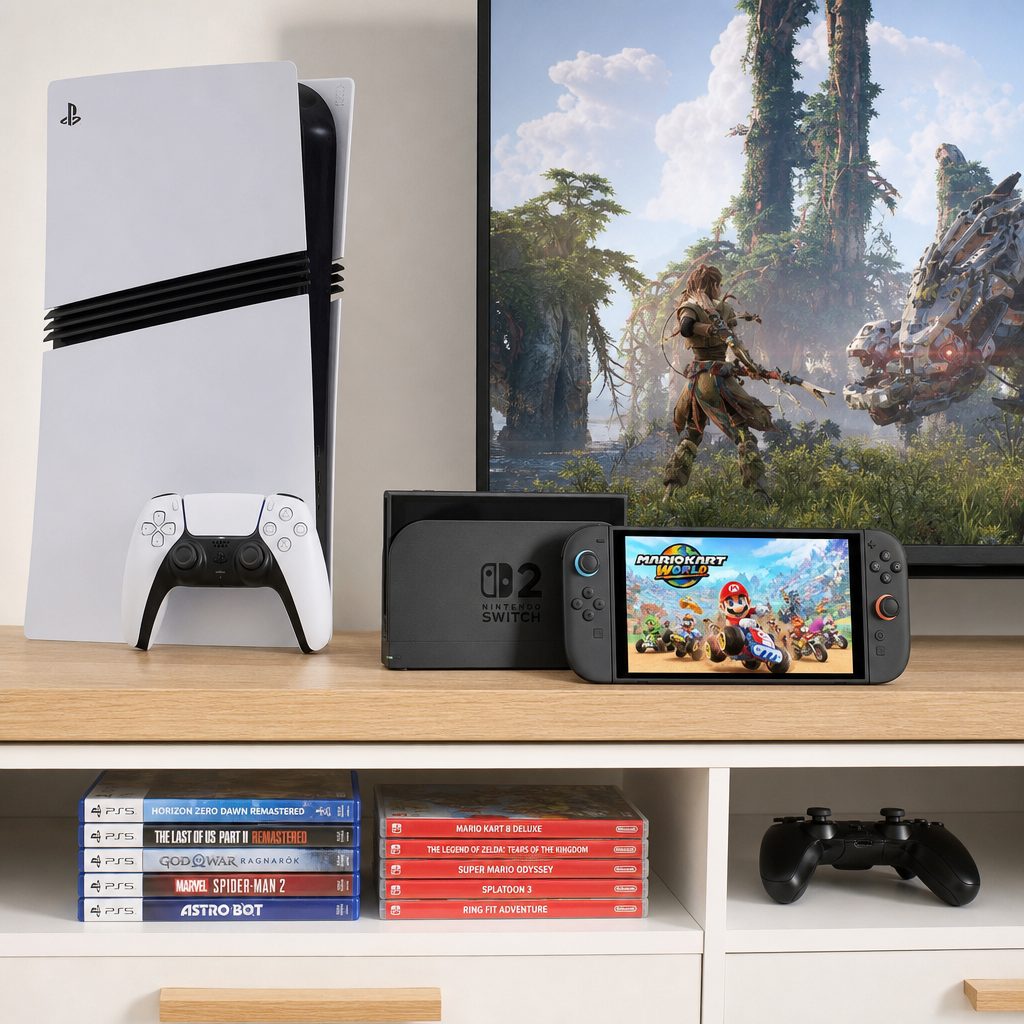
Backward compatibility made both systems easier upgrades for established households, although PS5 Pro's proposition centred on enhanced PS5 play rather than a new platform generation.
10. The best choice for different buyers
Here is where the comparison becomes pleasantly uncomplicated. There was no single champion because there was no single type of player. A student in a shared flat, a parent with limited television time, a committed home-cinema gamer and a family needing flexible multiplayer hardware could all make sensible but different choices.
Best for commuters and travellers
Nintendo Switch 2. Its built-in 7.9-inch display, battery and 534g hybrid design made gaming possible away from a television.
Best for 4K living rooms
PlayStation 5 Pro. Up to 4K at 120Hz, stronger ray tracing and PSSR made it the natural premium pick for a large modern TV.
Best for flexible family play
Nintendo Switch 2. Joy-Con 2, tabletop flexibility and a portable format suited a console that moved around the home.
Best for visual enthusiasts
PlayStation 5 Pro. Its 16.7-teraflop GPU and up-to-three-times ray-tracing throughput were built for this exact audience.
I would add one more human category: the person who rarely has uninterrupted gaming time. That buyer should take Switch 2 very seriously. Its power was not remotely equivalent to PS5 Pro's, but accessibility is a form of value. The console you can play for half an hour four times a week may bring more joy than the formidable machine waiting for the one free evening that never quite arrives.
11. Which console had the better long-term proposition?
Switch 2's long-term strength was its versatility. Nvidia DLSS, 12GB of LPDDR5X memory and 1,536 Ampere-based CUDA cores gave developers room to bring much more demanding software to Nintendo's platform than the original Switch could comfortably handle. Its 9GB of developer-accessible RAM and DLSS pipeline helped explain how games in the Cyberpunk 2077 and Elden Ring-class open-world mould could run on Nintendo hardware at all.
PS5 Pro's long-term strength was not portability or a radically new architecture. It was the ability to extend the life of current-generation games with better rendering, clearer reconstruction and stronger ray tracing. It was a premium enthusiast console, deliberately targeted at people who noticed image quality and frame-rate trade-offs and wanted fewer of them.
That makes both machines slightly specialist, just in different directions. Switch 2 specialised in being available. PS5 Pro specialised in being impressive. Neither is a bad specialism. Frankly, both are more useful than the dreaded middle ground: a machine too bulky to travel with and too underpowered to shine on the telly.
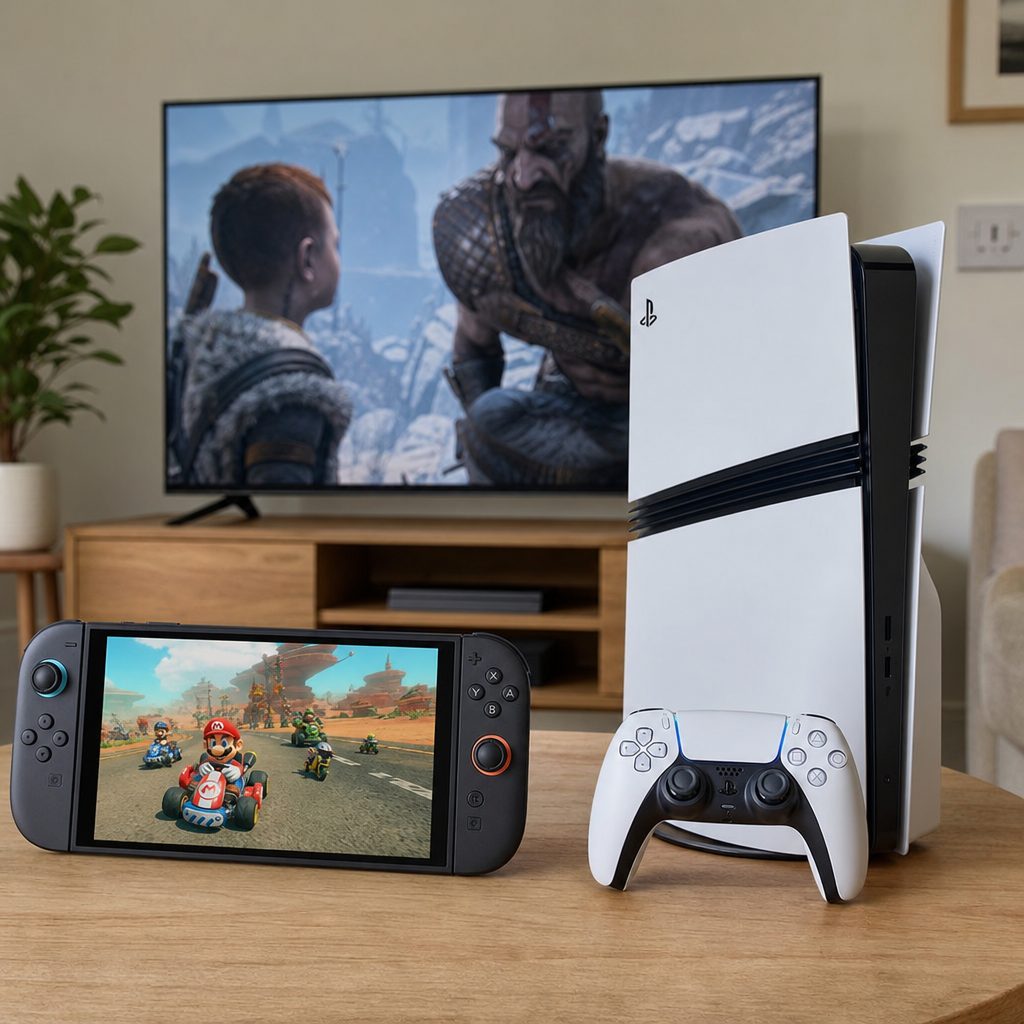
The choice came down to priorities rather than a single specification score: Switch 2 made high-quality gaming more available, while PS5 Pro made supported TV gaming more spectacular.
12. Frequently asked questions
No. Switch 2 delivered 3.072 TFLOPS when docked and 1.71 TFLOPS undocked, while PS5 Pro had a 16.7-teraflop GPU. Switch 2 used DLSS intelligently to deliver impressive ports in a compact hybrid format, but PS5 Pro had substantially more graphics headroom.
Yes. In docked mode, Switch 2 could output 4K at 60Hz through HDMI, as well as 720p, 1080p and 1440p at up to 120Hz. Its own handheld display was a 7.9-inch 1080p LCD.
Its 5,220mAh, 19.74Wh battery delivered approximately two to 6.5 hours depending on the game. Graphically intensive titles naturally sat closer to the lower end, so regular travellers should treat a charging plan as part of the ownership experience.
No. PS5 Pro shipped as a digital-only console and did not include a stand either. A disc drive was sold separately for $79.99, so physical-game owners needed to account for that before choosing it.
Switch 2 was exceptionally quiet in docked testing, sitting around one dBA above the test environment's noise floor even with Cyberpunk 2077 and Fortnite. PS5 Pro had improved cooling and quieter fans than the original PS5, though informal user readings showed it could be audible under load.
Yes. Switch 2 supported Nintendo Switch backward compatibility, making it a notably easy upgrade for households with an existing game library.
PlayStation Spectral Super Resolution was Sony's AI-powered upscaling technology. It was designed to improve image clarity and help supported games achieve higher frame rates at near-4K resolutions, complementing PS5 Pro's stronger GPU and ray-tracing capabilities.
For a family that shared screens and moved gaming between rooms, Switch 2 was usually the more accommodating choice. Its handheld, tabletop and docked modes, plus Joy-Con 2 controls, gave it a flexibility PS5 Pro was never intended to match.
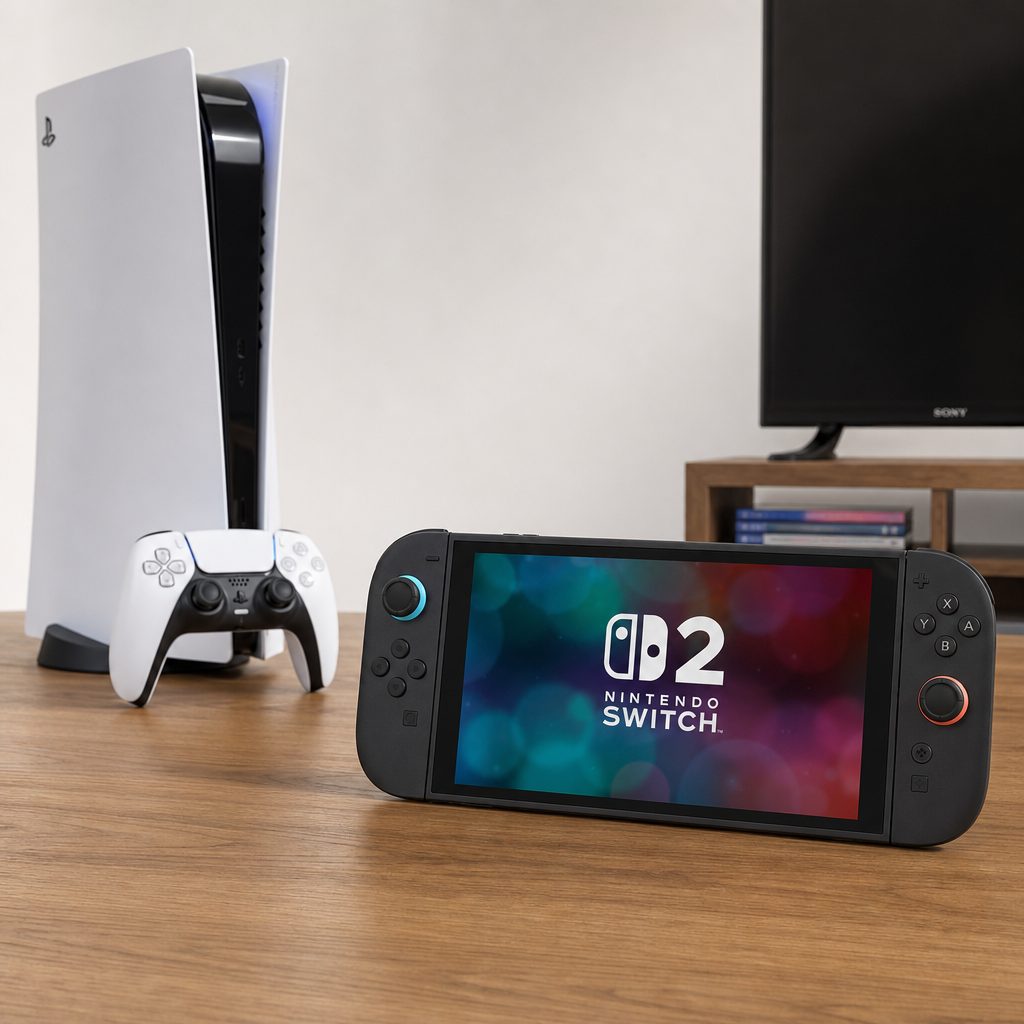
For some players, the best console was simply the one they could use most often — and that was the central strength of Switch 2's hybrid design.
Final verdict: portable powerhouse or living-room beast?
Buy Nintendo Switch 2 if gaming needs to fit around real life. It was the better choice for handheld play, travel, family flexibility, shared televisions and anyone who valued the ability to play wherever they happened to be. Its screen, DLSS-supported performance, quiet docked operation and Nintendo Switch backward compatibility made it much more than a convenient secondary console.
Buy PlayStation 5 Pro if your priority was the finest possible console image on a capable 4K television. Its 16.7-teraflop GPU, enhanced ray tracing, PSSR, 2TB SSD and 4K-at-120Hz output made it the clear choice for players who wanted supported games to look and run at their most ambitious.
Switch 2 was not a cut-price PS5 Pro, and PS5 Pro was not a Switch 2 that had forgotten to pack a screen. One gave you excellent games almost anywhere. The other gave you spectacular games in the best seat in the house. Choose the version of gaming you will actually live with, and you will have chosen well.