What Every Parent Should Know Before Buying a First Console
A first games console can be a lovely family purchase: a new way to play together, tell stories, solve problems and occasionally discover that your child is alarmingly good at racing games. It can also bring accounts, downloads, online chat and the immortal cry of "just one more go". Here is how to choose calmly, set sensible boundaries and make the first week feel exciting rather than exhausting.
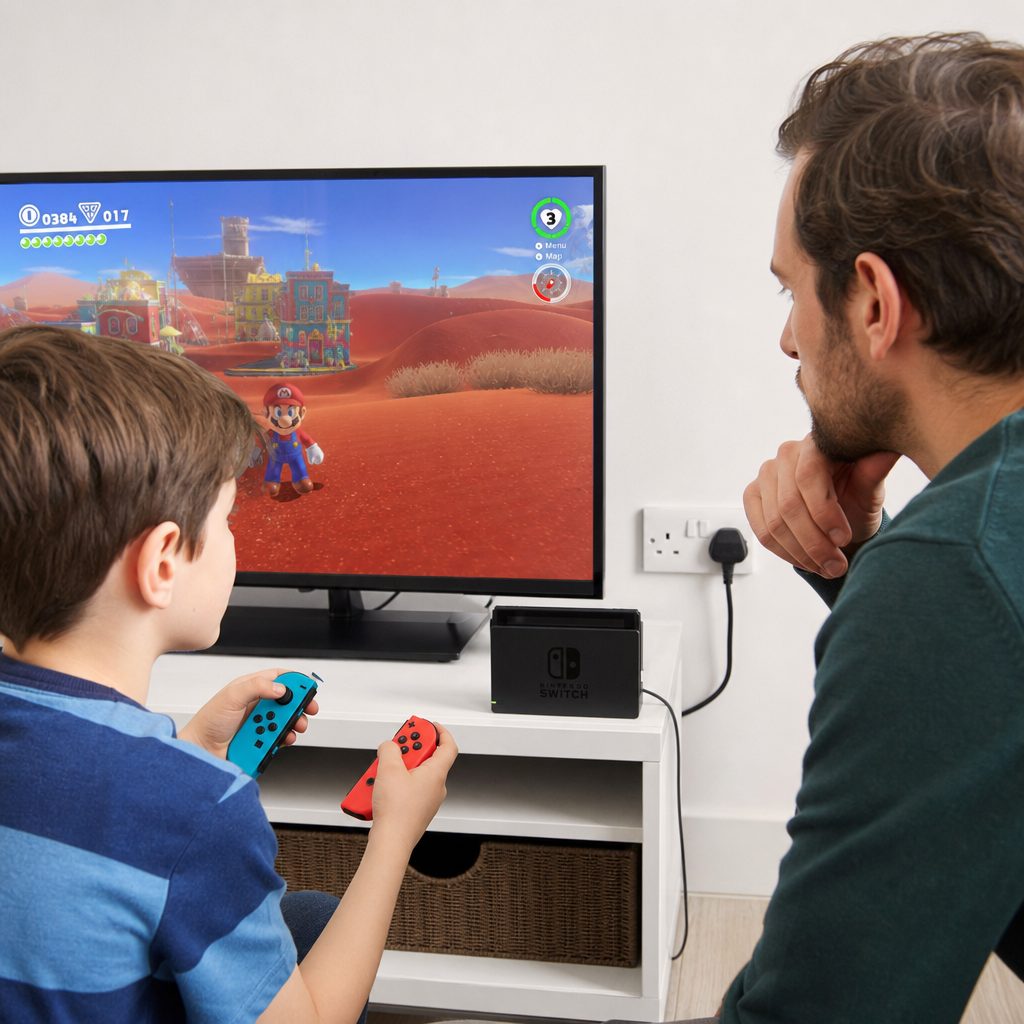
Watching how your child handles a controller, a menu and a small setback tells you more than an age label ever can.
1. Start with your family, not the console aisle
The biggest mistake is assuming there is one objectively "best" first console. There is not. There is only the machine that fits your child, your home, your television habits, your tolerance for menu screens and the amount of help you are genuinely willing to provide after school on a rainy Tuesday.
Before comparing Switch 2, PlayStation 5 and handheld options, decide what you hope gaming will look like in your house. Is this mainly a shared living-room activity? A reward for a child who already loves particular characters or games? Something for travel and waiting rooms? Or a hobby an older child will use independently, whilst you remain close enough to take an interest?
That question changes everything. A console can be wonderfully social, but only if the family actually has moments when somebody wants to sit down and play. It can be a useful independent pastime, too, but that works best when the child can understand the system well enough not to turn every login, update or pop-up into a family summit.
I would also resist buying a console solely because "everyone at school has one". That may be true, or it may be playground mythology of the highest order. Your child may value being able to join a conversation about a game, but the right purchase is still one that works safely and sustainably at home.
The parent-first rule
Buy the console you can confidently supervise, not the one with the loudest marketing or the longest list of things it might do. A simple, well-managed setup beats an ambitious one that leaves everyone confused.
2. Judge readiness by habits, not simply by age

Age guidance matters, particularly for game content, but it is only one part of the picture. Two children of the same age can have completely different levels of patience, confidence, emotional regulation and ability to stop when asked. One will happily hand over the controller at teatime. The other may negotiate as though they have been appointed legal counsel for the final level.
A child is probably ready for a first console if they can cope with a few basic realities of games: they can lose without melting down every time, ask for help rather than repeatedly pressing random buttons, understand that a game may contain purchases or online features they cannot access, and accept that adults keep the account password.
They do not need to be technical. Nobody was born knowing what a download queue is. They do need to be able to learn gradually and to trust that household rules are not punishment. If gaming already feels like a forbidden treasure chest, every boundary becomes more dramatic than it needs to be.
Emotional resilience
Look for a child who can recover from a lost race, failed puzzle or interrupted turn without feeling that the entire evening has been ruined.
Willingness to talk
The best safety tool is a child who will tell you when a message, character, advert or game moment makes them uncomfortable.
Ability to stop
Practise ending other enjoyable activities first. If stopping a favourite programme is a battle, gaming needs a very clear routine from day one.
Understanding limits
Children do better with short, familiar rules: ask before buying, play where adults can see, and tell us if something online feels odd.
For younger children, think of the console as a family device. You launch games together, choose what is played and stay nearby. For older children, you can progressively hand over more responsibility. That gradual approach is far kinder than either extreme: hovering over every button forever, or giving a child an unrestricted account and hoping they will somehow absorb the manual through the packaging.
3. Choose where the console will live before you buy it
Location is an underestimated parenting tool. A console in a shared room makes the early weeks easier because adults naturally hear what is happening, siblings can take turns, and gaming remains part of ordinary family life rather than a private activity behind a closed door.
This is not about spying. It is about building familiarity. When you are within earshot, your child is much more likely to say, "What does this mean?" before clicking through a message or prompt. You also learn what they enjoy. That makes later conversations more specific than the usual parental classic of "Are you playing that game again?"
A bedroom setup can work for a mature older child, but it is rarely the simplest starting point. It can make stopping harder, blur the line between winding down and staying stimulated, and reduce the little conversations that teach children how to handle games well. Begin in the communal space and revisit the decision later if it continues to suit everyone.
A shared location also helps with accessibility. Use the display and navigation options available on devices and services, and invite your child to say if text, menus, sound or controls are difficult to follow. Comfortable navigation is not a luxury; it helps a child stay independent and prevents frustration becoming the main event.
Think about the practicalities as well. Where will controllers be put after use? Who charges a portable device? What happens when a sibling wants the television? A small basket, a named shelf and a reliable charging habit sound almost aggressively unglamorous, but they prevent a remarkable number of arguments.
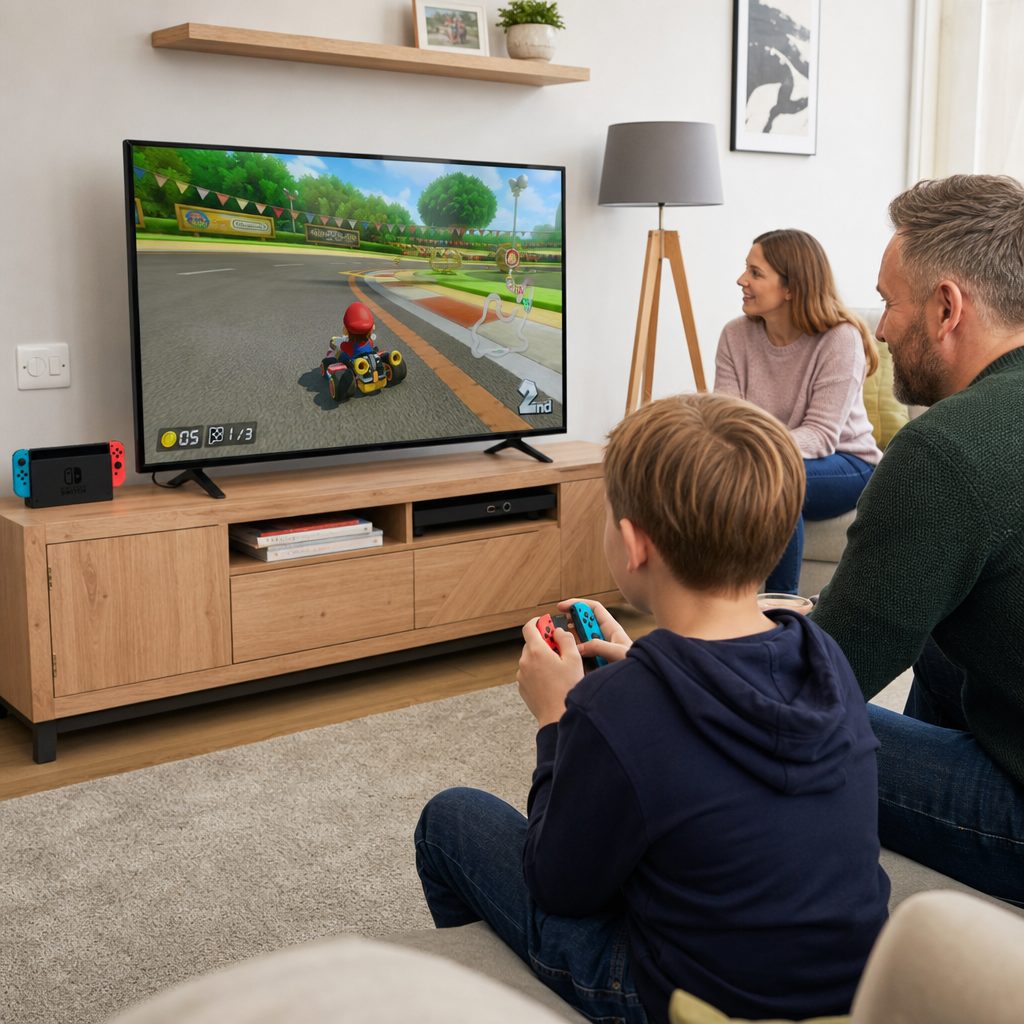
A visible family gaming spot makes turn-taking, supervision and the occasional "please pause now" far less confrontational.
4. Understand the three broad ways children can play
For a first console, the format matters as much as the logo. Broadly, families tend to choose a living-room console, a portable or hybrid machine, or a handheld device. Each can be excellent. Each also asks something different of the child and household.
A living-room console suits families who want games to be a shared event. The television becomes the gathering point, and it is easier to notice what is being played. The trade-off is that the television is often needed for other things, which means you should agree in advance whether gaming happens before dinner, after homework, at weekends or during a clearly defined family slot.
A portable or hybrid option can be appealing because it offers flexibility. It may fit a family that travels, has more than one television dispute in circulation, or wants the choice between playing together and playing in a quieter corner. Flexibility is useful, but portability can also make play less visible. Establish where it is stored and when it is allowed out.
A dedicated handheld can make gaming feel personal and contained. That can be brilliant for a confident child who likes solo puzzle, adventure or creative play. It is less ideal if your real goal is to create a new family activity, or if your child still benefits from adult help navigating menus and choices.
Those are not performance scores. They are a useful way to visualise the priorities that matter in a first-console decision. The "best" format changes depending on whether you want the family gathered around one screen or you need something that fits around a busy home.
5. Switch 2, PlayStation 5 and handhelds: compare the experience, not the hype
It is tempting to treat the choice as a straight contest between Switch 2, PlayStation 5 and handheld gaming. For a parent, it is more useful to compare the kind of household experience each route could support. You are not merely buying a box that runs games. You are choosing where play happens, how much help it needs, and whether your child is likely to play alone, with siblings or with friends.
Switch 2 may be the better conversation starter for a family already looking at games that encourage shared turns and familiar characters. PlayStation 5 may be the more natural route for an older child who is increasingly interested in the games their peers discuss and who can manage a more independent gaming hobby. A handheld may be the cleanest fit when portability is the point and the child is ready for the responsibility of looking after their own device.
Notice the wording there: may. The game library you choose, the account restrictions you set and the routines you agree will shape the experience more than brand loyalty ever will. A beautifully chosen console with unsuitable games remains unsuitable. A modest setup with brilliant boundaries can become one of the family's favourite things.
| Parent question | Switch 2 route | PlayStation 5 route | Handheld route |
|---|---|---|---|
| Where will most play happen? | Consider it if you want flexibility between shared and personal play. | Consider it if a main television setup suits the household. | Consider it if portable, personal play is the central need. |
| How much adult help is realistic? | Plan early sessions together, especially around accounts and game choices. | Plan time to learn menus, user settings and household rules together. | Make charging, storage and careful handling part of the routine. |
| What is the social goal? | Good fit to investigate where turn-taking is your priority. | Good fit to investigate for an older child's established hobby. | Good fit to investigate for quiet, self-contained play. |
| What needs the closest attention? | Whether portable use will happen in agreed places and times. | Whether online features and mature-looking game marketing are understood. | Whether a personal device will be charged, found and put away reliably. |
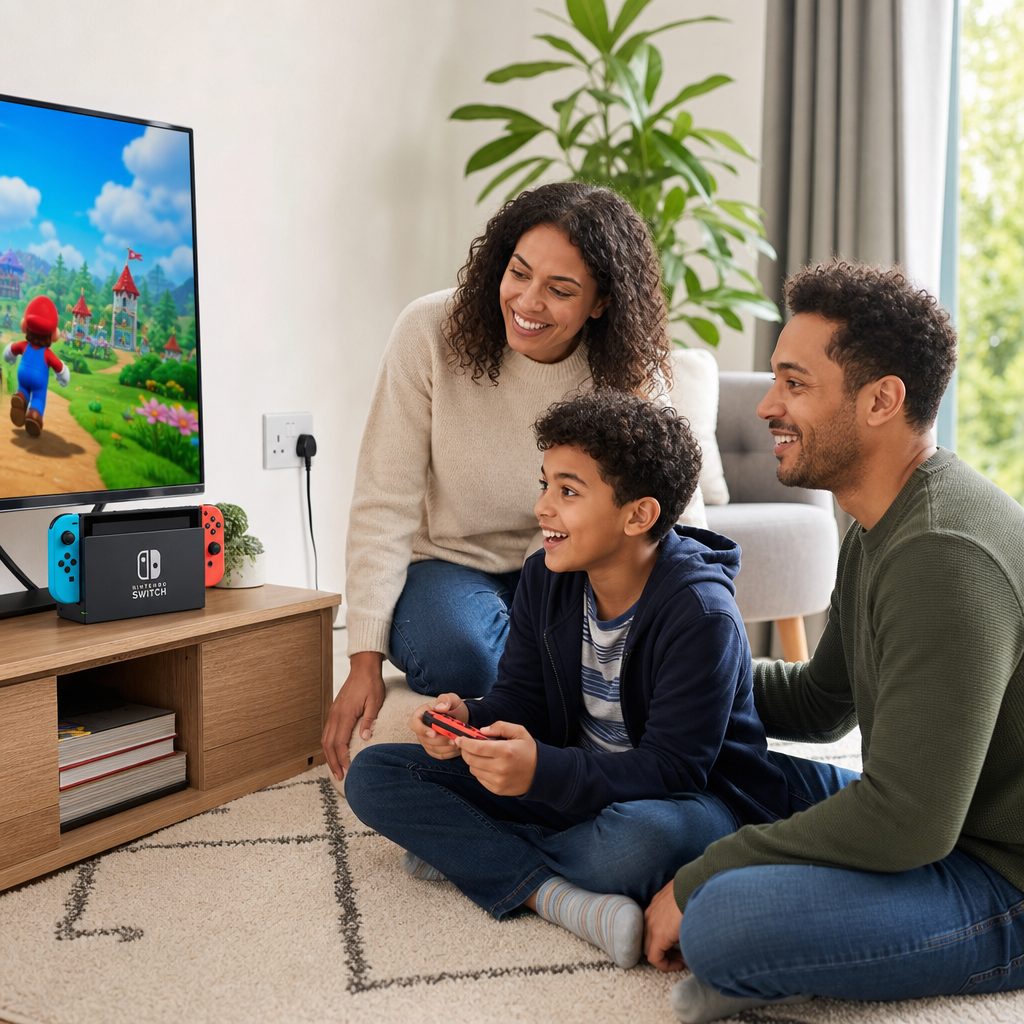
The logo matters less than the routine around it: where it plays, who can join, and what happens when the session ends.
What a first console can do well
- Create a genuinely enjoyable shared activity for adults and children.
- Give children chances to practise persistence, planning and turn-taking.
- Offer a social language around favourite games, characters and challenges.
- Provide a relaxing hobby when it sits alongside sleep, school, movement and friends.
What needs managing
- Excitement can make stopping difficult, particularly at the beginning.
- Online features can move faster than a child's judgement.
- Downloads, prompts and purchases require an adult-led setup.
- Gaming can become the default answer to boredom if no routine exists.
6. Set up parental controls before the first game begins
If there is one piece of advice worth putting in enormous letters on the front of every console box, it is this: do the grown-up setup before handing the controller over. Not later that night. Not after the first accidental purchase or mysterious friend request. Before.
Create the parent or family account yourself, keep the password private and use a child profile where that is appropriate. Work through the options for game access, communication, friends, purchases and play limits carefully. The labels differ between systems, but the principle is consistent: choose the permissions deliberately rather than accepting every default because the child is bouncing beside you.
Explain controls out loud as you set them. Children should know that the restrictions are there to help them enjoy games safely, not because you think they are untrustworthy. Tell them what they can do if a friend asks them to join something, if an unfamiliar person contacts them, or if an advert makes them want to buy an add-on. "Come and ask me" is a much stronger rule when they have heard it before they need it.
Protect the adult account
Keep payment details and the parent password under adult control. Do not make it a puzzle for a clever child to solve.
Decide on communication
Consider whether chat, messages and friend requests are necessary for the games your child will actually play. Often, they are not.
Make purchases intentional
Agree that no paid item is bought without an adult. This removes pressure and gives you time to decide together.
Teach reporting, not secrecy
Your child should know that strange, upsetting or pushy behaviour online is something to report, never something to hide.
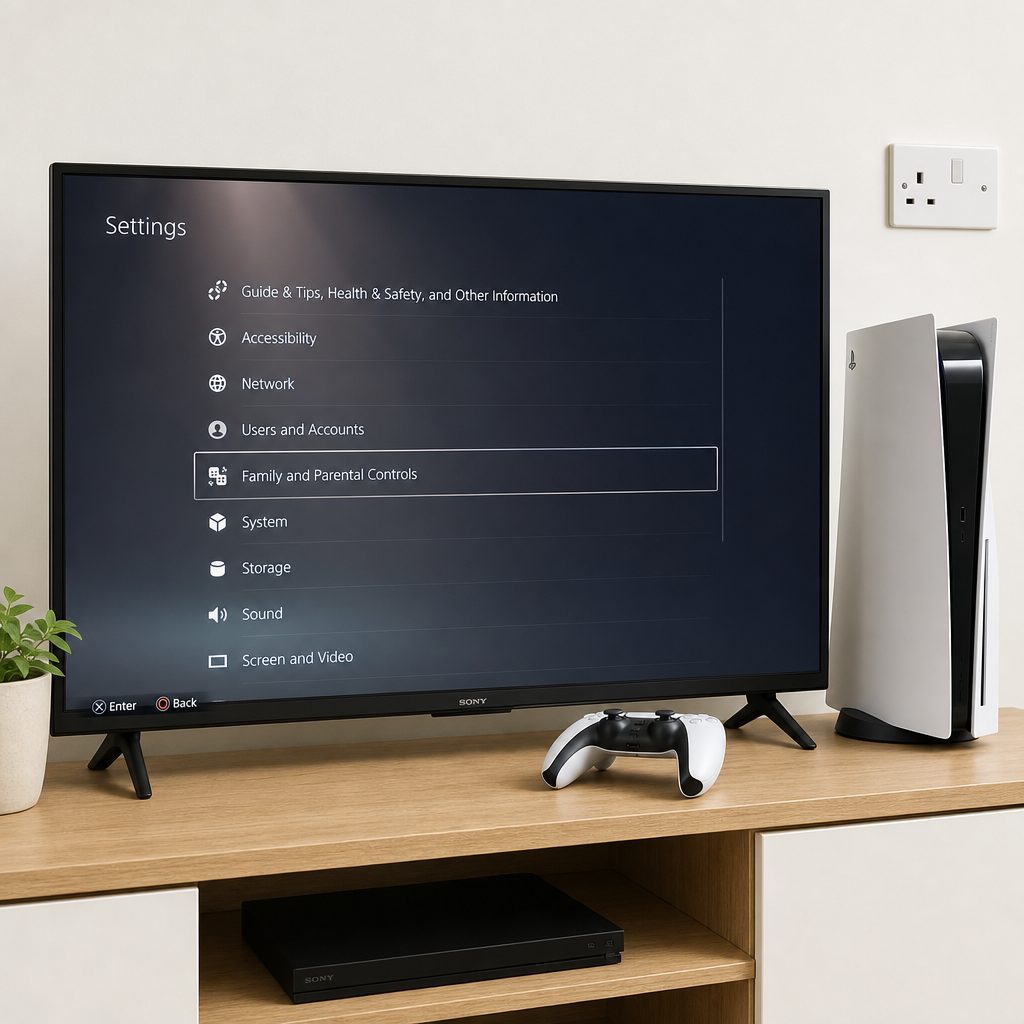
The boring-looking settings screen is where a calm, family-friendly gaming experience begins.
7. Treat spending as a household rule, not a surprise
A console is rarely the final purchase. Games, accessories, subscriptions, downloadable content and tempting in-game offers can all enter the picture. That does not make gaming a bad choice. It simply means the financial conversation should happen at the start, whilst everyone is still in a sensible mood and nobody is staring at a limited-time digital hat.
Decide what counts as a birthday or Christmas gift, what the child might save towards, and what requires adult agreement. You do not need to turn the living room into the Treasury, but children benefit from understanding that digital items are still purchases. If they want something extra, talk about whether it adds meaningful play or merely capitalises on a moment of excitement.
For a first console, fewer well-chosen games are often better than an enormous pile. A child has time to learn the controls, become comfortable with the world and discover what type of play they really enjoy. You also learn whether they prefer racing, puzzles, sport, building, stories, rhythm, co-operative challenges or something else entirely.
A useful family sentence
"We do not buy things inside games without talking first." Keep it short, repeat it calmly and apply it consistently. A rule does not need a lengthy speech to be effective.
Do not feel pressured to buy everything at once. The early weeks are partly an experiment. You are finding out how the console fits into your family and whether the first game choice was a hit. Leave room for that discovery rather than trying to predict an entire gaming childhood from one shopping trip.
8. Pick the first games with more care than the console
Parents often spend weeks comparing machines and then grab a game near the checkout because the cover looks cheerful. I understand the impulse. The console decision feels big; the game feels like an accessory. In practice, the game dictates what your child actually experiences: its tone, difficulty, pace, online features, language, pressure points and the reason they keep asking for another turn.
Check age guidance and content descriptions every time, even when a game appears colourful or is based on a familiar brand. Look beyond violence or scary imagery. Consider competitive pressure, frustration level, online interaction, advertising, purchases, reading demands and whether the game can be paused easily when dinner is ready. The humble pause function has saved many peaceful evenings.
For a first game, I favour something with a gentle learning curve, clear goals and room for adults to join or watch without needing a degree in button combinations. Co-operative games can be especially useful because you and your child are on the same side. A tricky section becomes a shared problem rather than an audition for the role of Household Gaming Champion.
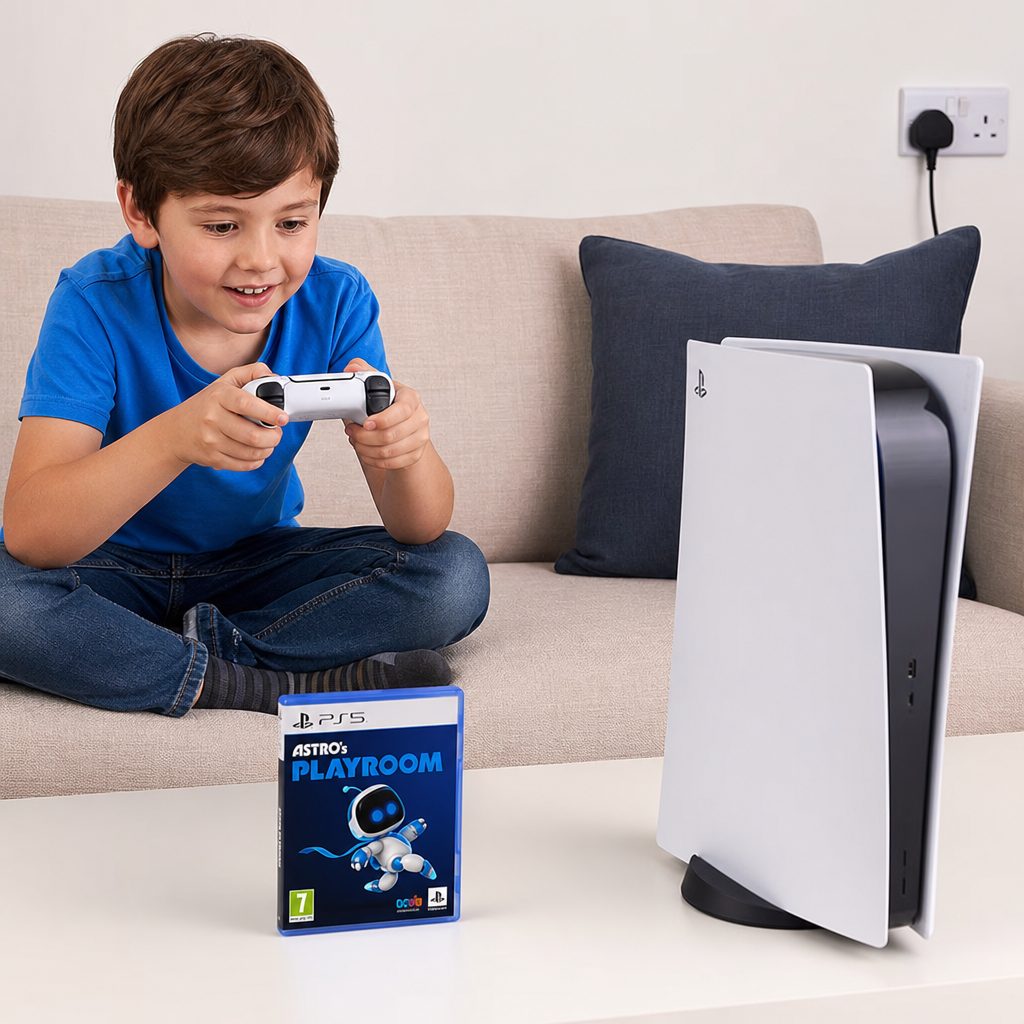
The first game should give your child a confident beginning, not a difficult lesson in menus, pressure and disappointment.
Shared living-room setup
Choose the console and games that make turn-taking and adult participation easiest in your particular home.
Handheld route
Best for families whose main need is travel-friendly, contained play and whose child can manage storage and charging.
Switch 2 route
Consider this route if flexible play and a family-friendly starting conversation are your priorities.
PlayStation 5 route
Consider this route for a child ready to develop a more independent hobby with active adult account management.
9. Build a gaming routine before gaming becomes a negotiation
The first fortnight sets the tone. If the console appears at random whenever somebody is bored, tired, upset or determined to avoid putting shoes on, it quickly becomes difficult to draw a boundary. If it has a familiar place in the week, it is just another activity: enjoyable, anticipated and not in charge of the house.
Choose rules that you can realistically enforce. "Only when every homework task is perfect, every bedroom is immaculate and all vegetables have been enthusiastically applauded" is not a routine. It is an invitation to a courtroom drama. Better rules are concrete: gaming after a particular task, only in a shared room, no game before school, controller returned to its place, adults asked before joining anything online.
Give warnings before the end of a session. Children often struggle less with a limit than with a sudden transition. Remind them that they have a little time left, then ask them to reach a sensible stopping point where possible. Do not promise that every game can end at the exact perfect moment, because games are spectacularly good at presenting a new tempting objective precisely when you need to leave.
Review the routine after a little while. Is it causing constant arguments? Is your child taking responsibility for putting things away? Do they play happily and move on, or do they seem increasingly wound up? A first console is not a lifetime contract. You can change where it lives, which games are available and how play fits around the family.
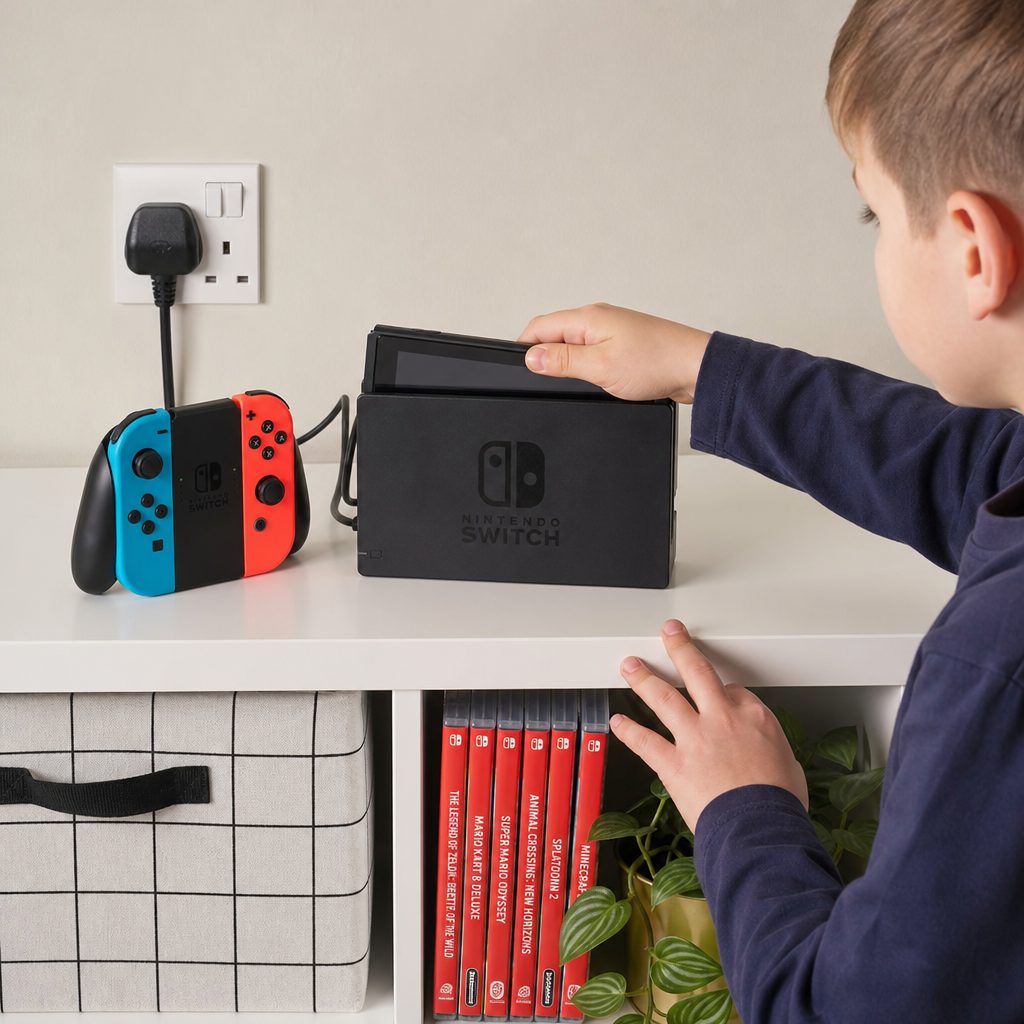
A charging spot and a simple storage routine make the end of play feel ordinary rather than like a confiscation.
10. Questions parents ask before buying a first console
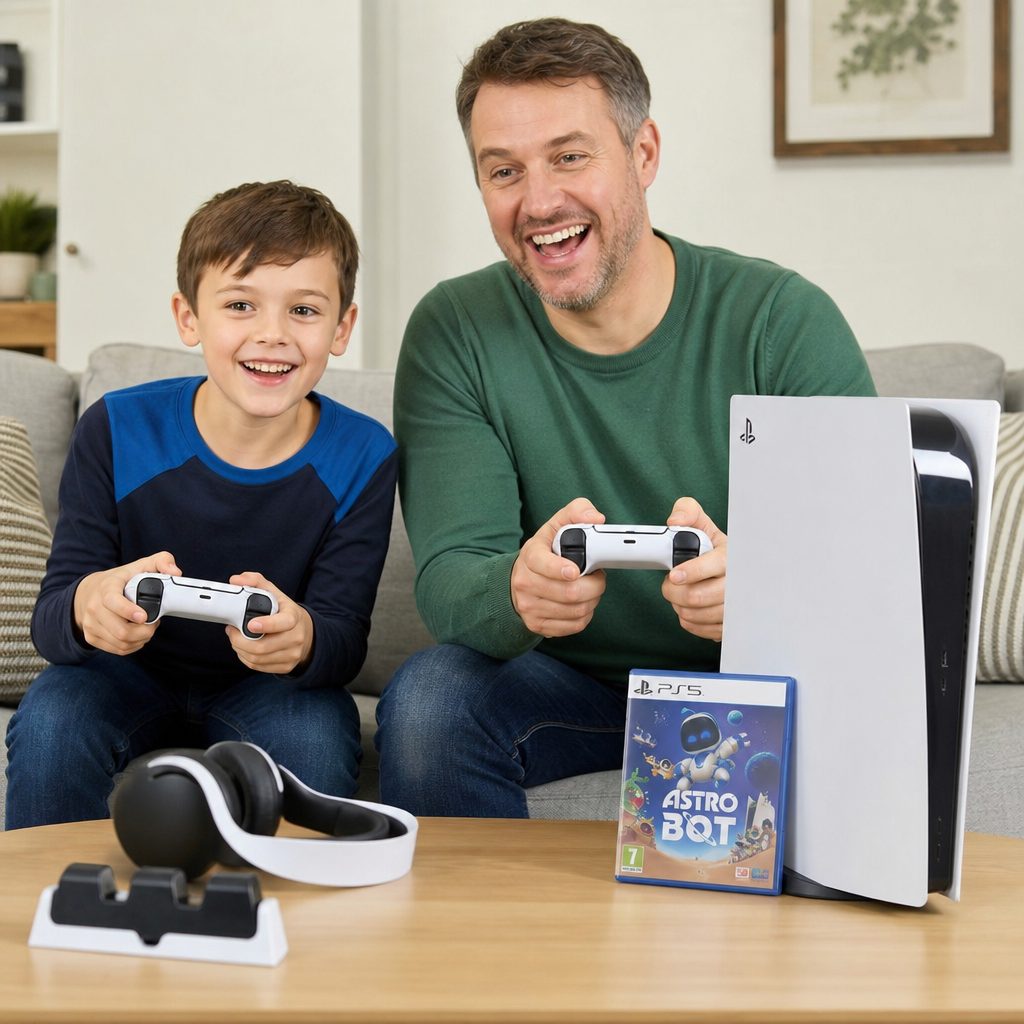
The ideal first console creates good memories around games, not a permanent argument about them.
The bottom line
A first console is a better purchase when you see it as a family system rather than a gadget. Choose the format that fits where and how your child will play, select games with as much care as the hardware, set parental controls before launch day, and make the routine clear from the start.
For most families, the winning choice is not automatically Switch 2, PlayStation 5 or a handheld. It is the option that your child can enjoy safely, that you can supervise without becoming the household technology department, and that leaves room for school, sleep, friends, fresh air and all the other splendidly non-digital parts of childhood.