DJI Flip drone review for families: the beginner drone with built-in propeller guards, from £269 in the UK
DJI Flip arrived in January 2025 with an unusually family-friendly idea at its centre: wrap all four propellers in permanent guards, then combine them with a proper 3-axis camera and simple palm-controlled filming. In July 2026, it remained one of DJI's most approachable flying cameras — although "approachable" should never be confused with "something to hand to a child and forget about".
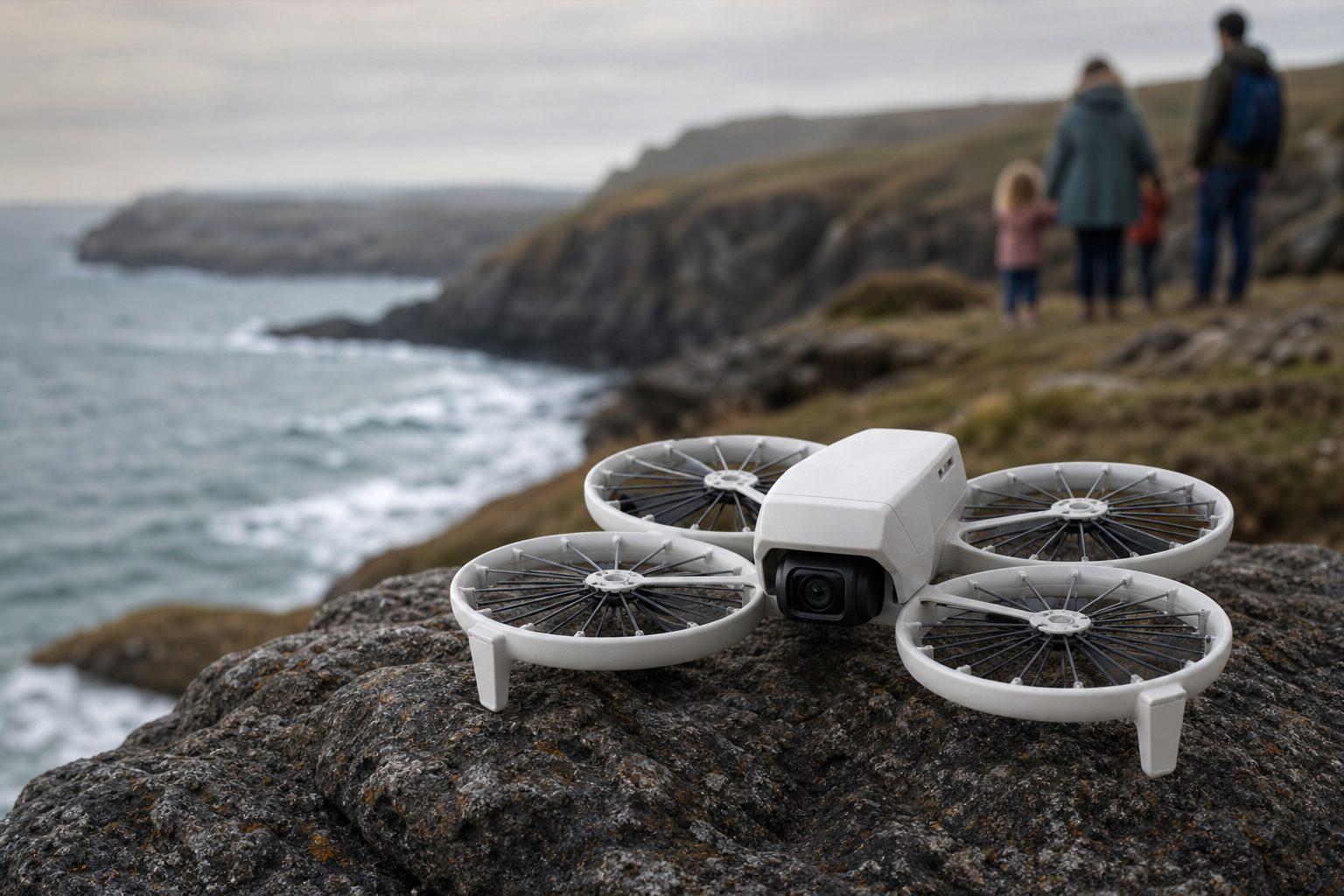
DJI Flip's folding propeller cages are the headline feature: a practical bit of reassurance for families, rather than merely a dramatic-looking design flourish.
DJI Flip at a glance
There are drones designed for heroic mountain shots, drones built for serious commercial work, and drones that seem to require a small flight school before you can make a cup of tea. DJI Flip was more interested in the ordinary family moment: a walk at the beach, a birthday in the garden, a holiday viewpoint, or getting everybody into the photo without balancing your phone against a tree.
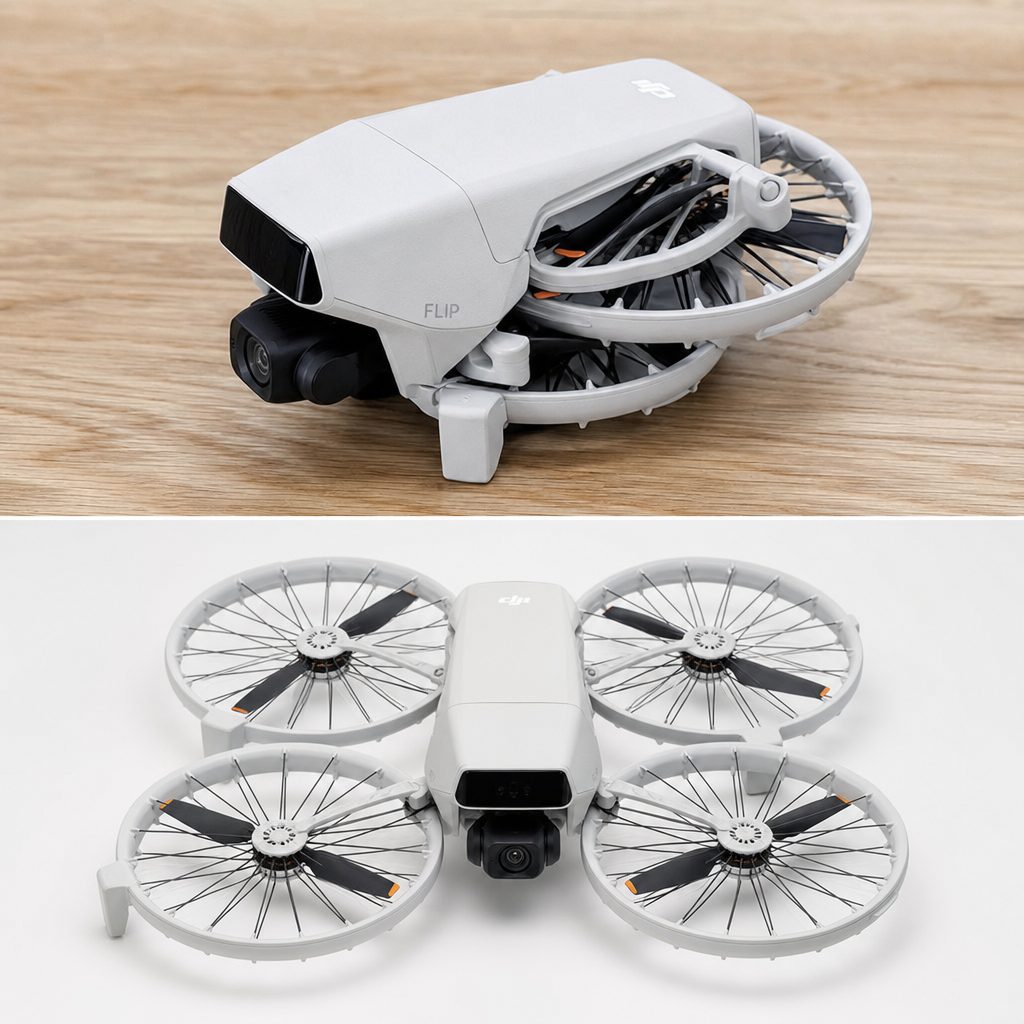
Folded for travel, DJI Flip is compact enough for a family day out; unfolded, its full perimeter guards remain around each propeller.
Its central trick was simple but genuinely useful. The propellers sat inside fixed, cinewhoop-style guards rather than being exposed on thin arms. That makes the drone less intimidating when it is taking off from a palm, tracking a child across a field, or hovering near people who quite reasonably do not want a small collection of spinning blades near their hair. The guards fold underneath for storage, so the aircraft still packs down neatly rather than becoming a giant plastic dinner plate.
The 249g weight matters because it makes Flip a notably light, portable camera drone. The folded body measured 136 x 62 x 165mm, whilst opening it up produced a 233 x 280 x 79mm flying machine. That is compact enough to feel plausible in a day bag, rather than another large item competing with jumpers, snacks and the half-empty water bottle everyone insists they will drink later.
A family drone, not a toy drone: Flip's guards reduce the exposed-propeller worry, but it was still a fast, camera-equipped aircraft. A responsible adult should remain in charge, choose an open area, keep people and animals at a sensible distance, and check the relevant flight rules before every outing.
DJI Flip design: the guards are the point
Shop DJI Flip design on Amazon UK
DJI has made plenty of small folding drones before, but Flip did not look like it was following the usual script. Instead of four delicate arms ending in uncovered propellers, its structural guards dominate the silhouette. Polycarbonate protected the edges, while lightweight carbon-fibre string formed the upper and lower parts of the cages. DJI described the guard support structure as one-sixtieth the weight of conventional polycarbonate material whilst retaining stiffness and durability. That is a very technical way of saying the drone was trying not to become a brick.
The result is more reassuring in the hand than a traditional mini drone. When a parent is learning, the fear is often not "will I make a terrible film?" It is "what happens when I press the wrong thing and it comes towards us?" Guarded props cannot make every mistake harmless, of course. They do not make walls vanish, protect the gimbal from every knock, or turn a drone into an indoor plaything. They do, however, place a physical barrier around the blades. That is a meaningful practical difference.
Unfolding the arms also powered the aircraft on automatically. It sounds tiny, yet it removes one of those friction points that can make casual gadgets feel like a project. Pick it up, unfold it, let it wake up, and decide whether you want a quick palm launch or a more deliberate flight with a controller. For family use, those saved seconds add up. A small window between rain showers or a restless child's willingness to be filmed can disappear surprisingly quickly.
Permanent propeller protection
The blades remained enclosed in flight rather than relying on guards that must be fitted, removed and eventually misplaced in a drawer.
Palm take-off
A useful route to a quick group clip or selfie shot without immediately reaching for a remote controller.
Automatic power-on
Unfolding the drone woke it up, making it feel less like specialist kit and more like a camera you might actually use.
Travel-friendly folding form
The guards folded underneath the airframe for a compact 136 x 62 x 165mm packed shape.
The compromise is that Flip is not a stealthy little thing. It was noted as comparatively loud, and that is worth spelling out because drone noise changes the mood of a family outing. It can turn "we are taking a lovely video" into "what is that mechanical wasp doing above the picnic?" The guarded design is excellent for confidence, but it does not make the drone discreet.
Flying DJI Flip as a beginner
Shop Flying DJI Flip as a beginner on Amazon UK
For a nervous first-time pilot, the nicest thing about Flip is that it gives you several ways to start. You could use the DJI Fly app, voice control, palm take-off, the RC-N3 controller or DJI's RC 2 screen controller, depending on the bundle and the sort of outing you had planned. This flexibility matters. A family does not always want the same experience: sometimes you want a properly framed flight from a controller; sometimes you simply want a short clip of everyone waving from a viewpoint before the weather turns.
Palm launch was particularly well suited to the latter. It lowers the ceremony around flying. You are not necessarily laying out a controller, connecting a phone, finding a bench and announcing that Dad will now be unavailable for fourteen minutes because he is "doing aerial cinematography". You can have a more spontaneous moment. That said, beginners should practise in a clear, calm location first. A palm launch may be easy, but it still needs attention, space and a calm pair of hands.
DJI included Dronie, Rocket, Circle and Spotlight modes, along with Follow and Direction Track. These are the features that make a beginner's footage look intentional rather than like a slightly confused security camera recording. Dronie pulls away from the subject; Rocket rises vertically; Circle does exactly what its name promises; and Spotlight lets the camera stay trained on a subject while the drone behaves more like an aerial tripod. None of them replaces learning basic control, but they make it possible to come home with a useful clip on day one.
Family flying tip
Use the first few battery sessions to practise take-offs, hovering, gentle turns and landing in an empty open space. Save tracking shots of excitable children, dogs and holiday groups until the controls feel ordinary. The best family footage is usually filmed after the novelty has worn off a little.
There was forward and downward sensing through 3D infrared obstacle sensing, which is welcome but should be viewed as a safety net rather than an invitation to fly blindly. It can help with certain hazards ahead and beneath the drone; it cannot see every possible problem around it. There was no promise of complete all-round obstacle detection, so reversing backwards beneath branches, sliding sideways near a fence, or assuming the drone will understand a washing line remains a poor plan. Family-friendly technology is still technology. It appreciates a sensible adult.
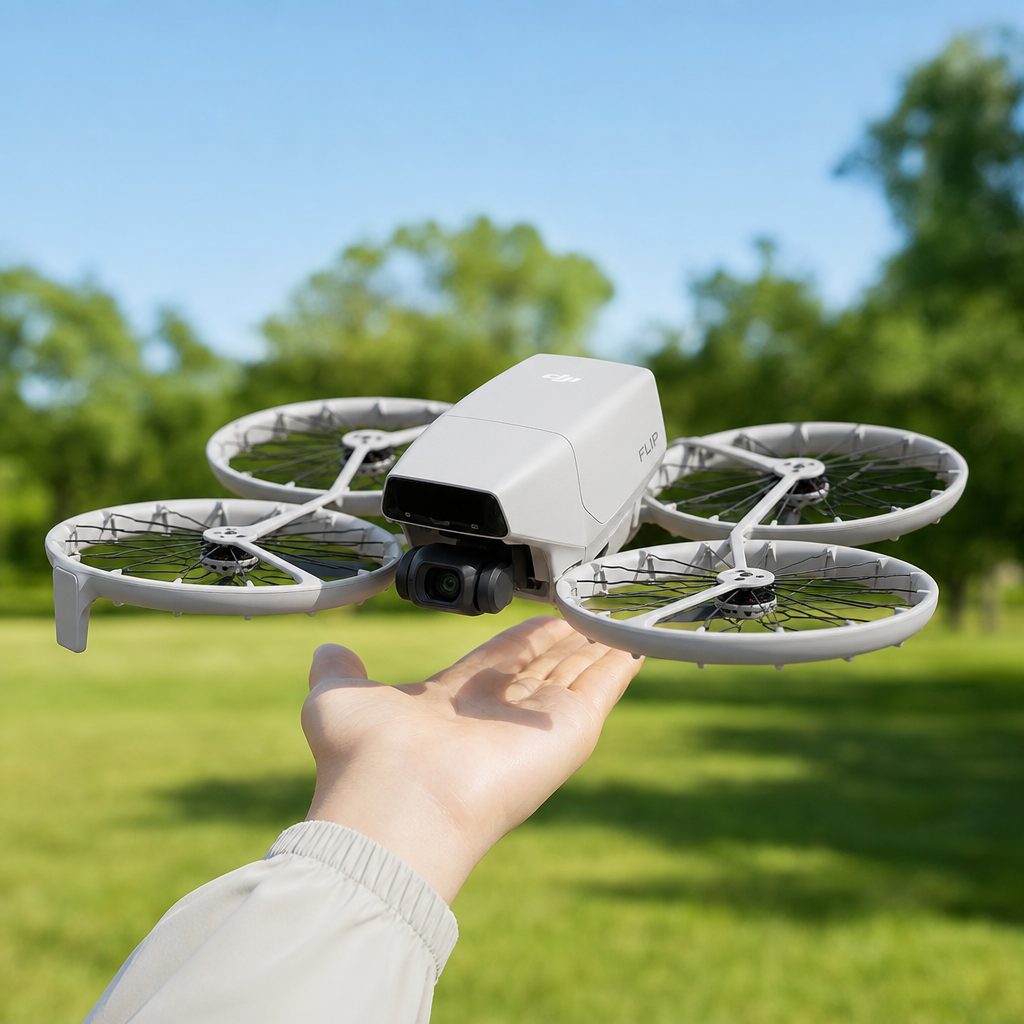
Palm take-off and automated filming modes make DJI Flip especially appealing for quick family clips, provided the launch area is clear and calm.
DJI Flip camera quality: much more than a novelty drone
Shop DJI Flip camera quality on Amazon UK
The camera is where Flip moved beyond the category of "nice little present that gets used twice". Its 1/1.3-inch sensor could capture 12MP photos as standard or 48MP images in high-resolution mode, and it was mounted on a 3-axis gimbal. That gimbal is crucial. The drone may be dealing with breeze, movement and your increasingly confident steering, whilst the camera works to keep footage looking level and composed.
Video was available at up to 4K and 100fps, with 4K/60fps HDR recording, a maximum 150Mbps bitrate, and optional 10-bit D-Log M. For the typical family buyer, the most important line there is probably 4K/60fps HDR. It gives you crisp, smooth clips with more flexibility than the standard home-video drone. For someone who enjoys editing holiday films or making social videos, 100fps also opens the door to slow motion. A child jumping into autumn leaves or racing across a beach can look surprisingly cinematic when you slow it down. This is perhaps excessive. It is also fun.
D-Log M and 10-bit recording are more advanced tools than most families will ever need, but their inclusion says something good about the ceiling of the product. A beginner can leave the colour settings alone and create appealing video. A more experienced family member can later grade their footage with more room to alter colour and contrast. It is a drone that does not punish you for becoming more interested in filming over time.
There was one significant limitation compared with DJI's Mini 4 Pro. Flip could not rotate its camera for true vertical 4K recording. You could crop its footage to 9:16 while retaining 2.7K resolution, which is still perfectly usable for social video, but it is not the same thing as native vertical 4K. If TikTok, Instagram Reels or YouTube Shorts are the main reason you are buying a drone, that distinction deserves more than a footnote. Flip can do the job; it simply does it with a crop rather than the more flexible physical camera rotation available on the Mini 4 Pro.
DJI Flip battery life and the reality of a family day out
DJI's headline figure was up to 31 minutes of flight time from the 3,110mAh Intelligent Flight Battery. In controlled conditions, a windless hover at 20 metres above sea level returned 28 minutes. In more realistic light-wind flying, testing placed the result between 22 and 28 minutes, while active tracking and palm-launch use produced around 24 to 27 useful minutes. That is good for a lightweight camera drone, but it is also a useful reminder that "31 minutes" does not mean half an hour of filming.
By the time you have taken off, positioned the shot, repeated it because somebody blinked, and left a sensible margin for landing, a single battery tends to encourage purposeful flying. That is not necessarily a bad thing. Family footage is often stronger when you have a plan: a quick reveal of a campsite, a group wave, a walk along a shoreline, then land. The real danger is attempting to document every second of a day out and finding the drone is in the bag just when the view gets good.
The battery weighed 83.5g, held 22.3Wh of energy and used LiNiMnCoO2 chemistry. Charging through the aircraft over USB-C took about 70 minutes at up to 30W. With the charging hub, one battery took roughly 45 minutes at up to 48W, while charging two in parallel took roughly 70 minutes with up to 65W. Those numbers make the hub more than a luxury if Flip becomes a regular holiday companion. It turns downtime into something manageable rather than a lengthy wait while everybody else has moved on to ice cream.
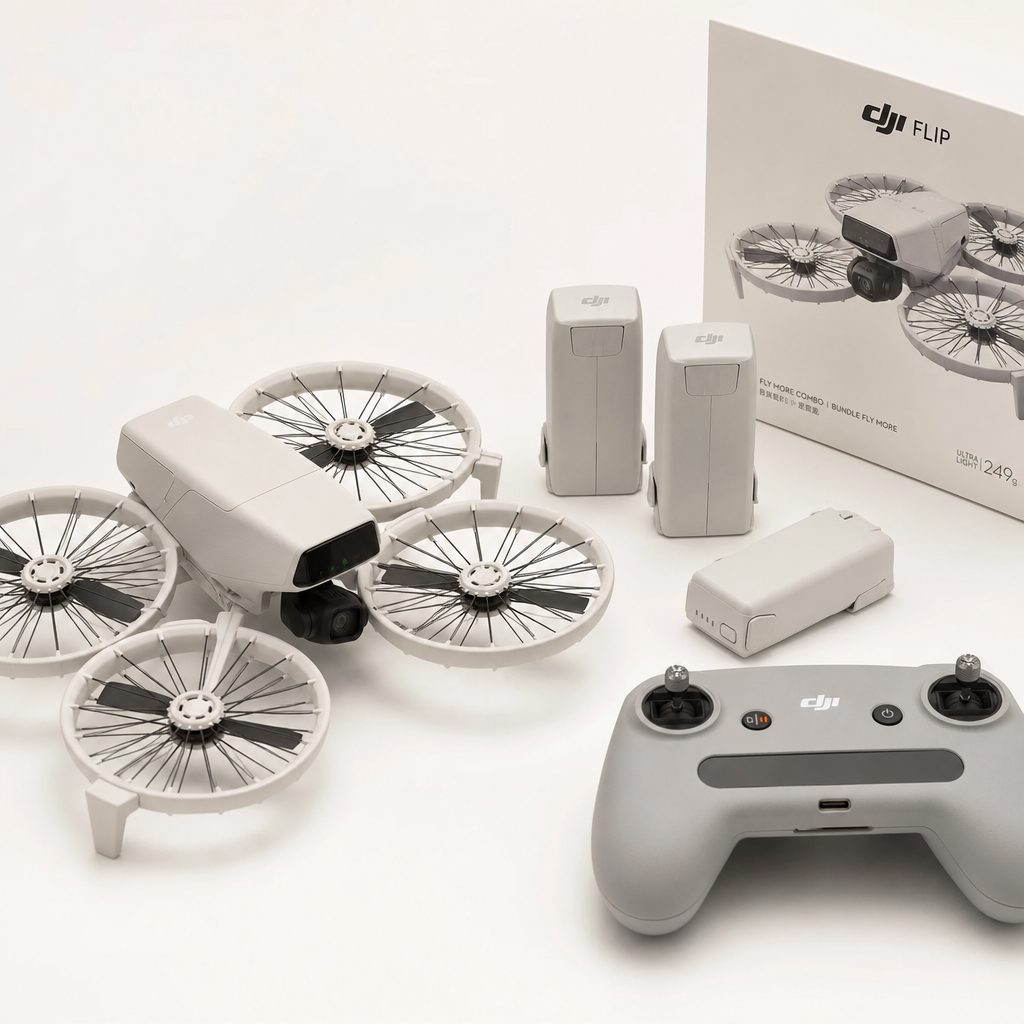
A second or third Intelligent Flight Battery changes DJI Flip from a quick-camera gadget into something practical for a longer family trip.
Flip operated between 5°C and 40°C. That covers most ordinary UK spring and summer outings, but it is worth noting for frosty mornings, heatwave holidays and anyone imagining a Christmas-morning maiden flight. Cold weather and small batteries are not famously devoted friends. Give the drone conditions it is designed for and it will repay you with more predictable flying.
DJI Flip speed, wind handling and transmission
Shop DJI Flip speed, wind handling and transmission on Amazon UK
Flip was no sluggish indoor crawler. Its maximum speed in Sport and Tracking modes was 12m/s, or 43.2km/h. With a 4m/s tailwind it could reach up to 16m/s, or 57.6km/h. That is a serious pace for something marketed around easy family filming, and it underlines why younger children should be enthusiastic subjects rather than pilots. The drone can cover ground quickly when it needs to, especially in Follow or Direction Track.
DJI rated wind resistance at Level 5, up to 10.7m/s or 38.5km/h. Again, that does not mean every breezy day is automatically a good day to fly. A drone fighting wind may remain airborne but still produce a less pleasant, less relaxed experience. For a first-timer, calm weather remains the best teacher. The advantage is that Flip has enough capability not to be limited to perfectly still garden afternoons.
DJI O4 supplied Full HD video transmission at up to 13km. In real family ownership, the headline range is far less important than the stability and confidence it suggests for normal nearby flights. You are unlikely to need to send a family camera drone anywhere close to that distance, and you should not treat a theoretical transmission maximum as a target. What matters is that the live view is designed to remain capable during ordinary line-of-sight filming around open locations.
Return-to-home accuracy was less convincing in testing, where Flip landed approximately three feet away from its original take-off point. Three feet is not a catastrophe in a field. It can be rather more irritating on a narrow patch of patio, beside a flower bed, or around bags, children and assorted holiday clutter. I would treat return-to-home as a useful recovery feature, not as a precision parking system. Give it a clear landing area and be ready to take over the final bit if needed.
DJI Flip intelligent filming modes for parents
Shop DJI Flip intelligent filming modes for parents on Amazon UK
AI Track was one of Flip's strongest family features. DJI positioned it for enhanced people and object tracking, allowing the drone to follow a person without requiring the pilot to juggle every camera movement manually. This is not just about making sporty clips. It is ideal for the sort of family footage that normally needs one person to stand outside the memory: children walking towards a viewpoint, a group crossing a bridge, or a parent joining the others for once instead of operating a phone camera from behind it.
FocusTrack, QuickShots, MasterShots and Hyperlapse added more creative routes. The names can sound like a menu designed by a marketing team that had too much coffee, but the underlying value is clear. They simplify camera movement. Rather than asking a novice to smoothly fly, pan, frame and maintain altitude at once — which is how you get a very artistic close-up of the grass — Flip can take responsibility for part of the sequence.
MasterShots is particularly appealing to the "we have ten minutes before lunch" kind of filming. It is designed around a subject and automated movements, giving a sense of progression that makes a short clip feel more finished. Hyperlapse is less immediately useful for family portraits but can be lovely for changing skies, traffic-free landscapes or a sunset settling over a campsite. The important point is that these modes are optional. Flip remains manageable if all you want is to hover and take a photo.
Pros
- Permanent guards make the spinning propellers feel much less exposed around family filming.
- Excellent camera fundamentals for the size: 1/1.3-inch sensor, 3-axis gimbal and 4K/60fps HDR.
- Palm take-off, voice control and automated modes lower the barrier for beginners.
- Real-world flight time of roughly 22 to 28 minutes is respectable for a 249g drone.
- Folded design, USB-C charging and automatic power-on encourage actual use.
Cons
- It was comparatively loud, which can make discreet family filming difficult.
- Forward and downward sensing does not amount to complete all-direction obstacle awareness.
- Return-to-home testing landed around three feet away from the take-off point.
- Vertical video is cropped to 2.7K rather than captured as true vertical 4K.
- A single battery is limiting if you want to film across a full day out.
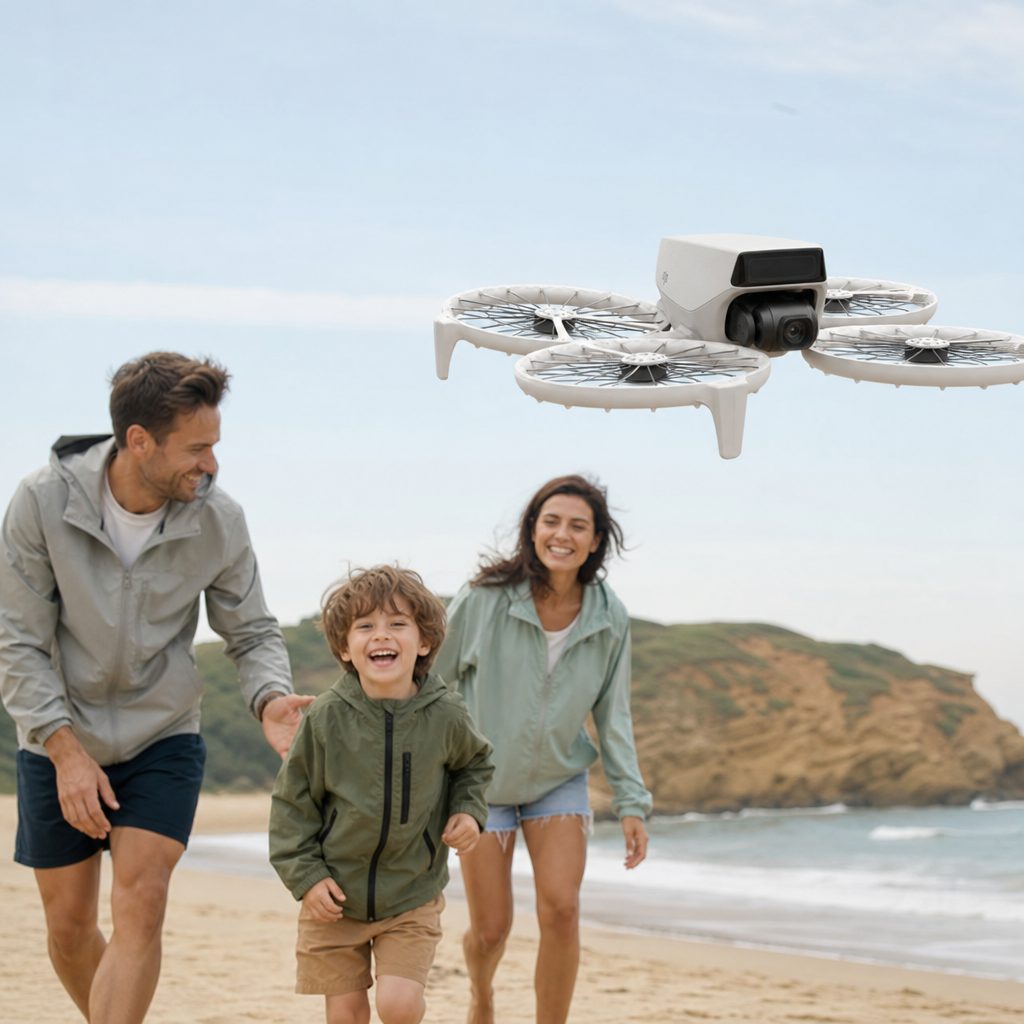
DJI Flip's automated tracking and QuickShot-style movements help turn a short family outing into footage that feels composed rather than accidental.
DJI Flip UK prices and bundle comparison
In the UK, DJI Flip prices ranged from £269 to £369 for the lower-priced options, with used examples starting from £239. The version with the RC-N3 controller was priced at £369. Buyers wanting DJI's RC 2 controller with its built-in display were looking at £549, while the Fly More Combo paired the RC 2 with three batteries and the charging hub for £659.
The headline "from £269" price was undeniably attractive, especially for a DJI camera drone with integral propeller guards. But the right bundle depends on how you expect to use it. A very occasional family buyer may be happy with the basic route and app-led control. Someone planning holidays, day trips and regular filming should think seriously about spare battery capacity. It is easy to save money at checkout and then spend the first summer wishing you had more than one meaningful flight per outing.
DJI Flip entry option
The lowest confirmed UK starting point. Best for buyers prioritising the smallest initial spend.
DJI Flip with RC-N3
A dedicated controller option for families who want more conventional hands-on flying.
DJI Flip with RC 2
The RC 2 screen controller bundle for buyers who value a self-contained control setup.
DJI Flip Fly More Combo
RC 2, three batteries and charging hub. The most practical package for frequent outings.
| Bundle | Confirmed UK price | Controller arrangement | Battery setup | Best suited to |
|---|---|---|---|---|
| DJI Flip entry option | From £269 | App, palm and voice-control route | Single-battery starting setup | Trying the format at the lowest cost |
| DJI Flip with RC-N3 | £369 | RC-N3 controller | Single-battery configuration | New pilots wanting a dedicated controller |
| DJI Flip with RC 2 | £549 | RC 2 screen controller | Single-battery configuration | Convenience-focused regular users |
| DJI Flip Fly More Combo | £659 | RC 2 screen controller | Three batteries plus charging hub | Holidays and frequent family filming |
Used prices from £239 complicated the decision slightly. A used Flip can be a sensible route for a cautious buyer, but this is a flying camera with moving parts, a gimbal, batteries and guards that may have had an adventurous previous life. Check condition carefully, particularly the propeller cages, arms, gimbal and battery health. A bargain that needs replacing after one awkward incident is not really a bargain. It is merely an expensive story.
DJI Flip versus DJI Mini 4 Pro for social video
The most meaningful comparison within DJI's small-drone family is not necessarily about raw image quality; it is about priorities. DJI Flip's clear advantage is its built-in full-propeller protection. For families and nervous beginners, that can outweigh a lot of specification-sheet arguments. It makes palm launch feel less alarming and gives the aircraft a more forgiving personality when people are nearby.
DJI Mini 4 Pro had an important advantage for vertical creators because its camera could rotate to capture true vertical 4K footage. Flip could crop its horizontal footage to a 9:16 frame while maintaining 2.7K resolution, which is still more than enough for many social posts. But if vertical-first video is the entire point of your purchase, Mini 4 Pro's rotating camera is the cleaner tool. No amount of cheerful marketing changes that.
For a family that primarily wants easy, guarded, good-looking memory-making, I think Flip's design is more persuasive than chasing the technically neater vertical workflow. For a creator who regularly publishes polished vertical 4K clips, the Mini 4 Pro feature is harder to dismiss. These are not quite rivals in personality. One is saying "come on, let's get everyone in the shot"; the other is saying "let's make this ready for the edit timeline".
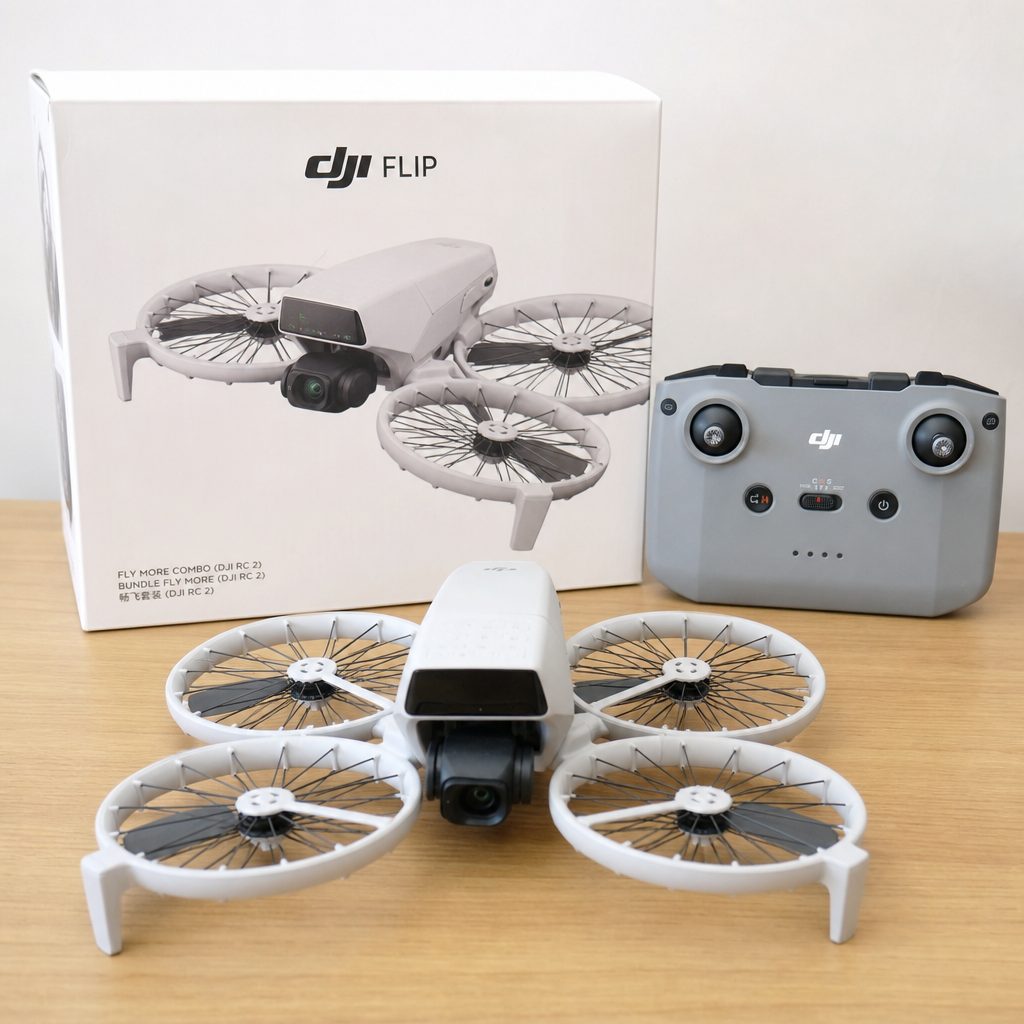
For vertical-first creators, DJI Mini 4 Pro's rotating camera offered true vertical 4K; DJI Flip instead created 9:16 video through a 2.7K crop.
Who should buy DJI Flip?
Flip made most sense when its guard design answered a real concern. If exposed propellers are the thing preventing you from buying a drone at all, this was not a gimmick. It was the feature that changed the entire ownership experience. It also worked well for people who wanted serious enough image quality to keep using the drone after the first weekend of novelty had passed.
First-time family flyers
Choose the DJI Flip entry option from £269 if your priority is getting the guarded design and core camera experience for the lowest confirmed UK outlay.
Families learning proper control
DJI Flip with RC-N3 at £369 is the strongest balance for households wanting a dedicated controller without moving into premium-bundle pricing.
Frequent family film-makers
The DJI Flip Fly More Combo at £659 is the practical choice for longer days because three batteries and a charging hub tackle the biggest daily-use limitation.
Buyers wanting the RC 2
DJI Flip with RC 2 at £549 suits those who value DJI's screen controller but do not yet need the three-battery Fly More package.
I would not choose Flip for somebody whose only goal is true vertical 4K social content, nor for someone hoping to fly without paying attention to surroundings. The guards are a confidence feature, not an invisibility cloak. Equally, I would not dismiss it as "only for beginners". The 1/1.3-inch sensor, 10-bit D-Log M, 4K/100fps recording and 3-axis gimbal give it enough creative headroom for an enthusiast in the household to have fun long after the children have stopped shouting "make it go higher".
DJI Flip review score
DJI Flip succeeded because it approached beginner drone ownership from the right direction. Instead of making a cheaper, weaker flying camera and calling it simple, DJI retained the ingredients that make aerial footage satisfying: a stabilised camera, useful automated modes, solid flight time and proper controller options. It then put guards around the bits that make beginners understandably anxious.
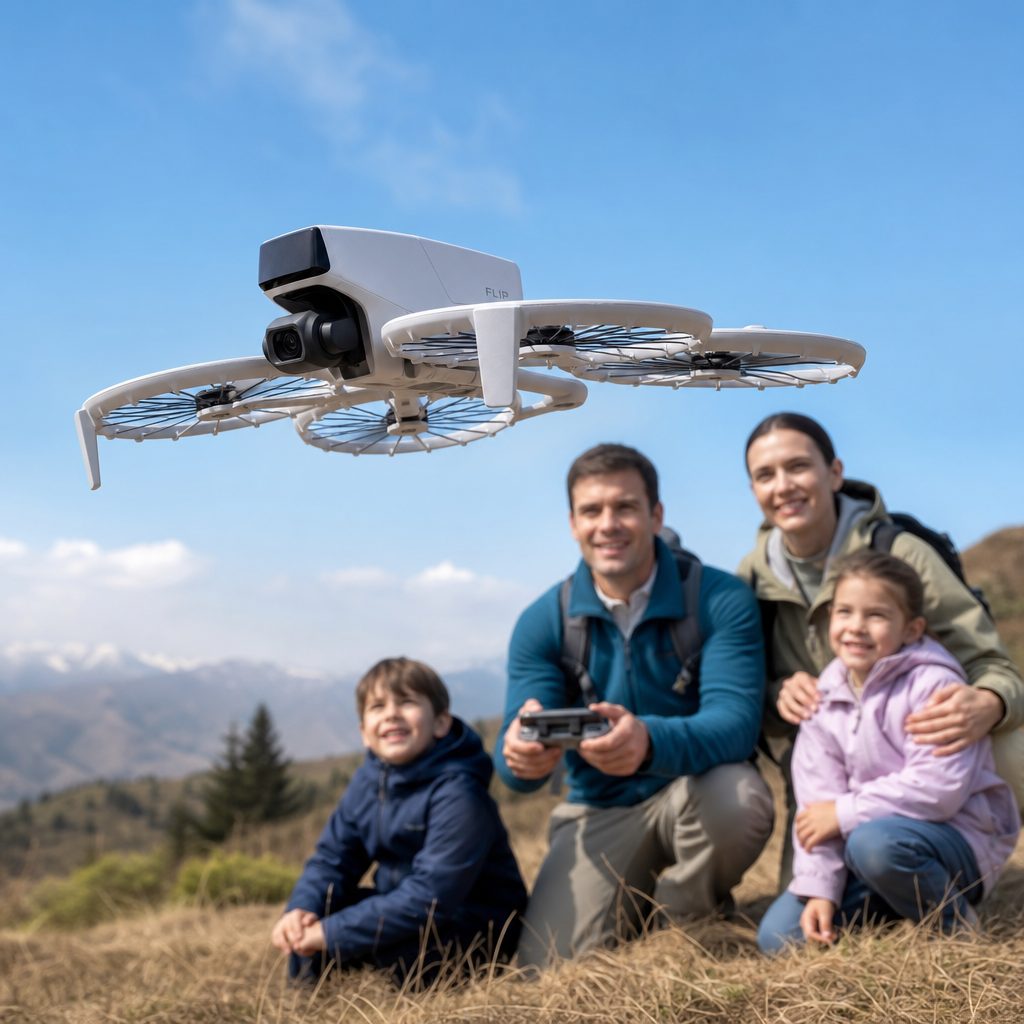
DJI Flip is at its best in open outdoor spaces: a compact, guarded flying camera that can capture family moments without requiring expert-level flying confidence.
DJI Flip frequently asked questions
Yes, provided the beginner approaches it responsibly. Palm take-off, voice control, automated camera moves, AI tracking and the built-in propeller guards all make Flip less intimidating than a conventional exposed-prop drone. It was still capable of up to 43.2km/h in Sport and Tracking modes, so start in an open space and learn the basic controls before trying more ambitious shots.
The guards were a permanent part of Flip's design. They surrounded the propellers in flight and folded beneath the aircraft for storage. That is precisely why Flip feels different from drones where optional guards must be attached before use and stored somewhere safe afterwards.
DJI claimed up to 31 minutes. A windless hover test returned 28 minutes, while light-wind real-world flying produced around 22 to 28 minutes. Tracking and palm-launch use returned approximately 24 to 27 useful minutes. Plan for the lower end when you are out with family, because filming, wind and sensible landing margins all reduce the headline figure.
Yes, but not as true vertical 4K. Flip could crop footage into a 9:16 format while retaining 2.7K resolution. That remains very usable for social video, but DJI Mini 4 Pro's rotating camera had the advantage if native vertical 4K was essential to you.
For many first-time families, yes. The £369 RC-N3 bundle offers a more traditional, deliberate flying experience than relying only on quick-control methods. It is particularly worthwhile if one adult expects to learn drone flying properly rather than use Flip solely for occasional palm-launched clips.
If Flip will mainly come out for occasional short garden sessions, perhaps not. If it is going on holidays, walks and regular family days out, the £659 Fly More Combo is much easier to justify. Its three batteries and charging hub address the biggest practical limitation of all small drones: one short flight can feel over just as everyone starts enjoying it.
No. It had 3D infrared obstacle sensing with forward and downward sensing. That is useful assistance, but it is not full all-round protection. Do not rely on it to see hazards to the side or behind, and do not fly close to branches, wires, fences or people on the assumption that the drone will solve every problem for you.
It was noted as comparatively loud. That does not stop it being enjoyable, but it is something to consider if quiet surroundings, nervous pets or nearby neighbours are part of the plan. Use short, purposeful flights and choose open spaces where the sound is less intrusive.
Verdict: DJI Flip made beginner drone ownership feel less scary
Shop DJI Flip made beginner drone ownership feel less scary on Amazon UK
DJI Flip was one of the most sensible family drones available in July 2026. Its 249g body, folding guarded propellers, palm launch and approachable intelligent modes all reduce the friction that stops many people enjoying a drone after the first few flights. Better still, it did not sacrifice the camera: the 1/1.3-inch sensor, 3-axis gimbal, 4K/60fps HDR and 4K/100fps capability gave it genuine staying power.
There were caveats. It was comparatively noisy, it did not offer true vertical 4K, its sensing was not all-directional, and return-to-home was not pinpoint accurate in testing. Yet those are manageable compromises for the right buyer. At prices from £269 in the UK, Flip was an excellent pick for families who wanted a real flying camera with a little extra reassurance around the propellers. Buy the RC-N3 bundle for the best everyday balance, or stretch to the Fly More Combo if this is going to become a regular part of family adventures rather than a once-a-month novelty.