
HobbyZone AeroScout S 2 Review: Can a Complete Beginner Really Fly It?
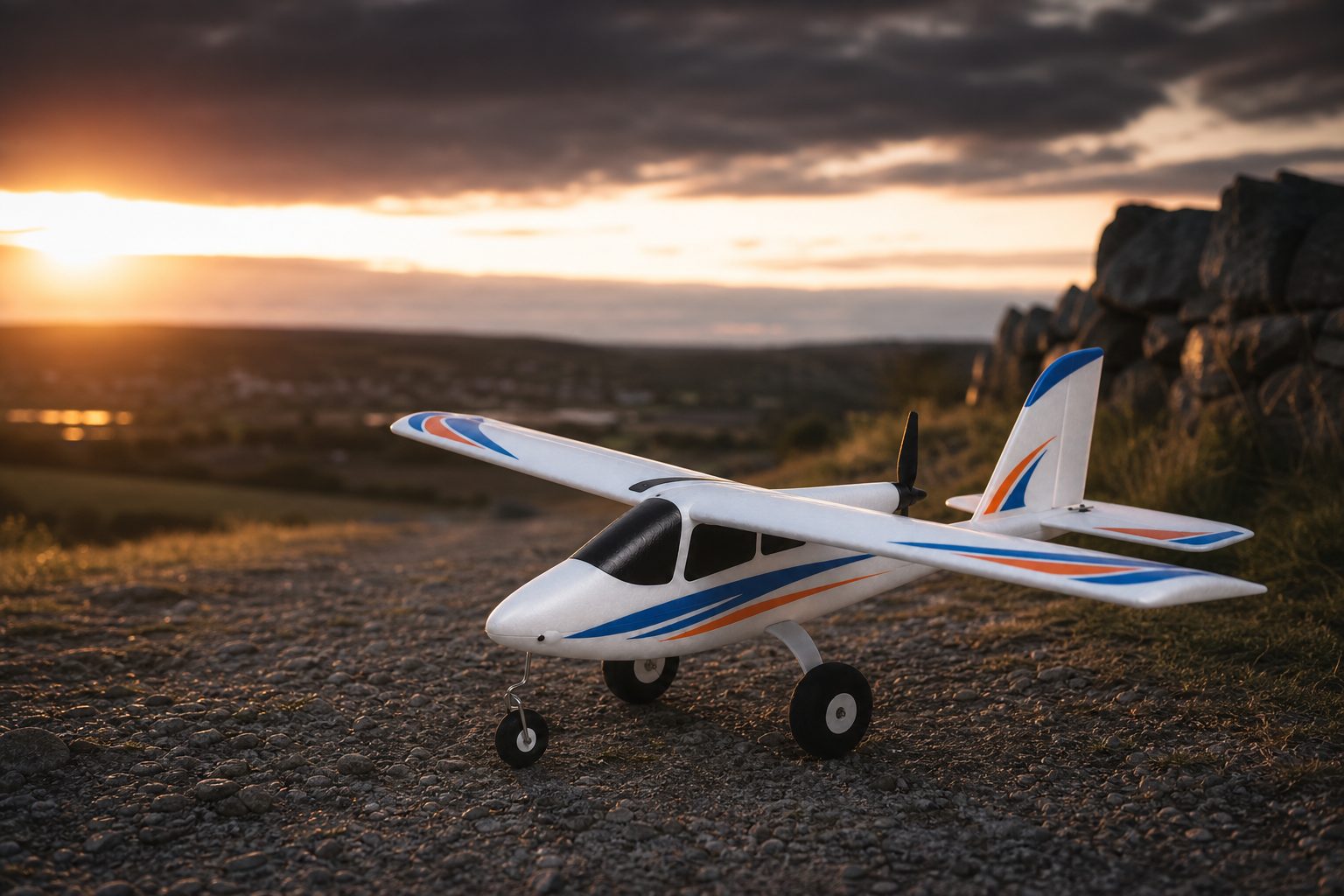
The HobbyZone AeroScout S 2 is a 1.1m high-wing trainer with its propeller mounted safely behind the wing rather than exposed at the nose.
The AeroScout S 2 was designed to make those first nervous steps into radio-control flying feel less like an exam and more like an afternoon at the park. Its SAFE stabilisation, protected pusher propeller and chunky undercarriage give it a very convincing beginner-friendly formula — but there are still a few realities to understand before handing over the transmitter.
The short answer: yes, with sensible expectations
Can a complete beginner really fly the HobbyZone AeroScout S 2? Yes — and it is one of the more persuasive arguments for buying a proper trainer rather than a cheap, tiny foam model that will spend its first day arguing with the nearest hedge. The AeroScout's job is not to make somebody a brilliant pilot in ten minutes. Nothing can do that. Its job is to make the basic controls understandable, give new flyers time to think, and turn the sort of mistake that would ordinarily mean a snapped propeller into a moment of embarrassment and a short walk across the grass.
That distinction matters. A newcomer can take off, fly gentle circuits and land the AeroScout S 2 in its Beginner mode with a much better chance of success than with an unstabilised sport plane. The built-in Spektrum SAFE system limits bank and pitch angles in that mode, whilst Panic Recovery can be used to bring the model back towards level flight when things have started to become a bit too exciting. It is clever assistance, not magic. You still need a suitable flying space, calm conditions, a charged battery and the good sense not to yank every stick to its stop at once.
I think the aircraft is especially appealing for families because it offers a genuinely useful progression path. A child, parent or returning adult can begin with considerable electronic help, grow comfortable with orientation and throttle control, then move through Intermediate to Experienced mode. In other words, it does not become redundant the minute the first successful landing happens. That is important when this is a hobby purchase rather than a £20 rainy-day toy.
HobbyZone AeroScout S 2 at a glance
This is a compact fixed-wing electric aircraft, not a toy drone and not a tiny indoor model. Its 1,095mm wingspan gives it enough presence to be stable outdoors, yet it remains manageable for a family with a car and somewhere sensible to store it. At 639g without a battery, it is a proper radio-control aeroplane with real momentum. Treat it with respect and it will reward you; treat it like a foam football and it will eventually make its displeasure known.
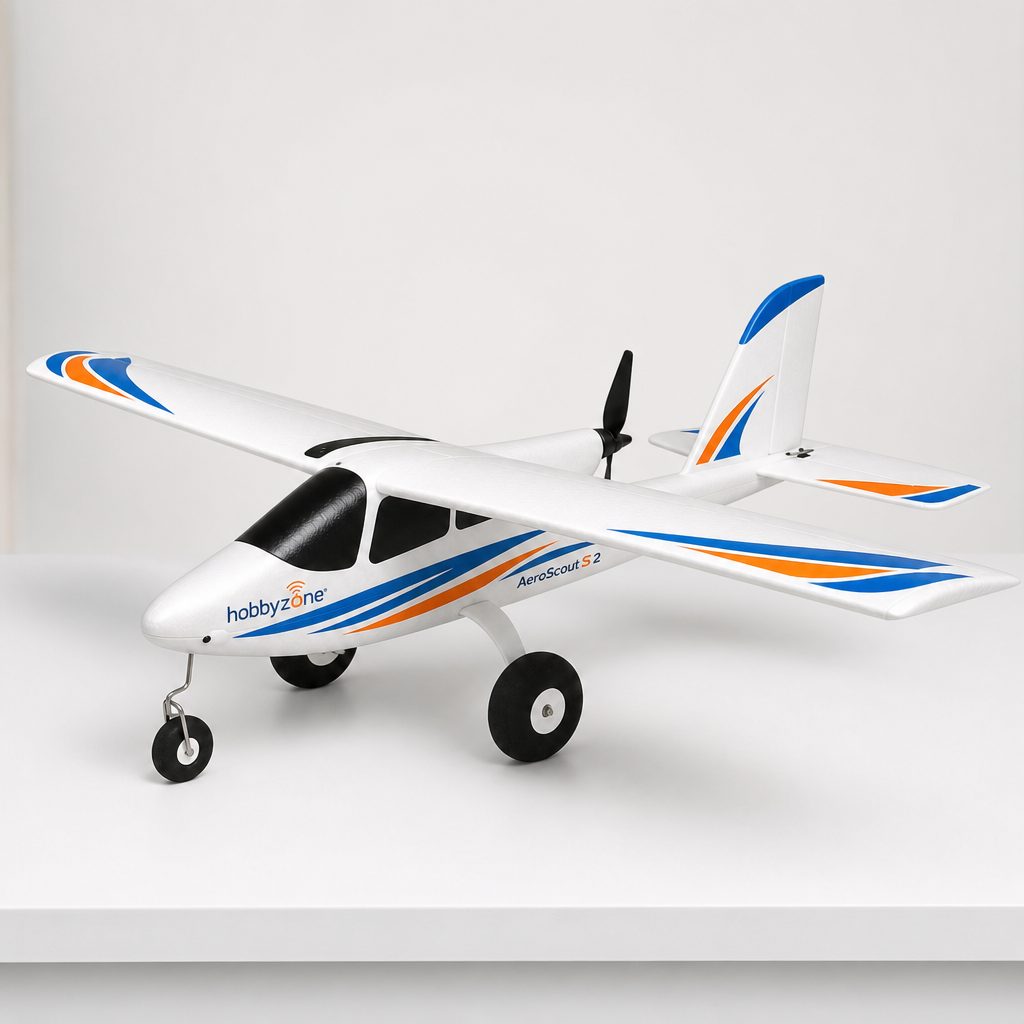
Its 43.11-inch wingspan sits in the useful middle ground: large enough for steady outdoor flying, without becoming an awkward giant for family transport.
The RTF, or Ready-to-Fly, version included a Spektrum DXS transmitter. The BNF Basic version was intended for pilots who already owned a compatible Spektrum DSMX transmitter and wanted to use their own battery and charger. There were also later S 2 variants with RealFlight and AS3X+ equipment. The important thing is to read the exact contents of the listing rather than assuming every box contains every item needed to fly. Radio-control abbreviations have a long tradition of looking friendly right up until they ask you to buy another component.
The AeroScout S 2 accepted 3S LiPo packs from 1,300mAh to 2,200mAh. The larger capacity gives more potential time in the air, but battery choice should suit the exact version being bought and should always be charged and handled according to the battery maker's safety instructions.
Design: why the pusher propeller is such a good idea
The most beginner-friendly thing about the AeroScout might be immediately obvious: the propeller is at the back. This is called a pusher layout, and it is one of those simple design decisions that earns its keep from the first slightly bouncy landing. On a conventional nose-prop trainer, touching down nose-first can destroy a propeller, bend a shaft or leave you rummaging through grass for a small but vital plastic part. Here, the motor and propeller sit well above and behind the wing.
It does not make the model indestructible. No foam aircraft has achieved that particular miracle. It does mean the parts most often damaged in novice mishaps are much better protected. The high-wing configuration also brings inherent stability, with the mass of the fuselage hanging below the wing in a way that naturally encourages the aircraft to settle itself. It is a forgiving shape, and forgiving shapes are precisely what a first aeroplane ought to be.
Rear-mounted propulsion
The pusher propeller is less exposed during rough arrivals, which is reassuring when every landing is still a work in progress.
Stable high-wing format
The high-wing layout was chosen for calm, predictable handling rather than dazzling aerobatic drama. That is exactly right for training.
Oversized tricycle gear
Large wheels and a steerable nose wheel make take-offs and landings less fussy on grass, pavement and dirt.
Durability-minded hardware
The EPO foam structure and metal-geared servos show that the model was built with learner knocks very much in mind.
The EPO foam airframe is another sensible choice. It is light, impact-resistant and more forgiving than a brittle moulded plastic shell. Minor repairs are part of the RC aeroplane experience, but the AeroScout was conceived so that a less-than-perfect session did not automatically become a bin-day event. Its oversized tyres were also promoted as offering a 50% crash-durability improvement, which sounds rather like a statistic invented after somebody repeatedly landed on a rugby pitch. Still, the basic point is fair: the undercarriage is substantial for a trainer.
Assembly and first-day setup
Aeroplanes have a reputation for requiring a workshop, three specialist degrees and an elderly relative who once built a Spitfire from balsa. The AeroScout S 2 takes a much friendlier route. It is designed as a quick-assembly foam trainer rather than a scratch-build project. That does not mean you should rush it. The first set-up is worth doing slowly, on a table, with the manual open and no audience asking whether it can fly yet.
For first-time owners, the RTF package made the most straightforward route because it came with the Spektrum DXS transmitter. The updated 2026 RTF offering also included RealFlight Trainer Edition and the Spektrum AR631+ receiver, adding a much more complete learning package than simply placing an aeroplane in someone's hands and wishing them luck. A simulator will not recreate wind, sunlight or the fact that a dog has taken an interest in your landing strip, but it can teach stick movements without consequence. That is enormously valuable.
Before the first flight, I would check that all control surfaces move in the correct direction, the battery is firmly secured, the wheels are sound and the chosen SAFE mode is understood. Do it every time. This is not glamorous advice, admittedly. Nobody has ever made an exciting film montage about checking an elevator surface. Yet these habits are what separate a relaxed first afternoon from an expensive walk of shame.
First-flight tip
Use the included RealFlight Trainer Edition before the maiden outing if you buy an RTF version that includes it. Practise keeping the AeroScout pointed away from you, turning gently and reducing throttle before landing. The simulator's great gift is allowing you to make the same mistake repeatedly without buying a replacement anything.
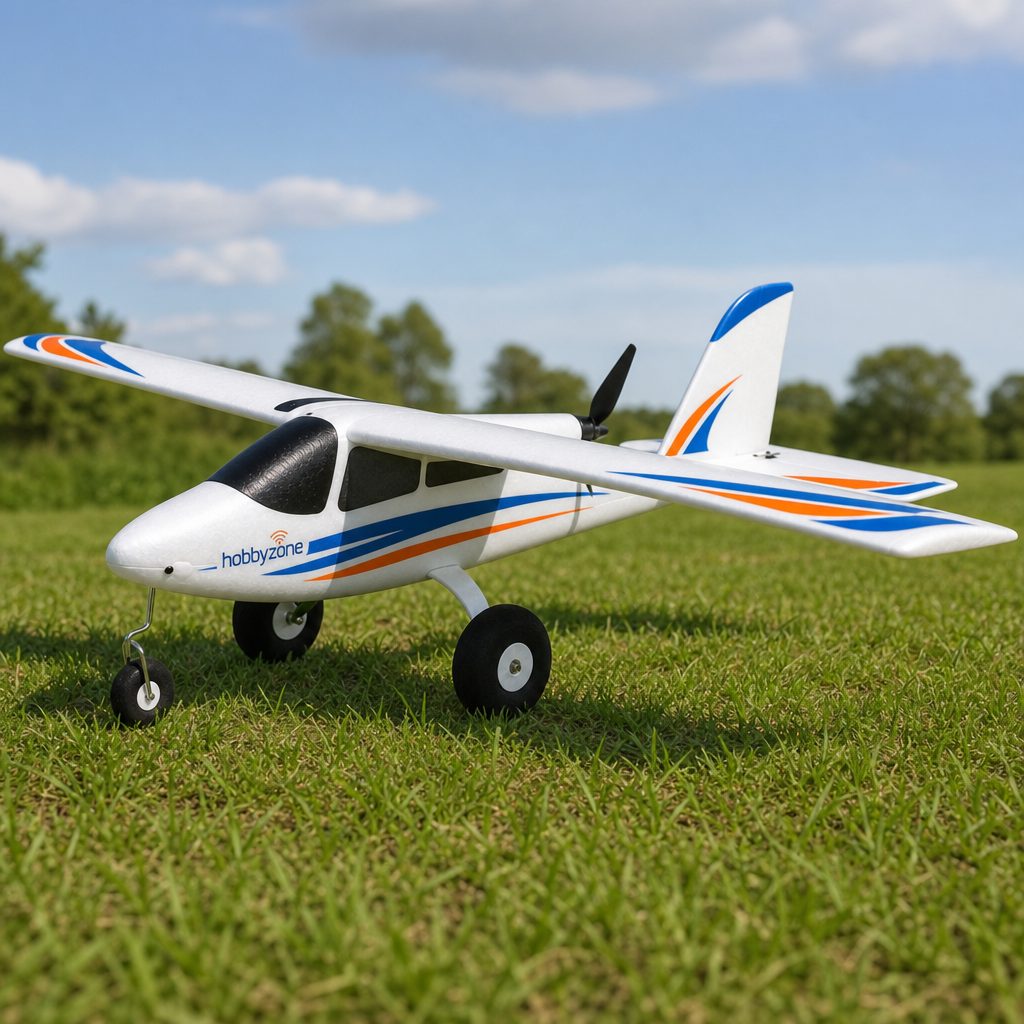
The AeroScout's wide stance, large tyres and steerable nose wheel are aimed squarely at grass-field take-offs and forgiving landings.
SAFE modes and Panic Recovery: assistance without the training wheels feeling silly
SAFE is the heart of the AeroScout S 2 experience. In Beginner mode, the system provides substantial self-levelling assistance and limits how far the model can bank or pitch. That gives a new pilot an important mental breathing space. Instead of continually fighting the aircraft, they can learn what each input does and begin to understand why gentle inputs are better than panicked ones.
Intermediate mode reduces those limits, allowing a pilot to make more confident turns and learn more of the aircraft's natural response. Experienced mode removes the artificial limits, so the model can become a more conventional four-channel aeroplane. It remains a trainer in character, but it does not insist on treating its owner like a beginner forever. That is a thoughtful balance.
Then there is Panic Recovery. This is not a button that can recover an aircraft from every possible predicament, particularly if it is low, travelling very quickly or headed directly towards an obstacle. What it can do is command a more level, stable attitude when the aircraft is high enough for the system to help. It is best thought of as a safety net, not a licence to ignore the sky. Use it early, release the sticks, breathe, then work out where the aeroplane is going.
How it flies in the real world
In calm air, the AeroScout S 2 behaves like a trainer should. It is stable, visible and unhurried enough that a learner can process what is happening. The brushless 2306-2250Kv motor and 30A Avian telemetry ESC give it the power needed for normal take-offs and steady flying, rather than turning it into a miniature speed machine. You do not need an aircraft that is desperate to prove a point when you are trying to remember which way to move the aileron stick.
Its tricycle landing gear is a major practical advantage. A beginner can roll along on a suitable smooth patch and build confidence in steering before committing to lift-off. On landing, the steerable nose wheel also makes it more straightforward to hold a line. The oversized wheels help on ordinary grass and less polished field surfaces. Naturally, very long grass, ruts and wet ground can still cause trouble. The model may be durable, but it is not a small agricultural vehicle.
Wind remains the big caveat. SAFE can steady a pilot's inputs; it cannot stop gusts moving a lightweight aeroplane around the sky. The AeroScout has enough capability for a skilled flyer to manage wind, but a complete beginner should deliberately choose a calm day for those first flights. This is one of the least exciting purchases you can make in a new hobby: patience. It is also one of the best.
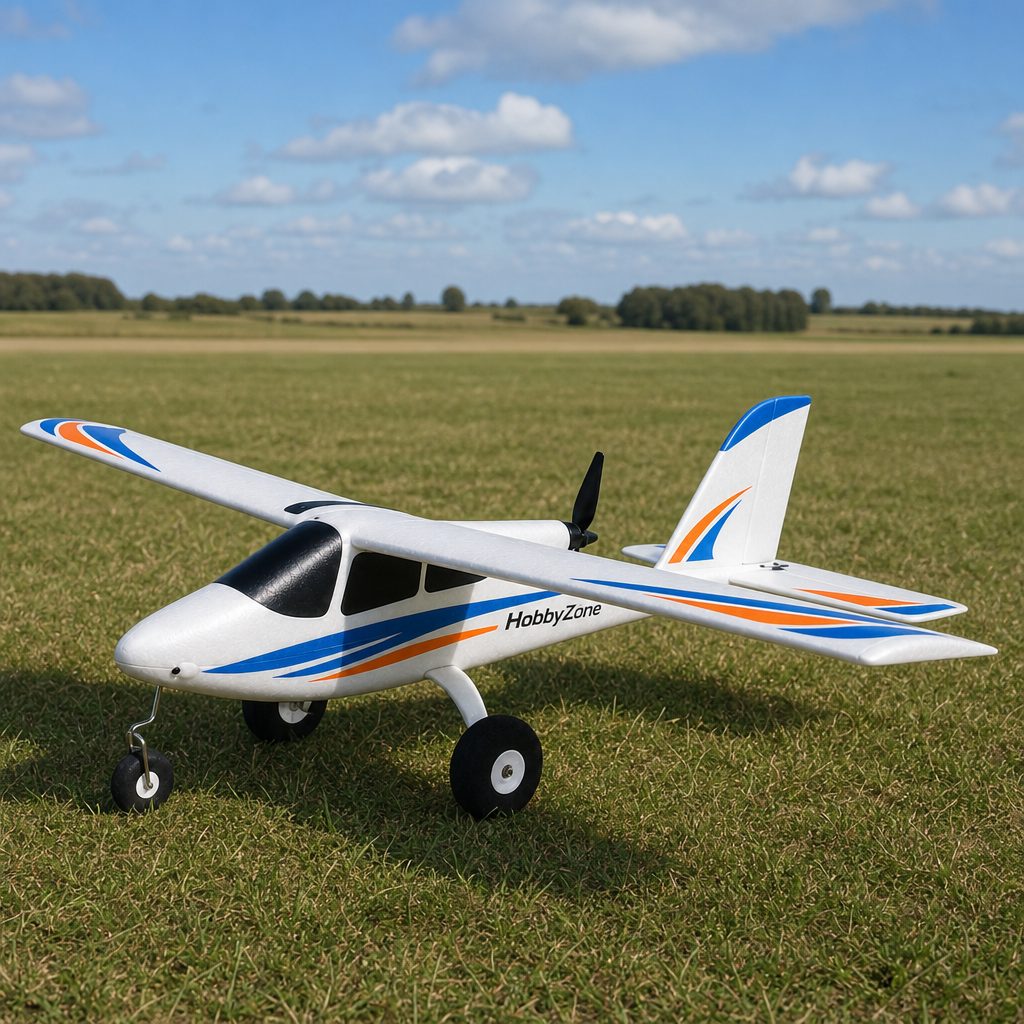
A calm, open flying site gives the AeroScout S 2's stabilisation system room to help rather than asking it to solve a wind problem it cannot control.
Battery life, telemetry and everyday ownership
The AeroScout S 2 worked with 3S LiPo batteries from 1,300mAh to 2,200mAh, with reported flight times of roughly 15 to 20 minutes. That is a useful session length for a learner. Early flights are surprisingly tiring because concentration is intense; 15 minutes can feel much longer when you are trying to maintain direction, height, throttle and family dignity simultaneously.
Rather than treating that figure as a promise, regard it as a sensible planning guide. Flying gently will be kinder to the battery than holding full power for extended periods. Having more than one compatible pack is often the difference between a quick trial and a proper afternoon out, provided you have a suitable charger and handle LiPos responsibly. The BNF Basic version required a battery and charger separately, so that cost needs to be included in any honest budget.
The Avian 30A telemetry ESC was a genuinely helpful upgrade in the S 2 generation. With compatible Smart equipment, it provided real-time battery-power information, reducing reliance on a timer and lowering the chance of a dead-stick landing caused by simply losing track of time. That is a modest convenience for a seasoned hobbyist, but a major confidence booster for someone who has enough things to remember already.
There is one domestic consideration worth mentioning: it is not silent. The AeroScout has noticeable motor and propeller noise compared with quieter trainer models. It is not an outrageous racket, but it is audible enough that a school playing field or established flying site makes more sense than a small suburban garden. The aircraft needs space anyway, so this is less a fault than a reminder that radio-control flying is an outdoor hobby with a bit of theatre attached.
Does the HobbyZone AeroScout S 2 survive family use?
"Family use" is a slippery phrase. It can mean a careful teenager learning with a parent beside them. It can mean two adults sharing a transmitter. It can also mean somebody's enthusiastic eight-year-old announcing that they have watched three videos and are ready to take over. The AeroScout is robustly conceived for the first two scenarios and should be supervised very closely in the third.
The pusher propeller, tough EPO foam and metal-geared servos all suit the messy reality of learning. A poor landing is less likely to end the day immediately. The quick-release arrangement also supported optional floats, which creates an appealing future route for an owner who has access to suitable water flying. That said, progression should be gradual. Master field take-offs, circuits and landings before adding a new operating surface to the equation. Water has a way of making even very familiar things feel unexpectedly far away.
The real strength here is shared learning. The RTF transmitter is approachable, SAFE offers a confidence cushion, and the model remains interesting as skills build. A parent does not have to understand every technical acronym in advance to enjoy the process, although joining a local flying club or asking an experienced pilot for help remains one of the wisest things a new owner can do. The first flight is more enjoyable when somebody knowledgeable can check the setup and talk you through the launch.
Pros
- Excellent beginner-focused high-wing design with SAFE modes and Panic Recovery.
- Pusher propeller protects a vulnerable component during novice nose-first arrivals.
- Oversized wheels and steerable nose gear work well for practical field flying.
- 3S 1,300–2,200mAh battery compatibility offers useful flexibility.
- RTF versions supplied a transmitter, while later bundles added simulator training.
- It offers a credible route from first flight to more independent flying.
Cons
- Wind can still make a first session difficult, despite the electronic assistance.
- The model is noticeable in use, so it is not ideal for a quiet back-garden experiment.
- BNF Basic buyers needed their own Spektrum transmitter, battery and charger.
- LiPo ownership requires care, planning and safe charging habits.
- SAFE is a safety aid, not a substitute for space, supervision or sensible control inputs.
HobbyZone AeroScout S 2 RTF Basic and BNF Basic: which version makes sense?
The choice is refreshingly simple once you know your starting point. If you are new to the hobby, the RTF Basic is the natural option because it included the Spektrum DXS transmitter. It removes a compatibility question at exactly the stage where you would rather be thinking about whether the weather is calm enough. The listed UK price for the HBZ380001 RTF Basic was £259.99, whilst the BNF Basic appeared at £220.32 through an eBay UK listing.
The BNF Basic is better suited to somebody already inside the Spektrum ecosystem. If you own a compatible DSMX transmitter, appropriate 3S packs and a charger, it can be a sensible way of avoiding duplicate gear. If you do not own those things, the lower headline price is not the whole story. In the United States, a 3S 2,200mAh battery was typically an additional $30 to $40 and a compatible charger around $40 to $50, which explains why a first-time BNF route can quickly lose its apparent bargain status.
RTF Basic HBZ380001
Complete aircraft with Spektrum DXS transmitter; the beginner-friendly starting point.
BNF Basic
Aircraft-only route for owners with compatible Spektrum equipment already in hand.
RTF with RealFlight and AS3X+
Enhanced RTF variant with the simulator-led learning experience built into the package.
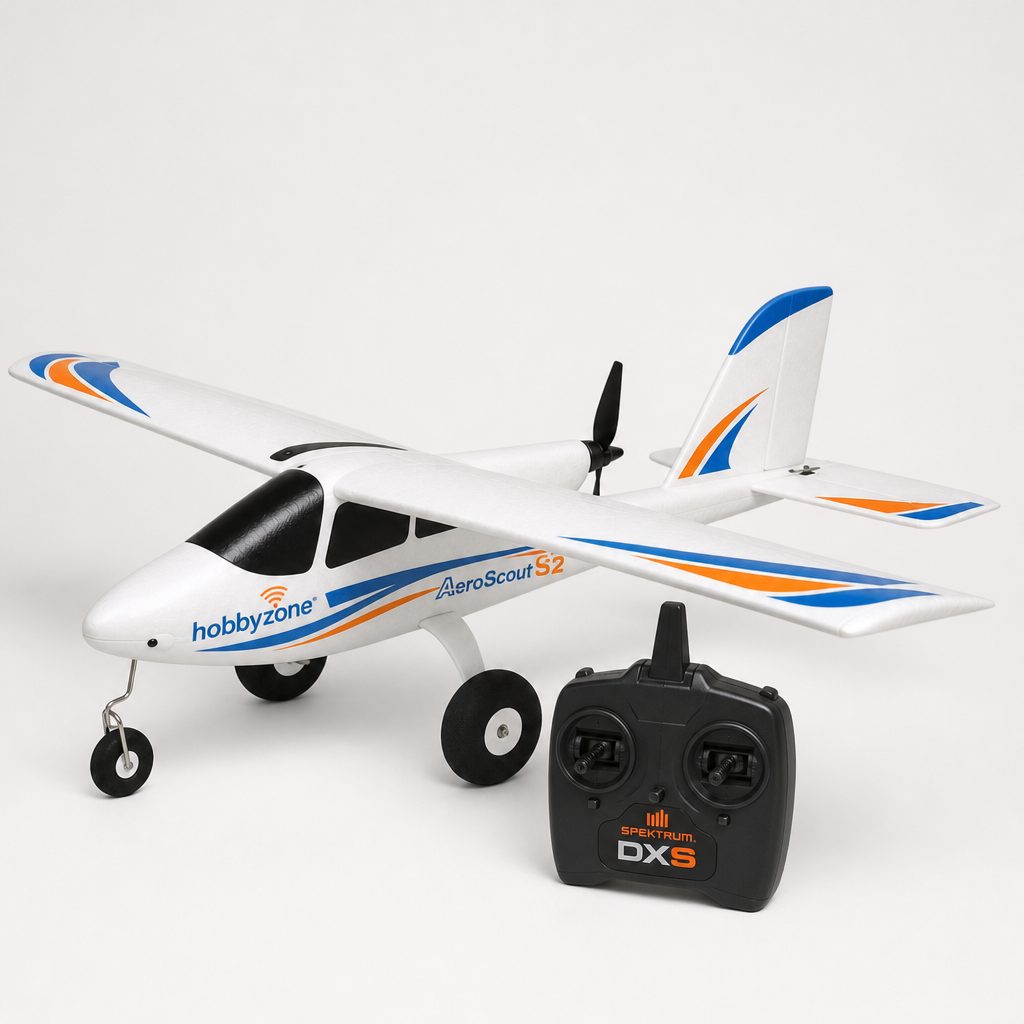
The Ready-to-Fly package is the sensible route for newcomers because its Spektrum DXS transmitter avoids an extra compatibility decision on day one.
Who should buy the HobbyZone AeroScout S 2?
This is not the right aeroplane for every radio-control enthusiast. An experienced pilot looking for high-speed aerobatics will find the AeroScout deliberately restrained. That is not a criticism. Buying a trainer and asking it to behave like a racing model is a little like buying a family estate car and being annoyed that it has not won Le Mans.
For its intended audience, though, the appeal is broad. It is a strong pick for a complete beginner who wants a proper fixed-wing aircraft, a parent looking to share a hobby with an older child, or an adult returning after a long break. It also suits the careful buyer who would prefer to learn on something that has a practical chance of surviving the learning process.
Best for total beginners
Choose the RTF Basic package if you have no existing RC equipment. SAFE, Panic Recovery and the supplied DXS transmitter make the entry route much clearer.
Best for family learning
A very good shared project for a patient adult and a young flyer who can follow instructions and fly in an appropriate open space.
Best for returning pilots
The selectable modes provide a reassuring way to regain stick confidence before progressing to less restricted flight.
Best for Spektrum owners
BNF Basic makes the most sense when you already own a compatible DSMX transmitter, suitable battery packs and charging equipment.
Is it worth the money in 2026?
At £259.99 for the listed RTF Basic version, the AeroScout S 2 was not an impulse-buy toy. Nor should it be judged against one. This is a hobby-grade trainer with brushless power, stabilisation, telemetry capability, a full-size radio transmitter and a design shaped around avoiding beginner damage. Viewed that way, the price is easier to defend.
The value proposition is strongest when you use what the model offers. Learn on the simulator where included. Start in Beginner mode. Take advantage of the RTF transmitter rather than immediately looking for upgrades. Fly from suitable fields. Let the aircraft grow with you instead of replacing it after three weekends. Its value falls sharply if it is bought as a backyard toy, flown in wind on day one and written off after a rushed landing. That is not unique to the AeroScout, but this model at least gives a newcomer several tools to avoid that fate.
There is also a longer-term case for it. The step from SAFE Beginner mode to Intermediate and Experienced flight makes the AeroScout more than a one-season crutch. You may eventually want something faster, lighter or more acrobatic, but you can reach that point having learned useful habits rather than merely surviving a string of crashes. In a hobby where replacing damaged equipment can quickly spoil the arithmetic, that is worth quite a lot.
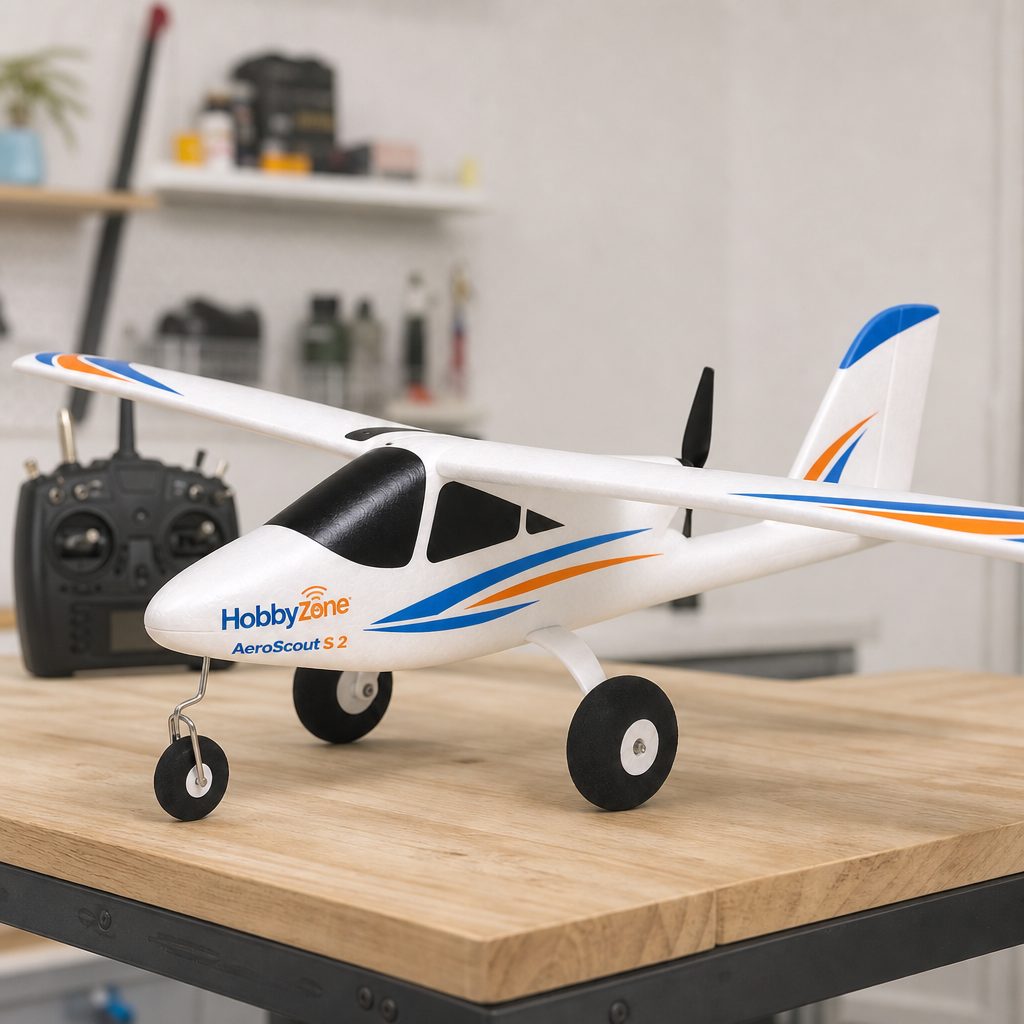
The AeroScout S 2 makes most sense as a long-term learning aircraft: start with electronic help, then reduce it as confidence and judgement improve.
Safety, space and the things the box cannot teach
The important warning is that beginner-friendly does not mean consequence-free. The AeroScout's 1.1m wingspan, brushless motor and 639g airframe make it unsuitable for indoor use or casual flying between houses. Find an open, unobstructed space, keep well away from people and animals, and do not fly when the wind is beyond your confidence level. If the aircraft begins moving in directions that make you uncomfortable, height and calm thinking are usually more useful than frantic stick inputs.
LiPo batteries also deserve proper respect. Use the correct compatible charger, follow its instructions, inspect packs before use and avoid treating battery charging as a background activity that can be forgotten. This is standard RC practice, but it is the part of the hobby that benefits most from being a little boring. Boring battery care gives you more flying days. That is a trade I am happy to make.
In the United States, the AeroScout's 612–639g weight placed it above the FAA registration threshold. UK buyers should also make sure they understand the current rules and appropriate operating requirements before flying. A local club can be invaluable here, not just for advice on regulations but for practical help with trimming, launches, field etiquette and the strange universal RC experience of discovering your model has landed ten metres farther away than it looked.
HobbyZone AeroScout S 2 FAQ
Yes. The Beginner SAFE mode limits bank and pitch angles and adds self-levelling assistance, making it one of the more approachable ways into fixed-wing flying. A calm day, wide open space and experienced supervision for the first flight remain strongly recommended.
The propeller and motor sit behind the wing instead of at the nose. This keeps them away from the ground in many rough landings, reducing a common source of novice damage and making the aircraft more practical as a trainer.
It was reported to deliver roughly 15 to 20 minutes of flight time with compatible 3S LiPo batteries. Actual time will vary with battery capacity, throttle use, flying style and conditions, so treat that as a realistic guide rather than a stopwatch guarantee.
The aircraft was compatible with 3S LiPo packs from 1,300mAh to 2,200mAh. Check the exact box contents before buying, especially with BNF Basic models, as the aircraft-only package required a separate battery and charger.
No. Panic Recovery can command a more level, stable attitude and is very useful when used early at a safe height. It cannot overcome a lack of altitude, a direct collision course, severe wind or every possible pilot error. It is assistance, not invincibility.
Yes, the oversized tyres and tricycle landing gear were intended to work on grass, pavement and dirt. A short, reasonably even grass surface is naturally easier than long, wet or deeply uneven ground.
For a new pilot, yes: the RTF Basic included the Spektrum DXS transmitter, so it was the simpler all-in-one route. BNF Basic was better value only if you already owned compatible Spektrum DSMX radio gear and the necessary battery and charging equipment.
Experienced pilots can manage wind, but a complete beginner should wait for calm conditions. Stabilisation helps the aircraft respond predictably to your inputs; it does not remove the physical effect of gusts on a lightweight foam model.
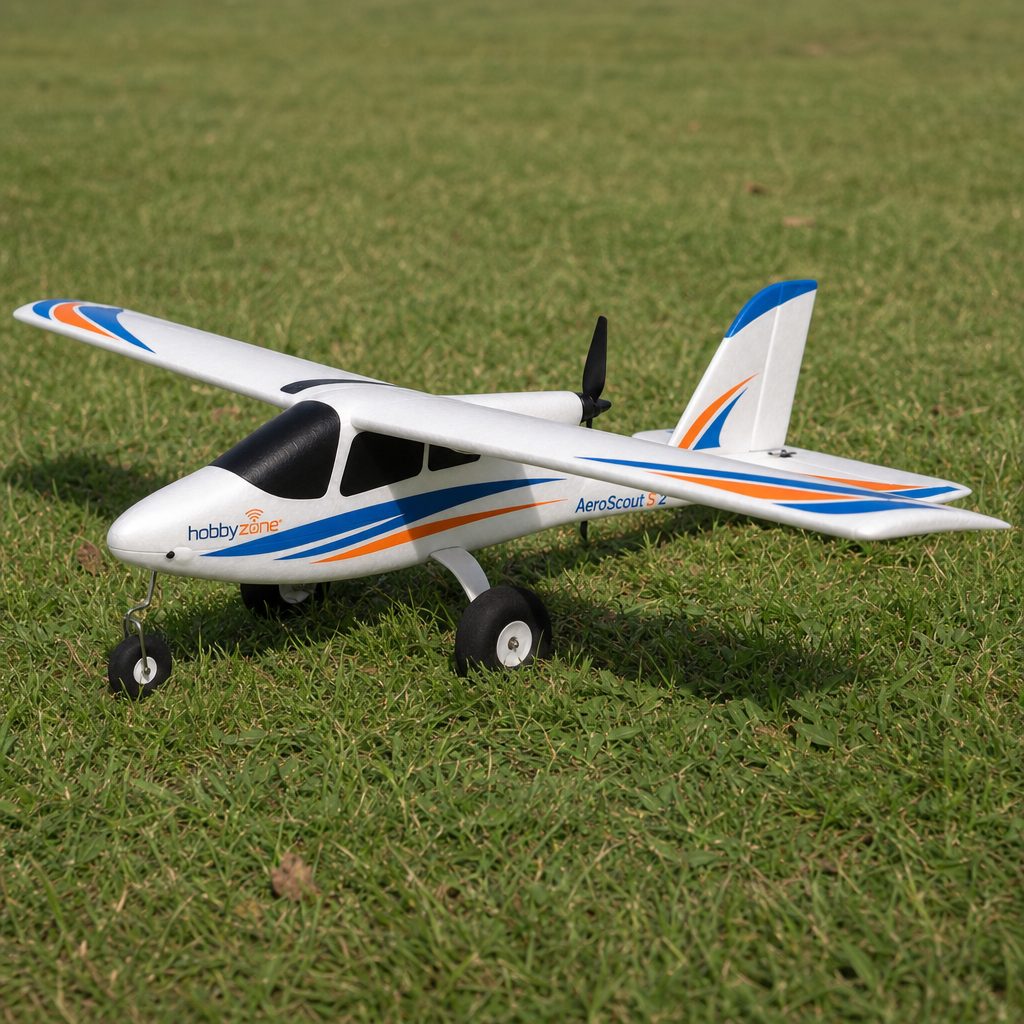
The best first landing is rarely the prettiest one. With its protected propeller and durable trainer layout, the AeroScout S 2 is designed to make imperfect arrivals less punishing.
Final verdict: a proper first aeroplane, not a gimmick
The HobbyZone AeroScout S 2 earned its reputation as a beginner trainer because its most useful features addressed the mistakes beginners actually make. The high wing helps stability. The pusher propeller protects a crucial vulnerable part. The oversized landing gear makes field use more realistic. SAFE modes and Panic Recovery give new pilots valuable breathing room, whilst the move to Intermediate and Experienced modes means the aircraft can continue teaching rather than being outgrown immediately.
My verdict: buy the RTF Basic version if you are starting from scratch and want the most approachable route into fixed-wing RC flying. Choose the BNF Basic only when you already have compatible Spektrum gear. Do not buy either expecting a windproof, indestructible backyard toy. Buy it as a thoughtfully designed trainer, give it a calm open field and a patient first few sessions, and the AeroScout S 2 gives a complete beginner a very real chance of getting airborne — then wanting to do it all again next weekend.