LEGO Icons Arcade Pinball Machine Review: Does LEGO's First Working Pinball Table Actually Play?
A 2,274-piece Classic Space love letter that promises flippers, a spring launcher and a proper scoring mission — all without a single battery. I've had hands (and thumbs) on it to find out whether the play holds up to the hype.
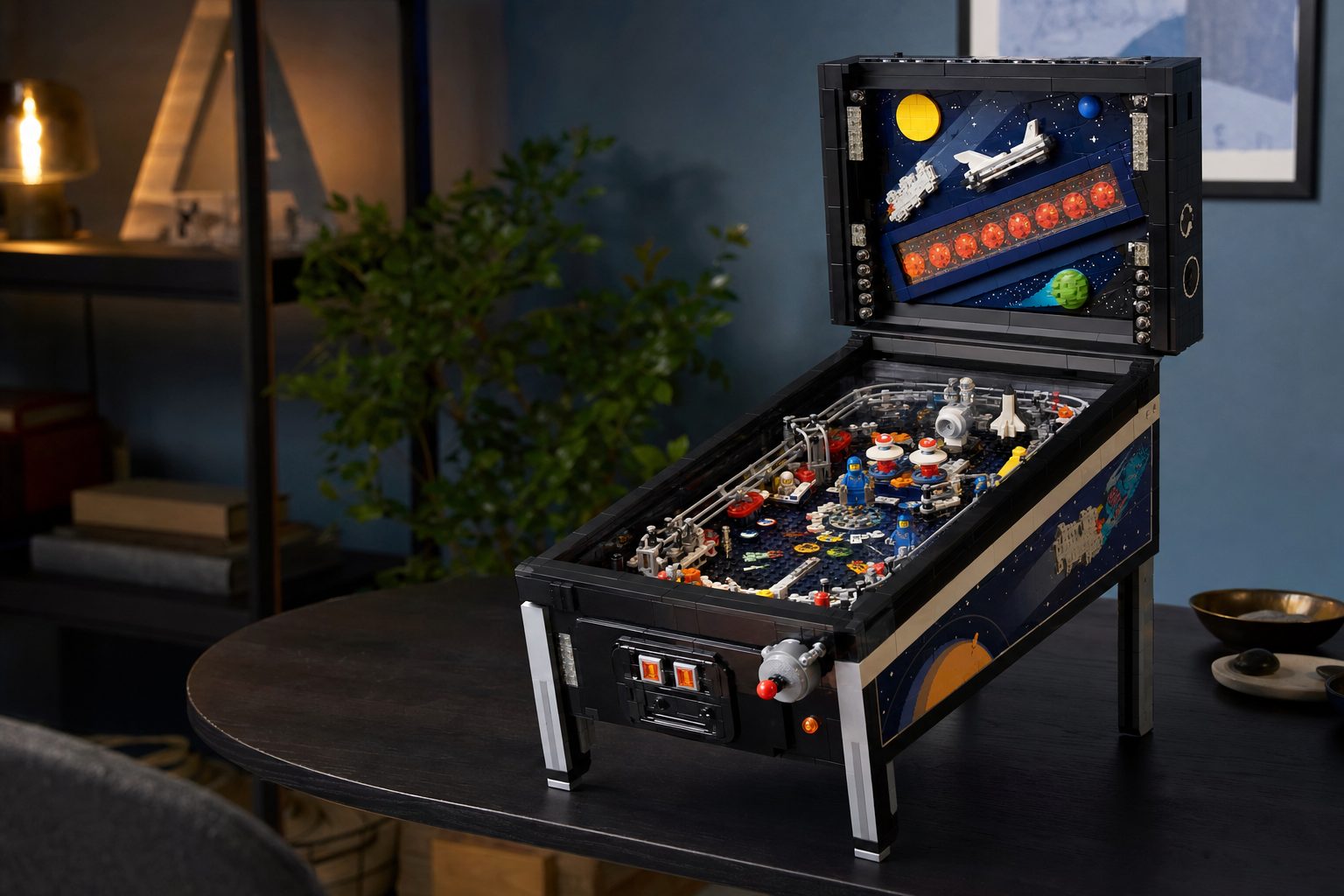
The LEGO Icons Arcade Pinball Machine (11374) — LEGO's first fully playable pinball table, complete with a Classic Space astronaut rescue mission.
Every so often LEGO releases a set that makes you sit up and rethink what a big adult-orientated build is actually for. For years the Icons line has leaned hard into the "display it and admire it" school of design — gorgeous models that look tremendous on a shelf but do very little once they're finished. The Arcade Pinball Machine (set number 11374) is a deliberate swing in the opposite direction. It is, per LEGO's own press release, the company's first fully-functional pinball machine, and it arrived on general release on the 4th of July 2026 after a short Insiders early-access window that opened on the 1st.
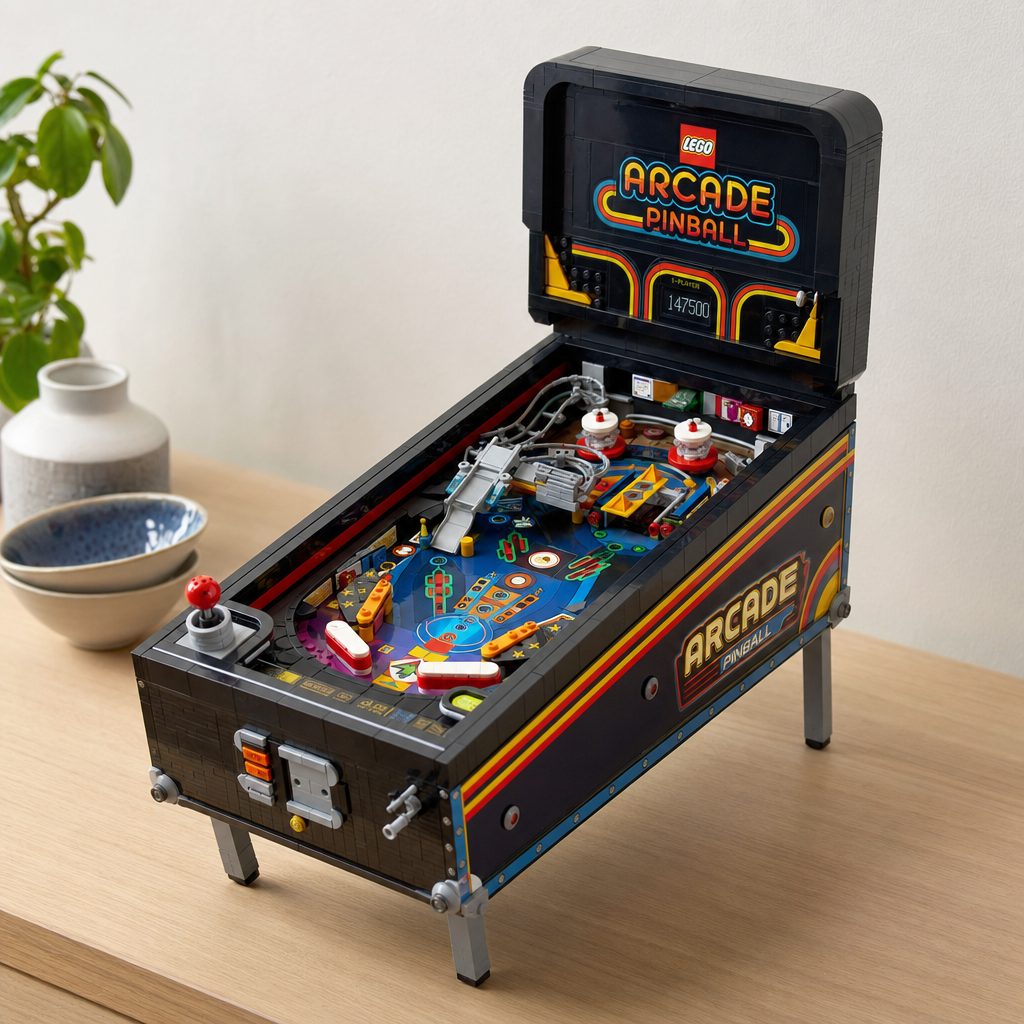
Flippers, a spring launcher, spinning bumpers and a ramp bridge — the Arcade Pinball Machine delivers a real, replayable game, not just another shelf ornament.
I'll be upfront: I went in a sceptic. A pinball table with no electronics, no solenoids, no scoring display — just Technic linkages and springs? It sounded like the kind of idea that reviews brilliantly in theory and then sits inert on a table in practice. Having now spent a good while both building it and, crucially, actually playing it, my scepticism has largely evaporated. Largely. There's a genuine caveat I'll get to, because it's an important one. But let's start with what this thing is and how it comes together.
What Exactly Is the Arcade Pinball Machine?
This is a tabletop pinball table rendered entirely in LEGO, standing over 9.5 inches (24 cm) tall, 15 inches (38 cm) long and 11 inches (28 cm) wide. It sits at a slight incline thanks to a short stand under the back end, which gives the ball the slope it needs to roll back towards the flippers — exactly as a real cabinet would. There are 2,274 pieces in the box, and the entire mechanism is driven mechanically: spring-powered launcher, dual flippers, spinning bumpers and an up-and-over ramp bridge, all worked by LEGO Technic elements hidden beneath the playfield.
The theming is Classic Space, and it's a rather sweet one. The scenario is a baby astronaut floating away into the void, with a parent astronaut who has to save them. Your progress in that rescue is tracked physically on the model — more on that clever bit of engineering shortly. It's essentially LEGO's affectionate nod to the beloved 3D Pinball for Windows – Space Cadet table that shipped with Windows XP, reimagined in brick form. If you spent any of the early 2000s ignoring homework to nudge a virtual ball around Space Cadet, this set is aimed squarely at your nostalgia gland.
The headline claim
Unlike the 10323 PAC-MAN Arcade and the 71374 Nintendo Entertainment System — both stunning display pieces that skipped genuine game mechanics — the Pinball Machine actually plays. That is the whole point of it, and it's a very welcome departure from the shelf-ornament direction the Icons line has taken.
The Build: Technic Wizardry Hiding Under the Playfield
The genuine joy of this set — and the part I hadn't quite anticipated — is discovering how the play features are engineered as you build them. This isn't a set where the interesting bit is bolted on at the end; the mechanism is the build. You spend a big chunk of the construction laying down Technic linkages, gear racks and shock absorbers beneath what will become the playfield, and there's a real "ohhh, that's how it works" moment as each function clicks into life.
Take the flippers. When you press one of the buttons on the side, a gear rack is pushed inwards, which rotates a gear that's connected to the flipper. That's the core motion — a satisfyingly direct mechanical translation of thumb to flipper. What elevates it is the use of Technic suspension shock absorbers to provide resistance against the button. The result is a press that has proper weight and spring-back to it, so mashing the buttons feels tactile rather than loose or floppy. Reviewers have consistently called the tension "just right", and I'd agree — it's the difference between a toy that feels like a gimmick and one that feels like a designed instrument.
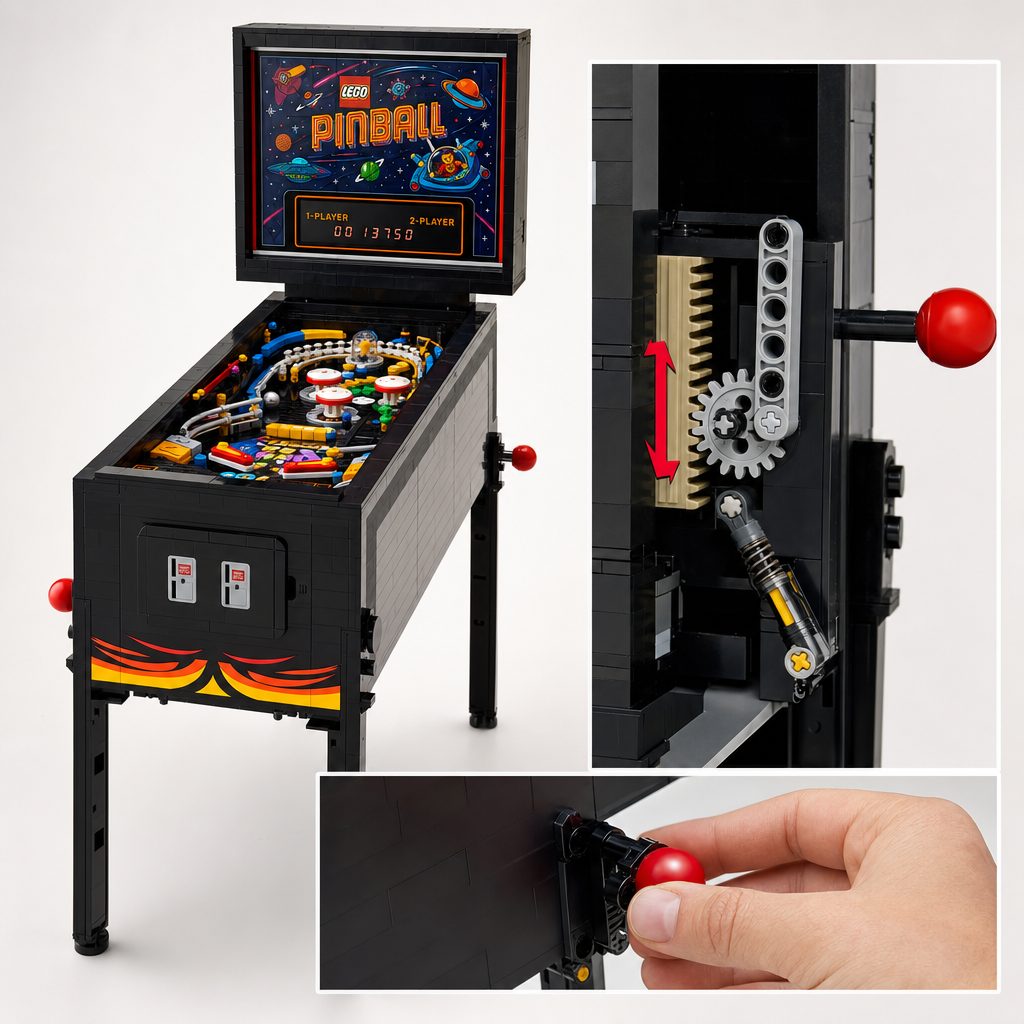
The flipper mechanism uses a gear rack driven by the side buttons, with Technic shock absorbers supplying just the right resistance under your thumb.
Then there's the mission-tracking gear, which is genuinely the cleverest thing in the box. Your rescue progress is recorded by an astronaut minifigure that inches along a giant worm gear. That worm gear only advances when you knock the ball into an asteroid target hard enough — and it does so via a new clutch gear that transfers motion in one direction only. In other words, the model has a physical, one-way ratcheting scoreboard built entirely from plastic gears. No electronics, no display screen, no batteries. It just works, and watching the astronaut slowly crawl to the rescue as you rack up successful hits is oddly compelling.
Dual manual flippers
Gear-rack driven, with shock-absorber resistance for a weighty, responsive press.
Spring-powered launcher
Pull back and release — the thrill of the launch is very much real and unmistakably pinball.
Spinning bumpers
Angular rather than the traditional mushroom shape, plus two vertical spinners with yellow arrows placed using the SNOT (studs-not-on-top) technique.
Up-and-over ramp bridge
A raised ramp the ball can travel over, adding proper multi-level pinball geometry.
One-way clutch scoring gear
A brand-new clutch element ratchets the mission astronaut forward only when you hit the asteroid target squarely.
The attention to detail extends to parts that never see the light of day. The angular bumpers are a design choice rather than a compromise, and the two vertical spinners are mounted with SNOT so the yellow arrows face the player correctly. It's the sort of fussiness that pays off in play feel, even if you never consciously notice it.
The Minifigures: A Classic Space Milestone
For the LEGO purists, the minifigures alone are a small event. This set completes the light blue Classic Space astronaut in full for the very first time, and it introduces a matching light blue baby astronaut figure to go with it. That's not a trivial detail if you follow Classic Space at all: the air tanks first appeared in light blue in 2025 sets, and the torso turned up in the Build a Minifigure bar, but the helmet and the baby are both new here. So this is the first time you can assemble the complete light blue astronaut, and the baby is a genuine debut.
You also get a spare ball, and the ball itself is a new white element. Small thing, but a spare ball is exactly what you want in a set you're expected to actually play with, because a stray pinball vanishing under the sofa is a rite of passage.
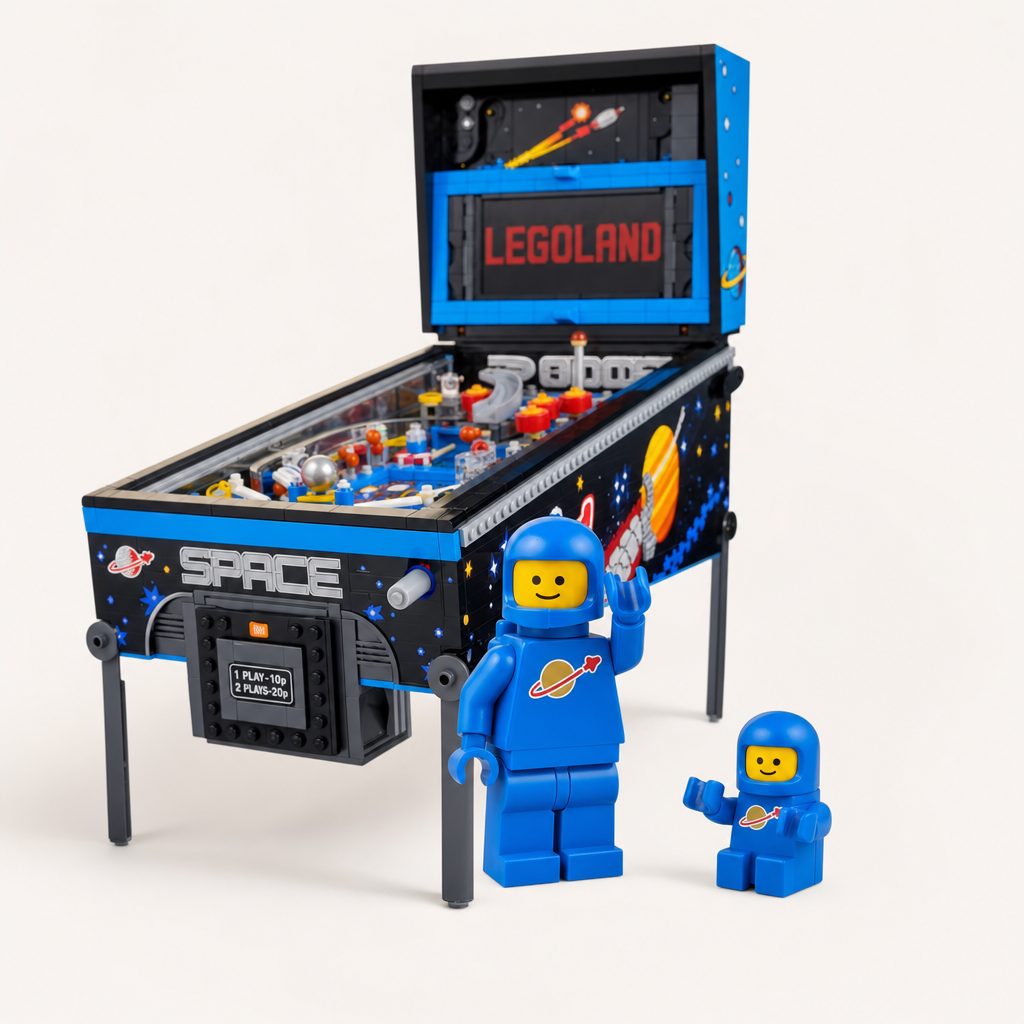
The set completes the light blue Classic Space astronaut in full for the first time and debuts a matching baby astronaut figure.
How Does It Actually Play?
This is the question the whole review hinges on, and for the most part the answer is a delighted yes. From pulling back the launcher to mashing the buttons in a panic as the ball comes hurtling back, the experience is unmistakably pinball. It's tactile, it's a little chaotic, and it has that Rube-Goldberg-machine charm where you can see every cause and effect play out in front of you. The "click" and "pop" sounds of the flippers and bumpers are all mechanical — there are no electronic sound effects — but honestly that acoustic authenticity is part of the appeal. Real pinball is a noisy business, and these little brick-on-brick sounds sell the fantasy.
Crucially, it's not a one-and-done novelty. It's genuinely challenging. The ball moves at a decent clip, the flippers require timing, and the mission gives you something to chase beyond simply keeping the ball alive. That extrinsic goal — advancing the astronaut to complete the rescue — is what separates this from a mechanical curio you fiddle with once. It gives you a reason to keep playing, which is precisely what a play-focused set needs.
Durability is another pleasant surprise. This is a set that's been designed to take a beating. Across numerous play sessions it holds up to abuse — nothing shakes loose, the mechanism keeps ticking, and it doesn't feel like it's going to disintegrate the moment a child gets enthusiastic with the flippers. For a model you're actively encouraged to play with rather than baby, that structural robustness matters enormously.
The One Big Caveat: The Mission Mechanism
Now for the honest bit, because a review that only gushed would be doing you a disservice. The mission mechanism — the asteroid-triggered worm gear that advances the astronaut — has produced mixed results, and I don't think it's all down to user error.
The design requires you to knock the asteroid fairly hard with the ball to shift it enough to trigger the gears. When it works, it's magic. But at least one reviewer found the core mission function simply wouldn't engage. They went through the instructions and quadruple-checked their work, took sections apart and rebuilt them, and even added extra pieces to weight the counterbalance — with no joy at all. That's the kind of exhaustive troubleshooting that suggests this may not be an isolated build mistake.
This echoes a known LEGO pattern: the mouth-missile function on 71411 The Mighty Bowser from 2022 was similarly temperamental for some builders. When a delicate, motion-dependent mechanism sits at the heart of a set's play value, tolerances matter, and a small amount of variation can be the difference between "it works beautifully" and "it never fires".
To be clear, plenty of builders report the mission working exactly as intended, and the flippers, launcher and bumpers all seem reliably solid across the board. But if the rescue-tracking system is the feature that sold you on the set, go in aware that it's the fussiest part of the whole machine and may need patience — or a little creative counterweighting — to get behaving. It's the single thing keeping this from being an unqualified triumph.
Build Time and Who's Building It
At 2,274 pieces with a mechanism this involved, this is very much an adult-level build — the kind of afternoon-or-two project where you'll want a clear table, a decent playlist and a cup of tea. The satisfaction comes not just from the finished object but from understanding how each play function is assembled, which makes it a rewarding build in its own right even before you touch a flipper.
It's worth stressing that although the finished model is robust enough for kids to play, the building of it is squarely an adult or older-teen affair. Younger children will get the fun of the flippers; the Technic gearing underneath is where the grown-up appeal lives.
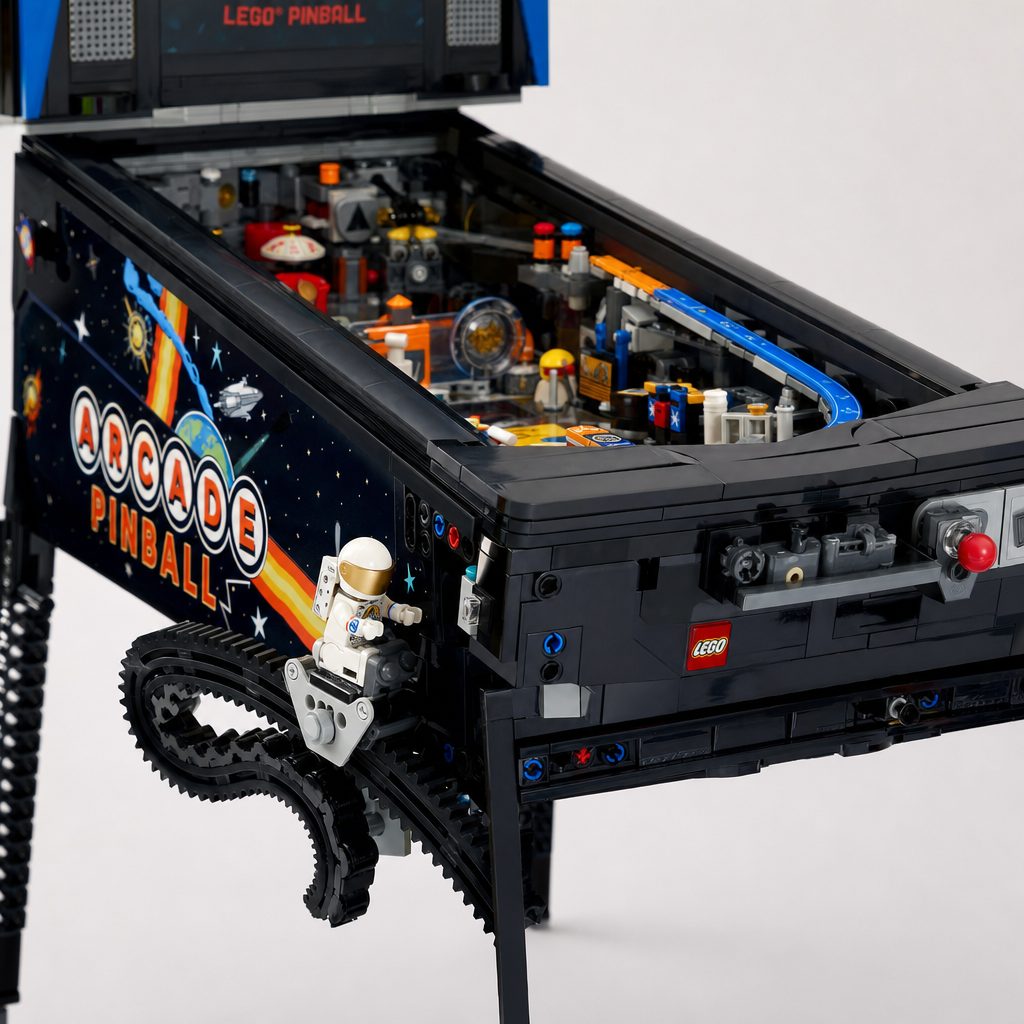
The mission astronaut crawls along a giant worm gear as you land asteroid hits — a physical, battery-free scoring system that's the model's cleverest trick.
How It Compares to Other Big LEGO "Play" and Display Sets
The most useful comparison is against LEGO's own recent history of large adult sets that look like games but don't play like them. Here's how the Pinball Machine stacks up against two obvious stablemates.
| Feature | LEGO Arcade Pinball Machine (11374) | LEGO PAC-MAN Arcade (10323) | LEGO NES (71374) |
|---|---|---|---|
| Piece count | 2,274 | 2,651 | 2,646 |
| Genuinely playable game? | Yes — flippers, launcher, bumpers, mission | No — display piece with animation | No — display piece |
| Power source | Fully manual, no electronics | Battery-driven display motion | Manual scrolling screen |
| Standout feature | One-way clutch scoring gear + rescue mission | Rotating maze display | TV with scrolling Mario level |
| Replay value | High — actively play it repeatedly | Low — admire, occasionally demo | Low — admire, occasionally demo |
| Theme integration | Classic Space (light on theming) | Heavy, iconic PAC-MAN branding | Heavy, iconic Nintendo branding |
The pattern is clear. The PAC-MAN Arcade and the NES are magnificent objects, but they're fundamentally sculptures — you build them, you put them on a shelf, and you show them off. The Pinball Machine is the one that asks you to keep coming back and using it. That's a meaningful philosophical difference, and if "play value" is high on your list, it's the reason this set stands apart from its siblings.
The theming trade-off
The flip side of that comparison: where PAC-MAN and the NES drip with instantly recognisable branding, the Classic Space theming here feels a touch like an afterthought. The play mechanism is the star; the space dressing is comparatively thin. Depending on your priorities, that's either a shrug or a genuine disappointment.
Value for Money
Let's talk numbers, because a 2,274-piece set is never an impulse buy. At launch the Arcade Pinball Machine landed at £189.99 in the UK, $229.99 in the US, €209.99 across the EU, CAD $319.99 in Canada and around AUD $349.99 in Australia. That works out at roughly 8.4p per piece in the UK, about 10.1 cents per piece in the US and around 9.2 cents per piece in the eurozone.
For context, a price-per-piece figure in the 8–10p/10c range is squarely within what most LEGO fans consider acceptable for a large licensed-feel Icons set, and it's arguably good value given how many interesting Technic and functional parts you're getting rather than plain bricks. You're not just paying for a pile of studs; you're paying for shock absorbers, gear racks, a new clutch gear and the engineering that ties them together. When you factor in the genuine replay value — a set you'll actually keep using rather than dusting — the cost per hour of enjoyment looks rather favourable compared with a pure display piece.
On availability: at launch it was sold exclusively through LEGO.com and LEGO Stores, which is standard for a set like this. LEGO typically widens distribution a few weeks after release, though no third-party retail partnerships had been confirmed as of mid-July 2026. If you're shopping around, it's worth comparing what's out there.
Check the latest price and any current bundles online before you buy.
Pros and Cons
Pros
- Genuinely playable — flippers, launcher and bumpers all deliver a real pinball thrill
- Not just fun but properly challenging, with a mission that gives you a reason to keep playing
- Sturdy enough to withstand numerous play sessions and a bit of enthusiastic abuse
- The one-way clutch scoring gear is a mind-blowing bit of battery-free engineering
- Technic shock absorbers give the buttons exactly the right tension and feel
- Completes the light blue Classic Space astronaut and debuts a matching baby figure
- Sits within an acceptable price-per-piece range with lots of interesting functional parts
- Easy to customise and make your own with a bit of creativity
- A refreshing, welcome departure from the display-only Icons formula
Cons
- The mission mechanism has produced mixed results — some builders report it simply won't trigger even after exhaustive troubleshooting
- You have to hit the asteroid fairly hard to advance the mission, which is fiddly
- Classic Space theming feels like an afterthought next to the mechanism
- No electronic sound or scoring display (a purist plus, but not for everyone)
- Adult-level build complexity may frustrate younger would-be builders
Our Rating
Who Should Buy It?
The Technic tinkerer
If you love understanding how mechanisms work, the gear racks, clutch gear and shock-absorber flippers make this a joy to build and demo.
The Windows XP nostalgist
Anyone who lost hours to 3D Pinball Space Cadet will grin the moment they clock what this set is paying homage to.
The Classic Space collector
The full light blue astronaut and the debut baby figure make this a must-have for Classic Space completists.
The play-first buyer
If you're tired of Icons sets that only sit on a shelf, this is the one you'll actually keep picking up and playing.
Who might want to think twice? If your primary interest is a heavily themed showpiece to display and rarely touch, the PAC-MAN Arcade or NES may satisfy you more on the theming front. And if the rescue mission is the specific feature that excites you most, be aware that it's the one part with a question mark over consistency.
Frequently Asked Questions
The Verdict
A landmark set held back by one fiddly feature
The LEGO Icons Arcade Pinball Machine is one of the most genuinely exciting large sets I've handled in a good while, precisely because it does the thing so many Icons sets refuse to: it plays. The flippers feel weighty and responsive, the launcher delivers a real thrill, and the one-way clutch scoring gear is a piece of battery-free engineering that deserves a round of applause. It's sturdy, it's endlessly replayable, and the build teaches you exactly how every function works. The LEGO design team should be proud.
The asterisk is the mission mechanism, which for some builders simply doesn't fire despite exhaustive troubleshooting — a real, documented reliability wobble rather than pure user error. Pair that with Classic Space theming that feels a little thin, and you have a set that falls just short of an unqualified masterpiece. But make no mistake: as a proof that LEGO can build a working game rather than a mere sculpture, this is a resounding success and a very welcome change of direction. If you want an Icons set you'll actually play with for years rather than dust, this is the one to get.
Bottom line: 8.6/10 — buy it for the play, forgive it the fussy mission, and enjoy the best pure-fun LEGO Icons set in ages.