
Magna-Tiles: The Original Magnetic Tiles, and What UK Parents Should Actually Buy
A Japanese maths toy called Pythagoras became the most copied children's toy on Earth. Here is how Magna-Tiles work, why they cost what they cost, and the honest answer for buyers in Britain.
The toy that builds itself
Most construction toys ask something of a child before they give anything back. LEGO wants fine motor control and patience. Wooden blocks want a steady hand and a flat floor. Duplo wants a decent grip. All of them have a barrier at the start, which is why a two-year-old's first encounter with a construction toy usually ends with the pieces being thrown rather than joined.
Magnetic tiles removed the barrier. A toddler who cannot yet line up two studs can absolutely hold a plastic square near another plastic square and let physics do the rest. The tile jumps the last few millimetres on its own. There is no failure state, no fiddly click, nothing to get wrong — and crucially, the reward arrives before the skill does. That inversion is the whole trick, and it explains why magnetic tiles ended up in nearly every nursery, waiting room and paediatric ward in the Western world within about fifteen years.
It also explains the second thing everyone notices: adults cannot leave them alone. Hand a set to a family and within ten minutes somebody over thirty is quietly building a dodecahedron and refusing to acknowledge it. There is no shame in this. The toy is very good.
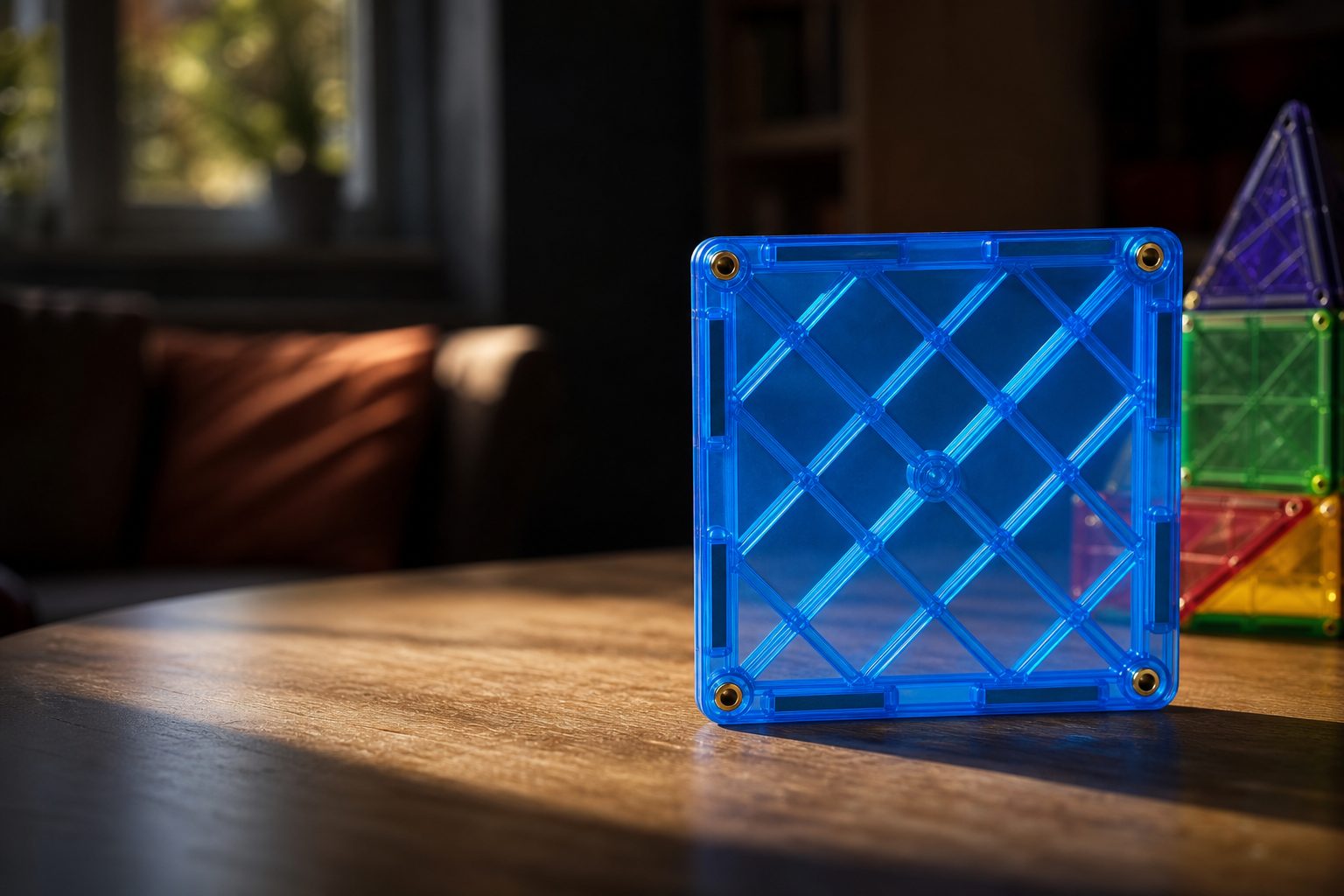
The whole appeal in one shot: a translucent tile with the light coming through it, and the rest of the set waiting behind.
From Pythagoras to Magna-Tiles: a toy that took two years of letters
The tiles did not start in America, despite the brand's "America's #1" badge. They started in Japan, as an educational toy called Pythagoras — opaque magnetic tiles designed to teach geometry, the sort of clever, unshowy classroom object Japan produces rather a lot of.
In the 1990s an American salesman called Rudy Valenta was visiting Japan — his wife Noriko is Japanese, and the family spent summers there. Their own children found the Pythagoras tiles and, in the detail that clearly sold it, played with them for hours without arguing. Any parent reading that sentence understands immediately why Rudy Valenta decided this was worth a business.
Getting the rights took roughly two years of phone calls and letters to the Japanese manufacturer before they agreed to let a pair of unknown Americans import their toy. Rudy and Noriko founded Valtech in 1997 and launched it in the United States, initially under the original name. It went nowhere. "Pythagoras" apparently had connotations that did not travel, and in any case it is a hard word to shout across a toy shop. They renamed it Magna-Tiles, and that — plus a decade of grinding away at specialty toy shops and educational suppliers — is the whole origin story.
Sales started slowly. Then they did not. By the mid-2010s the New York Times was describing the tiles as ubiquitous among American children, which is a polite way of saying every birthday party in the country had a tub of them. Rudy Jr joined in 2009 and pushed the range from about five products to more than twenty; his sister Antoinette took on marketing. The family sold the brand in the early 2020s, though a third generation of Valentas is still involved.
The bit nobody mentions
Magna-Tiles is the original brand in the West, but it is not the original toy. It is a Japanese geometry aid with an American name and thirty years of very good distribution behind it. That is not a criticism — it is a useful thing to know when you are standing in front of a shelf of near-identical rivals wondering what the extra money buys.
What is actually inside a Magna-Tile
Pick one up and hold it to the light. You will see a criss-cross lattice moulded into the inside of the tile, like the ribbing on the underside of a good plastic chair, and a small metallic dot at each corner. Both of those details are the reason the tile costs what it does.
The lattice is structural. A flat sheet of plastic that size flexes and eventually cracks; a ribbed one resists. It is also why the tiles look the way they do when sunlight comes through them, which is a happy accident the brand has leaned into ever since.
The corner rivets are nickel-plated, lead-free stainless steel, and they are the single biggest engineering difference between the original and most of its imitators. Magna-Tiles pioneered them. They clamp the two halves of the tile together mechanically, so the shell is not relying on welding alone. Plenty of rival tiles skip the rivets entirely and are perfectly serviceable — they are just, on the whole, easier to split.
Round the edges sit the magnets, fully sealed inside the plastic, free to rotate so that any edge attracts any other edge — which is why you never have to work out which way round a tile goes. The company also uses what it calls a V-Lock edge design, shaped to stop the corners chipping when a tower comes down, which towers do, constantly.
The plastic is a modified ABS, free of BPA and phthalates. The sets meet EN71 in Europe, plus ASTM and CPSIA in the United States. Every product carries a lifetime warranty, and — a genuinely notable claim, verified by the Good Housekeeping Institute — there has never been a recall in more than twenty-five years of production.
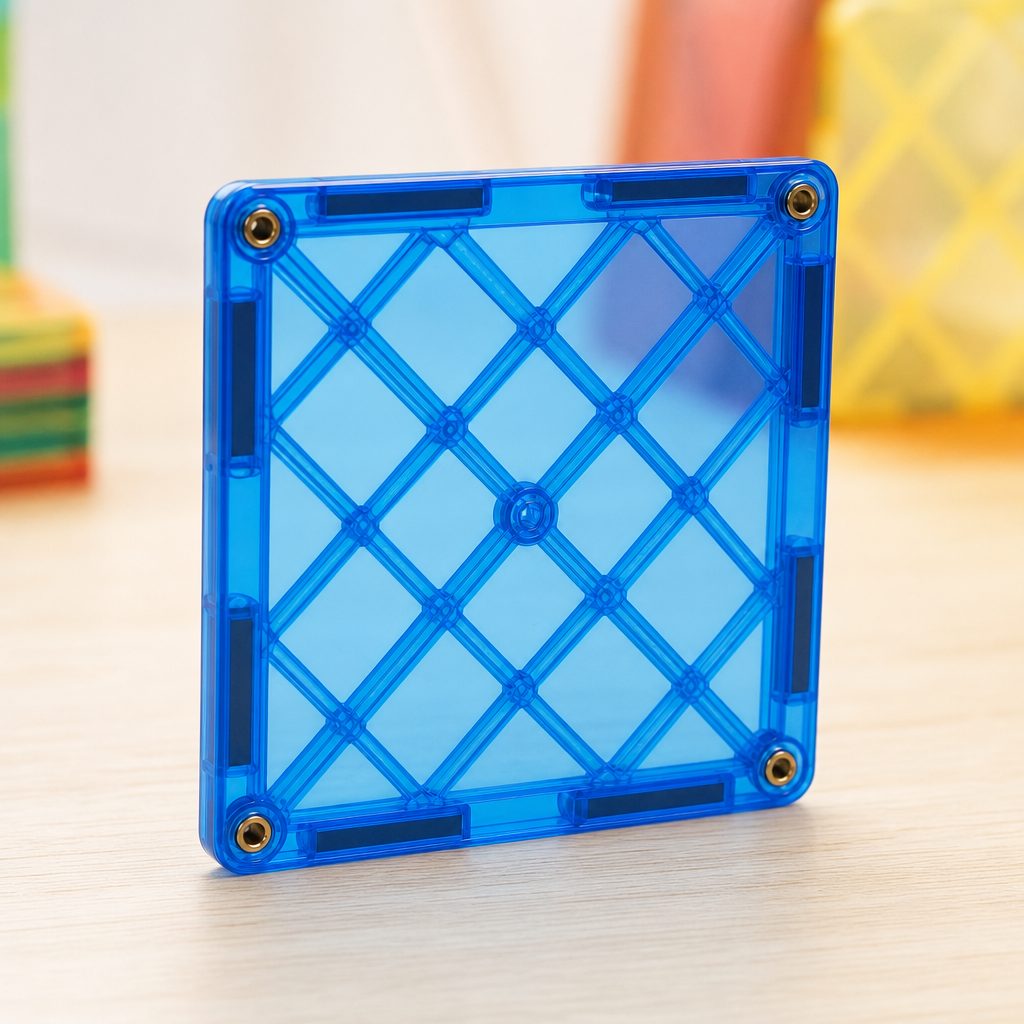
Look closely: the criss-cross lattice moulded inside, a nickel-plated rivet at each corner, and the dark bars along the edges where the magnets are sealed in.
Why they cost so much
There is no getting around this. Magna-Tiles are expensive, and in the UK they are expensive in a way that occasionally borders on the absurd. A 100-piece set is a three-figure purchase at some retailers.
Some of that is real. The rivets, the lattice, the sealed magnets, the testing regime and the lifetime warranty all cost money, and the tiles genuinely do survive years of being trodden on, posted behind radiators and used as ice-scrapers. Buy a set for a three-year-old and there is every chance their younger sibling inherits it intact.
Some of it is brand. Magna-Tiles was first, it is the name nurseries recognise, and it prices accordingly. And some of it, in Britain specifically, is simply distance: this is an American brand sold into a market where its main rival is closer, cheaper to ship and extremely good.
The sets, decoded
The range has grown well past the point of being obvious, so here is the map. Almost everything falls into one of four groups.
1. The plain ones (start here)
The Classic and Clear Colors sets are the foundation of the whole system and the only ones most families need. Classic tiles are solid colour; Clear Colors are translucent, and they are the ones that do the stained-glass trick when held to a window or laid on a light box. Both come in 32-piece and 100-piece boxes.
A standard 32-piece set contains fourteen small squares, two large squares, eight equilateral triangles, four right triangles and four isosceles triangles. That mix is not arbitrary — it is the minimum that lets a child build a closed cube, a pyramid and a house, which covers most of what a small builder wants to do on day one.
2. The expansions
Small packs of shapes the basic sets do not include: Polygons, Rectangles, and similar 8-piece add-ons. These are genuinely useful once a child has outgrown cubes and starts wanting doors, longer walls and odd angles. They are also the cheapest way to make an existing set feel new.
3. The themed sets
Metropolis for city play, Stardust with its mirrored and glitter tiles, Glow for the dark, Castle, Pet Playhouse, Rail Racers, Police Patrol and a steady stream of others. These add printed panels, wheels, figures and accessories. They are lovely and they are also where the range starts nudging you towards collecting rather than building.
4. The small ones
microMAGS are a smaller-format tile aimed at older children and travel. Worth knowing they exist; not worth being your first purchase.
If you buy one box
Make it a Clear Colors 100-piece set. The translucency is most of the magic, and 100 pieces is the point at which two children can build at the same time without a diplomatic incident. If the budget will not stretch, a 32-piece set plus a shape expansion beats a themed set of the same price every time.
Check Magna-Tiles prices on Amazon UK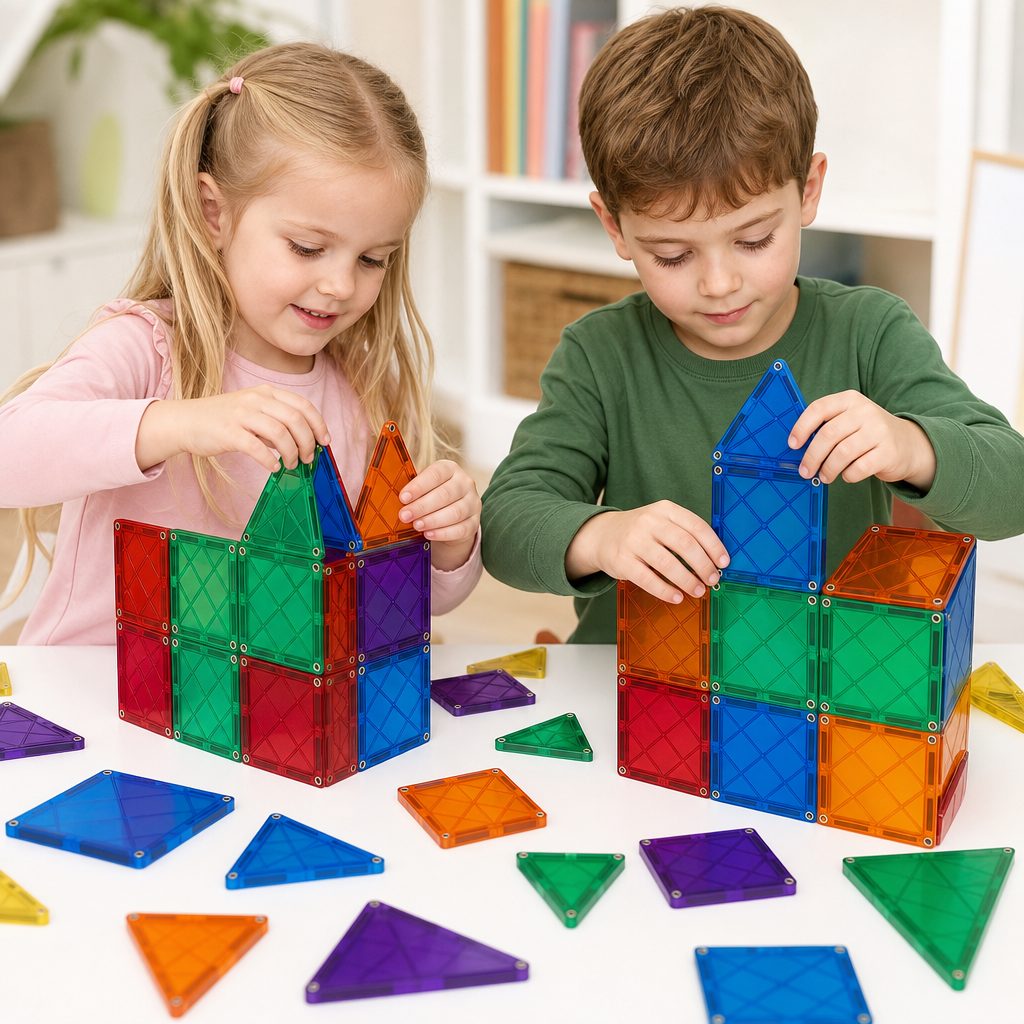
A hundred tiles is the point where two children can build side by side without negotiating over every square.
The sets at a glance
Piece counts vary by region and get revised, so treat these as the shape of the range rather than a price list.
| Set | Roughly | Who it's for |
|---|---|---|
| Classic | 32 or 100 pieces | The default. Solid colours, all the core shapes. |
| Clear Colors | 32 or 100 pieces | Same shapes, translucent. The one to buy. |
| Clear Colors DX | 48 pieces | A deluxe middle step when 32 feels mean and 100 feels steep. |
| Polygons / Rectangles | 8 pieces each | Shape expansions. The best value in the whole range. |
| Stardust | 15 pieces | Mirrored and glitter tiles. A stocking filler that transforms an existing set. |
| Glow | 16 pieces | Glow-in-the-dark. Brilliant for about a fortnight, then merely good. |
| Metropolis | Themed set | City play — printed panels, road and building pieces. |
| Castle | 48 pieces (DLX) | Turrets and gates for children who want a story, not a structure. |
| Pet Playhouse | 50 pieces | Animals and enclosures. Very popular with the four-and-under crowd. |
| Rail Racers | 33 pieces | Wheels and track. Turns a static toy into a moving one. |
| microMAGS | 26 or 70 pieces | Smaller tiles for older children and travel. |
Seven sets worth knowing about
1. Clear Colors 100-piece — the one to buy
If this guide has a single recommendation, it is this box. A hundred translucent tiles in the full shape mix is enough for two children to build simultaneously, enough for a structure a toddler can sit inside, and enough that you will not be back for more within a month. It is also the set that does the thing everyone bought magnetic tiles for in the first place: laid against a sunny window or on a cheap light panel, it throws coloured light across the carpet and a four-year-old loses twenty minutes to it.
It is expensive. It is also the set that will still be in the house when the child is nine.
Check prices on Amazon UK2. Classic 32-piece — the sensible starter
The original standard set: fourteen small squares, two large squares and twelve assorted triangles. That is precisely enough to build a cube, a pyramid and a house, which is the entire vocabulary a two-year-old needs on day one. Solid colours rather than translucent, which some children actually prefer — the colours are bolder and the tiles show fingerprints less.
Buy this one if you are testing whether the toy lands before committing three figures. Just accept that if it does land, you will be buying more.
Check prices on Amazon UK3. Polygons and Rectangles expansions — the best value in the range
Eight pieces each, and worth more to an established collection than another thirty squares would be. Every child hits the same wall at about the six-month mark: they want a doorway, a longer wall, a roof at a shallower angle, and the basic set simply does not contain those shapes. These packs are the fix, and because they are small they are the rare Magna-Tiles purchase that does not require a conversation about money.
Check prices on Amazon UK4. Stardust — the small set that changes everything
Fifteen pieces: four mirrored squares, seven glitter squares and four equilateral triangles. On its own it builds almost nothing. Dropped into an existing hundred-piece collection it is transformative, because the mirrored tiles turn any enclosed build into an infinity box and children find this genuinely astonishing. Pound for pound the most interesting thing in the range, and the correct answer to "what do I get them when they already have Magna-Tiles?"
Check prices on Amazon UK5. Glow — better than it has any right to be
Sixteen glow-in-the-dark tiles. The obvious criticism is that it is a gimmick, and for the first fortnight it is: charge them under a lamp, turn the lights off, everyone is delighted. What earns it a place here is what happens afterwards, when the novelty fades and the tiles become the ones a child reaches for at bedtime specifically because the room is dark. It quietly turns a floor toy into a wind-down toy.
Check prices on Amazon UK6. Rail Racers — the one that moves
Thirty-three pieces with wheels and track. This is the set that answers the complaint some parents have about magnetic tiles, which is that everything you build just sits there. Add wheels and a slope and the toy acquires physics: children start building ramps, testing gradients and arguing about which car is faster, which is a different and slightly older kind of play than stacking.
Check prices on Amazon UK7. Metropolis — lovely, and the one to think hardest about
The city set, with printed windows, doors and street-level detail. It is beautifully made and children love it, and it is also the clearest example of the trade-off running through the whole themed range: printed panels tell a child what a thing is. A plain square becomes a rocket, a garage or a hamster house depending on the day. A square with a shopfront printed on it is a shop.
That is not a reason to avoid it — a city is a rich thing to play with, and the printing is genuinely good. It is a reason to make sure the plain tiles came first.
Check prices on Amazon UKHow many tiles do you actually need?
This is the question everyone gets wrong, usually by buying too few and then paying twice. The rough consensus among UK retailers and long-suffering parents:
- 32–40 pieces — a genuine starter set for a toddler. Enough for a house, a cube and a tower. You will run out.
- 60–80 pieces — the sweet spot for one child aged three to six. Big enough for real structures, small enough to tidy away.
- 100 pieces — the right answer for siblings, or for an ambitious builder who has started asking for "the big ones".
- 100+ — at this point you are building a second collection, and mixing brands becomes the sensible move.
One genuinely useful fact: magnetic tiles from the major brands are cross-compatible. Magna-Tiles, Connetix, Playmags and PicassoTiles all snap together happily. So the expensive first box does not lock you in — you can top up with something cheaper later and nobody, least of all the four-year-old, will complain.
The UK problem: price, and patchy stock
Here is where an honest guide has to depart from the American consensus. In the United States, Magna-Tiles is the default. In Britain it is not, and there are two reasons.
The first is price. Checking UK retailers on the day of writing, a Clear Colors 100-piece set was £70.99 at Very and £95.00 at Argos — a £24 spread on the same box, which tells you something about how loosely this brand is priced here. Shop around, always.
The second is availability. Magna-Tiles turns up at Argos, Smyths and Very, but the range is thinner than the American catalogue and specific sets come and go. Several sets that are everyday stock in the US are simply not reliably available here, and at the time of writing the 100-piece Clear Colors set was not listed on Amazon UK at all — you had to go to a high-street retailer for it. If you have a specific themed set in mind, check before you set your heart on it.
See what Magna-Tiles sets are in stock on Amazon UKMagna-Tiles vs Connetix vs PicassoTiles
These three cover almost the entire market, and in the UK the fight is really between the first two.
| Magna-Tiles | Connetix | PicassoTiles | |
|---|---|---|---|
| Origin | US brand, Japanese design, since 1997 | Australian, founded 2018 | US budget brand |
| Magnets | Strong | Very strong | Slightly weaker, fine in practice |
| Build | Corner rivets, lattice, V-Lock edges | Marginally thicker, bevelled edges | Lighter, thinner |
| Clarity | Clear | Crystal clear | Clear, slightly softer colours |
| UK price | High | High | Much lower — often 2–3× the pieces for the money |
| UK availability | Patchy; Argos, Smyths, Very | Excellent; John Lewis and most toy shops | Mostly online |
The honest UK verdict: Connetix has taken the lead here on quality, looks and availability. Its magnets are slightly stronger, its tiles marginally thicker, and it is far easier to buy in Britain. If you are choosing blind, with no other information, Connetix is the safer buy for a UK family.
But — and this matters — Magna-Tiles' corner rivets are a real durability advantage, the lifetime warranty is real, and a set bought today will still be in service in a decade. If you find the original at a sensible price, or you already own some, there is no reason whatsoever to switch. And because everything is cross-compatible, "which brand" is a much lower-stakes question than the marketing on either side would like you to believe.
PicassoTiles is the value play. The magnets are a little weaker and the plastic a little thinner, but for the price of one premium 100-piece box you can have two or three times the tiles. For a big floor-covering collection where sheer quantity is the point, that is a perfectly rational trade.
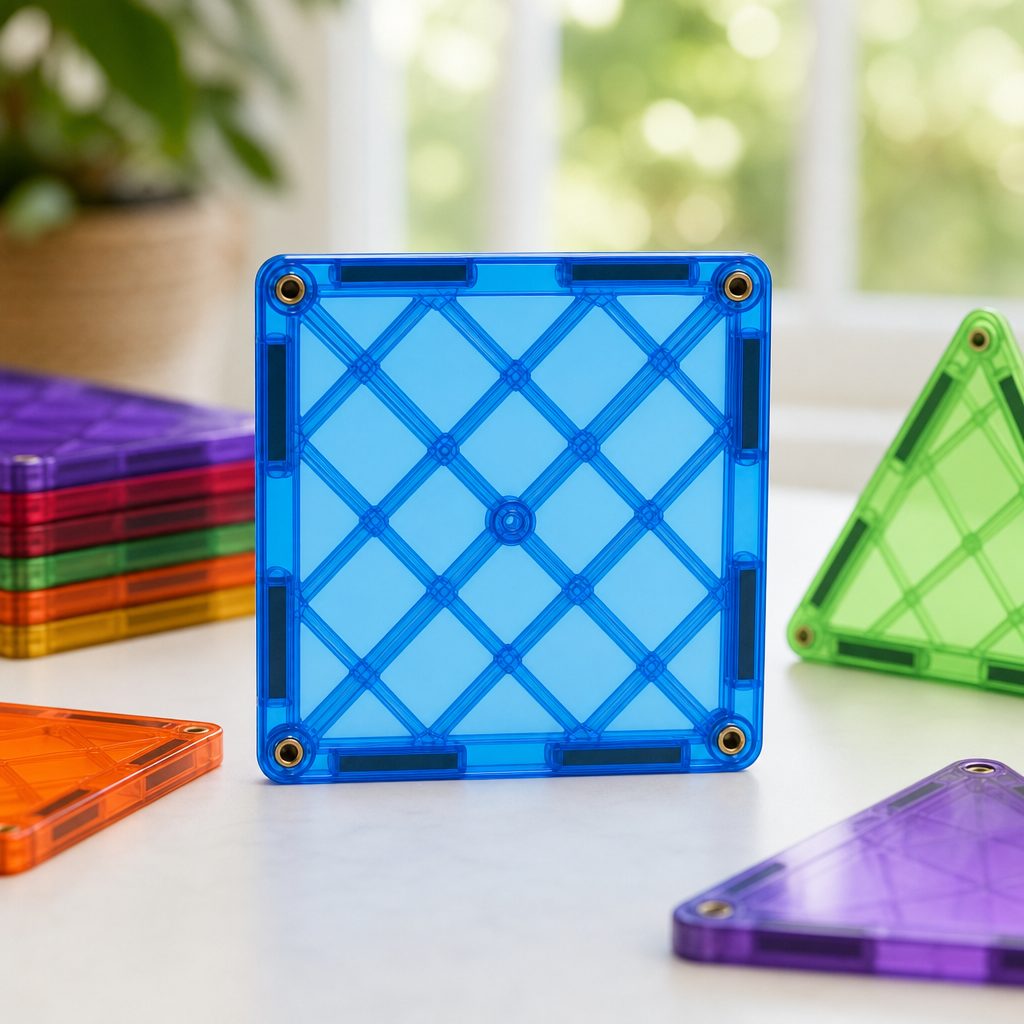
Squares, triangles and a magnet in every edge — the format every rival copied, which is why tiles from different brands still snap together.
Magnets and safety: the part that actually matters
This section is more serious than the rest of the article, and it is the reason we would rather you read to the end.
Swallowed magnets are one of the genuinely dangerous things a small child can do. When two or more magnets are swallowed separately, they attract each other through the wall of the gut, pinch the tissue between them and cut off its blood supply. That can cause serious internal damage within hours. NHS England issued a national patient safety alert on exactly this, and current figures point to around 300 children and young people hospitalised in the UK every year after swallowing magnets, with roughly half needing surgery to remove them.
If you think a child has swallowed a magnet
Go to A&E immediately. Do not wait to see whether symptoms appear — by the time there is pain or sickness, damage may already have been done. This is the explicit NHS advice, and it is worth knowing before you need it.
Now the important distinction, because scare stories and sealed toys are not the same thing. The NHS warnings are overwhelmingly about loose, high-powered magnets: magnetic ball sets, desk toys, and a social-media trend of using small magnets to fake tongue and nose piercings, which accounts for a meaningful share of cases. Magnetic building tiles seal their magnets inside moulded plastic precisely so this cannot happen, and Magna-Tiles' whole engineering story — rivets, lattice, welded shells, no recall in twenty-five years — is about keeping them there.
Which leads to the one piece of practical advice that genuinely matters:
Bin cracked tiles. Every time.
A sealed tile is a sealed magnet. A cracked one is a loose magnet waiting to happen. Check tiles periodically — especially cheap unbranded ones and anything that has been chewed, trodden on or left in a hot car — and throw away any that are split, crazed or rattling. This is also the single strongest argument against no-name magnetic tiles from marketplace sellers, where the shell quality is the first thing to be cut.
The official age rating on Magna-Tiles is 3+. Retailers commonly suggest supervised exploration from around 18 months and independent building from three, which is sensible: under-threes put things in their mouths, and the large square tiles are safe but a broken fragment is not.
How to spot a fake
Magna-Tiles is one of the most counterfeited toys on the market, and the fakes are a safety question rather than a snobbery one — the shell is exactly the component a counterfeiter economises on, and the shell is the only thing keeping the magnets inside.
Genuine tiles carry the MAGNA-TILES name moulded into every single tile, not just printed on the box. That is the brand's own stated authenticity check and it is the quickest one you can do in a shop or on a doorstep. Beyond that:
- Look for the corner rivets. Small metallic dots at each corner of the tile. Their absence does not prove a fake — several legitimate rival brands do not use them — but their absence on something sold as Magna-Tiles does.
- Check the edges. Genuine tiles are smooth and consistent. Rough seams, flashing or a sharp lip are bad signs.
- Squeeze and listen. A tile that flexes noticeably or rattles has a loose magnet. Do not give it to a child.
- Be sceptical of the price. These are expensive toys. A hundred-piece set at a third of the usual price is not a bargain, it is a different product.
- Buy from a retailer you recognise. Argos, Smyths, Very, John Lewis, or the brand's own listings. Marketplace sellers with no track record are where the counterfeits live.
None of this applies to buying a legitimate cheaper brand deliberately. PicassoTiles and Playmags are not fakes; they are rivals, they are clearly labelled as themselves, and they meet the same safety standards. A "Magna-Tiles" set that is not a Magna-Tiles set is a different matter entirely.
What they are genuinely good for (and the honest limits)
Magnetic tiles are sold with a lot of STEAM language, and some of it is marketing. Here is what actually holds up.
Geometry, honestly yes. This was a Japanese maths teaching aid before it was anything else. A child who has spent a year with these tiles has handled equilateral, isosceles and right triangles thousands of times and knows in their hands — long before they meet the words — that two right triangles make a square and six squares make a cube. That is real, durable spatial understanding, and it is very hard to teach any other way.
Persistence, yes. Because the failure mode is gentle. A LEGO build that goes wrong has to be dismantled; a tile tower that goes wrong falls over dramatically and gets rebuilt taller. Children iterate freely with these because collapse is fun rather than punishing.
Open-ended play, yes, right up until the themed sets arrive. A plain box of squares and triangles becomes a garage, a rocket, a hamster enclosure and a fairy palace in one afternoon. A set with printed windows and a police car is a police station, and mostly stays one.
The limits: they are not a fine-motor toy — the magnets do the precision work, which is the point but also means they do not build the hand strength that LEGO or threading beads do. They do not teach sequencing or instruction-following, because there are no instructions. And they will not, whatever the box says, make anyone an engineer. They are a superb open-ended toy with a genuine geometry benefit attached, which is more than most toys can claim, and quite enough.
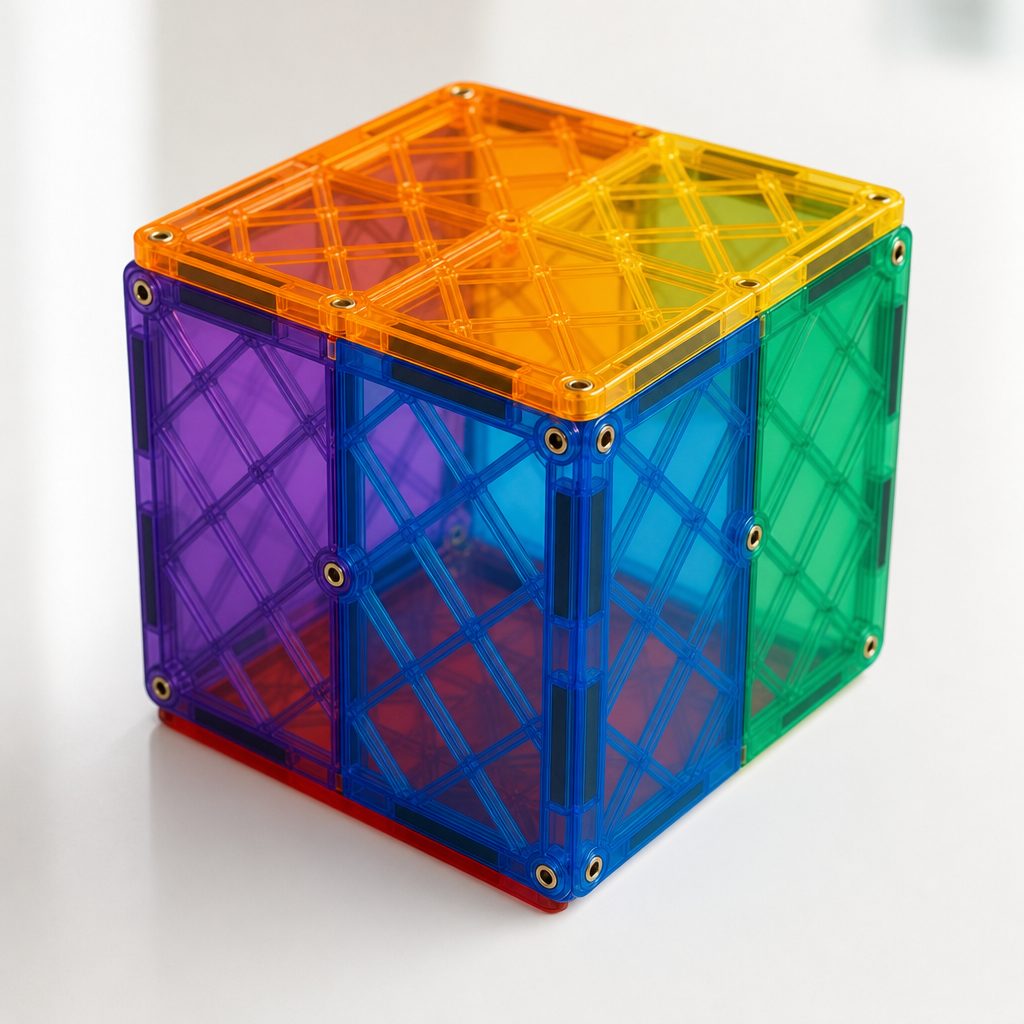
Six squares make a cube — a fact most children discover with their hands years before anyone teaches it to them.
Twelve things to build when they say they're bored
The standard failure mode of an open-ended toy is a child staring at it. These are the prompts that reliably restart things, roughly in order of age.
- A box big enough to sit in. Four walls, no roof. The first genuinely impressive thing a small child can build alone.
- A cube. Six squares. Harder than it sounds the first time, and a real moment when it closes.
- A pyramid, then a pyramid on top of a cube, which is a house, which is the gateway to everything else.
- A stained-glass window. Flat on a sunny windowsill or taped to the glass. No structure required, maximum payoff.
- A garage for whatever cars are already in the house. Magnetic tiles get much better when they stop being the only toy in the game.
- A ramp. Prop a large square on a book and race things down it. Then argue about the angle.
- A fridge mural. Vertical building on any metal door. Different muscles, different problem.
- A tower as tall as they are. It will fall over. That is the feature.
- An enclosure for a soft toy, with a gate that actually opens.
- A ball run — walls and slopes to guide a marble or a small ball from the sofa to the floor.
- An infinity box, if you have the mirrored Stardust tiles. Enclose a small space with mirrors facing in and let them look through the gap.
- A dodecahedron, for the adult who has been pretending not to be interested.
Living with them
Three things nobody tells you before the first set arrives.
They find every metal surface in your house. Radiators, fridge, dishwasher, oven door, the side of the washing machine. This is not a problem — it is a second play surface, and building vertically on a fridge is a genuinely different activity from building on the floor. Many families end up buying a cheap magnetic whiteboard purely for this.
Tidying up is fast, if you let it be. Tiles stack magnetically into neat columns, and a child who will not put away LEGO will often happily snap tiles into towers because the toy rewards it. A shallow open box beats a deep toy bag; you want to see the shapes.
They are quieter than they look. No small hard pieces skittering across floorboards, no 6am agony underfoot. Standing on a magnetic tile is an inconvenience. Standing on a LEGO brick is an event.
What to buy, depending on who you are
Buying for a 2–3 year old
A 32-piece Clear Colors set, supervised. Add a shape expansion at Christmas. Do not start with a themed set.
Buying for a 4–6 year old
Go straight to 100 pieces if you can. This is the age where structures get ambitious and running out of squares ends the game.
Buying for siblings
100 pieces minimum, and consider a premium 100 plus a cheap 100 from a compatible brand. Quantity prevents more arguments than quality does.
Topping up an existing collection
Buy shape expansions rather than another basic set — you almost certainly have enough squares and not enough angles.
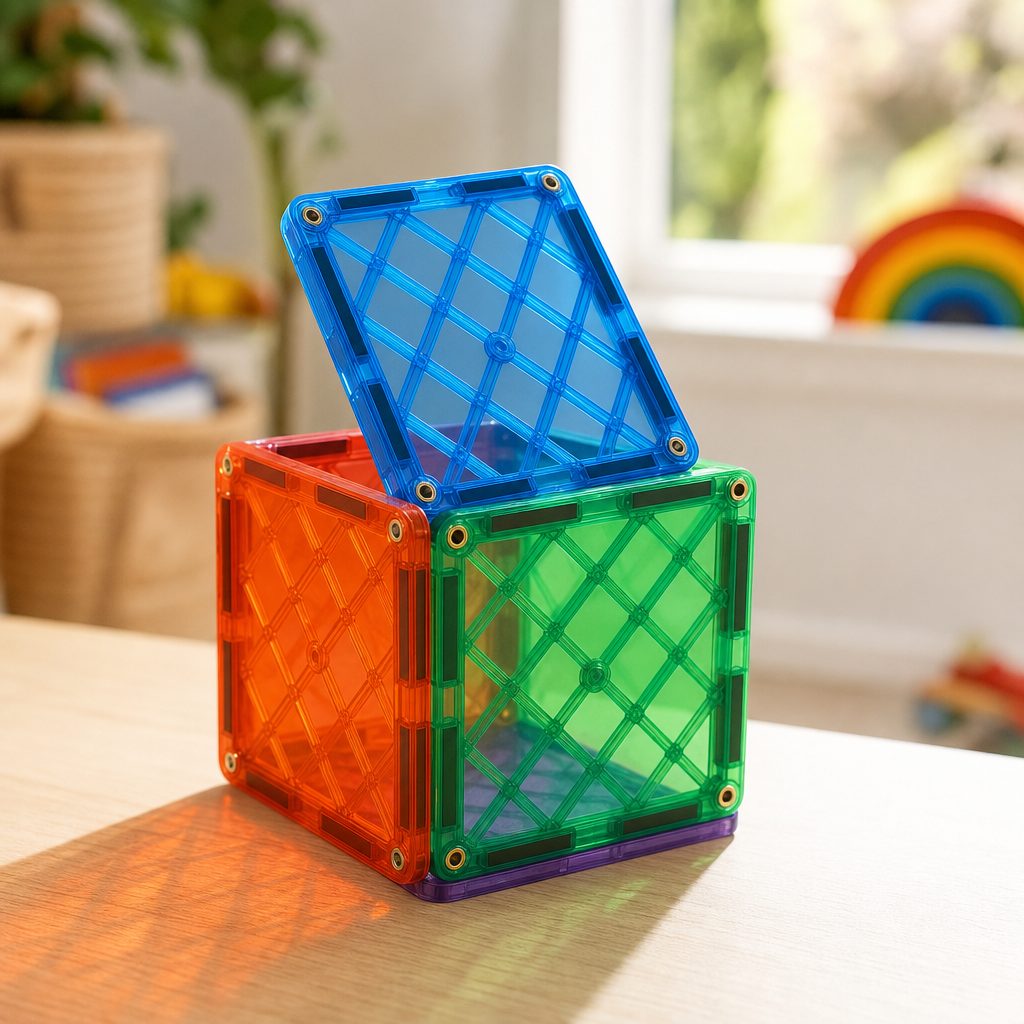
Squares are what every set gives you; angles are what every collection runs short of.
Frequently asked questions
Are Magna-Tiles worth the money?
If you buy the plain sets and the child is under six, yes — they get years of use and survive it. If you are buying a themed set at full UK price, less so. And if you are choosing purely on value in Britain, a cheaper compatible brand gets you more tiles for the same money without much practical loss.
Are Magna-Tiles and Connetix compatible?
Yes, completely. So are Playmags and PicassoTiles. Mixing brands is normal and nothing bad happens.
What age are they for?
Officially 3+. Supervised play from around 18 months is common and reasonable; independent building tends to start around three.
Are the magnets safe?
In an intact tile, yes — they are sealed inside the plastic and the brand has never had a recall in over 25 years. The danger is loose magnets, which is why you should throw away any cracked or rattling tile immediately, whatever the brand.
What is the difference between Classic and Clear Colors?
Solid colour versus translucent. The shapes and magnets are the same. Clear Colors are more popular because of what they do in sunlight, and are our pick.
Are they dishwasher safe?
No. Wipe them with a damp cloth. Heat and sealed magnets in moulded plastic are not friends, and warping a tile is exactly how you end up with the cracked shell you have just been warned about.
How many do I need?
More than you think. 32 for a toddler, 60–80 for one child, 100+ for siblings.
The verdict
Magna-Tiles is the original, and it has the engineering to justify the title: riveted corners, a reinforced lattice, sealed magnets, a lifetime warranty and an unblemished safety record stretching back more than twenty-five years. As a toy, magnetic tiles are close to unimprovable — instantly rewarding for a two-year-old, still interesting to a nine-year-old, and quietly teaching geometry the entire time.
In the UK, though, the crown is contested. Connetix is easier to buy, slightly stronger, and every bit as good, while PicassoTiles will fill a floor for a fraction of the price. Magna-Tiles remains an excellent buy at a sensible price — and everything is cross-compatible anyway, so the only genuinely wrong answer is buying too few.