
Tamiya Lunch Box Review: Why This Bonkers 1980s RC Van Is Still Brilliant
First released in 1987, the Tamiya Lunch Box was never a scale crawler, a racing machine or a model of restraint. It was a cartoon delivery van on giant tyres, built to wheelie, bounce and make every family trip to the park rather more entertaining. Nearly four decades later, the reissued 1/12-scale kit still has a peculiar magic.
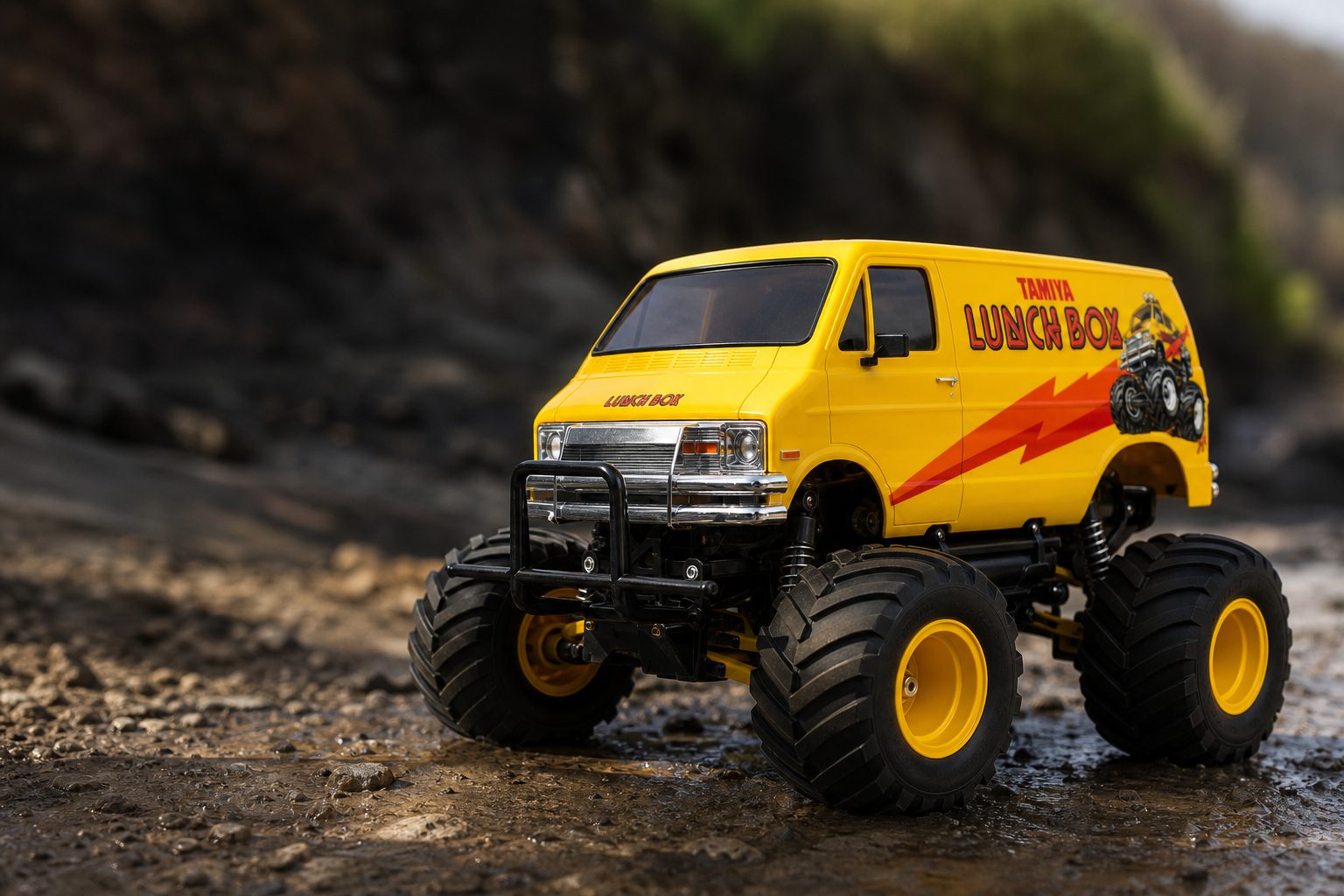
The classic yellow Tamiya Lunch Box remains one of RC's most recognisable silhouettes: huge tyres, a delivery-van body and absolutely no interest in appearing sensible.
The short version: a classic with a very clear purpose
The Tamiya Lunch Box is one of those RC cars that makes even a non-hobbyist stop and smile. You do not need to know what a bevel differential is, nor pretend that you own a timing board, to understand the appeal. It looks like a cheerful American lunch-delivery van that has accidentally been fitted with monster-truck tyres. Then you squeeze the throttle and it tries to point its nose at the sky. Job done.
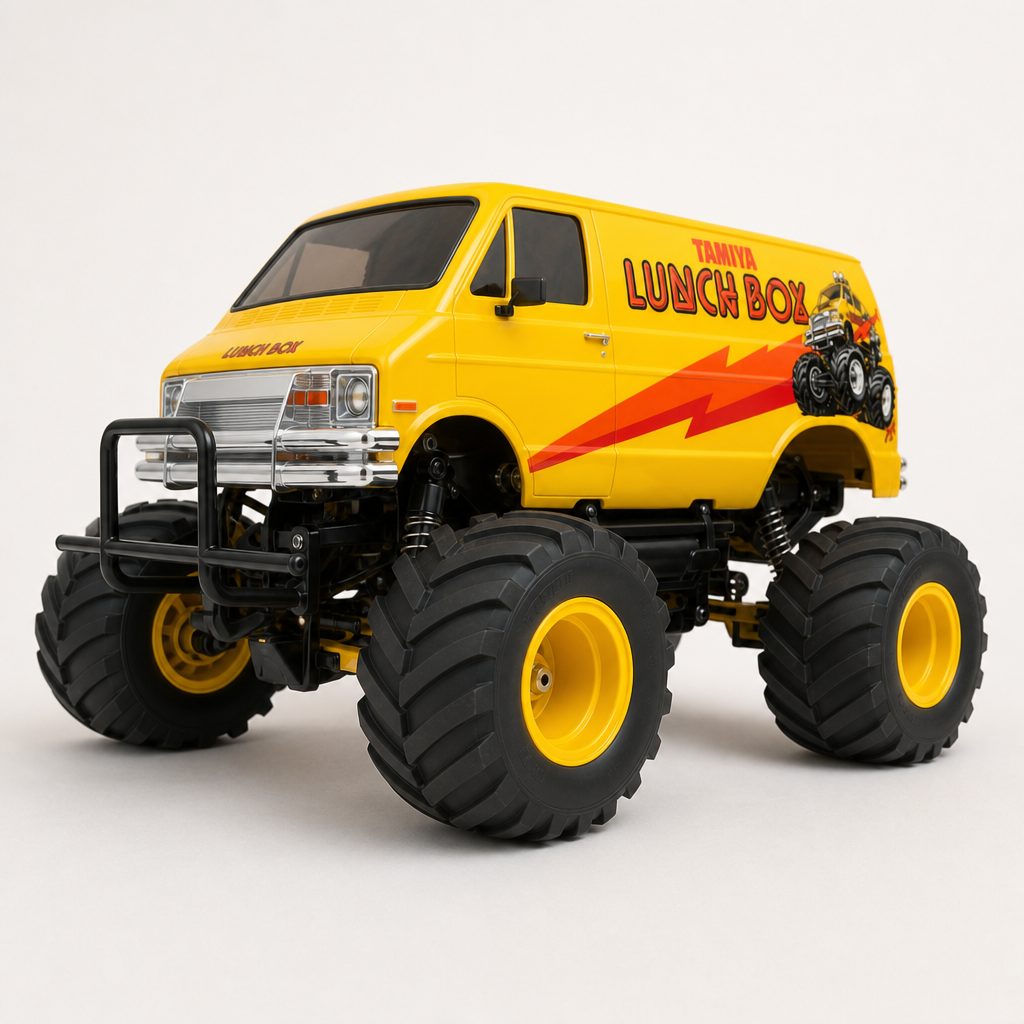
The Lunch Box's big 115mm tyres are not merely decoration. They provide the stance, traction and slightly unruly body movement that define the whole experience.
I think its continued appeal comes from the fact that it does not chase modern ideas of perfection. The 58347 reissue retained the character of the 1987 original: rear-wheel drive, a simple ABS box frame, independent swingarms at the front, a rolling rigid rear axle and friction dampers. On paper, that reads like a history lesson. In use, it means the Lunch Box is lively, communicative and agreeably daft. It wiggles. It bounces. It leans. It turns an ordinary patch of short grass into a small stadium.
There is a caveat, and it matters. This is an assembly kit, not a ready-to-run toy you charge for an hour and hand over at breakfast. You need a two-channel radio system and a suitable battery in addition to the kit, and building it is part of the ownership experience. For some families that is a glorious rainy-Sunday project. For others it is a deal-breaker involving tiny screws, a dining table and someone asking why there are gears in the fruit bowl.
Important perspective: treat the standard Lunch Box as a retro hobby kit rather than a modern toy-shop RC vehicle. Its simple engineering, bouncy handling and build-first approach are precisely why enthusiasts adore it, but they are not the same thing as plug-and-play convenience.
What the Tamiya Lunch Box 58347 actually is
The current classic-format Lunch Box is Tamiya item 58347, a reissue of the original 1/12-scale 2WD kit. It measures 385mm long, 290mm wide and 225mm high, so it is not a tiny desk model masquerading as an RC car. It has presence. Set it down beside a football or a child's scooter and it looks broad, tall and rather ready to cause mild trouble.
Its 207mm wheelbase and very wide stance give it that squat, toy-box shape. Front tread is 212mm and rear tread is 216mm, whilst the wheels carry tyres that are 71mm wide and 115mm in diameter at both ends. Those numbers explain why it can cope with loose earth, compacted park paths and grass far more confidently than a small on-road RC car. They do not turn it into a competition off-roader, mind. A Lunch Box does not attack rough ground with military precision; it bounds through it like a puppy that has just discovered mud.
Under the shell sits a rear-mounted Type 540 motor, sending power to the rear wheels through a 3-bevel differential. The sealed gearbox is a particularly practical touch for family running, helping protect the differential gears from the dust and sand that somehow find their way into every appealing driving spot. The kit includes an electronic speed controller, which is useful, although the radio gear remains your responsibility.
It is worth separating "simple" from "cheap". The chassis is straightforward because the Lunch Box was designed around accessible, enjoyable ownership. There is less complication between you and a wheelie. That is not a criticism. Plenty of much newer RC vehicles are technically more sophisticated, but also more intimidating to build, set up and repair when a collision with a kerb proves that physics continues to function.
The design: an icon that has never needed to grow up
There are handsome RC shells, there are realistic RC shells, and then there is the Lunch Box. Its yellow van body, raised ride height and giant wheels make it look like an illustration from a particularly optimistic 1980s toy catalogue. The design has enough detail to read as a delivery van, but it is deliberately exaggerated. You can see that from across a field, which is not only charming but genuinely useful when a child has steered it behind a bush.
The body is ABS rather than the thin, flexible polycarbonate shell you might expect on a racing buggy. It gives the model a satisfyingly substantial character and suits the boxy shape beautifully. It also makes the decoration stage feel more like model-making than simply applying a few stickers to a clear shell. Take your time here. The finished body carries much of the Lunch Box's appeal, and a careful decal job makes a huge difference to whether it looks like a cherished retro machine or something assembled during the final five minutes before tea.
Unmistakable van body
The deliberately oversized delivery-van look is the point. It is funny without becoming a novelty that wears thin after one run.
Huge all-round tyres
115mm-diameter tyres deliver the Lunch Box's towering stance and help it find grip on loose, informal surfaces.
Sealed gearbox
A sensible protection measure in an otherwise gloriously silly vehicle, keeping dirt and sand away from the diff gears.
Wheelie bar
The rear-mounted bar is an honest admission from Tamiya that the model was made for stunt driving, not polite behaviour.
The rear wheelie bar deserves special mention because it tells you everything about the product philosophy. Tamiya could have made a more planted, more serious van. Instead, it fitted a component that allows the model to celebrate its own tendency to rear up. This is a vehicle that knows exactly what it is.
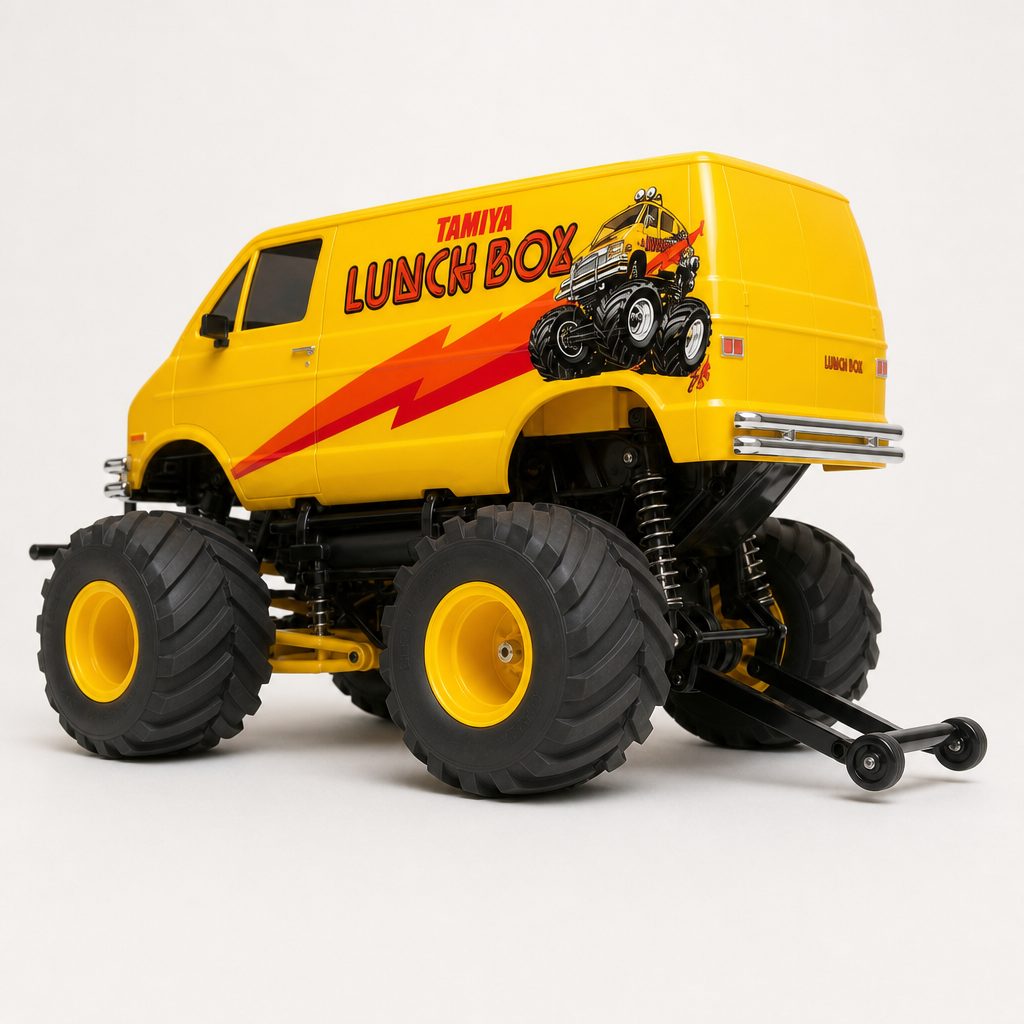
The rear wheelie bar is not a gimmick added for a photo. It is central to the Lunch Box experience, keeping repeated throttle-happy launches playful rather than destructive.
Building the Tamiya Lunch Box: the first family adventure
The Lunch Box build is a major part of the recommendation. It is approachable by RC-kit standards, but that does not mean it is a five-minute job. You are assembling a gearbox, suspension, steering and body, then installing the motor, speed controller, receiver and battery arrangement. The instructions reward patience. Young children can certainly help with sorting parts, passing screws, applying decals and watching the mechanical story take shape, but an adult should be prepared to take the lead on the critical stages.
In my experience, the best way to approach it is as a small project rather than a present that must be raced immediately. Clear a table, use small trays or tubs for hardware, and work through the manual in order. That sounds painfully obvious until a circlip decides to disguise itself as a breadcrumb. The simple box-frame design is actually helpful here: you can see what the chassis is doing, and the finished vehicle feels comprehensible in a way many enclosed modern platforms do not.
The mechanical layout also gives the Lunch Box long-term value. If something becomes worn or damaged through normal use, the owner understands where it lives and what it does. That is a quietly brilliant educational benefit. It is not just "STEM" printed on a shiny box. A child can physically see how the motor, gears, axle and steering work together, then experience the immediate consequence of getting a wheel caught in a fence post. Science, but with a slightly panicked reverse manoeuvre.
Build it for the memory, not merely the machine
The Lunch Box makes more sense when the build is part of the purchase. A shared afternoon of assembly, decorating and finally testing the steering adds something a ready-to-run model cannot replicate. If that sounds like a chore, choose an expert semi-assembled alternative rather than forcing the experience.
Tamiya also offered the Lunch Box X-SA, an Expert Semi-Assembled version that arrived professionally built and detailed, with motor and ESC included. It is the sensible route for someone who loves the look and driving character but would rather spend their free time at the park than at the workbench. It does lose the hands-on ritual, of course, but not everyone wants an engineering apprenticeship before their first wheelie.
How the Tamiya Lunch Box drives: charm before precision
Let us be clear: the Lunch Box is not a sharp-handling racing buggy. If you want clean cornering lines, high-speed stability and the sort of steering response that makes you mutter approvingly about geometry, it is not your machine. Its independent front swingarms, rolling rigid rear suspension and friction dampers produce a driving style that is more entertaining than exact.
That is not diplomatic language for "bad". It is character. The Lunch Box pitches under throttle, transfers weight dramatically and responds to uneven surfaces with visible movement. The rear-wheel-drive layout means the back end is always part of the conversation. On a firm, open area, gently feathering the throttle lets you explore its playful balance. Push harder and it becomes a short-wheelbase comedy act, with the nose lifting and the body leaning as if it has heard some very exciting news.
The stock-motor estimate of around 20mph is plenty for the kind of locations where this model shines. In fact, the Lunch Box is arguably better because it is not chasing extreme speed. A fast RC car can cover ground so quickly that the driver spends most of a run making corrections and hoping no one steps into its path. The Lunch Box gives you enough pace to feel lively, enough torque to feel theatrical and enough visual feedback that spectators understand what is happening. That last point is underrated when you are sharing a hobby with children.
The figures above should be read as useful real-world expectations rather than laboratory promises. Terrain, throttle use and the battery you choose all affect how long a run feels. The key takeaway is that it is not a long-distance cruiser. Its natural rhythm is a few exuberant blasts, some wheelies, a family handover of the transmitter, then a pause to laugh about the near miss with the picnic blanket.
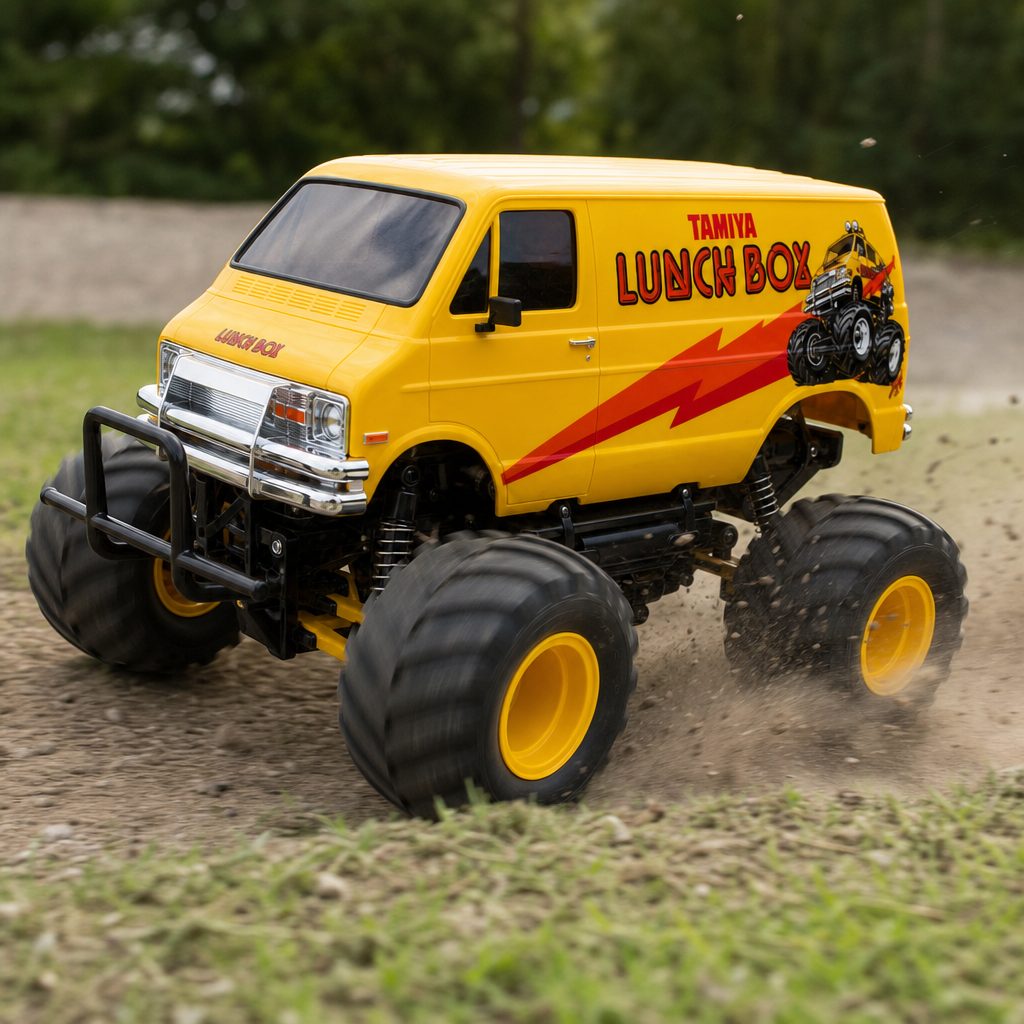
On firm grass and open dirt, the Lunch Box is wonderfully expressive. It is happiest where its rear-drive layout and bouncy chassis can be enjoyed rather than judged against a stopwatch.
Wheelies, grass and everyday durability
The defining Lunch Box manoeuvre is the wheelie. The rear-mounted motor, rear drive and big tyres combine to make throttle application feel slightly more dramatic than the vehicle's friendly delivery-van shape suggests. The wheelie bar provides a useful safety net, allowing the model to pivot back without immediately grinding the bodywork into the ground. It is a wonderfully simple solution to a wonderfully simple problem: "what if we made the van do that again?"
That playfulness makes the Lunch Box very good at getting reluctant family members involved. A serious racing buggy can seem like Dad's expensive hobby, especially if its owner is visibly anxious whenever somebody else touches the controller. The Lunch Box invites a go. Its whole body language says that a perfect lap is not required. It is difficult to look pompous whilst driving a yellow monster-tyred lunch van, and that is a public service.
It is nevertheless important to choose your ground with care. A broad open area with short grass, packed earth or a relatively smooth path suits it best. Avoid tight spaces, traffic, pedestrians and hard obstacles. The model may be comical, but it has a proper 540 motor and a substantial 1,560g kit weight before radio equipment and battery are added. It deserves sensible supervision, particularly with younger drivers.
The sealed gearbox offers reassurance after dusty running, but basic cleaning remains worthwhile. Brush away loose dirt, inspect the wheels and steering after a particularly enthusiastic session, and do not put the vehicle away caked in wet grass. That is not glamorous maintenance, but it keeps the next outing from beginning with an avoidable rattle and a parent trying to remember where the screwdriver went.
Battery, radio and the realities of a day out
The standard kit requires a two-channel RC radio system and uses a Tamiya battery connector. This is one of the places where the Lunch Box feels unmistakably like a hobby-grade model rather than a boxed toy. You are building a small system: transmitter, receiver, ESC, motor and battery all have a role. Once it is set up, the arrangement is straightforward, but a first-time buyer should include it in their planning.
A 7.2V stick pack delivered reported sessions of roughly 20 to 30 minutes, which is generous enough for casual family use. There was also a shorter report of around 10 minutes with a 1,800mAh battery and the stock motor. Rather than fixating on one number, I would plan the outing around having enough battery capacity for the length of play you actually want. The Lunch Box encourages repeat short runs, especially when several people want turns, so it is easy to use a whole afternoon without one person driving continuously.
The electronics supplied with the standard kit included an ESC. The Black Edition and Red Edition used Tamiya's TBLE-02S ESC, able to run brushed and sensor brushless motors alike. That flexibility will appeal to tinkerers, but there is no requirement to begin modifying anything. A stock Lunch Box already delivers its central promise. Upgrades can be enjoyable later; they should not become a compulsory shopping list before you have discovered whether your household simply likes driving it in circles and making it stand on its rear wheels.
Pros
- One of the most distinctive and joyful RC designs ever made.
- Simple 2WD mechanical layout is approachable to build and understand.
- Big tyres and sealed gearbox suit relaxed outdoor running.
- Wheelie bar and rear-drive behaviour make every outing memorable.
- A proper shared project for adults and children, not just another rechargeable toy.
Cons
- Requires radio gear and battery planning beyond the core kit.
- Handling is deliberately bouncy and imprecise rather than race-focused.
- Assembly takes time, care and a sensible workspace.
- Its size and speed demand open ground and adult supervision for young drivers.
- Not the right choice for indoor use or very small gardens.
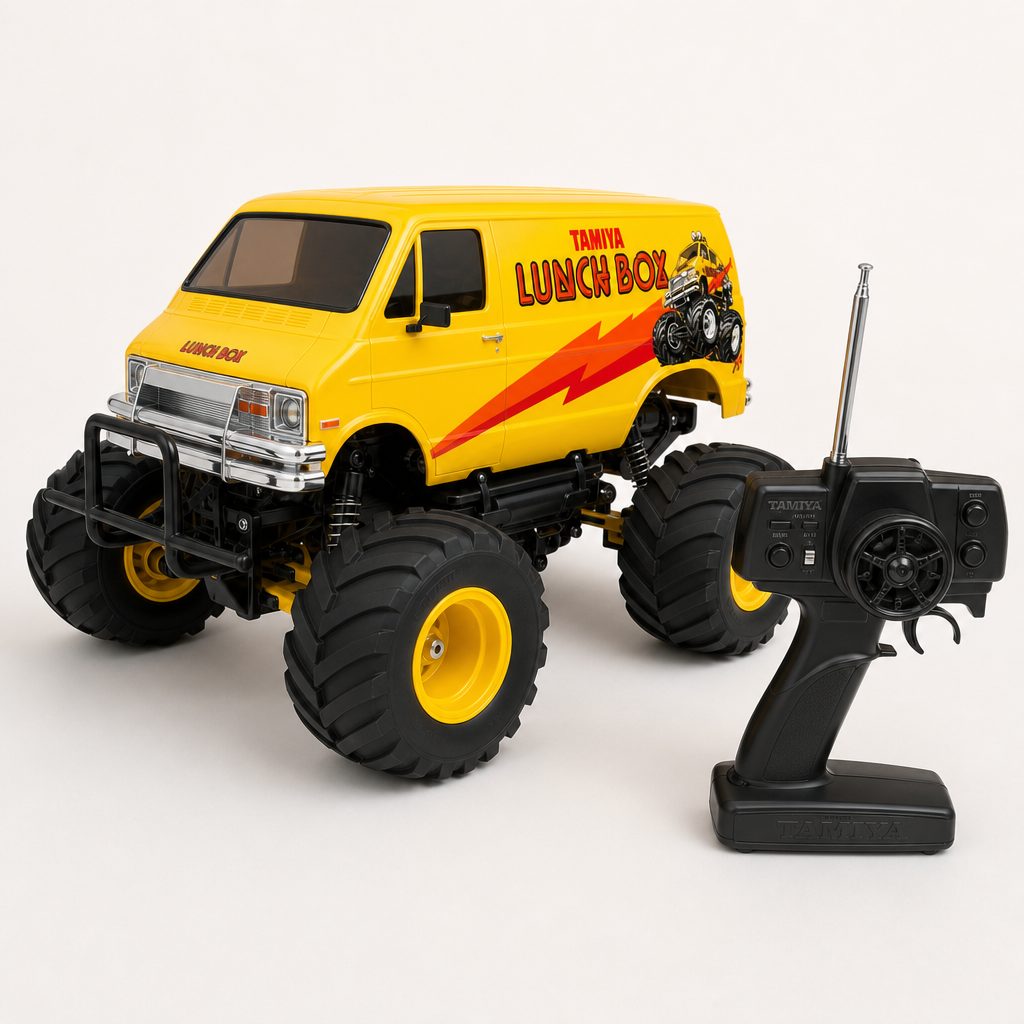
A proper two-channel radio is part of the Lunch Box ownership experience. The payoff is direct, proportional control rather than the stop-start feel of a basic toy-grade handset.
Family use: who enjoys it most?
The best Lunch Box households are not necessarily the most technically minded ones. They are the ones happy to make a little occasion of things. Build it together. Take it to the park. Let different people have a turn. Accept that the first session may involve more wheelies than steering. The model is at its best when it feels shared rather than precious.
For an adult who built Tamiya kits years ago, it is a concentrated dose of nostalgia. The design has remained beloved because it feels exactly like the idea of radio control many of us had as children: oversized tyres, visible movement and an utterly ridiculous body shape. For a child discovering it now, the retro element is almost irrelevant. It looks funny, it is large enough to feel impressive and it performs a stunt on command. Children are not especially worried about whether a platform was originally designed in the 1980s.
I would be more cautious for a family seeking an entirely independent, instant-use present for a very young child. The build and extra equipment make the standard kit a grown-up-supported activity. That is not a flaw; it is simply a different category of product. The reward is a more meaningful object, one that can be maintained, understood and brought back out year after year rather than discarded when a proprietary battery or a brittle switch fails.
Tamiya Lunch Box variants compared
The Lunch Box name covered more than one route into this peculiar little universe. The original-style 58347 remained the purest choice for anyone wanting the big wheeled 1/12-scale classic. The Black Edition 58546 and Red Edition 47402 changed the body presentation, whilst retaining the familiar formula. The Mini took the idea in a different direction altogether, shrinking it to 1/24 scale on the 4WD SW-01 chassis.
Then, in July 2026, Tamiya released the Lunch Box EVO, item 58755. It retained the comic wheelie-first identity but brought an updated CW-01E chassis with a longer wheelbase and tread, both 10mm greater than item 58347. Its front double wishbones and rear 3-link rigid-axle arrangement were designed to improve traction and controllability. This makes the EVO the more sensible technical choice for drivers who love the silhouette but would welcome a little more composure.
| Feature | Tamiya Lunch Box 58347 | Tamiya Lunch Box EVO 58755 | Tamiya Lunch Box Mini 57409 |
|---|---|---|---|
| Scale | 1/12 | Marketed as 1/12; listed as 1/10 in specifications | 1/24 |
| Length | 385mm | 390mm | 190mm |
| Width | 290mm | 295mm | 146mm |
| Drive system | 2WD rear drive | Updated chassis with rear rigid axle | 4WD |
| Wheelbase | 207mm | 217mm | 257mm |
| Suspension layout | Front swingarm, rolling rigid rear | Front double wishbone, rear 3-link | Body-leaning SW-01 design |
| Best setting | Outdoor family fun and classic collecting | Outdoor use with improved control | Indoor and outdoor small-space play |
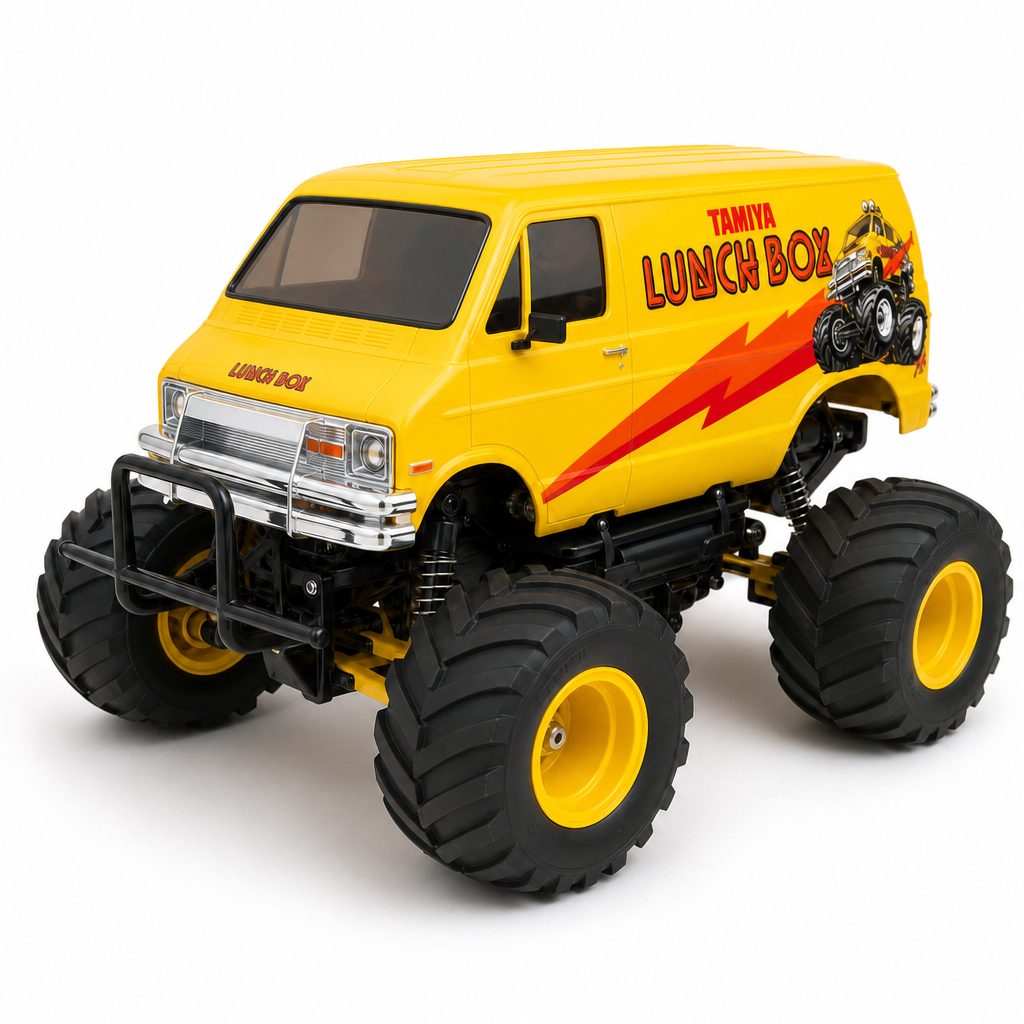
The wider, longer Lunch Box EVO retained the familiar comic attitude whilst introducing a more modern suspension arrangement for improved traction and control.
Which Tamiya Lunch Box is best for you?
The standard Lunch Box is still the emotional pick. It is the one most people picture when they hear the name, and its wonderfully old-school chassis behaviour is part of the deal. If you want the classic yellow icon and actively enjoy the idea of building a vehicle with character rather than chasing a tidy handling balance, this is the version to choose.
The EVO is the answer for someone who wants the Lunch Box look but has less patience for its traditional wobble. It did not replace the old version's personality; rather, it made the concept easier to drive with more consistency. The Mini is not a direct substitute for either. Its 190mm length, 4WD system and body-leaning steering behaviour make it a smaller, more versatile plaything for homes where a full-size Lunch Box would be too much machine for the available space.
Tamiya Lunch Box 58347
The essential pick for retro RC fans, family builders and anyone who considers an enthusiastic wheelie a feature rather than an error.
Tamiya Lunch Box EVO 58755
The stronger fit for drivers who want the familiar look with a 217mm wheelbase, wider stance and revised suspension layout.
Tamiya Lunch Box Mini 57409
The 190mm-long 4WD option for indoor fun, tighter areas and owners who want the Lunch Box flavour in a much smaller package.
Tamiya Lunch Box X-SA 46701
The sensible route if you want the standard-size model professionally built and detailed, with motor and ESC included.
Is the Tamiya Lunch Box worth owning in 2026?
Value is more complicated here than simply counting features. The Lunch Box is a classic kit with a long history, and it should be judged as such. It offers a model-building project, a mechanical introduction to hobby RC, a recognisable collectible and a genuinely fun outdoor vehicle. Those layers make it feel more substantial than a simple ready-to-run purchase, even before its wheels have touched grass.
There are newer designs that are more capable in almost every technical category. The Lunch Box EVO itself demonstrated that Tamiya could preserve the visual idea whilst improving traction and controllability. But the old chassis has survived because capability is not the only measure of enjoyment. The original-style Lunch Box feels alive. A clinical machine may be quicker around an imaginary course; this one is far more likely to make a crowd gather round.
For a collector, its enduring status is obvious. For a parent, it offers an unusually good bridge between a toy and a proper hobby. For an experienced RC owner, it can be a welcome antidote to endlessly optimising setups. And for a person who has never owned RC before but simply grins every time they see the van body, that may be all the research required. Sometimes taste is data.
Our Tamiya Lunch Box rating
The score below reflects the original-style 58347 kit on its own terms: a retro, family-friendly hobby model designed to entertain rather than dominate a racing circuit. It loses marks for the extra equipment and build commitment required, and for handling that cannot be described as disciplined. It gains them back for charm, repairable simplicity and the almost unmatched ability to turn a quiet afternoon into an event.
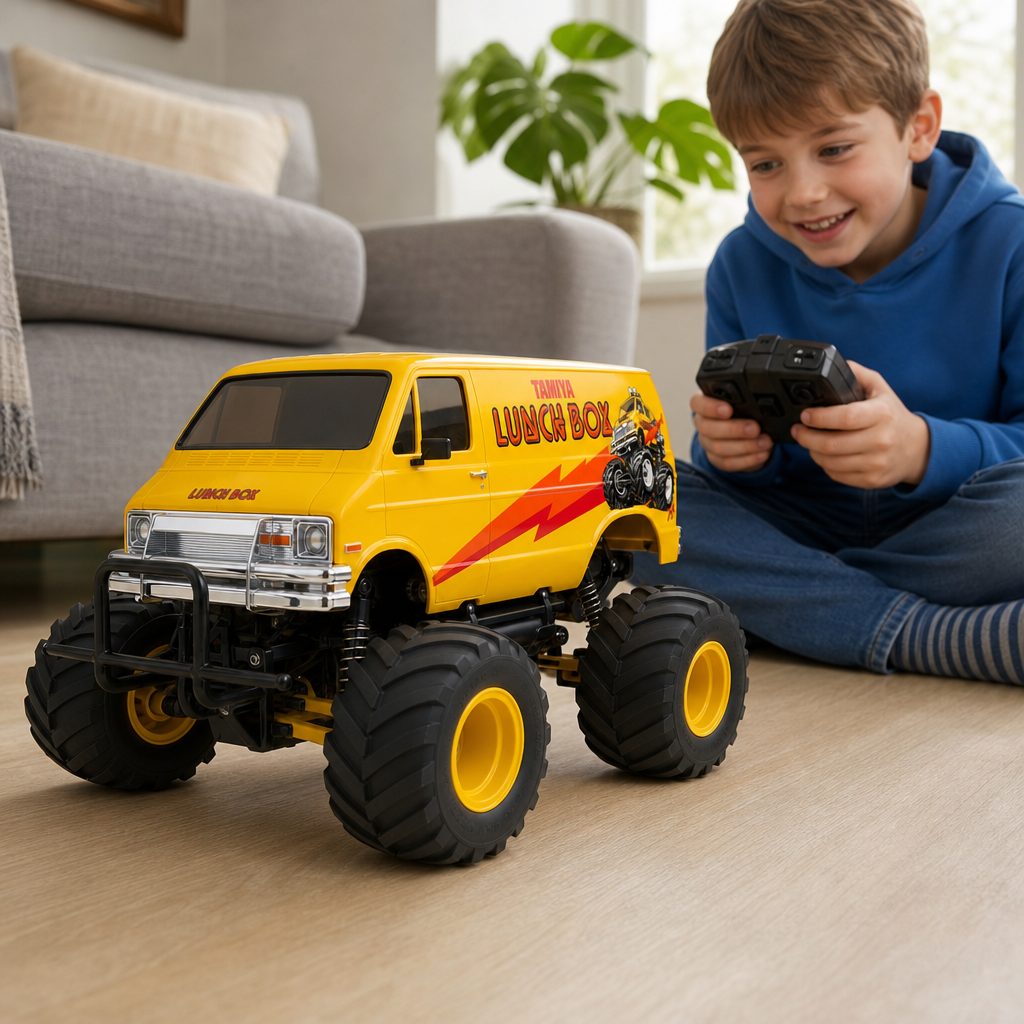
The Lunch Box is not trying to win a race meeting. Its lasting brilliance is that every driver, from nostalgic adult to curious child, understands the assignment within seconds.
Tamiya Lunch Box FAQ
No. The standard Tamiya Lunch Box 58347 is an assembly kit. It includes a Type 540 motor and electronic speed controller, but it requires a two-channel radio system and battery equipment before it can be driven. The X-SA version was the professionally assembled alternative.
With the stock motor, its top speed was estimated at around 20mph. That is quick enough to feel exciting in a park or open garden space, but its appeal is more about wheelies, bouncy turns and visible character than outright speed.
A 7.2V stick pack delivered reported running times of around 20 to 30 minutes. A separate stock-motor report with an 1,800mAh battery suggested around 10 minutes. Surface, driving style and battery choice all have an effect, so it is best to think in terms of short, repeatable family sessions rather than one fixed figure.
It can be excellent for a child and adult to enjoy together. The build requires adult support, and the model's size, speed and rear-drive wheelie behaviour call for sensible supervision. It is a better fit for a shared hobby project than an unattended first RC toy for a very young child.
Its large 115mm tyres make it well suited to short grass, packed dirt and relaxed off-road play. It is not a specialist competition off-roader, so smoother, open ground will allow the best combination of traction, steering control and entertaining wheelies.
The rear wheelie bar supports the vehicle when hard acceleration lifts the front wheels. It lets the Lunch Box perform the stunt it is famous for whilst reducing the chance of the rear bodywork scraping directly along the ground.
Released in July 2026, the Lunch Box EVO used the updated CW-01E chassis. Compared with item 58347, it had a wheelbase and tread that were each 10mm longer, plus front double wishbones and a rear 3-link rigid-axle setup intended to improve traction and controllability.
Choose the 1/24 Lunch Box Mini if space is limited or indoor running is important. At 190mm long and 146mm wide, it is far smaller and uses a 4WD SW-01 chassis with a body-leaning steering effect. Choose the standard Lunch Box if you want the full-size classic kit experience and outdoor spectacle.
Final verdict: still gloriously, wonderfully ridiculous
The Tamiya Lunch Box remains brilliant because it never confused seriousness with fun. Its original-style 58347 chassis is old-fashioned, its handling is untidy and its build asks something of you. Yet those qualities give it more personality than many technically superior RC vehicles. It is a machine with stories built in.
Buy it if you want a shared build, a genuine hobby-grade classic and the most entertaining thing likely to appear at your local park. Skip it if you need instant out-of-box driving, precise high-speed control or a model for a tiny indoor space. For everybody else, this bonkers little van remains one of Tamiya's most loveable ideas.