
Tamiya Grasshopper Review: Is the Classic Build-It-Yourself Buggy Still Worth It?
The Tamiya Grasshopper was never designed to win a modern RC race meeting. It was designed to get you building, tinkering and blasting around the garden with a very large grin. More than four decades after the original arrived, that simple appeal still matters — but so do its old-school compromises.
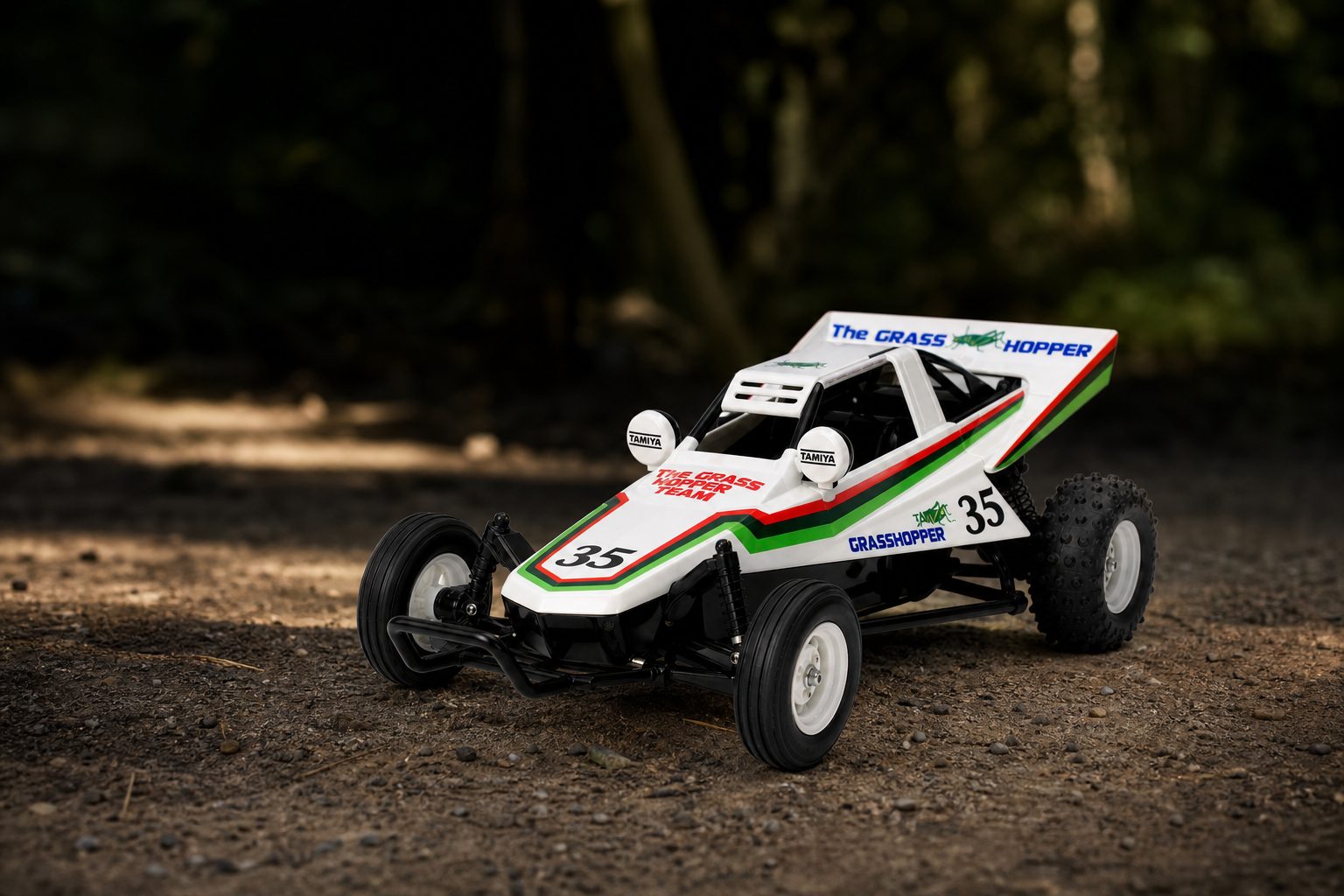
The Tamiya Grasshopper 58346 remains instantly recognisable: a 1984 buggy shape that still makes people of a certain age start telling stories about the garden.
1. The Tamiya Grasshopper in 2026
The Grasshopper is not a new RC buggy dressed up in retro clothes. It is the real thing, or at least a remarkably faithful continuation of it. The original Tamiya Grasshopper launched on 14 May 1984, and the version most UK shoppers encounter today is the 58346 re-release, which returned in 2005. That long history is central to both its charm and its limitations.
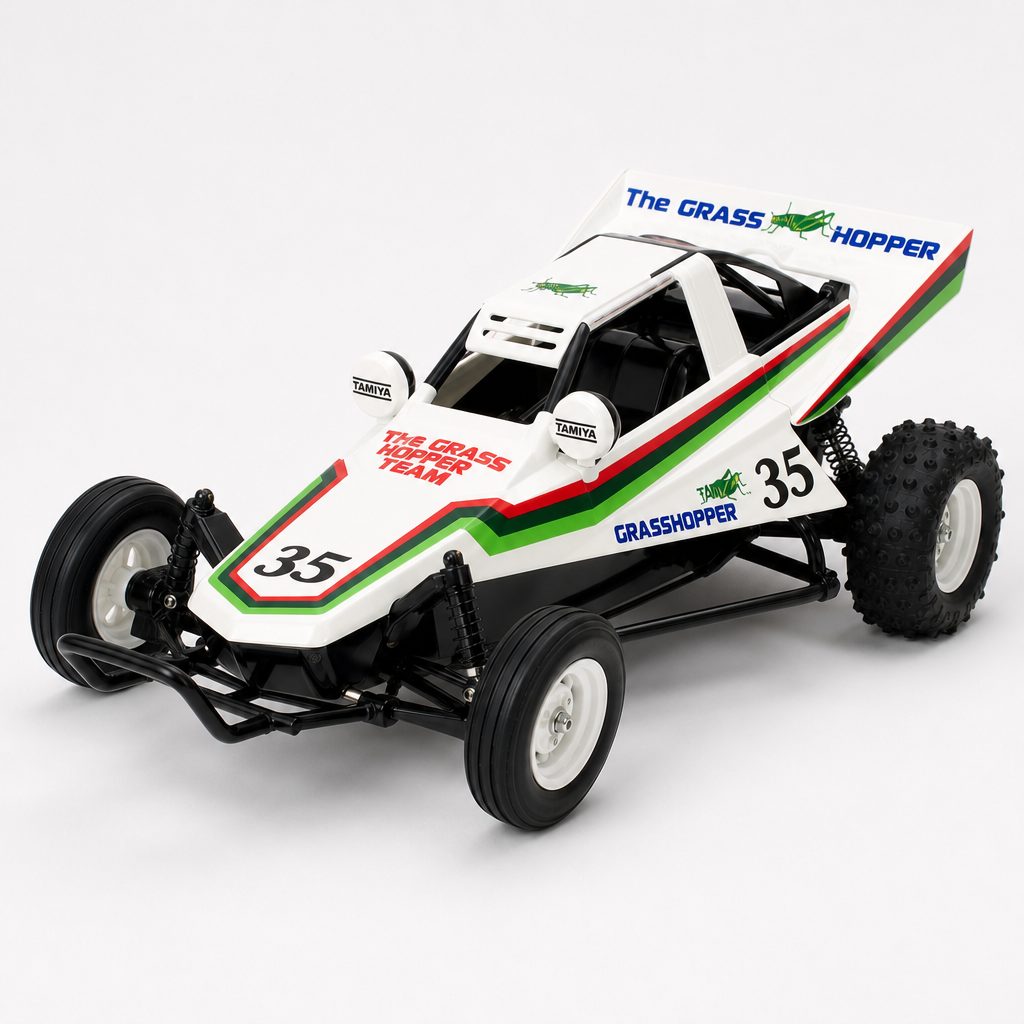
The bathtub chassis is one of the Grasshopper's defining features: uncomplicated, lightweight and pleasantly forgiving when the first build does not go perfectly.
In practical terms, this is a 1/10-scale, rear-wheel-drive, build-it-yourself buggy with a tough hard-plastic shell mounted to a bathtub-style ABS resin chassis. It arrives as a kit rather than a ready-to-run toy, so you build the mechanical car, paint and decorate the body, and provide your own radio gear and battery. This is important. A Grasshopper is an activity as much as it is an RC vehicle.
That distinction makes it a rather lovely family project. There is something satisfyingly direct about laying out screws, fitting the gearbox, adding the wheels and eventually seeing the buggy become a real, working machine. It is also why the Grasshopper continues to find an audience long after faster, more sophisticated off-road models took over the hobby market. You are not merely opening a box and driving. You are making a little bit of your own history.
There are faster buggies. There are better-handling buggies. There are certainly models with more advanced suspension. But none of those points automatically make the Grasshopper irrelevant. This little green-and-black icon occupies a different lane: approachable vintage RC, with enough upgrade potential to keep a budding hobbyist interested after the first muddy lap of the lawn.
Important distinction: this review covers the standard Tamiya Grasshopper 58346 re-release. It is not the 1988 Grasshopper II, and it is not the 2018 Tamiya Comical Grasshopper on the WR-02CB chassis. They share a family name, but they are very different machines.
2. Core specifications at a glance
The Grasshopper's specification sheet reads like a snapshot from an earlier, simpler chapter of RC. That is not a criticism. It tells you exactly what the buggy is trying to be: light, uncomplicated and sturdy enough to survive ordinary outdoor play without turning maintenance into a second job.
The 380-type motor is modest, particularly beside the 540 motors familiar to many modern 1/10 RC enthusiasts. However, the chassis is compatible with a separately sold 540-type motor, which means the buggy does not have to remain exactly as it left the box. That upgrade path is a major part of the appeal. Start simple; learn the car; then decide whether more speed, smoother drivetrain operation or improved damping would add to the fun.
The rear gearbox is sealed and includes a differential, both of which are welcome on a beginner-focused off-roader. It helps keep dirt and stones away from the working parts, whilst the differential prevents the rear wheels from fighting one another quite so brutally through a turn. The standard tyre arrangement is also true to the era: grooved tyres at the front and paddle-style tyres at the rear, fitted to three-piece wheels.
3. The build: simple enough to teach, involved enough to matter
The Grasshopper's strongest argument is not raw speed. It is the build. Tamiya's classic kits have always made the construction process feel like a proper event, and the Grasshopper's uncomplicated layout gives newcomers a manageable first step into that world.
You do not need to be an RC veteran to understand the main systems. The chassis forms a clear base. The gearbox is a contained unit. The suspension is comparatively straightforward. The body screws onto the completed chassis rather than relying on delicate clips. Each stage reveals a little more of how an RC car works, which makes the whole exercise feel educational without ever becoming homework in disguise. A rare trick, frankly.
For a parent and child, it creates useful conversations. Which screw goes where? Why must the gear mesh freely? What happens if a wheel is over-tightened? Why does the steering need to move cleanly before you power anything up? These are tiny lessons in patience, mechanical sympathy and problem-solving. They are also lessons that tend to stick, because the reward is immediately visible: your own buggy is sitting on the table looking rather splendid.
Adults returning to RC after a long break will probably enjoy the lack of fuss. The Grasshopper does not drown you in complex adjustable geometry, a tower of optional settings or a parts bag that appears to have been packed by a mischievous goblin. It is refreshingly direct. The trade-off, naturally, is that its mechanical design is basic. That simplicity is the point, but it is worth recognising before you buy.
Build-it-first advice
Do not treat the Grasshopper as a quick-assembly present for the final hour before a birthday party. The build deserves unhurried time, a clear table and someone willing to check each step before moving on. The driving is more satisfying when the construction has been part of the occasion.
4. Design and durability: why the old shape still works
The Grasshopper looks like a childhood memory with wheels. Its hard-plastic body, high sides and squared-off buggy silhouette have none of the ultra-detailed realism found on newer racers. Yet that is exactly why it remains so charming. The design is bold, toy-like in the best possible way, and clear enough that younger builders immediately understand what it is supposed to do: head outside and get dirty.
The hard body is fastened to the resin monocoque chassis with screws, producing a solid, cohesive structure. It feels like a piece of equipment rather than a thin decorative shell sitting above a race chassis. That makes sense for family use. A first RC buggy will meet fence posts, kerbs, patio furniture and at least one dog who believes it is an insult. The Grasshopper's robust-looking, uncomplicated outer structure suits that reality.
At 830g, it is also light. That matters more than it might initially seem. A lighter buggy is easier for a younger owner to carry, place on the ground, retrieve from a hedge and turn back upright after an enthusiastic corner. It also makes the model feel less intimidating during the build. There is no sense that you are constructing a fragile, high-performance machine that must be handled with tweezers and hushed reverence.
Screw-fastened hard body
The body's hard-plastic construction and screw mounting suit a buggy expected to live an active life rather than a shelf-only existence.
Bathtub monocoque chassis
The ABS resin chassis keeps the layout clean and gives the Grasshopper its distinctive, uncomplicated mechanical character.
Sealed differential gearbox
A dirt-conscious gearbox design is a useful practical touch for grass, dry soil and the sort of surfaces families actually have nearby.
A project with personality
Building and finishing the car makes the eventual buggy feel personal in a way that a ready-to-run model rarely can.
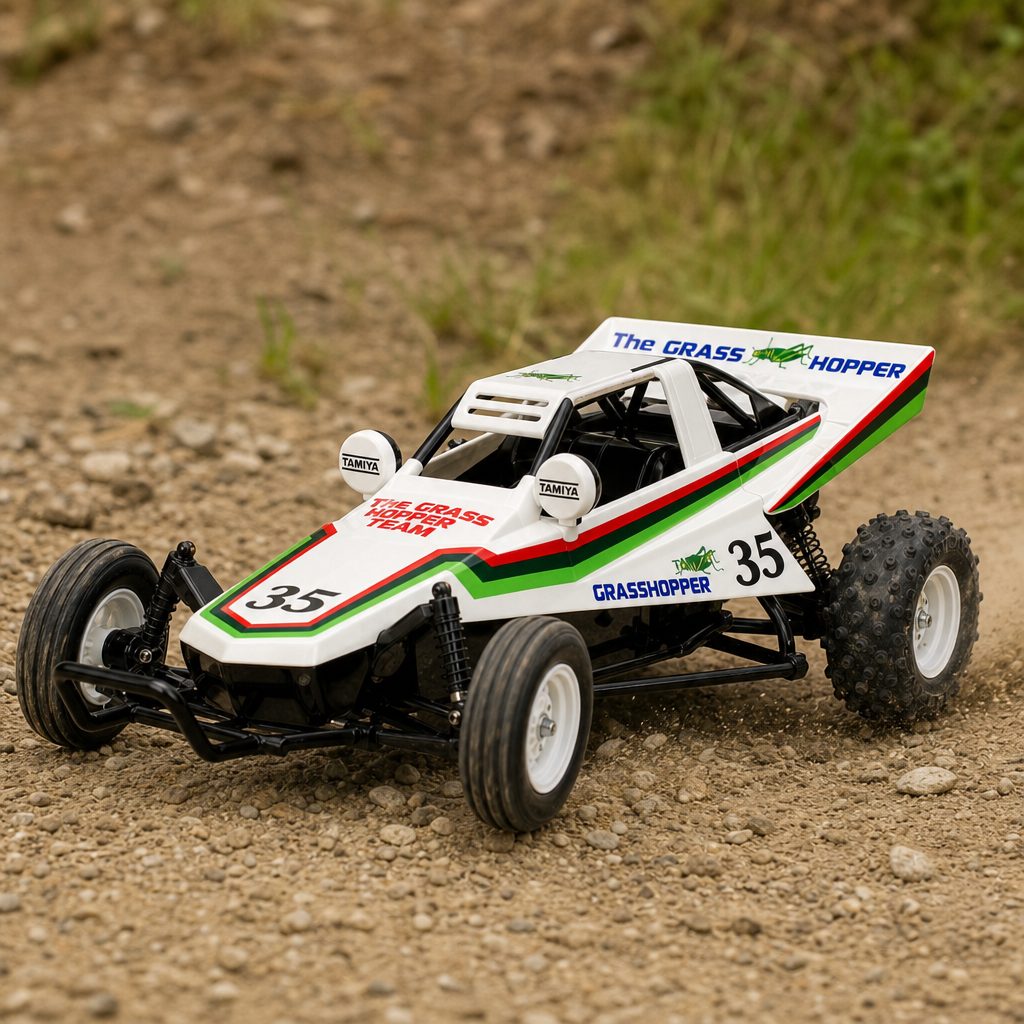
The Grasshopper's hard body and simple, recognisable buggy stance are a large part of its enduring appeal — it looks like it wants to be driven, not displayed under glass.
5. How the Grasshopper drives on real family terrain
Let us be honest about the driving experience. The Grasshopper was a 1984 design, and it drives like one. That means rear-wheel drive, a front swing axle, a rolling rigid rear axle and friction dampers rather than the oil-damped, fully independent sophistication buyers may expect from a modern 1/10 off-road kit.
On flatter grass, compacted dirt and a dry garden path, it has the easygoing, tail-happy character you want from a classic buggy. The paddle-style rear tyres give it a purposeful look and help it feel willing to push forward over loose ground. Its 2WD layout is easier to understand than a more aggressive four-wheel-drive racer: point it, feed in power and learn how throttle changes the direction of the rear end.
On rougher ground, however, the limitations become visible. The rear suspension is fundamentally rigid, and friction dampers do not offer the same calmness over repeated bumps as oil dampers. The Grasshopper can bounce and skip rather than settle. That is part of the old-school drama, but it means this is not a buggy for attacking a deeply rutted BMX track at maximum enthusiasm and expecting race-car composure.
This is where expectations matter. It is not a poor driver because it is not a modern competition buggy. It is a classic fun machine. Drive it on terrain that suits it, let it slide a little, accept the occasional ungainly landing and it feels wonderfully alive. Demand polished high-speed handling from it and you will mostly be reminded that shoulder pads were once considered a sensible fashion choice.
Pros
- Very recognisable retro styling with genuine RC heritage.
- Simple kit construction makes it an inviting first build.
- Light 830g design is easy to carry and retrieve.
- Sealed differential gearbox is sensible for outdoor use.
- Supports later upgrades including a 540-type motor and oil dampers.
Cons
- Rear-wheel-drive layout and basic suspension demand realistic expectations.
- Friction damping feels old-fashioned on rough surfaces.
- Radio equipment and battery are not included in the kit.
- The supplied 380-type motor prioritises approachability over pace.
- It is more rewarding as a build-and-drive project than an instant-use toy.
6. Battery choices, charging routine and everyday running
The standard Grasshopper kit asks you to supply your own battery, radio and receiver, which is normal kit territory but can catch out a first-time buyer. The upside is flexibility. You can build a sensible setup around how the buggy will actually be used rather than accepting whatever electronics were bundled into the box.
The model is compatible with 7.2V NiMH and 7.4V LiPo battery packs. A modern 2S LiPo is the obvious route for owners who want sharper throttle response and a little more energy in reserve. In practical use, moving from a stock-style NiMH pack to a modern 2S LiPo can produce around 20 to 30 per cent longer runtime. Throttle response becomes more immediate, acceleration feels sharper and the Grasshopper holds its speed more effectively across rougher ground.
There is a sensible middle ground to find, though. A 4,000–5,200mAh pack offers the best stated balance between runtime, weight and punch. Smaller 2,200–3,200mAh packs keep the buggy lighter and can give it a more agile feel. Larger 5,600–6,600mAh packs naturally favour extended sessions, but extra capacity brings extra weight. The Grasshopper is light by design, so loading it up purely because a bigger battery exists can dilute some of its breezy, playful feel.
Standard 2S hard-case LiPo packs at around 138 × 46 × 25mm fit neatly into the original battery compartment. That is a particularly helpful detail for anyone upgrading a re-release without wanting to modify the classic chassis. It means the Grasshopper can benefit from modern battery technology whilst staying physically true to the model's original layout.
For families, the main lesson is simple: buy the correct charging equipment, establish a routine and do not leave battery decisions until the buggy is already built on the dining table. The construction is fun; discovering you cannot drive it yet is less fun. Nobody wants the grand unveiling to end with everyone staring at a battery compartment like it has personally betrayed them.
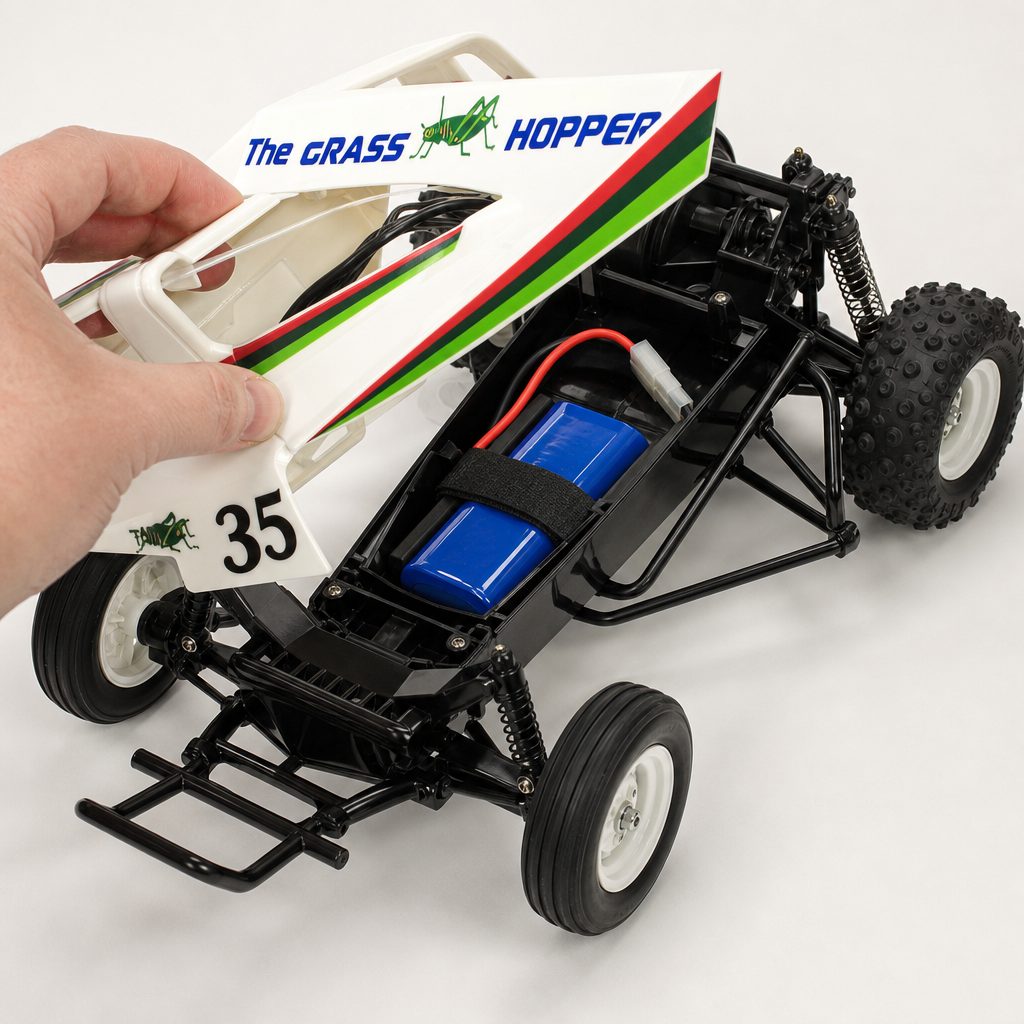
A correctly sized 2S hard-case LiPo can fit the Grasshopper's original battery bay, bringing a modern boost to a fundamentally vintage chassis.
7. Upgrades: where the Grasshopper becomes a hobby
One of the Grasshopper's greatest strengths is that it does not force an all-or-nothing decision. You can build it as intended, learn its personality and make gradual changes later. That is a healthier introduction to RC than buying something highly modified on day one and never understanding what each part actually does.
The most obvious performance-related option is a separately sold 540-type motor. The chassis supports one, and that makes the Grasshopper more than a fixed snapshot of 1984. The kit's included 380 motor is gentle and appropriate for initial use, whilst the 540 route offers an upgrade when the owner wants more urgency. I would not rush into it on the first weekend. The standard motor gives new drivers time to learn steering discipline, throttle control and the fact that grass is not as flat as it looks from the kitchen window.
Oil dampers are another meaningful option. The standard friction damping is authentic and simple, but upgrading to oil dampers can help the buggy behave more consistently over uneven terrain. This is not just about going faster. Better damping can make a vehicle easier to drive because it settles after bumps rather than repeatedly pitching and hopping.
Ball bearings are also a logical part of the classic Grasshopper ownership story. The beauty of upgrades such as these is that they create a reason to open the buggy back up, inspect the drivetrain and understand how small mechanical changes affect its feel. For a child who has caught the RC bug, that process can be more valuable than the headline improvement itself.
Upgrade in the right order
Build and run the Grasshopper in standard form first. After that, consider ball bearings and oil dampers before chasing more motor power. A better-controlled buggy is usually more enjoyable than a faster one that spends every other corner inspecting a shrub.
8. Tamiya Grasshopper 58346 versus Grasshopper II and Comical Grasshopper
The Grasshopper name can be confusing because Tamiya used it for more than one model. The original-style 58346 is the proper retro choice. The Grasshopper II, first released on 9 August 1988 and no longer in production after 1995, represented a later take on the formula. The Comical Grasshopper, released in Japan on 2 November 2018, is a deliberately exaggerated modern reinterpretation built around the WR-02CB chassis.
These are not direct replacements for one another. They serve different appetites. The standard Grasshopper makes most sense for somebody specifically drawn to the classic kit experience. The Comical Grasshopper is for the buyer who likes the name and visual nods but wants a far more contemporary chassis layout, four-wheel double-wishbone suspension, CVA oil dampers and a supplied 540 brushed motor. The Grasshopper II sits firmly in the vintage and collector conversation.
| Feature | Tamiya Grasshopper 58346 | Tamiya Grasshopper II 58074 | Tamiya Comical Grasshopper 58662 |
|---|---|---|---|
| Original release | 14 May 1984 | 9 August 1988 | 2 November 2018 in Japan |
| Length | 389mm | 400mm | 356mm |
| Width | 223mm | 221mm | 244mm |
| Drive | 2WD rear-wheel drive | 2WD | 2WD |
| Suspension | Front swing axle, rolling rigid rear axle | Front swing axle, rolling rigid rear suspension | Four-wheel double wishbone with CVA oil dampers |
| Motor | 380 type included | Compatible with standard Tamiya motors | 540 brushed included |
| Body material | Hard plastic | High-impact styrene | Polycarbonate |
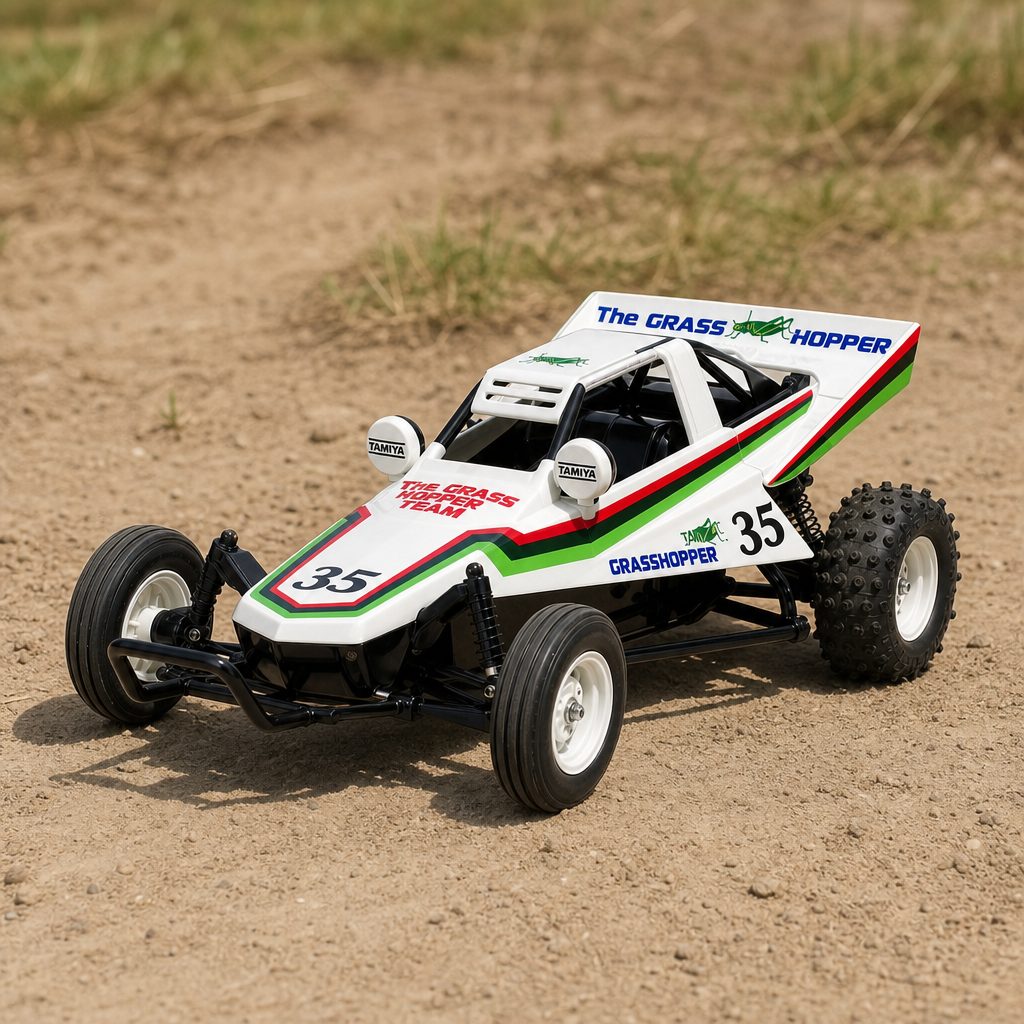
The Comical Grasshopper shares the name and visual inspiration, but its WR-02CB chassis, four-wheel double wishbones and wheelie bar place it in a very different category.
The standard Grasshopper is the least technically advanced of the three, and that is precisely why it has such a clear identity. It is a retro build that remains available rather than a contemporary off-roader trying to imitate one. If nostalgia, simplicity and the pleasure of an iconic build matter most, it is the one to choose.
9. Value for money: what you get for the kit price
The standard Grasshopper 58346 was listed at £84.99 from Wonderland Models. At that figure, it is important to remember that the kit price is not the same as the total cost of getting on the ground. The radio system, receiver and battery are separate requirements, and a charger is necessary if you do not already have suitable equipment. That makes it a different kind of purchase from a self-contained ready-to-run toy.
However, the price is not only paying for a basic 2WD buggy. It is paying for a Tamiya kit experience, a hugely recognisable design and a platform that can be improved gradually. For the right buyer, that has genuine value. The Grasshopper is not attempting to offer the most hardware per pound. It is offering an accessible entry point into building and maintaining an RC car that has a real place in hobby history.
Tamiya Grasshopper 58346 kit
Listed price from Wonderland Models for the classic re-release kit.
Tamiya Comical Grasshopper 58662
Listed price from Wonderland Models for the more modern WR-02CB version.
The Comical Grasshopper costs more, but it brings a 540 brushed motor, oil dampers and a substantially more sophisticated suspension setup. It represents stronger hardware value if modern driving performance is your priority. The original-style Grasshopper represents better emotional value if what you want is the classic object, the classic construction and a buggy that feels rooted in the era that made Tamiya kits famous.
That might sound like a soft argument, but hobbies are not bought by spreadsheet alone. If you simply want the quickest route to a tougher, more capable off-road machine, the standard Grasshopper is not the rational winner. If you want a project that can be shared, personalised and remembered, its value becomes much easier to understand.
10. Who should buy the Tamiya Grasshopper?
There is no point pretending this is the right buggy for everybody. It rewards a particular kind of owner: someone who enjoys the process, accepts the vintage engineering and wants a machine with personality. The good news is that this covers more people than you might think, from returning hobbyists to families looking for something more meaningful than another ready-charged gadget.
Best for first-time kit builders
The Grasshopper's straightforward layout makes it an approachable first proper RC build, particularly with adult help and a relaxed afternoon set aside.
Best for nostalgia
The original-style Grasshopper is the clear choice for adults who remember 1980s Tamiya catalogues and want the real retro experience.
Best classic value
At the listed £84.99 kit price, it is the less expensive route into the Grasshopper family for buyers who value the original design.
Best for modern rough-ground driving
The Tamiya Comical Grasshopper is the better fit for buyers prioritising oil dampers and four-wheel double-wishbone suspension over historical accuracy.
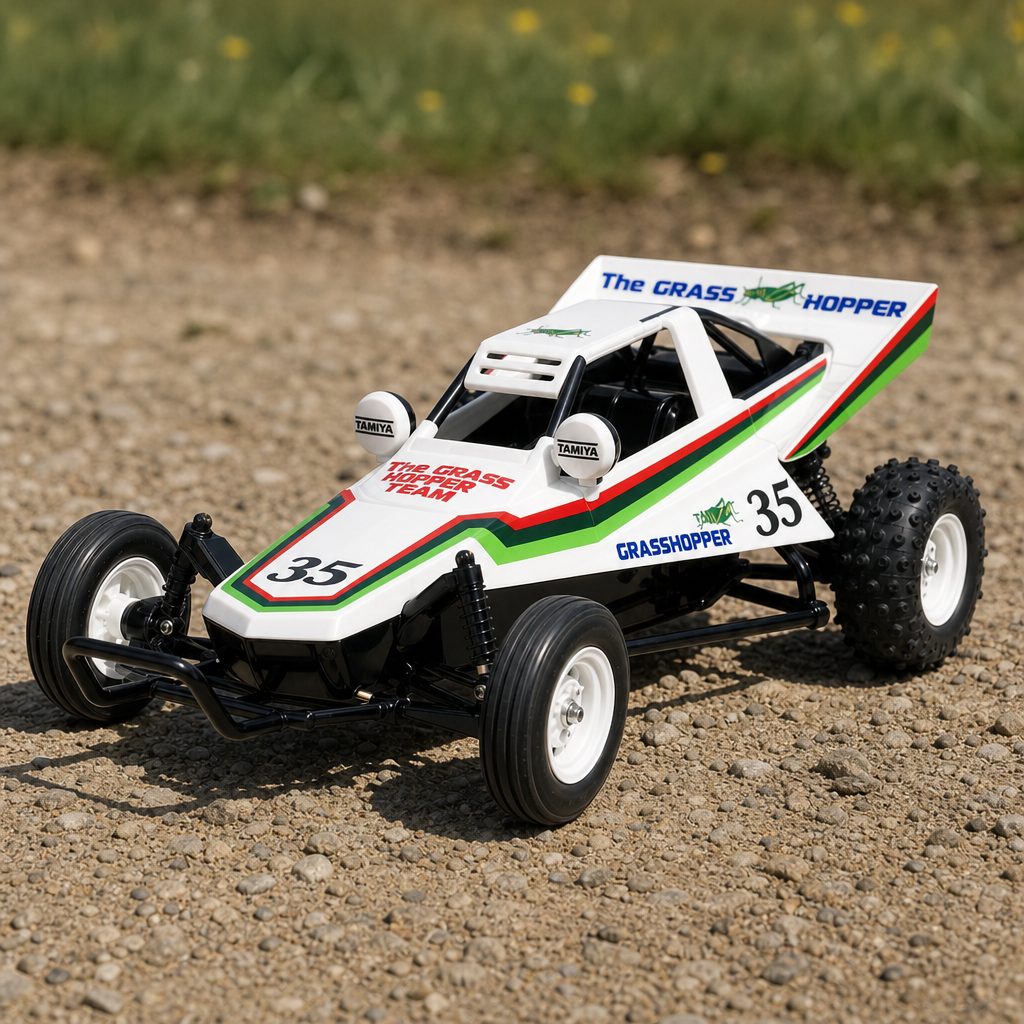
The standard Grasshopper makes the most sense as a shared project: build it carefully, run it on suitable ground and let its vintage character be part of the fun.
I would recommend the Grasshopper to a parent who wants to build alongside a child, an adult looking for a satisfying return to RC, or a younger enthusiast who is more excited by mechanics than by instant gratification. I would be more cautious for someone who wants immediate, no-assembly driving, demands serious rough-terrain performance or has no interest in adding radio equipment and a battery separately.
11. ToyScout rating
The Grasshopper is easy to score badly if you judge it by the wrong standards. It does not have cutting-edge suspension, it does not come ready to run, and it is not an ideal answer for every garden surface. But judged as a classic kit that remains enjoyable, upgradeable and genuinely accessible, it still earns its place.
The score reflects the fact that the Grasshopper is a specialist recommendation rather than a universal one. It is a superb expression of classic RC kit building. It is merely an adequate choice if your sole measure of success is how quickly it can cross a battered field without bouncing. Choose the experience, not just the specification, and it makes far more sense.
12. Tamiya Grasshopper FAQ
Yes, provided the buyer understands that it is a kit and not an out-of-the-box ready-to-run toy. Its mechanical design is relatively straightforward, making it a sensible first build with patient adult support where needed. The driving character is also approachable on suitable ground, although its rear-wheel-drive layout and basic suspension reward calm throttle inputs rather than flat-out charging.
No. The kit includes a 380-type motor and a Tamiya TBLE-02S ESC, but the radio and receiver are not included. You also need to provide a suitable 7.2V NiMH or 7.4V LiPo battery setup. Plan for those essentials before beginning the build, otherwise the completed buggy will be waiting rather impatiently for its first run.
Yes. The Grasshopper is compatible with 7.4V LiPo batteries, and standard 2S hard-case packs around 138 × 46 × 25mm fit the original battery compartment. A modern 2S LiPo can offer sharper response and around 20 to 30 per cent longer runtime than a stock-style NiMH setup, depending on the battery choice and running conditions.
It can be, but it is best seen as a later upgrade rather than an essential first purchase. The chassis accepts a separately sold 540-type motor, giving owners a clear route to more performance. I would build and drive the buggy in standard form first, then decide whether extra speed would genuinely improve the way it is being used.
It is happiest on reasonably short grass, compacted dirt and similarly manageable outdoor terrain. The rear paddle-style tyres give it useful character on loose surfaces, but the front swing axle, rigid rear arrangement and friction dampers mean it will not absorb very rough ground like a modern oil-damped buggy. Think garden fun rather than race-track punishment.
The standard Grasshopper 58346 is the classic-style 1984 design with a 380 motor, hard-plastic body, front swing axle and rigid rear suspension. The Comical Grasshopper 58662 is a 2018 reinterpretation on the WR-02CB chassis, with a polycarbonate body, supplied 540 brushed motor, four-wheel double-wishbone suspension, CVA oil dampers and a rear wheelie bar.
It can absolutely be both. The 58346 re-release remains available through specialist retailers, so it should not be treated as an untouchable museum piece. Its hard body, sealed gearbox and lightweight construction invite use. The best ownership experience is usually to build it carefully, preserve the parts you value and then let it collect the occasional proper bit of garden dust.
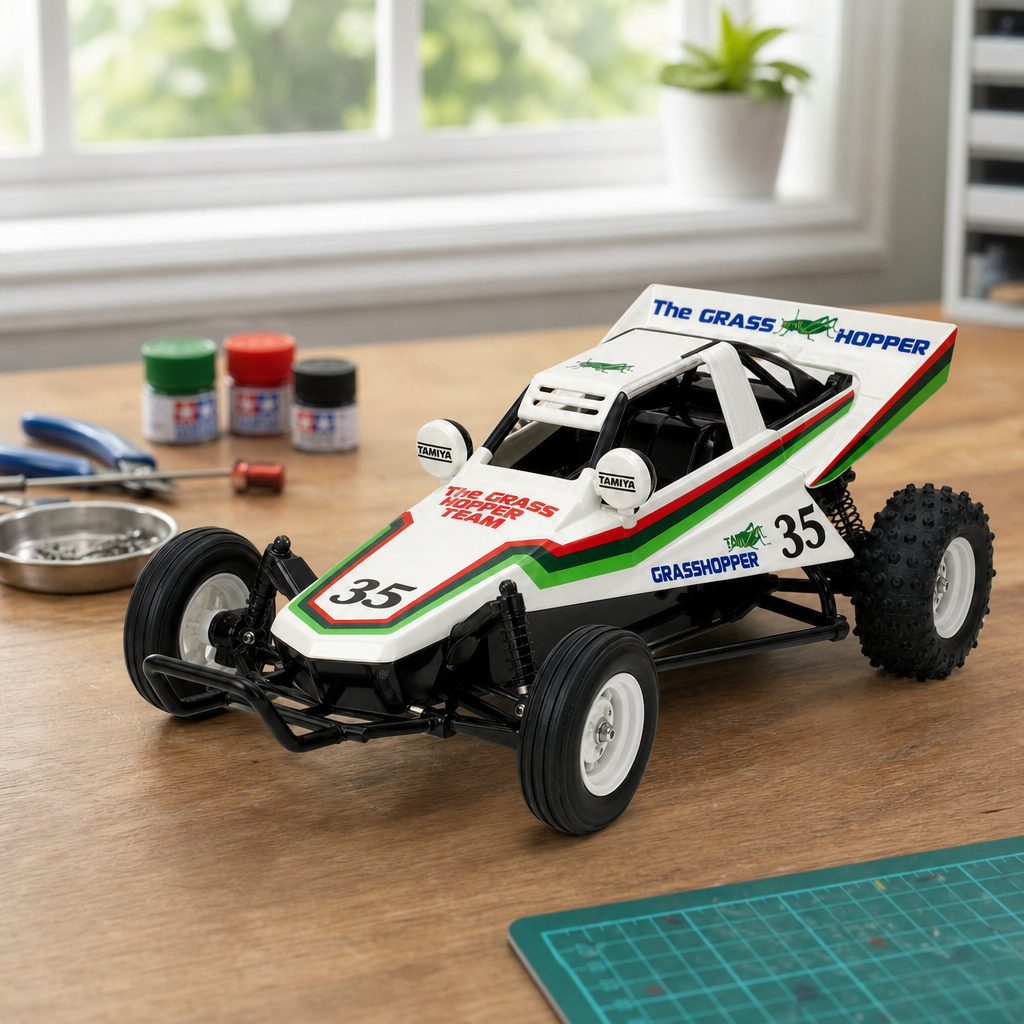
The Grasshopper's appeal has always been bigger than outright speed: it is a build, a lesson in mechanics and an excuse to spend a little more time outside.
Final verdict: the classic is still worth it — for the right buyer
The Tamiya Grasshopper 58346 remains worth buying in 2026 because it still does something modern RC models often overlook: it turns the route to driving into part of the pleasure. Its 1984 design is uncomplicated, characterful and visibly dated in places, especially in the suspension. Yet it remains a fantastic first kit, a hugely satisfying nostalgia purchase and a genuinely enjoyable family project.
Buy it for the build, the iconic look, the upgrade path and the delight of seeing a classic buggy kick up dirt under its own power. Skip it if you want a ready-to-run machine with modern rough-terrain poise. For everyone else, the Grasshopper is proof that old-school RC is not merely surviving. It is still very good fun.