
Catan review: does the modern classic still deserve a place on your shelf?
Catan had already spent three decades teaching families, friends and suspiciously competitive cousins how to trade sheep before becoming the centrepiece of the table. The 2025 sixth edition refreshed the presentation, but the real question in 2026 is simpler: does Klaus Teuber's landmark settlement game still deliver a brilliant games night, or has it become a relic of the board-game boom it helped create?
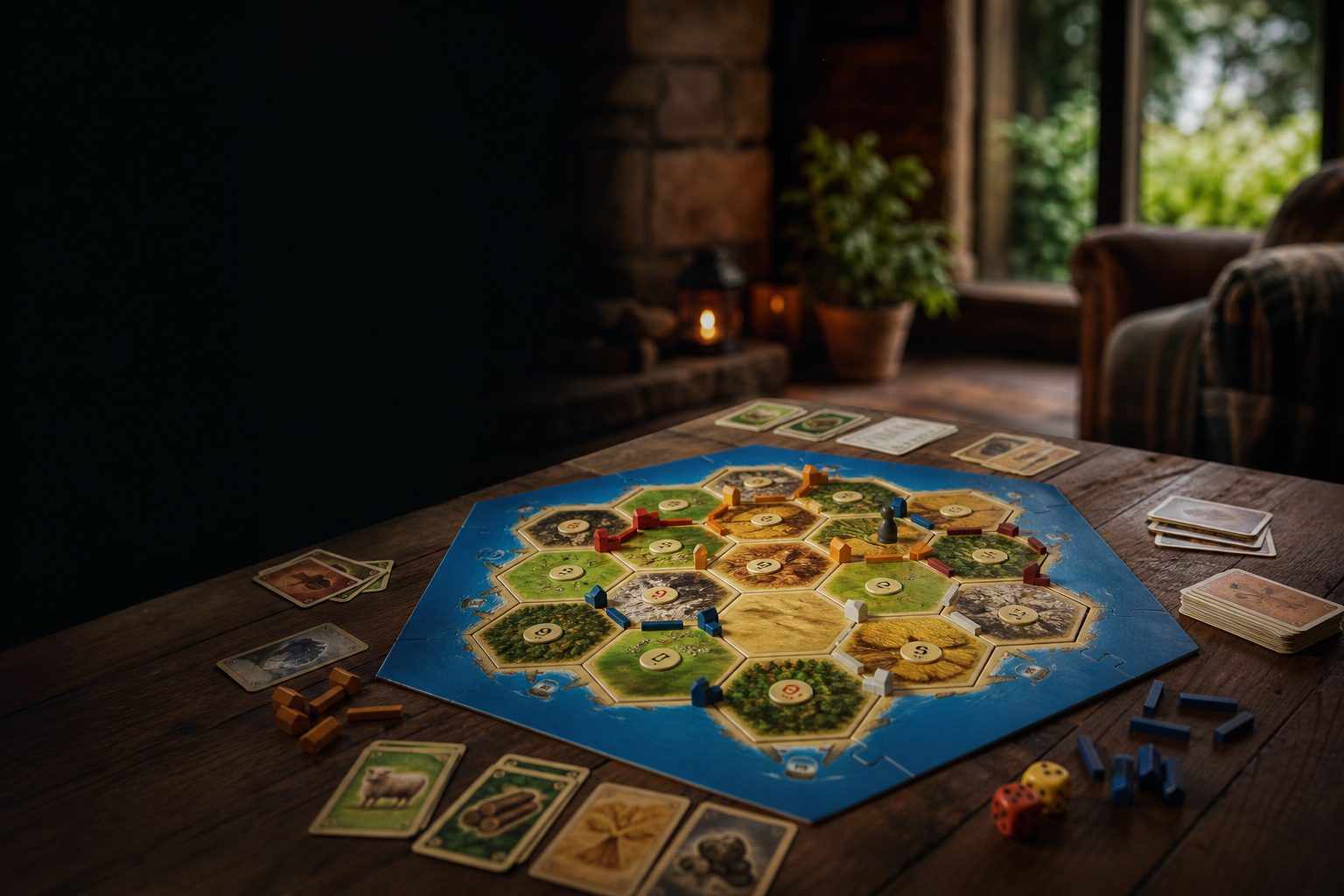
Catan's modular island is built anew for each game, turning familiar wooden pieces and hexagonal tiles into a surprisingly tense little economic contest.
There are board games that ask you to remember a page of special powers before you have even found the snacks. Catan is not one of them. Its basic proposition is beautifully plain: build settlements, gather resources, trade cleverly, expand your road network and be the first player to reach 10 victory points. That is it. Well, that and the fact that everyone around the table will suddenly care very deeply about whether you have any brick.
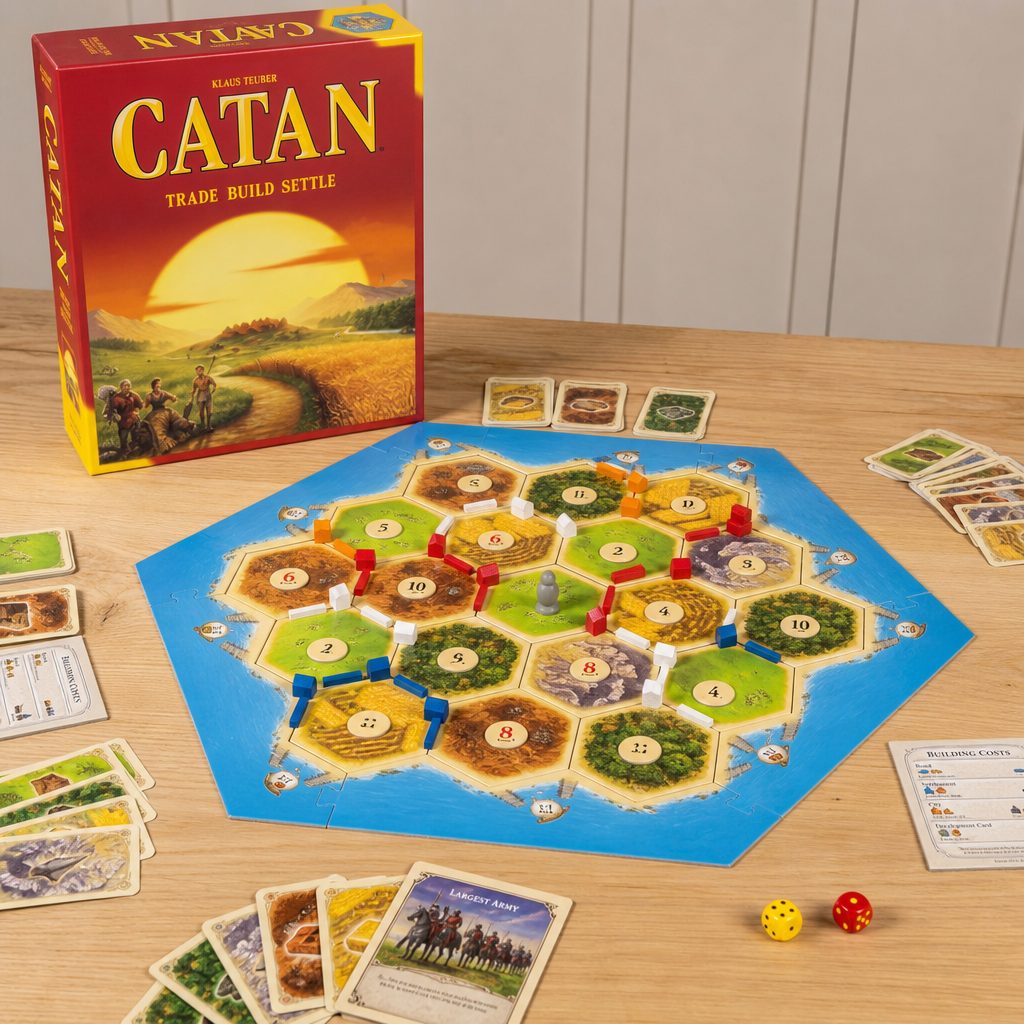
The best Catan games end with a crowded island, a narrow race to 10 points and at least one player claiming they would have won if only their number had rolled.
First published in Germany in 1995 as Die Siedler von CATAN, then released in English as The Settlers of CATAN in 1996, Catan was a genuine turning point for modern board gaming. It made the hobby feel welcoming in a way that many older strategy games simply did not. The rules were approachable, games told a story, and players could make meaningful decisions without spending an entire evening calculating six turns ahead. Its influence on the Eurogame genre was enormous.
That history matters because Catan is no longer the automatic answer to "what board game should we buy after Monopoly?" There are now thousands of excellent gateway games. Some are faster. Some have less luck. Some are kinder to players who fall behind. Yet Catan remains a fixture because the core experience still works: it gets people talking, bargaining, laughing and occasionally promising never to trade wheat with Dad again.
Catan 6th Edition at a glance
The version considered here is the 2025 sixth edition base game. It was released to mark Catan's 30th anniversary and brought revised packaging, refreshed tile artwork, larger roads and buildings, and redesigned rulebook material. This is not a radical mechanical reboot. Crucially, it should not be. The structure that made Catan famous remained intact, whilst the presentation became a little more inviting for a household discovering it for the first time.
Inside the box are 19 terrain hexes, six coastal frame pieces, nine extra harbour pieces, 95 resource cards, 25 development cards, 18 number tokens, four building-cost cards, two special bonus cards, two dice and the wooden robber pawn. Each of the four players receives a colour-coded set of five settlements, four cities and 15 roads. It is a satisfyingly complete package. You open the box, sort a few pieces, and you have the whole island economy in front of you.
That component list is more than box-back trivia. Catan succeeds because it uses a relatively modest number of objects to create lots of small decisions. A settlement is only a wooden house. A road is only a short wooden stick. But where you place them determines which resources you receive, what routes you block, which harbours you can use and, very often, who needs to talk to you before their plan can work.
The base game is for three or four players. A 5–6 player expansion existed for groups that regularly needed extra seats, adding further terrain, harbours and green and brown player sets. It is not a substitute for the base game; it needs the main box.
What Catan actually feels like to play
Each match begins by arranging the island's terrain hexes and placing number tokens on them. In the standard layout, the board is varied from game to game rather than permanently fixed. That one decision gives Catan much of its longevity. The wheat fields, forests, hills, mountains and pasture do not always appear in the same arrangement, so the apparently obvious "best spot" from last week can become a dreadful cul-de-sac this week.
Players then place two starting settlements and connecting roads. This opening is the game's quietest and most important moment. Your starting locations decide which resource types you will produce, how frequently those tiles are likely to activate, which expansion routes are available and whether you have a harbour within reach. Beginners often choose the prettiest-looking cluster of numbers or chase a favourite resource. Experienced players learn that flexibility is usually more valuable than one exciting tile.
On each turn, the active player rolls two dice. Every terrain tile with that total produces its resource for adjacent settlements and extra resource for adjacent cities. A roll of eight might deliver wood to one player, ore to another and sheep to the person who has somehow built an entire pastoral empire. Everybody remains involved even when it is not their turn, because everybody may receive cards. That small feature is one reason Catan was so effective in mixed groups: there is less of the glazed-over waiting that can make a long family game feel like homework.
Resources are used to build. Wood and brick make roads; wood, brick, sheep and wheat make settlements; ore and wheat improve settlements into cities. Development cards add a gentle layer of uncertainty, with useful effects and hidden victory points. The two special achievement cards, Longest Road and Largest Army, create extra routes to victory. None of this is difficult in isolation. The tension came from the fact that resources arrive unevenly and no player can usually build exactly what they want without trading.
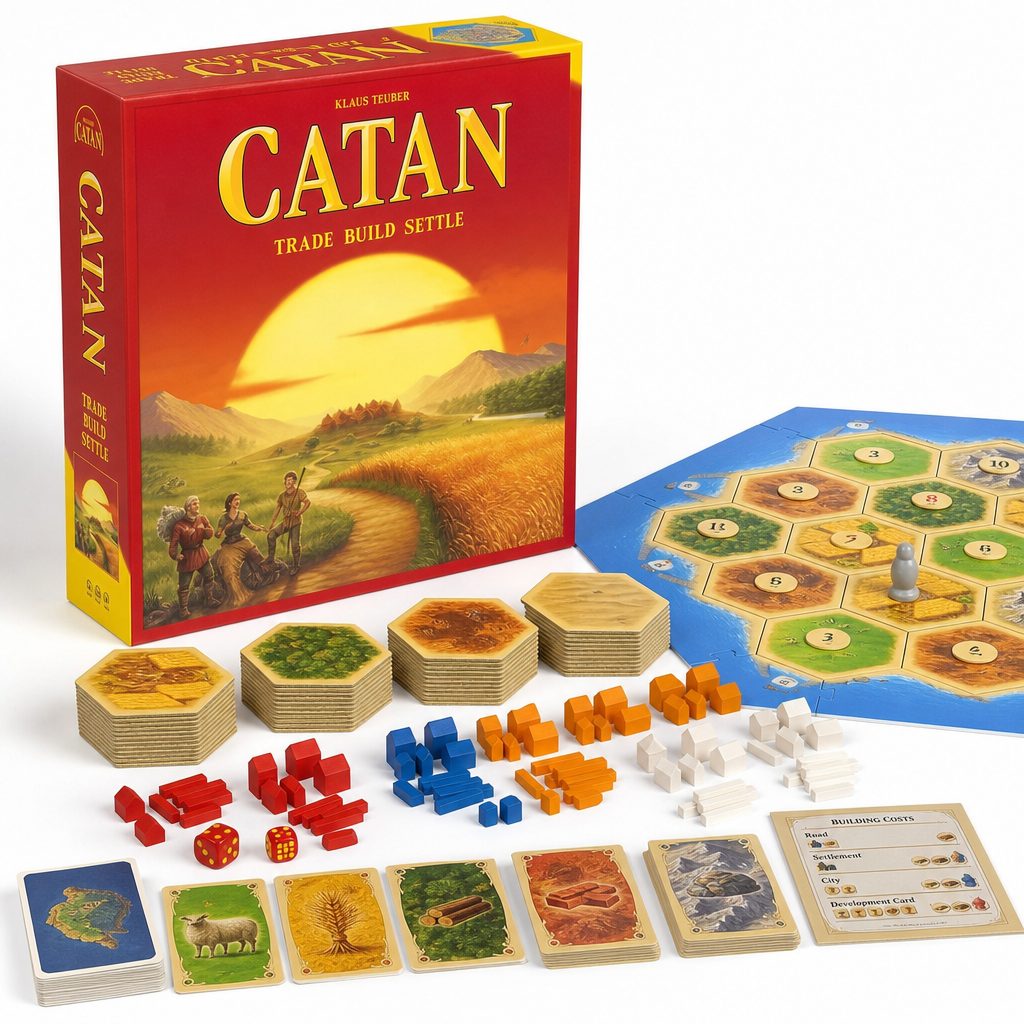
The 2025 sixth edition retained the famous five-resource economy: brick, wood, sheep, wheat and ore are easy to understand, but rarely arrive in the quantities you want.
And that is Catan's party trick. Trading is not a decorative option. It is the game's social engine. You can offer cards to the whole table, negotiate exchanges, bluff about what you need or insist that your final sheep is absolutely not for sale. You may barter with the bank at a poor standard rate, or improve those rates through harbours, but player-to-player trading is usually where the interesting stuff happens.
There is a lovely bit of human theatre in watching a trade proposal travel around the table. One person asks for brick. Another offers wheat. A third says they have brick but only if they receive ore. A fourth player, who was initially minding their own business, suddenly realises the trade will help someone build on the only route they want. The decision changes. Nobody has rolled again, yet the table is alive.
That conversational flow is also why Catan is a poor fit for a group that dislikes direct interaction. It is not hostile in the manner of a ruthless take-that card game, but you cannot play it as four people quietly solving private puzzles. You need to watch what others are collecting, notice where they might expand and make trades that benefit you without handing an opponent their final piece of a winning combination. The island may look peaceful. It is not peaceful.
The board design: clever modular geography, not just pretty hexes
There is something immediately tactile about a Catan board. Hexes form an island in the middle, the sea frame wraps around it, and the little wooden settlements begin to appear at intersections as the game grows. It looks more like a place than a spreadsheet. That was true of earlier editions, and the sixth edition's updated art gives the terrain a more polished, detailed look without making it fussy.
The board is not a board in the usual sense. It is a modular map assembled from separate terrain tiles and frame pieces. That matters because Catan's geography is gameplay. An intersection bordering three productive tiles is usually highly desirable. A location that points towards open space is valuable because roads need somewhere to go. A settlement beside a harbour can make an otherwise awkward resource mix much more workable. You are never simply placing a house where it looks nice; you are committing to a local economy.
For younger players and adults new to hobby games, this visual clarity is a real strength. You can see forests producing wood, hills producing brick and fields producing wheat. You do not need a lore glossary to understand why you are collecting those things. The theme is loose rather than deeply simulated, of course. Nobody is truly running a settlement. You are moving cards and wooden shapes around. But the visual language gives the mechanics enough grounding that the rules make sense quickly.
The revised rulebook helped here. It uses clearer imagery and graphic examples, which is exactly what a game like this needs. Catan's rules are not particularly long, but the initial setup, placement restrictions and production sequence are easier to absorb when you can see a worked example rather than decode a dense paragraph. Once a player understands the opening placements and the idea that every settlement must sit at least two road segments away from another, most of the game becomes surprisingly intuitive.
A different island each time
The 19 terrain hexes and number tokens make setup variable, so no single opening pattern can solve every game.
Position tells a story
Your first two settlements establish your resource mix, potential harbour access and the routes you may later fight over.
Everyone stays involved
Other players can gain resources when the dice are rolled, then join the discussion when somebody wants to trade.
A clear finish line
The first player to 10 victory points wins, keeping the objective visible even for people who have not played before.
There are practical compromises. Because the island is built from loose parts, it can be nudged if someone reaches across the table carelessly or a small child decides the sea frame is a racetrack. The pieces are not designed to lock together like a jigsaw. In normal use this is not a problem, but it does mean Catan likes a reasonably stable dining table. It is less happy balanced on a thick rug beside a bowl of crisps and a dog with strong opinions.
Components, presentation and day-to-day ownership
The sixth edition presented Catan as a more premium, organised family game than some of its predecessors. The square-format box had vibrant, detailed artwork, while the internal trays and card holders were redesigned with an eco-friendly focus. This is welcome because Catan contains enough tiles, cards, tokens and wooden pieces to become a small cardboard avalanche if the storage is poor.
In daily use, the most noticeable improvement is not something dramatic. It is that the larger roads and buildings are easier to pick up, easier to tell apart and easier to read across the table. This sounds laughably minor until you play with children, grandparents, or somebody who has put their glasses somewhere "safe". Clear components reduce friction. You spend more time discussing trades and less time asking whether that tiny brown object is a road or a biscuit crumb.
The resource cards do a lot of work. They are handled, traded, fanned out, hidden and occasionally clutched to a chest with the seriousness of a wartime ration book. They are understandable at a glance, and the card count is generous enough for normal play. As with any card-driven tabletop game, a little care goes a long way: keep drinks away from the resource deck, put it back in the tray after a game, and consider sleeves if your household is exceptionally enthusiastic or exceptionally sticky.
Catan needs no batteries, charging cable, screen update or account login. That is still one of its underrated charms in 2026. You can decide after dinner that you fancy a game, put the box on the table and begin. There is no "just installing something". There is no patch note explaining that wheat now behaves differently. There is only the mild panic of discovering that all the brick is trapped behind someone else's road.
Practical table tip
Before the first game, sort each player's roads, settlements and cities into small piles and put the resource cards within everybody's reach. Catan is easy once it is moving, but an orderly table makes the first 15 minutes far less intimidating for newcomers.
The physical package is best treated as a long-term household game rather than a toy that will live loose in a cupboard. It rewards a little routine: return the dice, robber, number tokens and cards to their intended spaces; keep the terrain tiles flat; and make sure all wooden pieces come back before the box lid closes. That is not because the game is fragile. It is because a missing road or settlement will be noticed precisely when a player is one build away from winning. Naturally, this will be the moment you are absolutely certain it was there last time.
The box did not turn Catan into a travel game. The 2002 Travel Edition existed specifically for that use, with pieces that slotted into a fixed-layout board. Standard Catan is much better as a stay-at-home game where it can occupy a proper table for an hour or more. It can be packed away during a game if necessary, but its loose island and collection of cards make that an exercise in patience rather than something I would plan for.
Learning Catan with children, teens and adults
Catan's stated age guidance is 10 and up, and that feels sensible. A confident younger child may grasp the broad rules, particularly if an adult helps with trading and building costs, but the game's real challenge is not adding dice totals. It is planning. Players need to understand that a settlement placed now affects resource income for the rest of the game, that a road may be useful because of where it leads rather than what it does today, and that handing over a card can create a problem for future-you.
For a typical family with children around the recommended age, Catan is often an excellent bridge from simpler board games into strategy games that have proper decisions. It is less abstract than a pure card game and less punishing than a heavyweight war game. Children can see their settlement network grow. They can learn probability gently through the regular appearance of certain dice totals. They can also experience negotiation in a low-stakes environment, which is a far more useful life skill than knowing the exact value of an orange property in Monopoly.
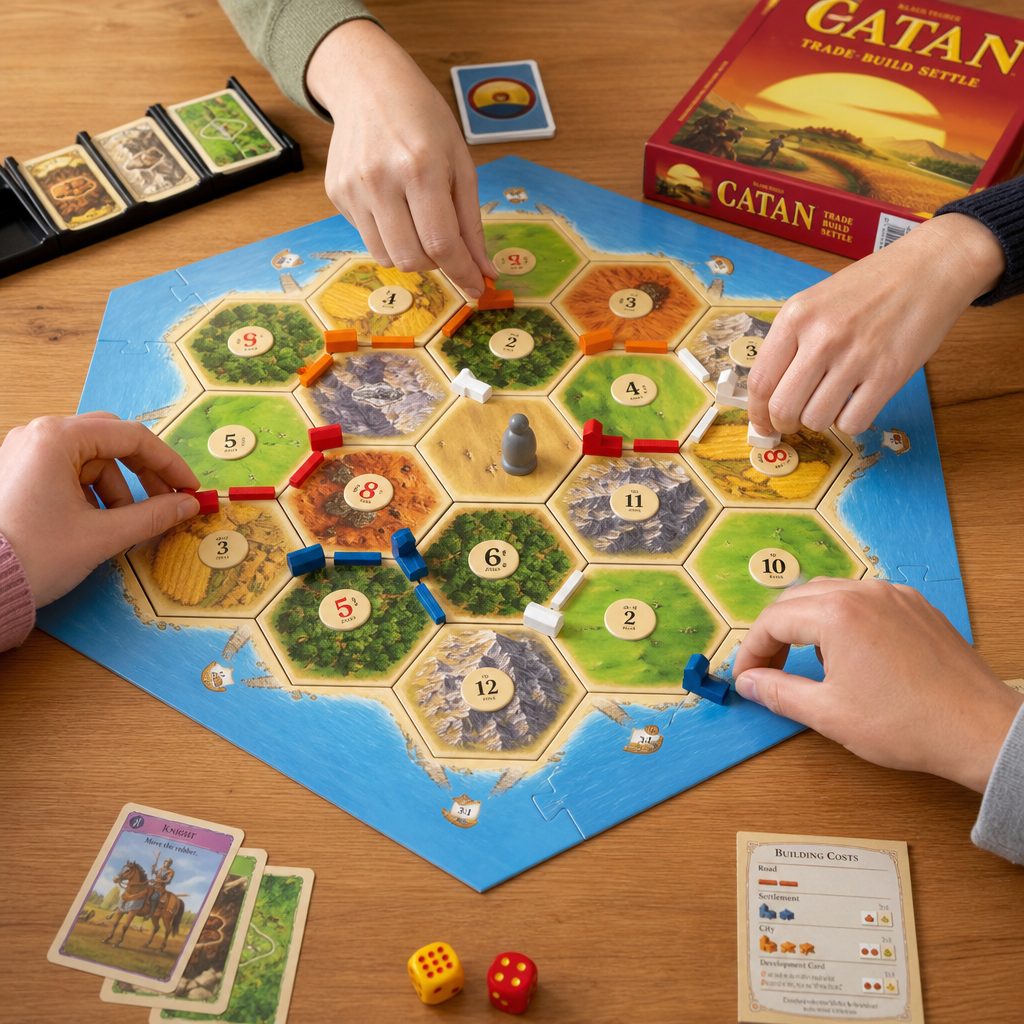
The larger wooden roads and buildings in the sixth edition are a small but meaningful usability win when several players are reaching across the island at once.
Adults who say they "do not like board games" often mean they do not enjoy games where they are stuck reading rules for 40 minutes before being allowed to make a decision. Catan avoids much of that. You can explain the broad aim, show the build costs, demonstrate a turn and get people started. The finer details settle in as the game unfolds. First games are usually slower because people ask whether they can build here, trade that, or move the robber now. By the second game, the rhythm becomes much more natural.
There is a caveat: being easy to learn is not the same as being easy to play well. Catan contains genuine strategic judgement. You can make poor opening placements. You can overvalue a rare resource and find yourself short of basic building materials. You can build a road in a direction that looks promising before someone blocks it. You can make a trade that solves your own immediate problem but gives an opponent exactly what they need to take the lead. None of those errors ruin a family game, but they ensure experienced players have something to think about.
Mixed-age groups benefit from a little social restraint. An adult who knows the game can easily dominate trade discussions, direct a child's choices or ruthlessly deny every reasonable exchange. Technically, that is legal. Socially, it is how you turn a lovely shared hobby into a sulk with wooden sheep. The best Catan teachers explain possibilities, let newer players choose, and save the truly cut-throat bargaining for a group that has explicitly asked for it.
For very young children, Catan Junior was the more appropriate branch of the family. Released in 2012 and intended for ages six and up, it exists because standard Catan asks a little too much of an early primary-school player. That is not a criticism of either game. It is simply useful to buy the version that matches the people actually sitting around your table, rather than the people you hope will magically become economic masterminds by Saturday afternoon.
Strategy, luck and the robber: where the arguments begin
If you have heard a Catan player say, "I would have won if the dice had not betrayed me," they were probably not entirely wrong. Dice are central to the experience. Resource production depends on rolling numbers, and no amount of clever planning can force a needed number to appear. The roll of seven introduces the robber, which blocks production on a chosen tile and allows the active player to steal a card from somebody adjacent to it. This creates both drama and a very obvious target for anyone currently in front.
Luck is therefore not a side issue. It is part of Catan's design. Some groups love that because every game has swings, surprises and opportunities for players who started less strongly. Others find it frustrating because a well-laid plan can stall when a number simply does not arrive. The honest answer is that both reactions are fair. Catan is not chess. It never pretended to be. It is a strategy game shaped by probability and human negotiation.
The better you get, the more you can soften bad fortune. Good starting placements cover several useful resources, use productive number tokens sensibly and leave room to expand. Harbours can turn a surplus into flexibility. Trading can plug gaps. Development cards can offer an alternate route towards points. Watching other players can help you decide whether to race for an intersection, pursue Longest Road or focus on city upgrades. Clever play cannot abolish randomness, but it can stop one unfortunate turn from becoming your whole game.
The robber is the piece most likely to change the mood of the table. On paper, it is an elegant catch-up mechanism. In practice, it asks players to choose who to hinder, and that can feel personal even when it is plainly sensible. If one person is visibly leading, most groups accept that they will be targeted. If somebody puts the robber on a newer player because they happened to have one card, eyebrows may rise. Catan teaches a subtle but important lesson: the rules define what you can do; your group defines whether doing it makes for a fun evening.
The dice also create memorable stories. You remember the game where nobody rolled your precious eight for half an hour. You remember the moment a seven forced a player with too many cards to discard half their hand. You remember the trade that looked absurd until it won somebody the last point. In a modern market full of polished, tightly balanced systems, there is still value in a game that produces stories people retell afterwards.
That said, groups who hate kingmaking or prolonged negotiation should take this warning seriously. When the table sees a likely winner, it can collectively choose not to trade with them, block their routes and place the robber in their path. That is part of the game, not a flaw in the rules. But it means Catan rewards social awareness as much as resource management. If you want a game in which everybody concentrates silently on their own board, look elsewhere.
Catan 6th Edition versus earlier and alternate Catan versions
The sixth edition was not the first Catan box most long-time fans owned. The fifth edition had been available from 2015 until 2024, and many households still had it on the shelf. It remained a very playable edition. The 2025 refresh did not make an existing fifth edition suddenly obsolete, nor did it rewrite the fundamental experience. If you already own a complete, well-loved copy, there is no urgent gameplay reason to replace it.
Where the newer box made sense was for first-time buyers, people returning after many years, and households that wanted the tidier presentation, refreshed art and larger pieces. It has the advantage of looking like a current, approachable family game while preserving the rules that made the original a classic. That is a more meaningful update than a needless reinvention would have been.
| Feature | Catan 6th Edition | Catan 5th Edition | Catan Junior | Catan: 3D Edition |
|---|---|---|---|---|
| Release period | 2025 | 2015–2024 | Released in 2012 | Released in 2005 |
| Core audience | Players aged 10 and up | Standard Catan players | Players aged six and up | Collectors seeking a more immersive presentation |
| Base player count | 3–4 players | Standard base-game format | Children's variant | Premium three-dimensional take on the island |
| Presentation | Revamped art, square box and eco-friendly trays | Previous standard edition presentation | More accessible junior version | Island terrain rises off the table |
| Best reason to choose it | Best starting point for a new standard Catan household | Worth keeping if you already own it | Better fit for younger children | Best for display-minded enthusiasts |
The 3D Edition, first released in 2005, took the familiar island and made it physically rise from the table. It is an undeniably dramatic collector-style version, designed for the person who wants Catan to be a visual event as well as a game. That does not make it the practical choice for most families. The standard sixth edition is easier to think of as the sensible, durable game-night copy; the 3D edition is for somebody who wants to make a statement before the first dice are rolled.
Simply Catan, released by SimplyFun in 2006, took a different approach. It replaced individual hexes with hex strips to speed setup. That is a useful historical footnote because it highlights one of standard Catan's tiny inconveniences: building the island does take a few minutes. Most groups will not mind. The setup is part of the anticipation, and the modular tiles are central to the game's identity. But if your family wants the quickest possible route from opening the box to rolling dice, it is worth knowing that alternative formats existed.
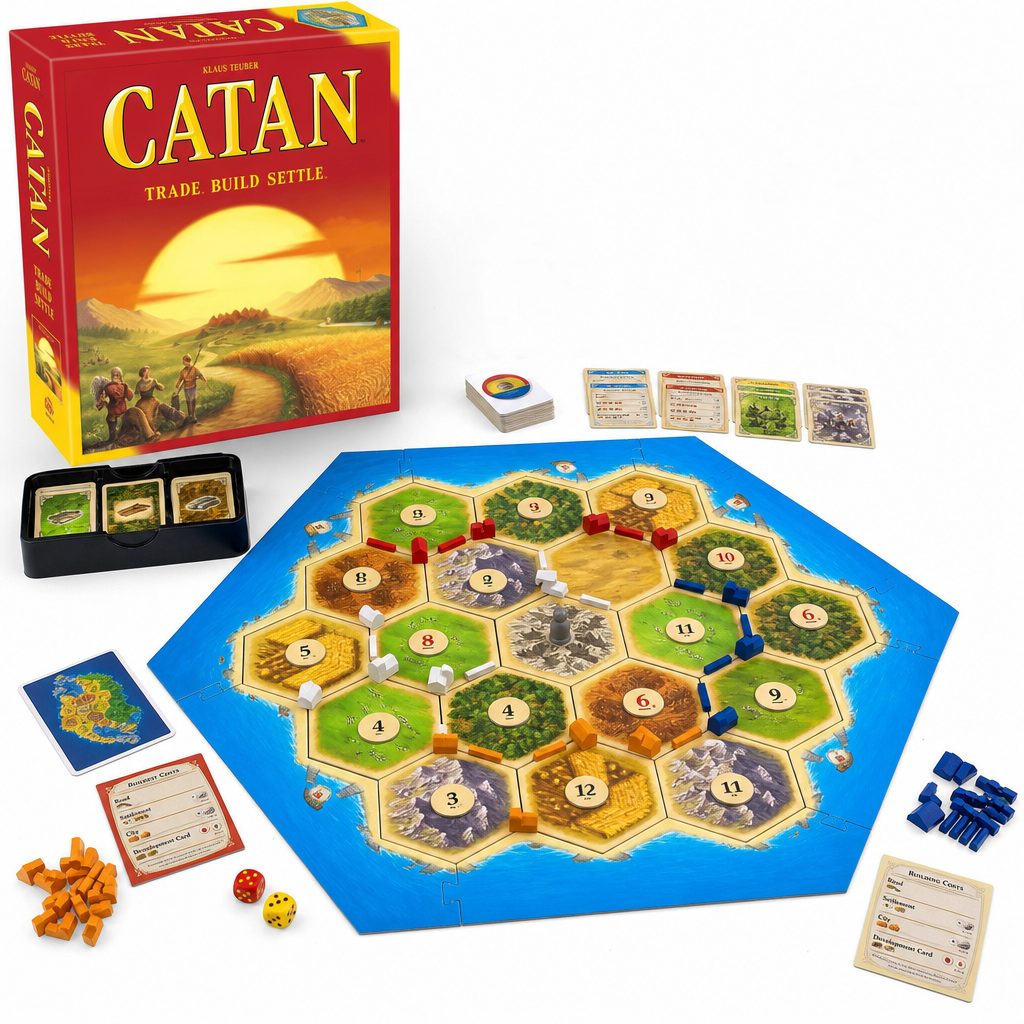
Catan's board begins as an open island and slowly becomes a visible record of every promising route, blocked intersection and trade-fuelled expansion.
The Travel Edition, published in 2002, used a fixed layout and pieces designed to slot into the board. It served a genuinely different use case. It was for holidays, trains, compact tables and players who wanted the Catan concept in a more portable format. The sixth edition base game should not be judged by those standards. Its appeal is the full dining-table experience: spread out, build the island, let the negotiation breathe and accept that it will probably be there until someone wins or the tea goes cold.
Expansions: how far can the island grow?
One reason Catan kept its place in so many collections was that the base game could become a platform. The main game stood perfectly well on its own, but expansions offered ways to change its scale and texture once your household had exhausted the obvious strategies. This is good news for people who fall in love with the game, but it is also a reason not to buy everything at once. The base box needs time to prove itself before your cupboard begins looking like a small shipping depot.
Catan: Seafarers, released in 1997, was the first major expansion. It broadened the island experience with exploration and sea travel, which made sense for players who liked the map-building aspect and wanted a wider horizon. It added more geography to think about rather than simply adding more rules for the sake of it. For groups who enjoyed finding routes and expanding into new areas, Seafarers was the natural next step.
Cities and Knights of Catan, released in 1998, pushed the game further towards a richer strategy experience. It introduced new resource types including coins, paper and cloth, and gave players more to manage than the base game's straightforward build-and-trade rhythm. It was better suited to a regular Catan group that wanted extra layers, rather than a family still learning why wheat is suddenly everyone's favourite card.
Traders & Barbarians and Catan: Explorers & Pirates, released in 2013 as the fourth major Catan board-game expansion, showed how wide the system became over time. Explorers & Pirates leaned into adventure and discovery. Traders & Barbarians supplied further ways to vary the formula. All of these had sixth edition versions available, which is reassuring for new buyers who want a clear route forward from the current base game.
The 5–6 player expansion has a more immediately practical purpose. If your usual group is five or six, it provides extra terrain, harbours and the green and brown player sets needed to bring more people in. That is useful, but I would be realistic about the consequences. Catan at three or four players has a brisker, more contained feel. Adding seats means more turns, more negotiation and more opportunities for someone to say, "Wait, what was the trade offer again?" It can be tremendous fun with the right group, but it does not make the game shorter.
Expansion advice for new owners
Play the base game several times before expanding. Catan already contains enough variation through its modular island, dice outcomes and player trading. An expansion is best bought because your group wants a specific new flavour, not because the main box looks too quiet on the shelf.
This expandable ecosystem is part of Catan's legacy. It did not have to be a one-and-done family game. It could grow with a group's confidence. Yet there is something to be said for the original box's restraint. Its resource system is elegant because there are only five resource types. Its goal is clear because 10 points is easy to track. Its board is rich because the island changes, not because it needs a mountain of extra subsystems. For many families, base Catan is the sweet spot and always will be.
Price, value and what you are really paying for
As of Sunday 19 July 2026, Catan 6th Edition had a US recommended price of $49.99. UK listings placed the game at £39.98 or £39.99, depending on retailer. A US promotional price of $34.99 had also been observed, down from a usual $54.99 and lower than a previous low of $41. Those figures made it clear that the game's selling price could vary, so it was worth checking the current deal rather than assuming the box always sat at one fixed number.
US recommended price
Catan 6th Edition base game.
Observed US promotion
Previously seen at a 36% reduction from $54.99.
UK retailer pricing
Listed pricing for the sixth edition base game.
At around the £40 mark, Catan is not an impulse buy in the way a pack of cards or a small party game can be. But it is a more substantial game than either. You are paying for a complete, replayable tabletop system with wooden components, a variable board, a large deck of resource cards and an experience that can support many evenings. Split across even a handful of games, it can feel like excellent value. Split across dozens over several years, it begins to look positively thrifty compared with many entertainment purchases.
The important thing is to buy it for the right group. If your household has two people who mainly play together, the base game is not designed for that player count. If everyone prefers very short games, an hour to 90 minutes may feel like a commitment. If nobody enjoys talking through a trade, Catan's greatest strength becomes a feature you are paying not to use. Value is not just a price label; it is whether the game fits the rhythm of your real home.
For families with three or four likely players, the value proposition is much stronger. It covers a broad age range, works for parents and teens, provides a clear activity for visiting relatives, and does not demand any continuing subscription, consumable refill or electronic accessory. It also has a strong enough legacy that it can be passed on, rediscovered and taught again. That is a rather nice quality in an age when so many things seem designed to be replaced before you have learned where the power button is.
There is also value in familiarity. Catan is sufficiently well known that friends may already understand the basics, or at least recognise the name. Teaching one new player is easier when another player can explain how harbours work or remind the table that a settlement needs a connecting road. A popular game has a built-in network effect: more people know how to play, more expansions exist, and it is easier to find a willing opponent. Not every household needs that. But it is worth something.
Who should buy Catan 6th Edition?
Catan is not a universal recommendation, and that is fine. Few games are. It is at its best with people who enjoy a little strategy wrapped in plenty of conversation. The best groups are often not hardened hobby gamers or complete beginners, but a mix of people willing to make deals, laugh at a bad roll and remember that blocking somebody's road should not lead to a diplomatic incident.
Best for family game nights
Choose Catan 6th Edition for families with players aged 10 and up who want a proper strategy game that remains approachable and social.
Best all-rounder for 3–4 players
The base game was built for three or four players, making it a strong centrepiece for regular friend groups and family tables.
Best for younger children
Catan Junior is the better pick for children aged six and up, rather than asking a younger child to handle the full standard game.
Best premium Catan pick
Catan: 3D Edition is the choice for collectors who value a more immersive, display-worthy island above everyday practicality.
Buy standard Catan if you enjoy games where a decision has both mechanical and social consequences. Should you trade your wheat now? Is the offer fair? Will you need that brick in two turns? Can you persuade the player with the harbour to help you? These are not dry optimisation questions. They are the reason the game generates conversation.
It is especially good for a household ready to step beyond roll-and-move classics. The dice are still there, so the game feels familiar. But the dice do not simply tell you how many spaces to move. They feed an economy, and you decide how to use it. That is a major leap in game design for a child or adult who has only played traditional family titles. You begin to see that strategy games can be about choices rather than merely waiting for the right number.
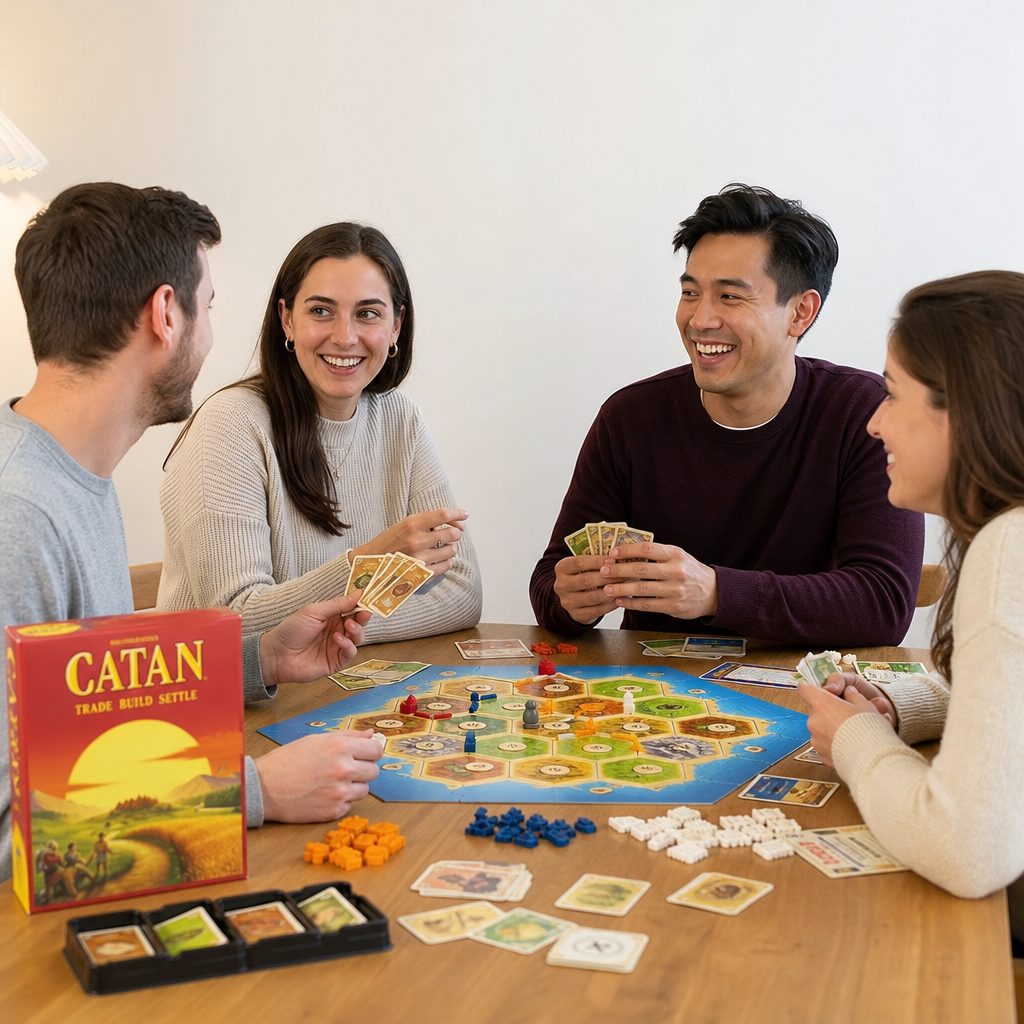
Catan is at its best when the table has three or four players who are willing to negotiate, make imperfect deals and enjoy the stories that emerge from them.
I would be more cautious if your group includes players who hate being targeted, dislike bargaining or become frustrated when luck interrupts a careful plan. The robber can feel mean. Trading can feel political. A bad sequence of rolls can feel unfair. These are not hidden flaws; they are core ingredients. The right group sees them as drama. The wrong group sees them as reasons to pack the box away early.
For solo players, couples and people seeking a quiet, low-interaction evening, Catan is simply not the neatest fit. Its magic happens between players. It needs competing ambitions, imperfect information and the awkward moment when everyone notices that you have eight resource cards and are trying to look innocent. Play it with people, not merely alongside them.
Strengths and weaknesses after 30 years of history
It is easy to praise a classic by pretending its age has removed all rough edges. That would not be useful. Catan deserved its reputation, but it also came from an earlier stage of the modern board-game hobby. The things it does brilliantly remain brilliant. The things that can annoy are now easier to identify because many newer games have tried to smooth them away.
What Catan still does brilliantly
- Its modular island gives every game a different spatial puzzle without making setup difficult to understand.
- The five-resource economy is simple enough for newcomers yet creates genuinely interesting building and trading decisions.
- Players stay engaged on other people's turns because dice production and trade offers can affect everyone.
- It plays naturally across generations, particularly for families with children aged 10 and over.
- The sixth edition's updated art, larger buildings and organised trays improve the everyday experience without damaging the classic formula.
- The wider range of expansions gives committed groups a route into more elaborate versions of the Catan world.
Where it can test your patience
- Dice luck can stall a strong plan, particularly when a needed number simply refuses to appear.
- The robber can feel personal and may cause friction in groups that dislike direct player targeting.
- A 60–90 minute game can overrun when players are new, negotiations are lengthy or turns become over-analysed.
- Players who fall behind may find it hard to recover if the board and trade table both work against them.
- The base game does not suit two players, and the 5–6 player format requires the separate expansion.
- It relies on conversation; quiet groups who prefer independent puzzle-solving may not see its best side.
The main strength is accessibility without emptiness. Many games are easy because there is not much to decide. Catan is easy to understand but leaves enough room for a player to develop instincts. You learn to value flexible openings, notice who is collecting ore, protect a route, use a harbour well and avoid helping the obvious leader. Those are satisfying lessons because they emerge naturally from play rather than being buried in a rulebook.
The main weakness is that the game can punish the emotionally unprepared. If you are the sort of player who needs a perfectly fair, perfectly controllable contest, Catan's dice and robber may grate. Modern strategy games often use clever catch-up mechanisms, reduced randomness and more protected personal spaces. Catan is more exposed. Your business is visible. Your roads are visible. Your best resource tile is visible. And the person holding the robber is looking directly at it.
But there is a reason it remained popular. That exposure produces interaction. You are not merely nudging cubes on a private board. You are competing for a shared island. You can see somebody's plan and interfere with it, or help them because helping them also helps you. The game's flaws and its personality are tangled together. Remove every unpredictable moment and every difficult trade, and you might make a cleaner game. You would not necessarily make a more memorable one.
How Catan holds up in 2026
Thirty years after its first publication, Catan no longer needs to prove that board games can appeal beyond dedicated hobbyists. It already did that work. Its real challenge in 2026 is different: can it earn a place among shelves packed with newer, shinier games that promise shorter sessions, tighter balance and more elaborate themes?
My answer is yes, with conditions. Catan still holds up because it offers an experience that many newer games do not quite replicate. It has a kind of friendly friction. You must negotiate. You must react to luck. You must share the board. You must watch the people across from you rather than stare only at your own hand. For some groups, that is exactly what a tabletop game should do. It takes people away from parallel screen time and makes them interact properly.
The sixth edition was a sensible way to preserve that legacy. It did not position the game as a radical new invention, because that would have been silly. It gave the box a modern visual lift, made the components easier to handle and clarified the teaching material. Existing owners of the 2015–2024 fifth edition had no need to panic-buy a replacement. New buyers, however, got a polished current entry point into one of the hobby's most important games.
Catan has also aged well because it does not depend on topical references, app support or a particular pop-culture moment. A settlement, a road, a trade and a dice roll are still legible. The game can sit in a cupboard for six months, then come out when friends visit. You do not have to remember a campaign storyline or rediscover a companion app password. You just rebuild the island and start asking who has brick.
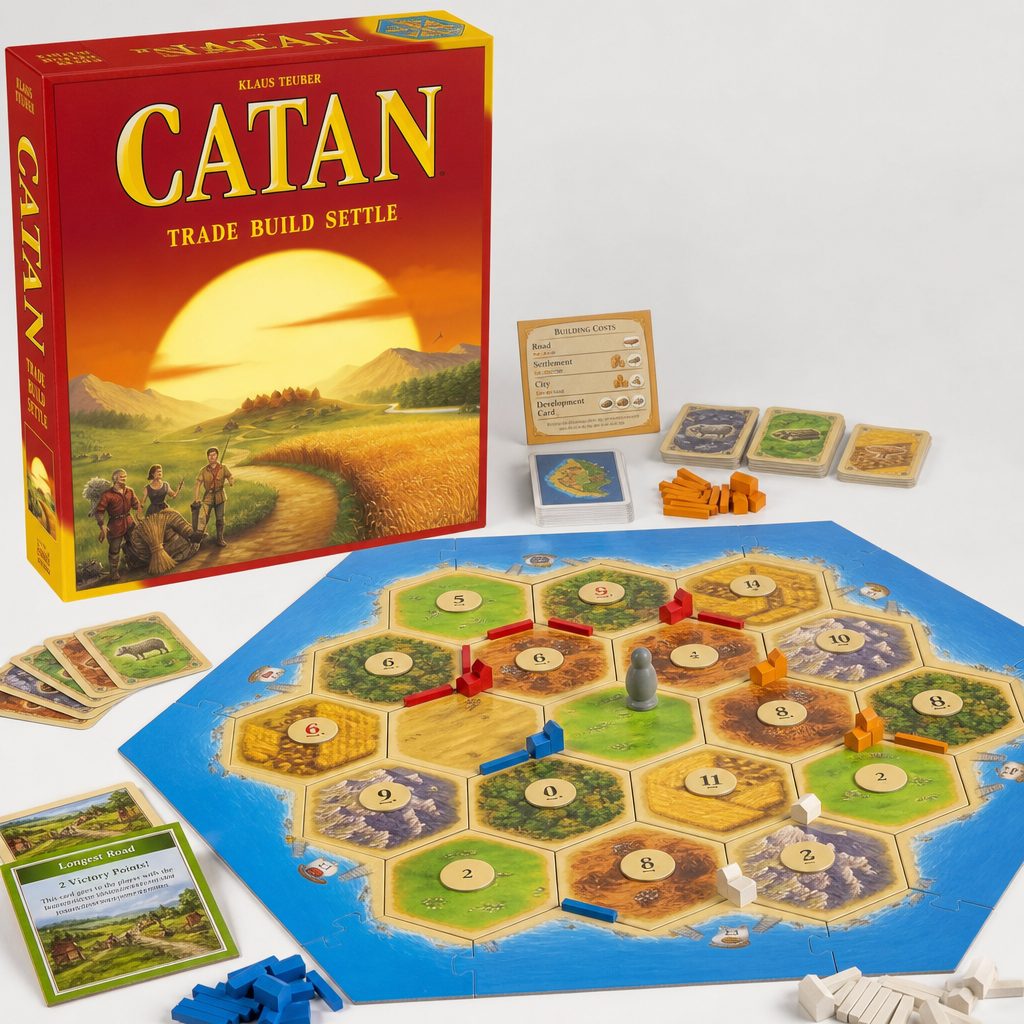
After three decades, Catan's appeal remains refreshingly physical: cards in hand, roads on the table and just enough uncertainty to make every trade matter.
It is not the most innovative choice for an experienced board-game collection in 2026. Nor is it the only gateway game worth considering. But "not the newest" is not the same as "outdated". The game remains a classic because it understands a simple truth: players will forgive a few rough edges if a game creates good stories and gets everyone involved. Catan still does both.
Catan FAQ
Final verdict: Catan remains a deserved classic
Catan 6th Edition is still one of the strongest family strategy games for three or four players aged 10 and up. The refreshed 2025 presentation made a famous game easier to teach, nicer to handle and more inviting on the shelf, whilst keeping the wonderfully social trading system that made it a landmark in the first place.
It is not perfect. Dice luck can be cruel, the robber can stir up arguments, and a long game is not always ideal when everyone is tired. But those rough edges are part of a game that generates proper stories, encourages conversation and turns a table of people into competing island economists within minutes. If your group likes trading, light strategy and a healthy amount of cheerful suspicion, Catan absolutely still deserves a place in the games cupboard.