
Snap Circuits Electronic Construction Kits Review: Still the Friendliest Route into Real Electronics?
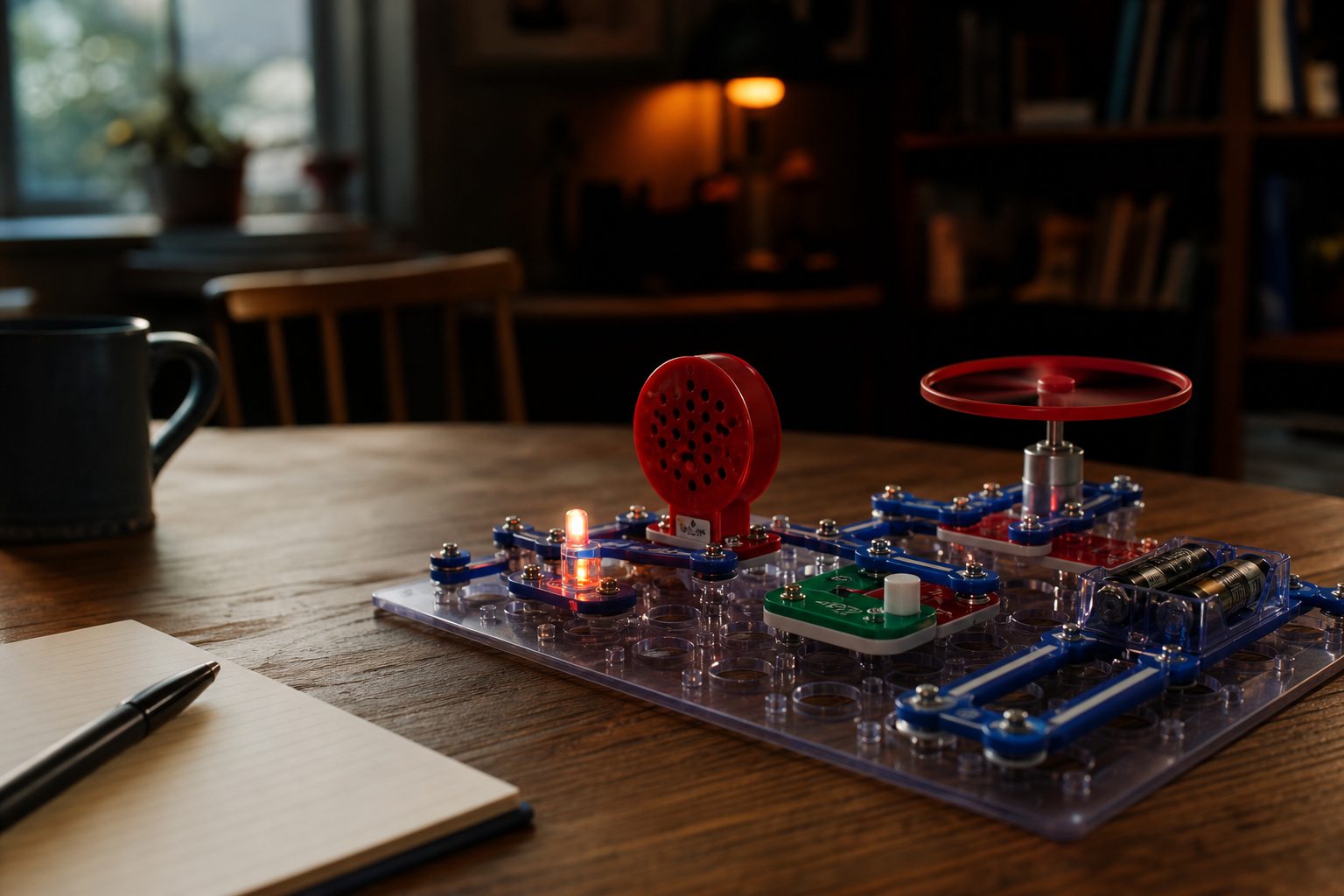
Snap-together modules turn a kitchen table into a compact electronics lab, without requiring a soldering iron or a drawer full of mysterious wires.
Electronic construction kits have spent years making LEDs flash, buzzers sing and young engineers feel quietly unstoppable. Snap Circuits remains the most recognisable name in the category, but in 2026 does its click-together approach still justify a place on the toy shelf when coding boards, Raspberry Pi projects and more serious soldering kits are everywhere?
1. The short version
There are toys that announce their educational intentions from across the room. They arrive in beige packaging, use the phrase "learning outcomes" rather too often, and somehow make curiosity feel like homework. Snap Circuits has generally avoided that trap. Its appeal is wonderfully direct: place components onto a board, snap them together, follow a circuit diagram and watch something happen.
That "something" might be a light, sound, motor or another little effect that makes the underlying idea visible. It is not magic, although younger children may reasonably conclude that it is for the first ten minutes. The point is that the kit gives electricity a physical form. Instead of reading that a switch opens or closes a circuit, you build one. Instead of being told that components have different jobs, you connect them and see the result.
The Snap Circuits family is broad rather than a single boxed product. Snap Circuits Jr. sits at the entry end, Snap Circuits Classic offers more than 200 circuits, the larger Snap Circuits Extreme SC-750 moves towards a more ambitious project library, and specialist sets such as Snap Circuits 3D Illumination focus on light-based builds. There have also been coding-oriented options with Arduino integration. That breadth is the range's great strength and its occasional complication: choosing the right box matters more than simply buying the biggest one.
For a child who is intrigued by how things work, the fundamental experience holds up extremely well. The pieces are tangible, the feedback is immediate and the early projects are approachable. It is not a substitute for a proper electronics bench, nor does it pretend to be. But as an on-ramp to circuits, cause and effect, fault-finding and patient experimentation, it remains one of the more convincing educational toys around.
The essential appeal
Snap Circuits succeeds because it lets children build a working circuit before they have had time to worry whether they are "good at science". That early success is more valuable than a box full of advanced terminology.
2. Snap Circuits at a glance
It helps to be clear about what you are buying. These are electronic construction kits: packages of components, diagrams and guided projects designed to let users assemble functioning circuits. The Snap Circuits approach is solderless. Components mount on a board and connect using the distinctive snap format, which makes the circuit layout visible and makes rebuilding a normal part of play rather than an alarming technical procedure.
Snap Circuits Classic is the central all-rounder. It is aimed at ages 8 to 108, which is a charmingly broad claim but not an unreasonable one. A curious eight-year-old can follow a guided build with some support; an older child can start asking why it works; an adult can enjoy revisiting the basics without feeling patronised. Its more-than-200-circuit library gives it considerably more room to grow than a one-afternoon novelty kit.
That last figure is worth pausing on. The wider Snap Circuits catalogue included 226 items across base sets, parts, mini kits, radios, coding kits, green-energy themed products and project labs. It is a proper ecosystem, not merely a single red board that somebody happened to put in a science aisle. That matters for long-term ownership, because a child who enjoys the basic format has routes onwards without immediately having to learn a completely new system.
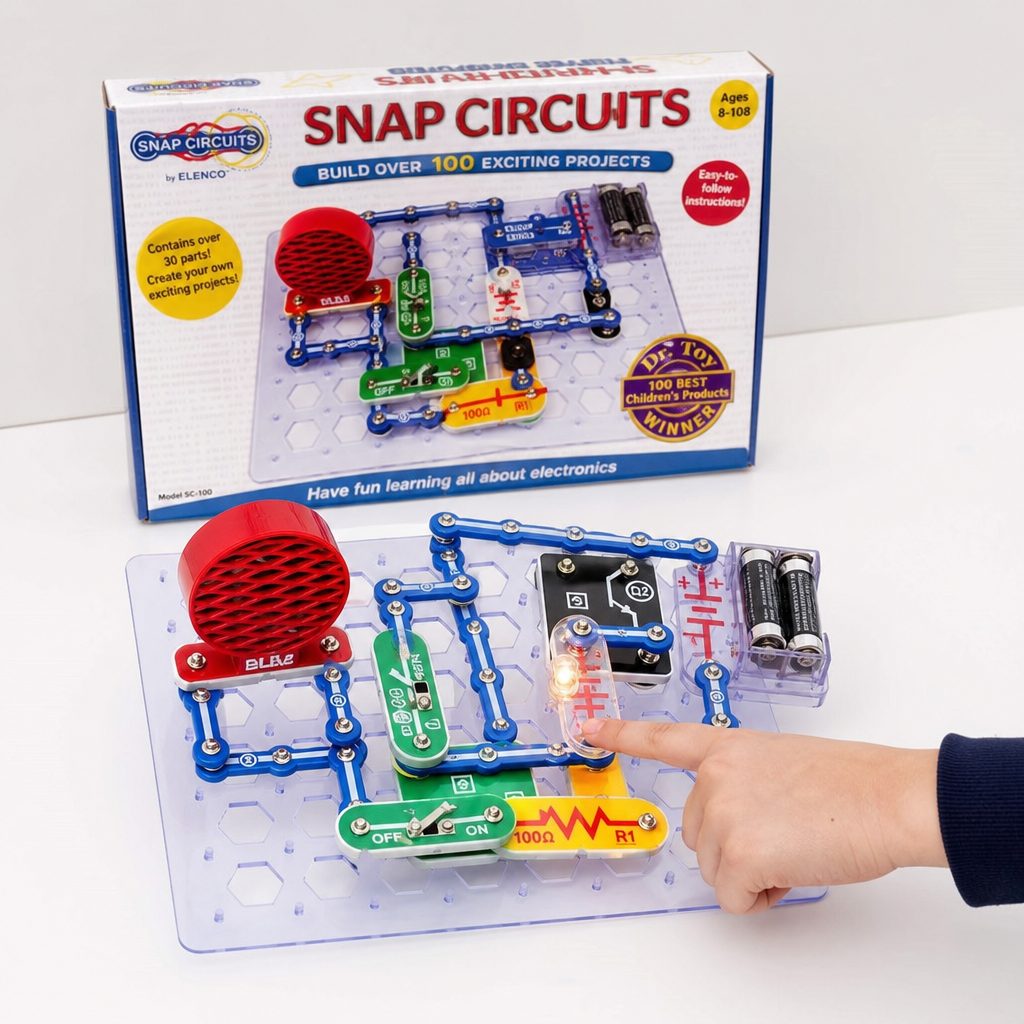
The value of a transparent, diagram-led system is that a child can trace the route of a circuit rather than simply press a button and hope for the best.
3. Design and build quality: satisfyingly physical
The design philosophy is brilliantly low-friction. Individual pieces represent electronic functions rather than asking the user to decode a tangle of loose components and jumper wires from the outset. A switch looks and behaves like a switch. A lamp component produces light. A motor component produces movement. This may sound obvious, but it is an excellent bridge between toy-like confidence and real technical thinking.
The snap format also changes the emotional temperature of making mistakes. With a conventional breadboard, a beginner can spend ten minutes wondering whether a wire is in the wrong hole, whether a component is facing the wrong way, or whether the universe has simply decided it dislikes them. Here, a build can be disassembled and reassembled quickly. The parts give a clear physical indication that they are in place. It is not impossible to make an error, of course, but the system does not make failure feel permanent.
Snap Circuits 3D Illumination deserves a mention because it demonstrates how the core format can be pushed into a more theatrical direction. Its light tunnel and projector components give the output a genuine sense of occasion, while its extra baseboards make larger illuminated arrangements possible. It is still teaching a principle, but it does so with enough visual flair to pull in the child who may not be motivated by the words "electrical circuit" alone. Fair enough. We all like a dramatic light tunnel.
There is a practical advantage in the durability of this sort of construction system too. The parts are made for repeated assembly rather than a single completed model that sits on a shelf gathering heroic amounts of dust. A kit can return to the table repeatedly, with projects dismantled, recreated, modified and occasionally left half-finished until someone remembers where the final connector went.
Immediate construction
The snap-based layout means a beginner can start building with a physical confidence that loose-wire electronics kits rarely offer.
Visible circuit paths
Components are arranged on an open board, helping users see that electricity needs a complete route rather than merely "making things work".
Easy rebuilding
Projects can be broken down and retried without soldering, which makes experimentation less intimidating and tidying far less dramatic.
Outputs children notice
Lights, sounds and moving parts provide quick feedback. A circuit that visibly does something is an excellent teacher.
4. The learning experience: from instructions to understanding
Following the booklet is the obvious starting point, and there is no shame in that. In fact, it is the correct place to begin. Electronics has enough invisible behaviour without expecting a newcomer to invent a working project on day one. The best guided projects establish a rhythm: identify the parts, place them carefully, check the diagram, activate the circuit and observe what changes.
The real educational value arrives a step later. Once a child has built a successful circuit, the natural question becomes, "What happens if I move this?" That is where a construction kit earns its keep. A switch can be repositioned. A lamp can be added or removed. A build can be remade slowly to find an error. The result is not merely knowledge of a finished model; it is an early habit of testing ideas.
Snap Circuits Classic's 200-plus possible circuits are significant here. A project count is not a guarantee of 200 entirely distinct experiences. Some builds will naturally share components and principles, and some are variations on a theme. But a large library provides repetition with progression. Repetition is often dismissed as boring by adults who have forgotten how skills are actually learned. For children, rebuilding a familiar type of circuit with one additional idea can be exactly the right level of challenge.
The instructions will suit children who enjoy visual order and clear stages. They will suit parents too, particularly those who have not touched a circuit since a slightly alarming school science lesson involving crocodile clips. You do not need to arrive as a physicist. You do need to be happy saying, "Let's check the picture again," rather than immediately assuming the kit is broken. That is a useful family skill in general, to be honest.
Electronic construction kits work best when adults resist the urge to take over. Helping a child read a diagram is useful; quietly rebuilding the whole circuit while they fetch a biscuit is rather less so.
5. Performance: what "works" feels like in practice
Performance in a kit like this is not about benchmark charts in the usual gadget-review sense. Nobody is buying Snap Circuits to compare processor scores or chase frame rates. Its performance is measured in clarity, reliability of the build process and whether the result communicates an idea. When a completed circuit illuminates, makes a sound or activates a motor, it confirms the user's work in a way that a worksheet simply cannot.
That is why the modular design is so effective. The child is not just watching a pre-programmed toy perform a trick. They have assembled the pathway that allows the trick to happen. The visual and audible outputs become evidence. It is a small distinction from an adult perspective, but an enormous one for someone forming their first mental model of electricity.
Snap Circuits Classic's more-than-200-circuit scope gives it a meaningful advantage over smaller introductory offerings when sustained use is the goal. Meanwhile, Eitech's electronic construction kit offers over 80 experiments from a 26-page instruction book and covers projects including electric motors and relay alarm systems. Eitech's easy-click approach is similarly designed for quick assembly, although its specified experiment count is much lower. It is a perfectly sensible alternative, but the numbers explain why Snap Circuits Classic tends to make more sense for the household hoping one kit will remain interesting over a longer stretch.
One limitation is that the format deliberately simplifies electronics. That is the bargain. The components are approachable because they are packaged into robust modules, not presented as tiny resistors, capacitors and raw circuit-board work. A child can learn core ideas here, but someone who becomes genuinely absorbed will eventually want to move on to breadboards, microcontrollers, coding or soldering. This is not a criticism. A good starter kit should create exactly that problem: the pleasant problem of wanting to know more.
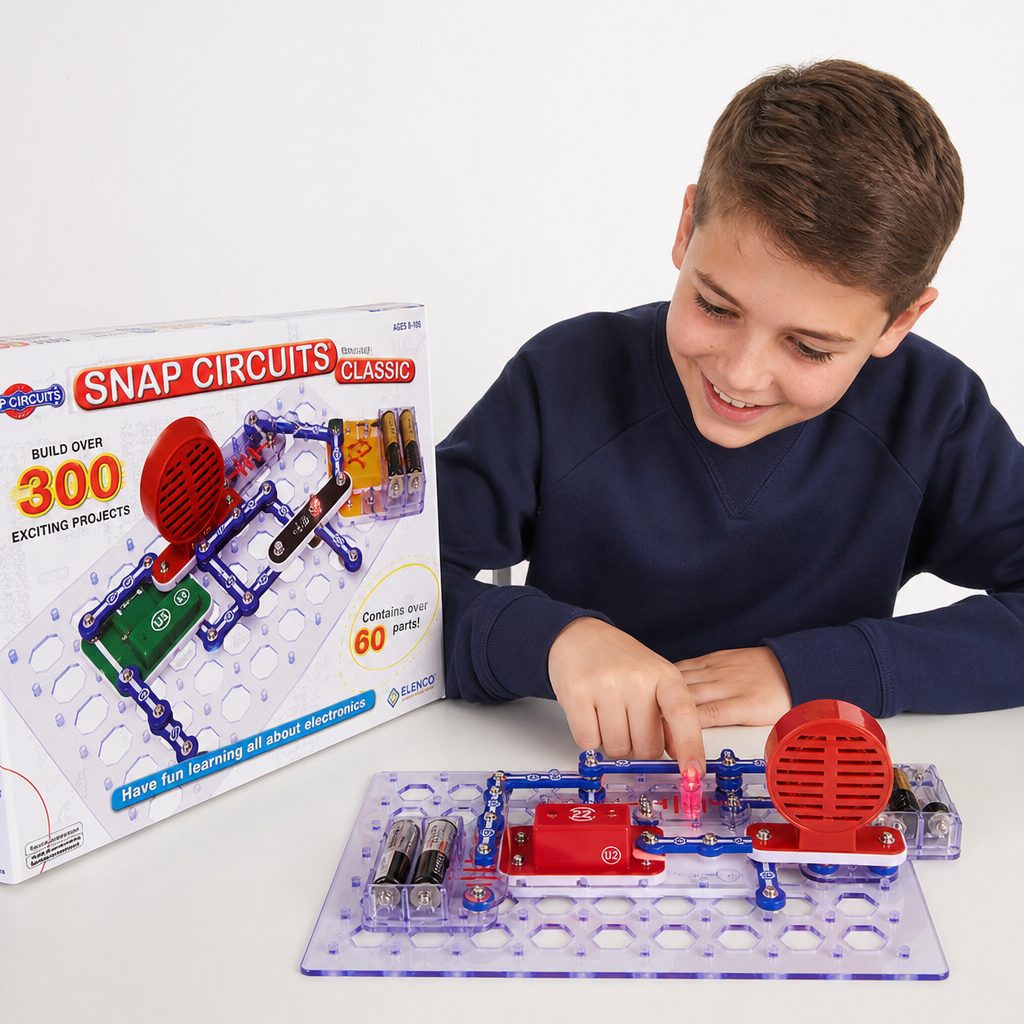
A successful motor or light project delivers instant feedback, turning an abstract circuit diagram into something a child can see, hear or watch move.
6. Batteries, setup and everyday ownership
Daily use is one of Snap Circuits' quiet strengths. There is no software installation, no account creation, no pairing process and no screen asking an eight-year-old to agree to terms and conditions they cannot possibly have read. A project can begin at a table with the board, the parts and the instructions. For many families, that simplicity is not quaint. It is a relief.
The actual setup routine is also easier to integrate into ordinary life than a big robotics project. A child can build for twenty minutes after school, return to it at the weekend, or bring the kit out on a rainy afternoon when the phrase "I'm bored" has started making the rounds. It is contained enough to be manageable, but substantial enough not to feel disposable.
Eitech's kit uses two AA batteries, which is a sensible reminder that electronic construction sets do have a basic practical requirement: keep suitable batteries available. There is nothing more deflating than finishing a build only to discover that the power source has been diverted to a remote control. Parents of the world know this scenario. It is usually the remote control's fault, somehow.
Organisation matters almost as much as power. These are component-based systems, and the smallest pieces are only fun when they can be found. A child who completes a build, dismantles it thoughtfully and returns each piece to a sensible place will have a dramatically better experience next time than one who pours the lot into a drawer with old crayons and a Lego wheel from 2019. The kit rewards a little care, which is not a bad secondary lesson.
Pros
- The solderless snap format makes early electronics feel achievable rather than forbidding.
- Snap Circuits Classic's 200-plus circuit count offers far more repeat-play potential than a single-build science toy.
- Visible outputs such as light, sound and movement give children immediate confirmation that their work mattered.
- The wider range offers a route from beginner sets to specialist, advanced and coding-focused options.
- No screen-based setup is required for the core building experience.
Cons
- The modular format teaches concepts clearly but is less like handling raw electronic components.
- Younger children will often need help reading diagrams and checking connections.
- Pieces need to be kept organised or the next session can become a frustrating treasure hunt.
- Ambitious older makers may outgrow guided builds and want coding, breadboards or soldering next.
- Different boxes serve very different users, so choosing purely by the largest-looking package is not always wise.
7. Which Snap Circuits set makes the most sense?
The right choice depends on where the child is starting and what you hope the kit will become. Snap Circuits Jr. is the obvious entry point for a family testing the waters. It is the version to consider when you want the snap-based experience without committing to the fuller Classic set from the outset. It makes particular sense as a birthday present for a child who likes building but has not yet shown a clear interest in electronics.
Snap Circuits Classic is the safer all-round recommendation for the child who is already curious, likely to revisit the kit, or sharing it with siblings of different ages. Its 200-plus circuits are enough to create a sense that the box contains a small laboratory rather than a finite list of tricks. If you are buying one main electronics kit and want it to have a decent lifespan, Classic is the version with the strongest argument.
Snap Circuits 3D Illumination is more specialised. It is a strong fit for children who respond to visible, artistic and room-filling results. The light tunnel and projector elements provide a much more decorative kind of payoff than a basic circuit exercise. That focus makes it a characterful choice, but not necessarily the best first kit for a child who wants the broadest introduction to electronics.
Snap Circuits Extreme SC-750 is the range's advanced direction. It is best approached as a step up for somebody who has already enjoyed the format and wants more to explore, rather than as an automatic starting point. More components and more possible builds are exciting, but they can also mean more choice than a complete beginner really needs. There is no medal for starting at the deep end. There is only a slightly overwhelmed child and an adult pretending they definitely understand the booklet.
Snap Circuits Jr.
Entry-level route into the Snap Circuits format.
Snap Circuits Classic
More than 200 circuits; the strongest broad all-round option.
Snap Circuits 3D Illumination
Specialist light, tunnel and projector-focused builds.
Those prices show the central buying question rather neatly. Snap Circuits Jr. and 3D Illumination sit around the US$50 mark, while Classic costs more but brings a much larger project library. If the child's interest is uncertain, the smaller route is easier to justify. If you already know they enjoy construction toys, science activities or tinkering with mechanisms, Classic's broader scope makes the higher outlay easier to defend.
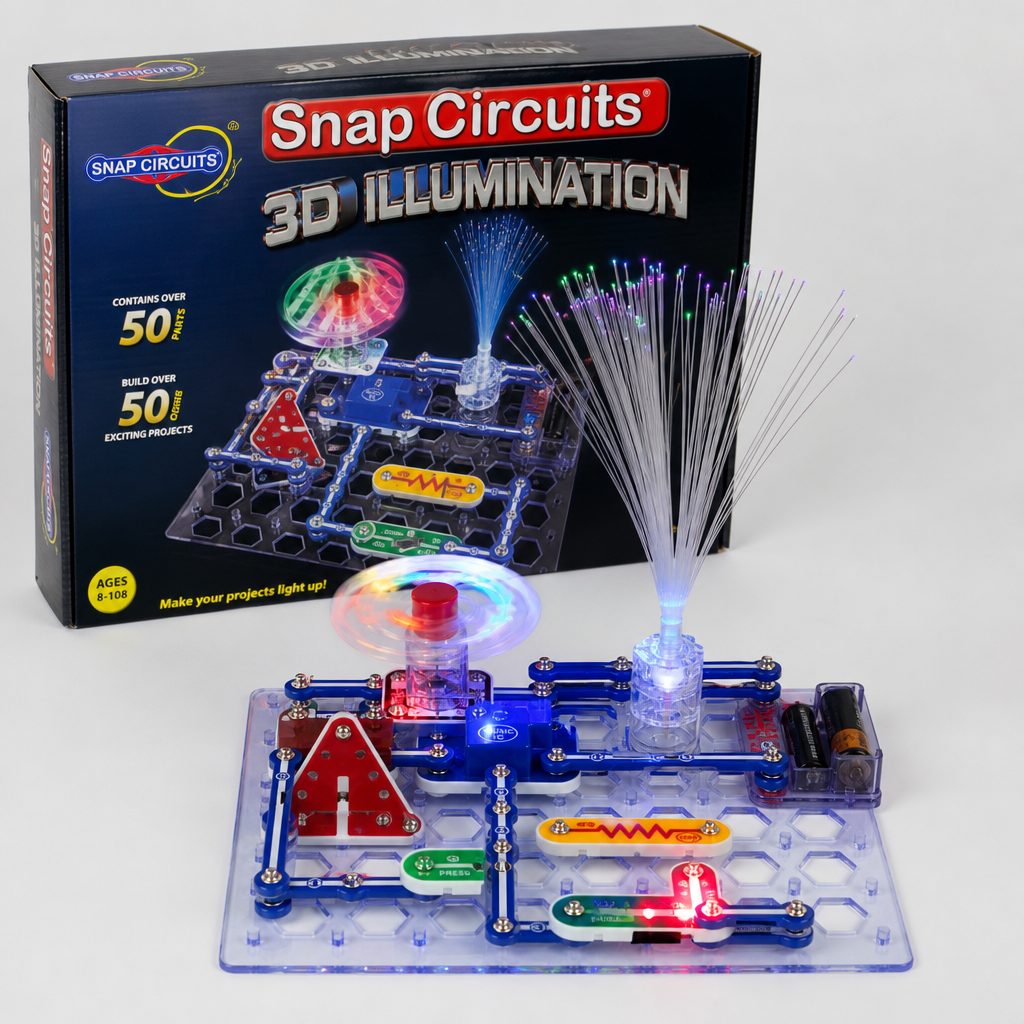
Specialist sets such as Snap Circuits 3D Illumination use dramatic light effects to attract children who may prefer visual creativity to conventional science experiments.
8. Value: expensive toy, useful tool, or both?
Electronic construction kits occupy an awkwardly interesting space in the toy world. They can look expensive beside a craft set or a conventional board game, yet they invite a different kind of repeat use. The relevant question is not whether a child can complete every project in one weekend. They probably cannot, and they should not feel obliged to. The better question is whether the kit returns to the table over months, becoming a familiar thing to explore when curiosity strikes.
Snap Circuits Classic makes its value case through breadth. More than 200 circuits gives families a sizeable bank of guided activities, and the possibility of rebuilding makes the experience inherently less linear than a model kit. A completed plastic spaceship is finished. A circuit that can be dismantled, changed and rebuilt is an invitation.
There is also a useful social dimension. The kits work nicely as a shared activity between an adult and child, or between siblings with different levels of confidence. One person can find the component, another can compare the diagram, and a third can be put in charge of testing the switch with an importance usually reserved for mission control. That kind of cooperative play is difficult to quantify, but it is part of why these kits often have a longer household life than solitary screen-based activities.
Still, do not buy one merely because you feel you ought to buy something educational. That is how well-intentioned presents become cupboard residents. The ideal recipient is a child who likes asking questions, enjoys construction, or is willing to follow a visual sequence long enough to see a result. For a child who only wants immediate competitive action, a circuit board may not win against a football, a console or a very noisy remote-control car. Know your audience. It saves everybody a slightly awkward Boxing Day.
9. Snap Circuits Classic vs Eitech Electronic Construction Kit
Eitech is the clearest direct comparison because it also offers a child-friendly, solderless construction approach. Its electronic construction kit is intended for ages 8 and over, uses robust connection technology and includes detailed 26-page instructions for more than 80 experiments. Its projects cover electric motors, relay alarm systems and fundamental exploration of electricity. That is a credible proposition, especially for a child attracted to motors and alarms.
Snap Circuits Classic, however, has the advantage in stated project volume. With more than 200 circuits, it offers over twice the stated library of Eitech's 80-plus experiments. The styles are not identical, so that figure should not be treated as a scientific scorecard. But for a buyer seeking a kit with lots of material to revisit, it is a meaningful distinction.
The range around Snap Circuits also offers more obvious branching points. A child can start with an introductory set, move towards Classic, investigate a visual speciality like 3D Illumination, step up to Extreme SC-750 or explore Arduino integration. Eitech's offering is still a worthwhile alternative, particularly when its particular experiments appeal, but Snap Circuits is the more established platform for families who expect interest to develop over time.
| Feature | Snap Circuits Classic | Eitech Electronic Construction Kit | Snap Circuits 3D Illumination |
|---|---|---|---|
| Recommended age | 8–108 years | 8 years and over | Specialist light-focused set |
| Stated project count | More than 200 circuits | More than 80 experiments | Light tunnel and projector builds |
| Connection approach | Solderless snap modules | Easy-click, robust connection technology | Solderless Snap Circuits format |
| Notable focus | Broad introduction to STEM and circuit building | Motors, relay alarm systems and electricity experiments | Illumination, light tunnel and projector effects |
| Power detail | Electronic circuit kit | Requires 2 × AA batteries | Electronic light projects |
| Listed price | US$89.99 | — | About US$50 |
The comparison reflects stated product information. The sets have different priorities, so the best choice depends on whether broad circuit variety, specific mechanical experiments or visual light projects matter most.
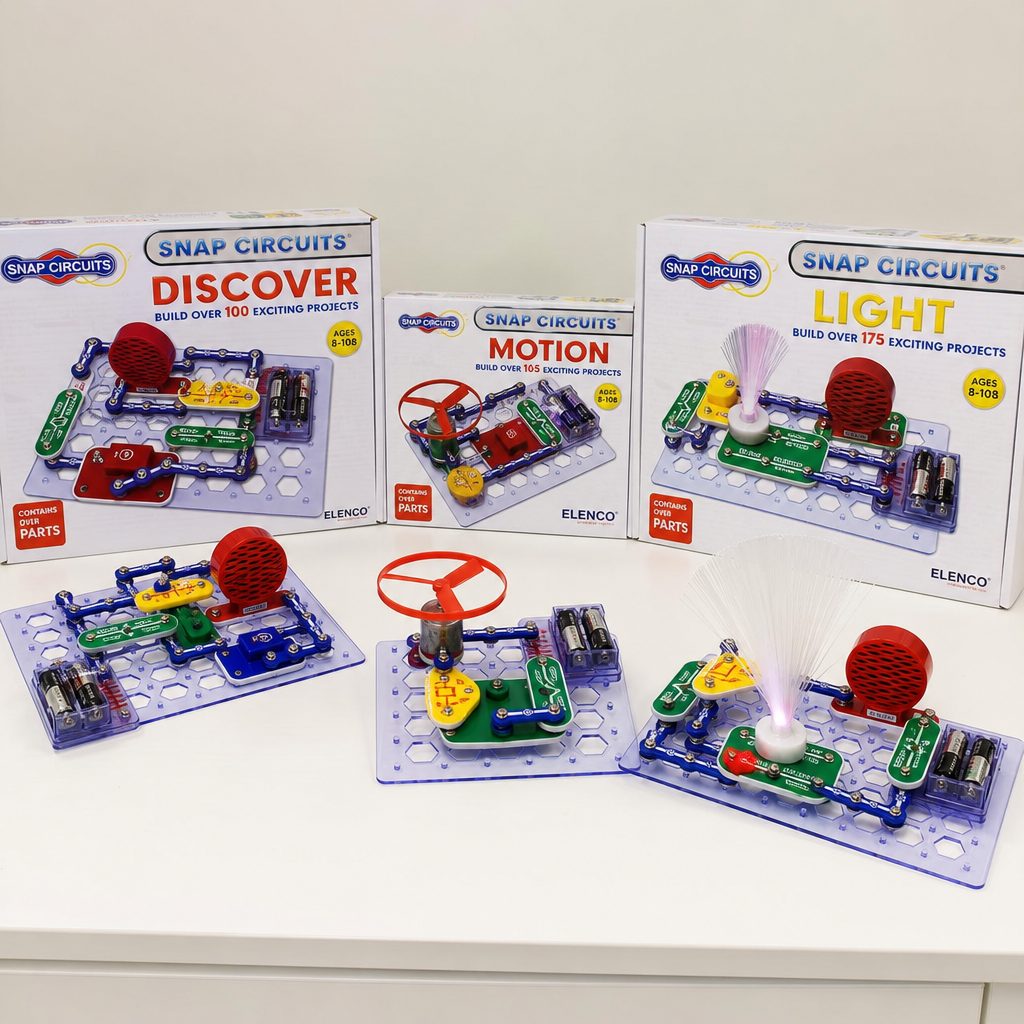
Comparing kits is not just about component counts: the best match depends on whether a child wants broad circuit practice, motor-and-alarm experiments or a visually spectacular project.
10. Best pick for each kind of young maker
A category this broad deserves a clear answer rather than a vague "they are all good". The options below are not universal winners. They are the most sensible choices for specific types of buyer, which is usually a much more helpful way to shop.
Best for first-time builders
Snap Circuits Jr. is the sensible entry route for a child who is curious about electricity but has not yet shown that they want a large project library.
Best all-rounder
Snap Circuits Classic is the strongest choice for most families thanks to its ages 8–108 positioning and more than 200 circuits.
Best for visual creativity
Snap Circuits 3D Illumination is the pick for children who will be motivated by projector effects and an exotic light tunnel.
Best alternative approach
Eitech Electronic Construction Kit suits makers drawn to its 80-plus experiments, including motors and relay alarm systems.
Best for the committed hobbyist
Snap Circuits Extreme SC-750 makes most sense as a progression choice for somebody already confident with the basic format.
Best next step into coding
Snap Circuits with Arduino integration is the natural direction for a maker ready to connect physical circuits with programming.
For the majority of UK households, I would start with the all-rounder rather than chasing the most intimidating set. Snap Circuits Classic has enough variety to satisfy an eager beginner without making the activity feel like a tiny engineering degree. It is the box that best captures why the range has endured: it makes the first step easy, then leaves enough runway for curiosity to gather speed.
11. Who should buy an electronic construction kit?
These kits suit children who enjoy building systems rather than merely assembling a finished object. If they love construction toys because they can change the outcome, or if they tend to ask what is inside a torch, a doorbell or a remote control, there is a good chance an electronics kit will land well. The child does not need to be academically obsessed with science. Curiosity is the more important qualification.
They also make unusually good shared gifts. A grandparent, aunt, uncle or family friend can give a kit that creates a reason to sit down together and make something work. That is a better legacy than another novelty toy with a two-day honeymoon period. An adult does not need to lead every session, but having somebody nearby for the earliest builds can transform uncertainty into confidence.
They are less suitable for children who strongly dislike instructions or become frustrated when an activity requires careful checking. That does not mean such a child cannot enjoy electronics; it simply means a more open-ended making activity may be the better first step. Likewise, a teenager already serious about programming and hardware may find the snap modules a little too structured. In that case, Arduino-based kits or Raspberry Pi projects may offer a more relevant challenge.
The sweet spot is the eight-to-twelve-ish child who enjoys hands-on discovery, though the stated 8–108 range for Classic is more than marketing whimsy. An older beginner can genuinely learn from it. A younger child can enjoy it with guidance. And an adult who once thought school physics was not for them may discover that it becomes a good deal friendlier when a project lights up on the dining table.
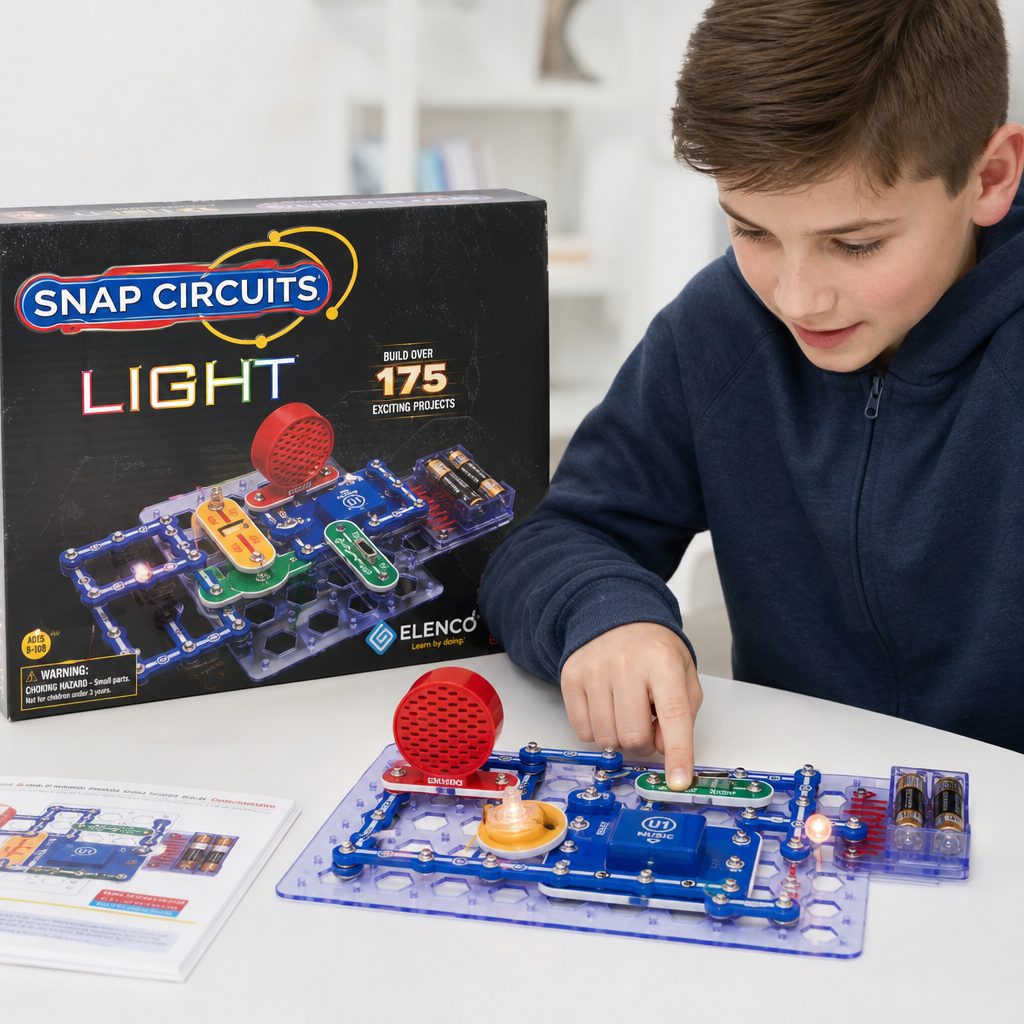
The ideal owner is not necessarily the child with the highest science marks; it is the one who wants to know why a switch, motor or light behaves as it does.
12. ToyScout score
Snap Circuits Classic earns a high score because it understands its role. It does not attempt to replace advanced hobby electronics, coding platforms or formal classroom equipment. Instead, it gives beginners a satisfying, durable and understandable way to start. That modesty is a virtue. The best educational toys often make difficult ideas feel approachable before the learner has time to decide they are difficult.
The lower advanced-potential score is not a punishment. It reflects the fact that a guided snap system should eventually lead an enthusiastic learner beyond itself. In a way, that is success. A child who finishes a set of projects and asks about Arduino, Raspberry Pi, soldering or raw components has not outgrown the kit in a disappointing way; the kit has done its job.
13. Frequently asked questions
Snap Circuits Classic is positioned for ages 8 to 108. In practical terms, children around eight can begin with guided help, while older children can work more independently and get more from discussing why each circuit behaves as it does. Adults can enjoy it too, especially as a gentle reintroduction to circuit basics.
Yes. Snap Circuits Classic offers more than 200 different circuits. Some builds naturally develop similar principles in different forms, but the large project library is a major reason it has stronger long-term appeal than smaller introductory kits.
No. The central appeal of Snap Circuits is its solderless snap-module construction. That makes it much easier for beginners to build, dismantle, correct and rebuild projects without the equipment and permanent commitment involved in soldering.
Snap Circuits Jr. is the more cautious first step when you are unsure whether electronics will hold a child's interest. Snap Circuits Classic is the better all-round purchase when the child already enjoys construction, science activities or tinkering, because its more-than-200-circuit library offers much greater scope to return to the kit.
Eitech offers a child-friendly easy-click system, more than 80 experiments and detailed 26-page instructions. Its projects include electric motors and relay alarm systems, and it requires two AA batteries. Snap Circuits Classic has the larger stated circuit library, with more than 200 circuits, while Eitech may appeal particularly to children drawn to its specific motor and alarm experiments.
It can be, particularly for a child motivated by dramatic visual results. Its light tunnel and projector components make the experience feel more creative and decorative. However, Snap Circuits Classic remains the stronger starting point for someone who wants the broadest general introduction to circuits.
Eventually, an enthusiastic maker may want more open-ended electronics, coding or soldering. That is entirely normal. The wider Snap Circuits range includes advanced options such as Extreme SC-750 and products with Arduino integration, creating a sensible progression before a child moves to more specialist hardware.
They teach different things. Electronic construction kits are especially good for understanding physical circuits, switches, light, sound and cause and effect. Coding kits introduce logic and programming. For a younger or completely new maker, tangible circuit building is often the more immediate starting point; coding can be an excellent next stage.
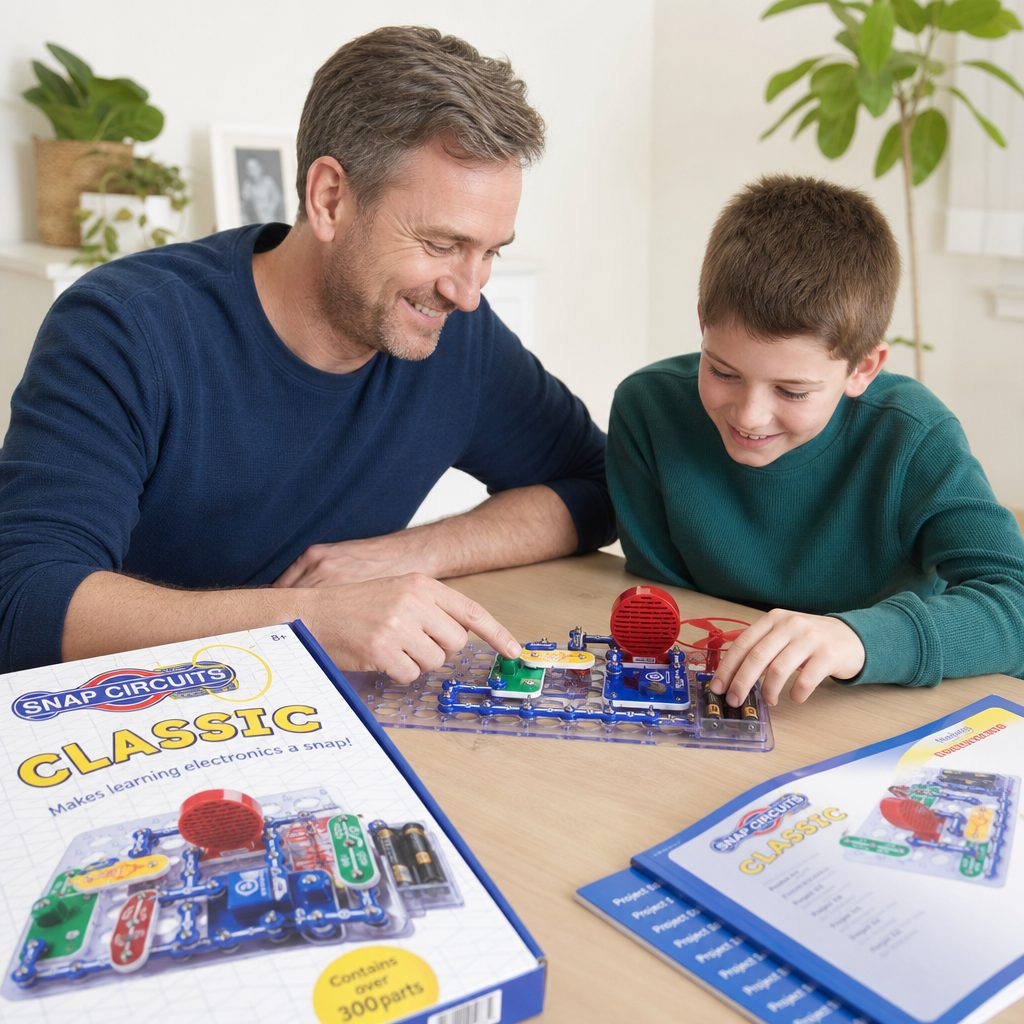
Snap Circuits Classic remains at its best when it becomes a repeat-visit family activity rather than a project box rushed through in one determined weekend.
Final verdict
8.8/10
Snap Circuits Classic remains one of the best all-round electronic construction kits for beginners. Its solderless format removes much of the fear from building circuits, its more-than-200-project library gives it lasting substance, and its tangible feedback makes it much more engaging than a page of science facts ever could be.
Choose Snap Circuits Jr. for a gentler entry point, 3D Illumination for the child who wants spectacle, Eitech for its particular motors-and-alarms angle, or Extreme SC-750 when a confident maker needs a bigger challenge. But for most families seeking a single kit that is accessible, educational and genuinely fun to revisit, Classic is the one I would put on the shortlist first.