Peppa Pig's George Gets a Hearing Aid: A Look at Toys That Represent Every Child
Hasbro's Joke & Sing George figure was more than another chatty Peppa Pig toy when it arrived in February 2026. It put George's hearing aid on a mainstream preschool shelf, then let him sing, stomp and say "Dine-saw" with all the glorious enthusiasm children expected. Here is what that milestone meant in everyday play.
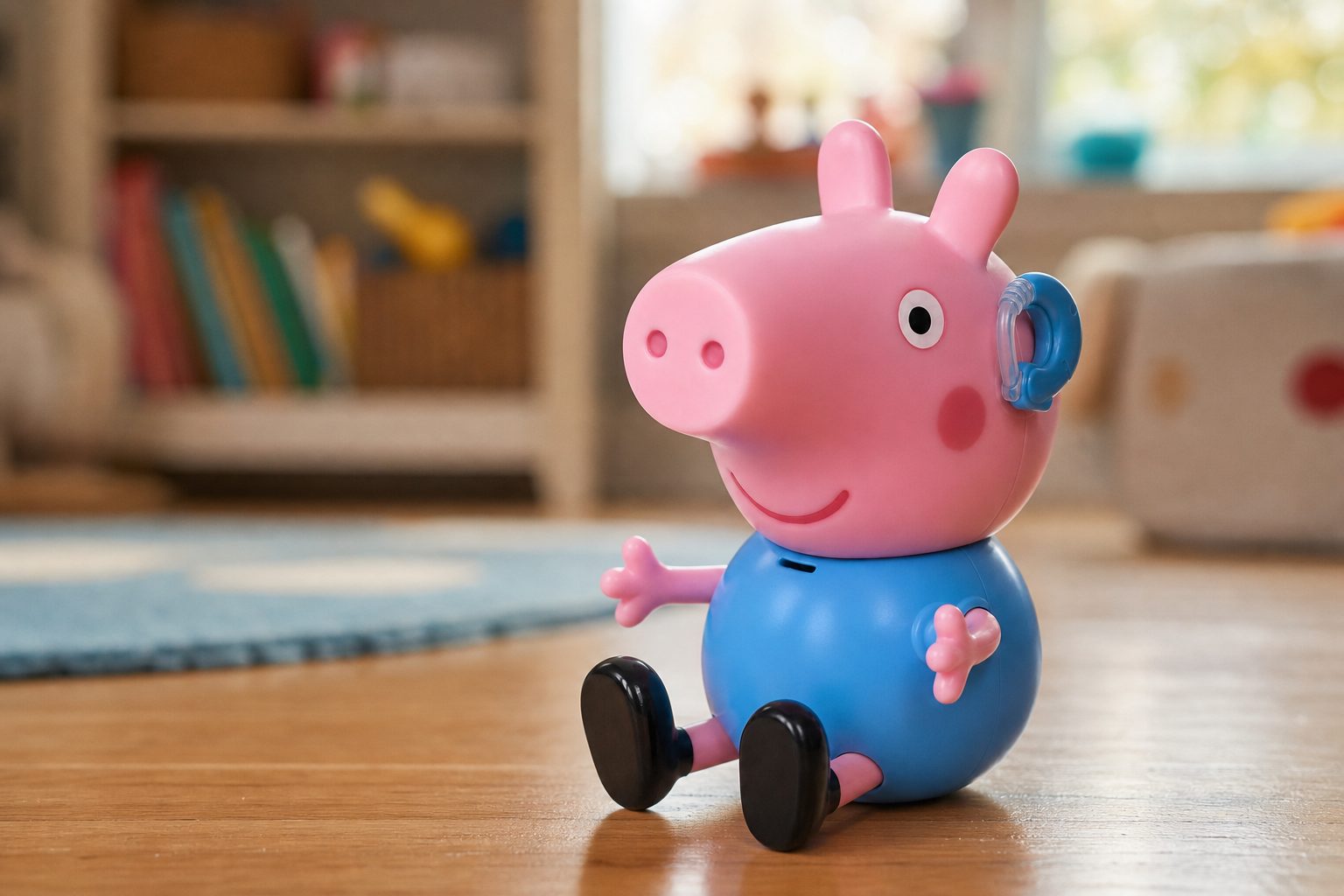
George Pig's hearing aid is a small visual detail, but it changes who gets to see themselves in one of preschool television's most familiar worlds.
Why this little George mattered
Peppa Pig had never been short of toys. The brand had supplied mud-splattered cars, playsets, families, houses, soft toys and enough tiny accessories to turn the living-room rug into an administrative nightmare. But the Peppa Pig Joke & Sing George Figure that appeared in February 2026 carried a detail that made it genuinely different: George wore a hearing aid.
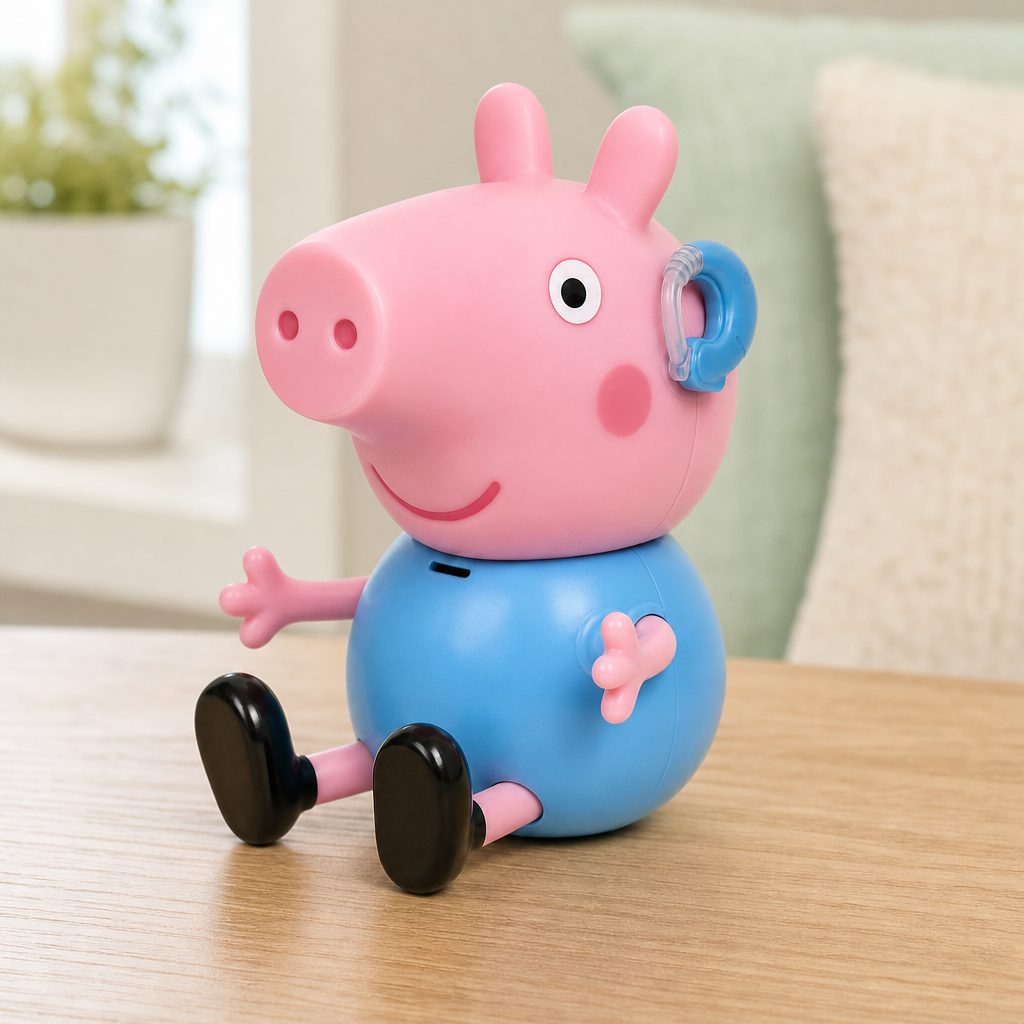
The microphone-led mode change makes singing feel like part of George's performance, rather than a hidden setting adults have to manage.
That may sound like an unusually serious opening for a toy whose principal career involved dinosaurs, puddles and saying "Dine-saw" at a volume suggesting he had just invented the word. Yet representation in preschool toys often worked best when it was this ordinary. The hearing aid was not a detachable lesson, a special limited-edition storyline or a label demanding applause. It was simply part of George. He still loved his dinosaur. He still joined in. He still got excited by the sounds around him.
George's hearing story reached television in the Season 11 episode Hearing Test, which aired on Nickelodeon on 23 March 2026. The story portrayed him as moderately hard of hearing and showed the hearing aid helping him understand everyday sounds, from muddy puddles to an ice-cream van melody. Importantly, the episode and accompanying toys did not make hearing loss the entirety of George's personality. Preschool children are rather good at understanding that someone can use a helpful thing and still be exactly the same friend who loves jumping in puddles. Adults sometimes need a few more reminders.
Hasbro developed the character's introduction with the UK's National Deaf Children's Society and deaf executive producer Camilla Arnold. That matters. Children spot tokenism with a speed normally reserved for locating biscuits, and families deserved better than an accessory attached without thought. This felt like a considered attempt to make a beloved character's world wider without turning difference into spectacle.
The central point is simple: the toy did not ask children to play a different kind of game because George wore a hearing aid. It invited them to include that detail in the same loud, silly, imaginative play they were already having.
Peppa Pig Joke & Sing George Figure at a glance
The main interactive release is an 8-inch, or 20cm, plastic George designed for children aged three and over. It is a substantial enough size to feel like a proper character toy rather than a tiny pocket figure that disappears under the sofa before tea. Its approach is broad, busy and very recognisably Peppa Pig: voice clips, songs, sound effects and simple physical actions all work together to encourage a child to make George perform.
The headline figure of more than 50 jokes, sounds and songs is generous for this format. Parents know the usual pattern with talking toys: a child finds the button, presses it 400 times, and the toy reveals that its "interactive range" was four phrases recorded during somebody's lunch break. George had considerably more material to work through. It did not turn him into a conversational AI, thankfully; no preschooler needed that sort of escalation. It did give him enough variety to remain a toy children could return to rather than a one-afternoon novelty.
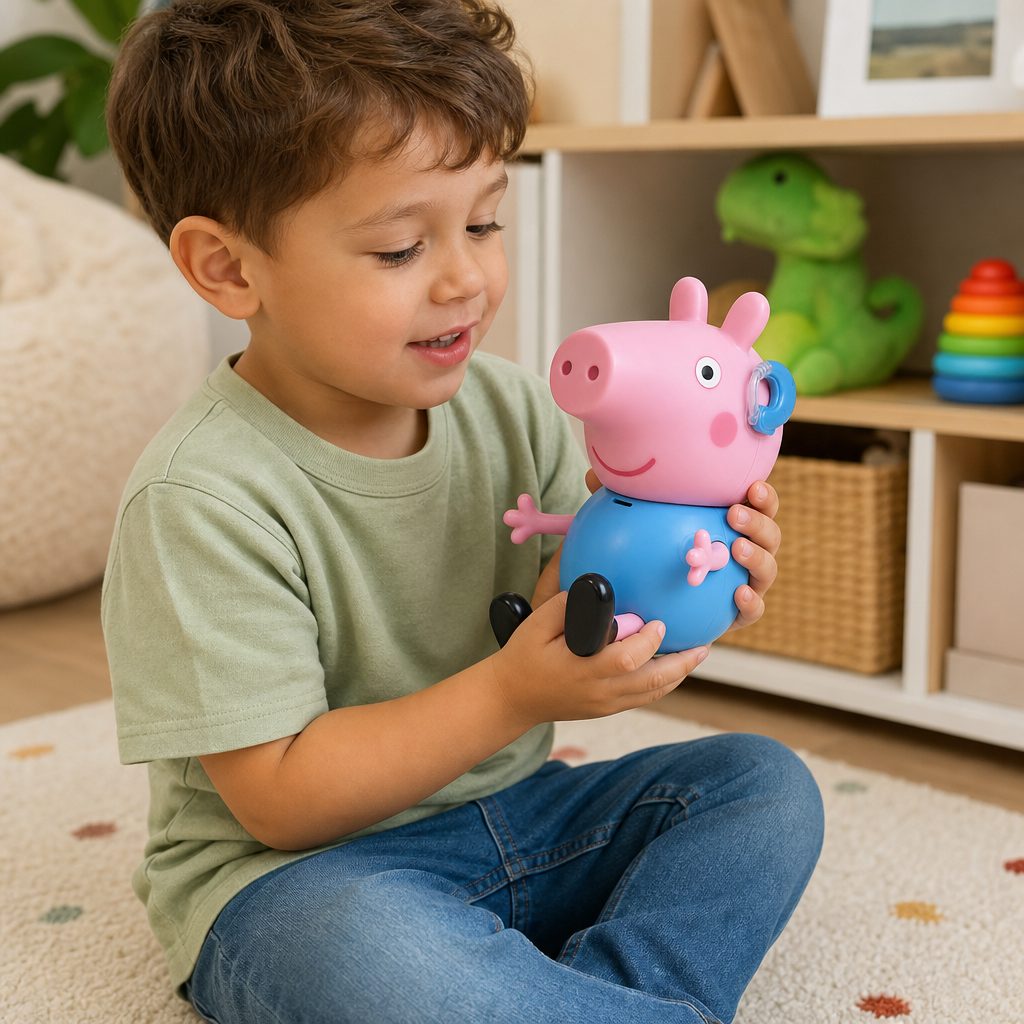
The 20cm Joke & Sing George is large enough for young hands to carry, cuddle briefly and take charge of during a very important dinosaur concert.
Design: familiar George, thoughtfully updated
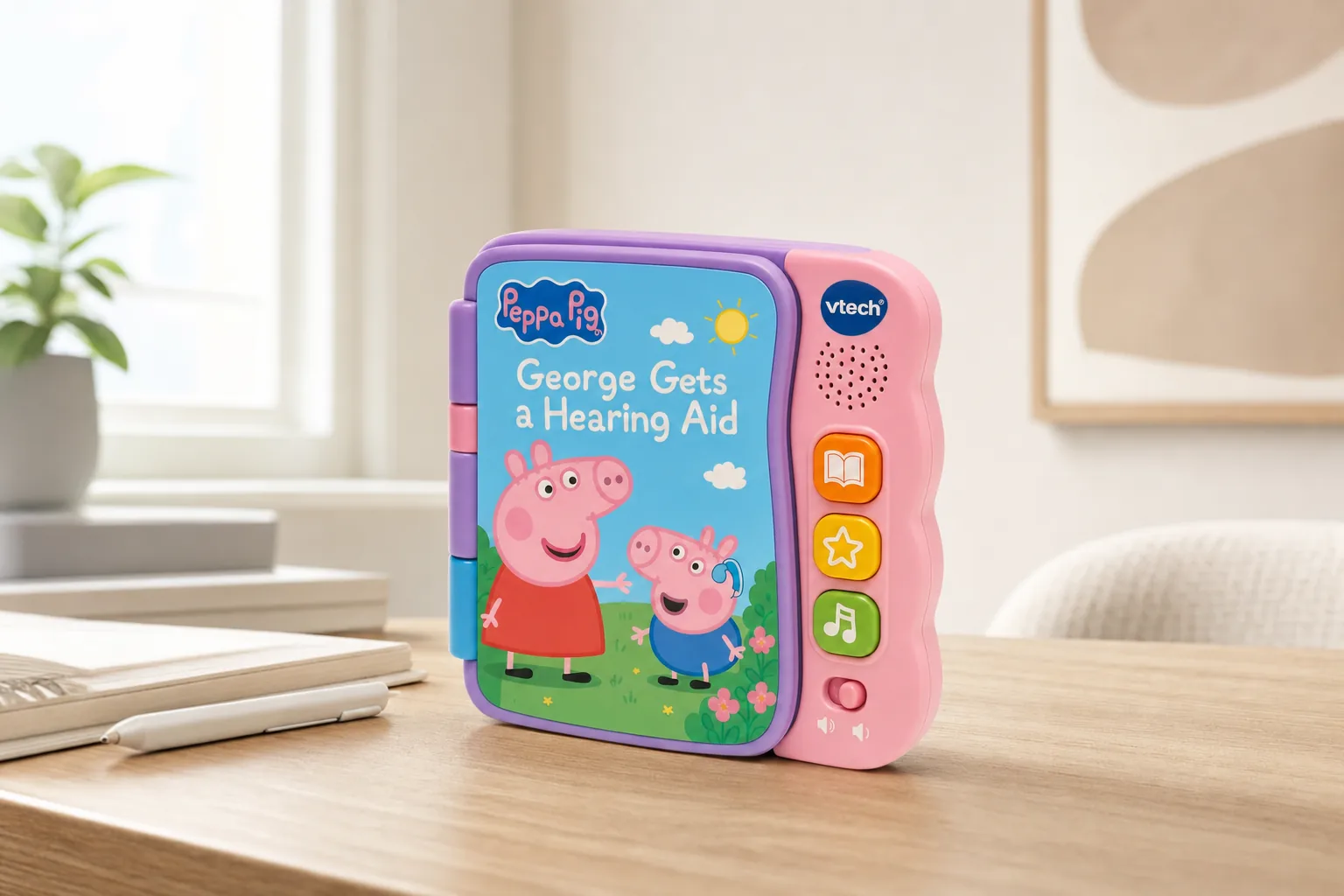
There is a risk with any character toy that a meaningful detail gets lost in the noise of buttons, branding and bright plastic. Here, the hearing aid was visibly part of George's design. That sounds obvious, but it is the whole point. A hearing aid that is technically present but so small or disguised that nobody notices would do very little for a child looking for recognition.
George remained instantly George: the round head, little ears, cheerful expression and simple preschool-friendly silhouette were all intact. The hearing aid did not transform him into a medicalised version of the character. It was not framed as something sad, fragile or extraordinary. It was a part of his everyday appearance, in the same way children understand glasses, a favourite pair of wellies or the dinosaur that nearly never leaves his hand.
The plastic construction suits the toy's intended job. This is a figure for handling, acting out stories and being transported from room to room in a toy buggy, a cardboard spaceship or the deeply questionable "soup" currently being prepared in a play kitchen. A soft toy has its place, and George's plush counterpart is better for bedtime, but the figure has the advantage when a child wants a character who can become active in a scene.
Representation you can actually see
The hearing aid is built into George's everyday look rather than presented as a separate add-on or a special play mode.
Physical cause and effect
Moving George's arm controls his mouth, giving young children a direct and easy route into pretend conversation.
More than one tune
Four named songs prevent the musical side from being a single snippet on repeat. Your household may still develop favourites. Sorry in advance.
A proper Peppa Pig moment
Pressing George's legs triggers muddy-puddle sound effects, which is exactly the sort of feature a Peppa toy ought to have.
For parents, the best design decision is its lack of fuss. There is no need to sit a child down and announce that this is now an Important Conversation Toy. If a child asks about George's hearing aid, you can answer in age-appropriate language. If they do not, they can simply play. Both outcomes are useful. Normalisation is often built from repetition, familiarity and seeing a detail treated as ordinary.
How the interactive play worked
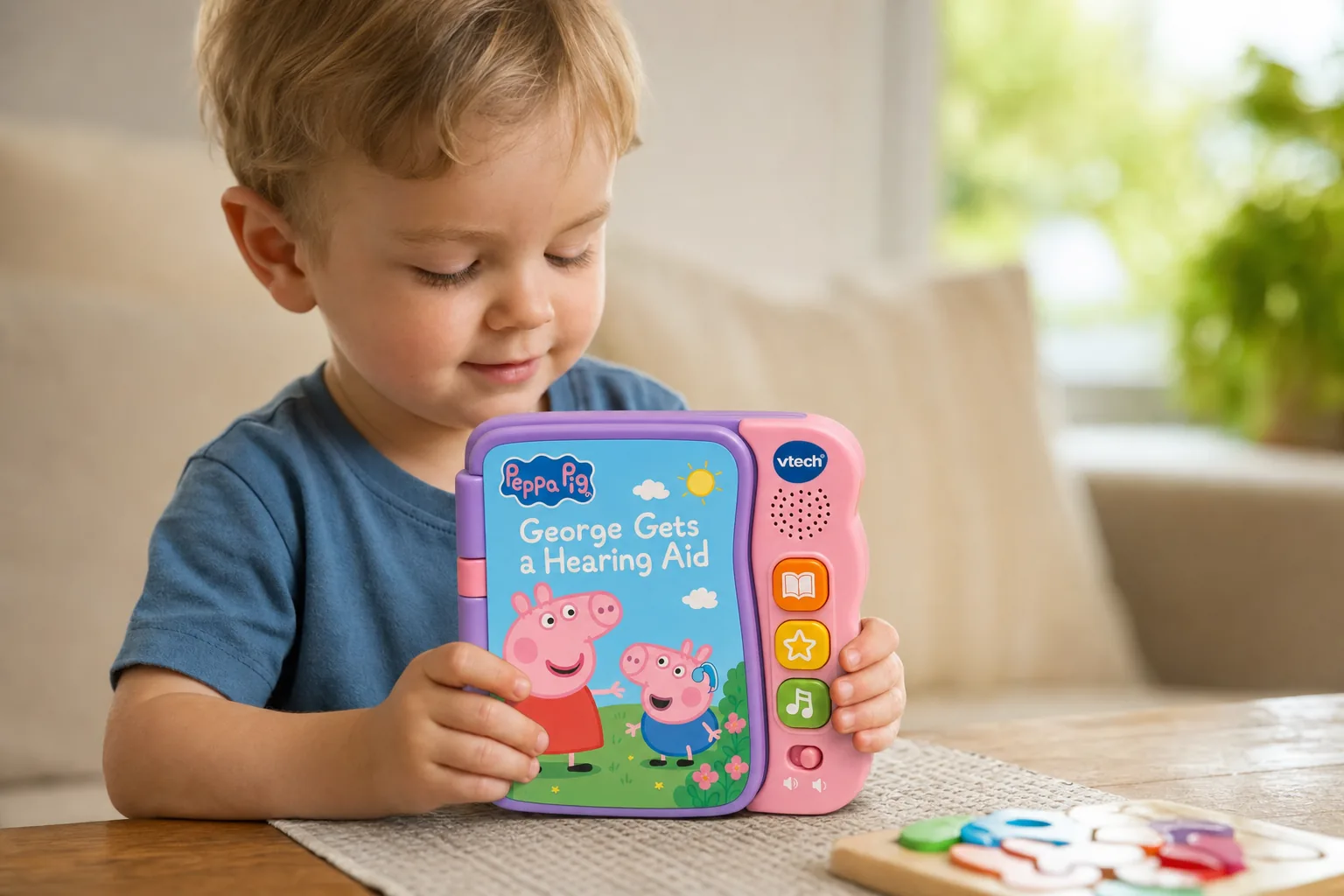
Joke & Sing George had two principal modes, with the microphone position used to switch between speaking and singing. That is a more playful solution than burying a mode switch where only an adult can reach it. The microphone became part of the performance. A child can understand that George is ready to talk or sing because of something they can see and manipulate, not because a tiny slider has been moved from setting A to setting B.
In speech play, there are jokes and familiar George sounds to prompt stories and role-play. In singing mode, he sings "Dinosaur Dance", "The School Bus Song", "Bing Bong Zoo" and "Let's Jump In". These were sensible choices because they are active songs. A child does not merely listen; they can dance, copy George, invite Peppa figures to join in, or make a toy dinosaur take centre stage. The toy succeeds best when it gets children doing something away from the button.
The arm-controlled mouth is another simple but effective touch. It gives young children a physical way to make George "speak", even when the electronic voice is not playing. That distinction matters. A toy that only talks when a button is pressed can accidentally teach children to wait for the toy to provide the entertainment. A movable mouth lets them put their own words into the character's story. George can announce a dinosaur rescue, ask for ice cream or, more realistically, repeat a single funny noise until everyone has agreed it is time for lunch.
Then there are the legs. Press them and George makes muddy-puddle effects. It is not revolutionary engineering. It is, however, exactly the right sort of low-barrier cause-and-effect play for the audience. Children know what it means immediately. They will press, listen, laugh and turn it into a scene. The best preschool toy features are often not complicated; they are legible.
Play tip for parents and carers
Use George's hearing aid as a natural detail in a made-up story rather than a quiz. "George heard the ice-cream van—shall we tell Peppa?" is warmer and more useful than putting a child on the spot about what the hearing aid is for.
The hearing aid: representation without a lecture
It is worth lingering on the hearing aid because it is the reason this product exists as more than a standard licensed release. Children with hearing loss deserved to see a character they knew and loved wearing an assistive device like theirs. That can be quietly powerful. A toy cannot solve every challenge around confidence, access or understanding, but it can contribute to a child's sense that they belong in the centre of play rather than on its edge.
For hearing children, the benefit is just as real, if different. Toys help establish what feels normal long before a child has the vocabulary to explain why. If George wears a hearing aid and is still the same funny, dinosaur-obsessed little brother, then a hearing aid is not a strange plot twist. It is one ordinary part of a friend. That is an excellent message to absorb at three, four or five.
I also liked that the product did not treat George's hearing aid as a collectible gimmick. Inclusivity can become oddly commercial when the marketing implies that representation is a feature to be ticked off, like a glow-in-the-dark wheel. The stronger approach is the one Hasbro took here: make the character recognisable, keep the aid visible, and let the toy deliver the play pattern children already expect from George.
There is an important limit to acknowledge. This toy represented one character's experience of being moderately hard of hearing. It did not, and could not, speak for every deaf child, every hearing-aid wearer or every family's experience. Deafness is not one story. But mainstream children's products have historically offered very little room for assistive devices at all, so George's arrival was a meaningful step rather than a final answer.
Sound, songs and the reality of a talking toy at home
Talking toys inspire a particular type of parental question: "Will this be lovely, or will it become the soundtrack to my slow unravelling?" The honest answer is that Joke & Sing George is designed to be heard. With more than 50 sound, joke and song elements, he is not a quiet comfort toy. He is an interactive character figure, and his whole purpose is to respond when a child comes back for another go.
What softened that concern was the variety. There is a meaningful difference between a toy repeating one phrase and one offering jokes, sounds and four songs. "Dinosaur Dance", "The School Bus Song", "Bing Bong Zoo" and "Let's Jump In" give the musical function several lanes to explore. For a Peppa Pig fan, those cues can quickly spark a bigger game: dance party, school bus journey, zoo visit, puddle expedition. That is better value in play terms than a button whose only contribution is a catchphrase.
The sound side also sits neatly beside the hearing-aid story. In Hearing Test, everyday sounds become meaningful discoveries for George. The toy's interactive audio lets children engage with sound as something fun and connective. It does not attempt to simulate hearing loss or teach hearing science, and it should not be expected to. It simply makes listening part of George's normal play world.
This is not an audio-quality chart; it is a straightforward illustration of the difference in content breadth between the two George releases. The 50-plus total includes several types of sound, while the plush has seven spoken phrases, so it is not a laboratory comparison. Still, it tells shoppers something useful: choose the plastic figure for active variety and the plush for a simpler, lower-interaction companion.
Batteries, setup and daily-family practicality
George uses two AAA batteries, and a pair is included. That is a small kindness which should not be remarkable in 2026, but remains worth celebrating because there are few things more deflating than opening a birthday toy, finding an empty battery compartment and discovering that every shop nearby has sold out of the size you need. You can get going without an immediate extra errand. A rare victory for household logistics.
Replaceable batteries make practical sense for a toy in this category. George is not tied to a charging cable, does not require an app and does not ask a parent to remember another device's charging cycle. Once the batteries eventually need replacing, the routine is familiar and manageable. For grandparents, childminders and families who prefer a toy to stay firmly off the family Wi-Fi, that simplicity is a genuine advantage.
Daily use is primarily about whether a child can trigger satisfying actions independently. Here, the answer is broadly yes. The microphone position, movable arm and leg press all make intuitive sense in the hands of a preschooler. The toy gives a child agency rather than demanding a grown-up hover nearby to activate its best bits. That is especially important with a character toy, where spontaneous role-play is a large part of the appeal.
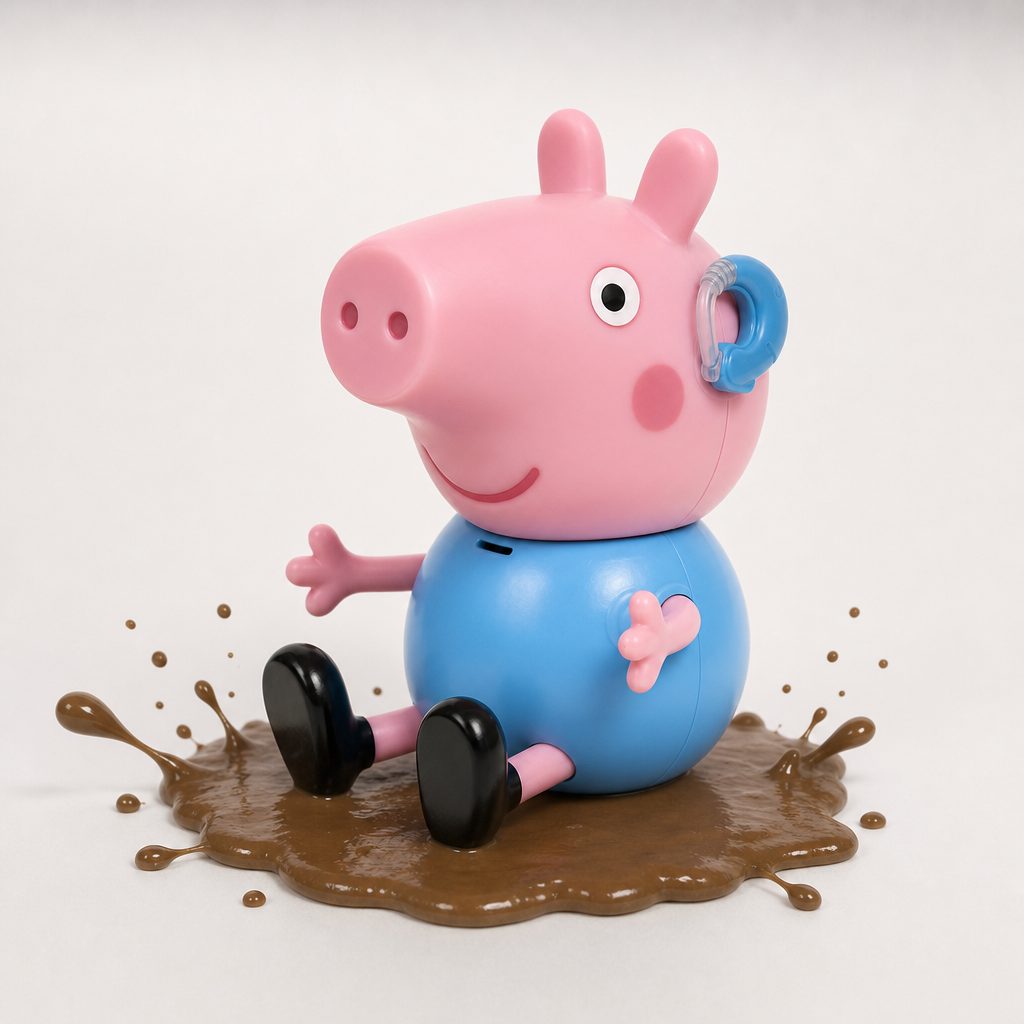
George's leg-press muddy-puddle effect gives children an instantly understandable action-and-reaction moment for independent play.
One consideration is the familiar one with any electronic figure: it works best as part of a toy ecosystem. If your child owns other Peppa Pig figures, vehicles or playsets, George has a ready-made world in which to sing, chat and splash. On his own, he still offers plenty, but character toys tend to deepen with companions. George needs an audience. Most of us do, to be fair.
Peppa Pig Talking George Plush Soft Toy versus Joke & Sing George
Hasbro also released the Peppa Pig Talking George Plush Soft Toy alongside the figure. It shared the important visual representation: plush George wore his hearing aid as seen in the series. But it was a different proposition, aimed at a different kind of play. It stood 20cm tall, measured 16 x 11 x 21cm, weighed 0.130kg and arrived in a platform box. The central appeal was softness and familiarity rather than physical mechanisms.
Press the plush toy's tummy and it speaks seven phrases, including "Dine-saw" and "Ice Cweam". It also says Peppa's name for the first time. For a child who likes George's distinct speech but wants a cuddle buddy rather than an all-singing performer, that is charming. Plush is often better suited to quiet imaginative play, bedtime routines, travel and the very serious work of being brought downstairs before breakfast.
The figure remains my pick for the fullest interactive experience. Its arm movement, mouth action, muddy-puddle sound effects, two modes and 50-plus sound elements offer more ways to play. But the plush should not be dismissed as the lesser version. It is the better fit for children who find hard plastic figures less comforting, who are not especially interested in songs, or who simply want a soft George beside them.
| Feature | Peppa Pig Joke & Sing George Figure | Peppa Pig Talking George Plush Soft Toy | Mattel Barbie with Autism |
|---|---|---|---|
| Representation | George wears a hearing aid | George wears a hearing aid | Includes autism-related representation |
| Primary play style | Interactive figure and musical role-play | Soft companion and phrase play | Fashion-doll imaginative play |
| Size | 20cm tall | 20cm tall; 16 x 11 x 21cm overall | Not a directly comparable format |
| Audio content | 50+ jokes, sounds and songs | 7 phrases | No spoken-play feature stated |
| Notable accessories or interaction | Microphone mode change, arm mouth control and leg-press puddle effects | Press tummy to activate speech | Noise-cancelling headphones, fidget spinners and communication tablet |
| Best suited to | Children wanting busy, character-led activity | Children wanting a softer George | Older fashion-doll fans exploring inclusive representation |
The Mattel Barbie with Autism, introduced in January 2026, is not a direct rival in the usual toy-shop sense. Barbie and George live in different aisles, target different play patterns and speak to different ages. It is nevertheless useful context. Inclusive representation was becoming more visible across mainstream toy shelves, whether through George's hearing aid or Barbie's noise-cancelling headphones, fidget spinners and communication tablet. The important thing is not to crown one "better" representation. Children benefit when the toy box contains more than one kind of child, more than one kind of support and more than one way to play.
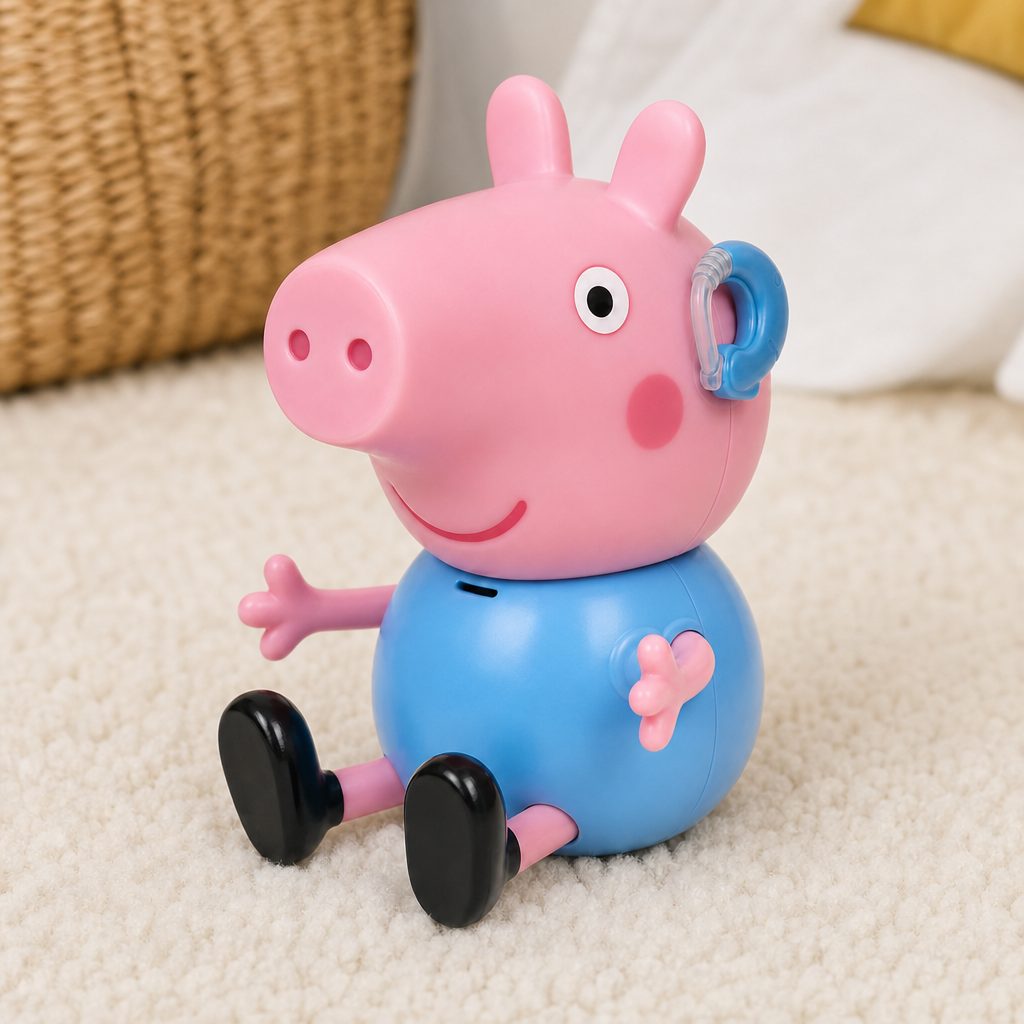
The Talking George Plush offers the same visible hearing-aid representation in a softer 20cm format with seven familiar phrases.
Which George is best for different children?
There was no one-size-fits-all answer, even within a single character. The best version depended on how a child played, what sensory experience they preferred and whether the toy was meant to become an active playroom character or a treasured soft companion. The good news is that both releases kept the hearing aid visible, so families did not have to choose between representation and their preferred play style.
Best all-rounder: Joke & Sing George
Choose the interactive 20cm figure for a Peppa Pig fan who likes songs, noises, movement and lots of prompts for made-up adventures.
Best for cuddles: Talking George Plush
The soft 20cm plush is the natural choice for a child who wants George as a comfort object as much as a plaything.
Best for visible hearing-aid representation: either George
Both versions make George's hearing aid part of his ordinary character design, so choose based on your child's play preference.
Best for shared family play: Joke & Sing George
Its 50-plus sound elements, songs and physical actions give siblings more reasons to join in and create scenes together.
For a child with hearing aids, the choice may be especially personal. Some will want the durable figure they can make talk and dance. Others will want a soft George to keep nearby. Neither response is more meaningful than the other. Ask what they actually enjoy playing with, not what adults think they ought to choose because of the representation involved.
Strengths and limitations
The clearest strength is that this is an inclusive toy without becoming a narrow educational product. It carries a real-world detail that many children recognise, but it still behaves like George. The hearing aid is integrated, the personality is intact and the play is accessible. That combination is what makes the release feel successful rather than merely well intentioned.
Pros
- George's hearing aid is clearly visible and treated as an ordinary part of the character.
- More than 50 jokes, sounds and songs give the interactive figure better variety than a basic phrase toy.
- The microphone modes, arm-controlled mouth and leg-press puddle sounds invite hands-on play.
- Two AAA batteries are included, so the toy can be enjoyed straight from the box.
- Development with the National Deaf Children's Society and Camilla Arnold gives the representation welcome grounding.
- The 20cm size feels substantial and easy for preschool hands to manage.
Cons
- The interactive figure is deliberately audio-led, so it will not suit every household's appetite for talking toys.
- English-language content limits how naturally the spoken and sung features work for non-English-speaking families.
- Children looking for a bedtime comfort toy may prefer the separate Talking George Plush.
- The hearing-aid story is a valuable beginning, but naturally cannot reflect every deaf child's individual experience.
I would also encourage parents not to place the whole weight of inclusion on this one toy. George is a lovely and meaningful addition, but a truly inclusive toy box includes different bodies, communication styles, cultures, disabilities, family structures and personalities. Representation works best as a normal habit rather than one special purchase made with a photograph and a round of applause.
Who should buy Peppa Pig Joke & Sing George Figure?
This was a particularly strong choice for children aged three and over who already watched Peppa Pig and knew George's character. Familiarity helped because the songs, voice and puddle play all had a foundation in a world they recognised. Children who liked performative play should get the most from it: those who make toys sing, announce things into pretend microphones or give every dinosaur in the house a speaking role.
It also made a thoughtful gift for a child with hearing aids, provided it matched that child's own interests. The fact that George's hearing aid is visible may make the toy feel validating, but no child should be expected to want a particular toy purely because it mirrors one aspect of their life. A dinosaur-mad Peppa fan? Excellent fit. A child who has never cared for electronic figures but loves soft toys? The plush may be the better route.
For nurseries, childminders and early-years settings, George could be a useful starting point for naturally inclusive pretend play. The emphasis should remain on children's lead. They may talk about the hearing aid. They may ignore it and arrange a bus trip to the zoo. Both are fine. The benefit is that the detail is there when it is wanted, and normal when it is not being discussed.
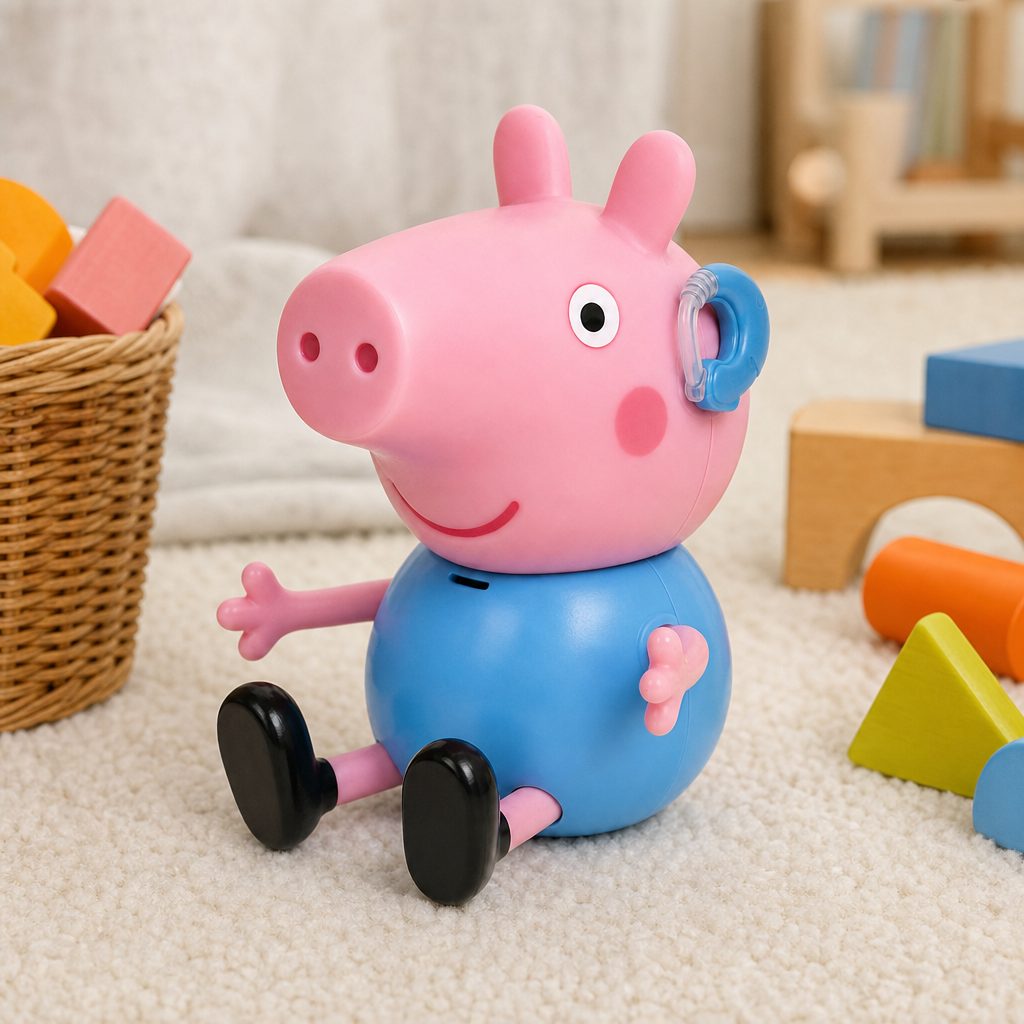
In a shared toy box, George works best as an active character who can bring songs, muddy puddles and a visible assistive device into everyday pretend play.
How it held up as an inclusivity milestone
By August 2026, the significance of George's hearing aid was clear: it had moved an assistive device into one of preschool entertainment's most recognisable character ranges. That is not a tiny thing. Peppa Pig reaches children at an age when toys help shape their assumptions about whose stories are central, whose bodies are familiar and what friendship looks like.
The milestone mattered precisely because it was so unflashy. George was not rewritten as a saintly teaching tool. Peppa was not positioned as a heroic rescuer. The family did not suddenly become a different kind of family. George had a hearing test, received support to hear sounds more clearly and carried on being George. That storytelling choice translated well to the toy. The hearing aid was present, visible and matter-of-fact.
There is still more work for the industry to do. Parents should not have to hunt through specialist ranges to find toys reflecting disabled children's lives, and no individual product can cover the range of deaf identities, communication preferences and technologies families use. Yet mainstream characters have reach. When a child sees George wearing a hearing aid among all the usual Peppa Pig toys, the message lands in the ordinary, powerful territory of "of course he does".
Rating: Peppa Pig Joke & Sing George Figure
This rating reflects the interactive figure rather than the Talking George Plush. It is weighted around its intended audience: young Peppa Pig fans, parent-friendly everyday use and the importance of representation that feels woven into play rather than bolted on afterwards.
The near-nine score is not because every child needed a talking George. They absolutely did not. It is because Hasbro combined a well-judged, substantial interactive toy with a landmark piece of mainstream representation. The result gave children lots to do, while also making a hearing aid part of a familiar, happy preschool universe.
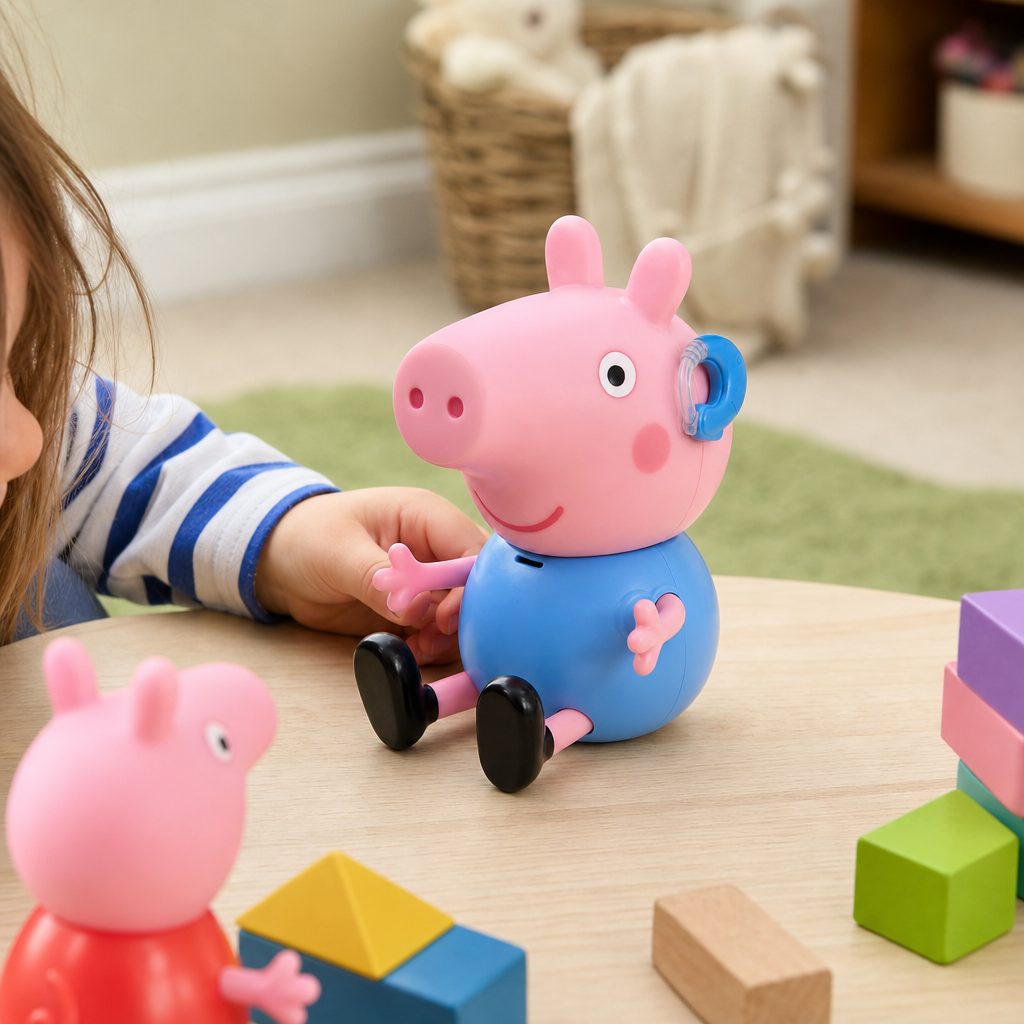
The best outcome is not a solemn "inclusive toy" moment, but George being included in the same messy, imaginative games as every other favourite character.
Frequently asked questions
The interactive plastic figure is intended for children aged three years and over. Its actions are straightforward enough for preschool hands: move the microphone to change modes, move the arm to control the mouth and press the legs for muddy-puddle sounds.
Yes. George's hearing aid is part of the toy's visible character design, matching his appearance in the series after the Hearing Test storyline. It is presented as an ordinary part of who George is.
He has more than 50 jokes, sounds and songs. The named songs are "Dinosaur Dance", "The School Bus Song", "Bing Bong Zoo" and "Let's Jump In".
Joke & Sing George uses two AAA batteries, and they are included. That means children can start playing without needing a separate battery purchase on opening day.
No. The Talking George Plush Soft Toy is a separate 20cm plush release. It wears the same hearing aid but focuses on cuddly play and seven phrases activated by pressing its tummy, rather than songs, moving parts and 50-plus sound elements.
It can be a helpful conversational starting point because it makes a hearing aid familiar and visible on a loved character. It is not a medical teaching tool, though, and the best conversations are simple, child-led and respectful of the different ways deaf and hard-of-hearing people communicate.
Not at all. It is a Peppa Pig interactive toy for any child who enjoys George, songs and pretend play. Its wider value is that it lets all children see a hearing aid as a normal part of a friend's life.
The television story and toy release followed work with the National Deaf Children's Society and deaf executive producer Camilla Arnold. That partnership helped ground the portrayal in a more authentic, sensitive approach rather than treating the hearing aid as a decorative novelty.
Final verdict
Peppa Pig Joke & Sing George Figure was a joyful, properly playable toy with a genuinely important detail at its heart. At 20cm tall, with more than 50 jokes, sounds and songs, four named sing-along tracks, a movable mouth and muddy-puddle effects, it gave preschoolers plenty beyond the initial novelty.
More importantly, George's hearing aid was not treated as a problem to fix or a feature to advertise. It was simply part of George: dinosaur-loving, noisy, enthusiastic George. For children with hearing aids, that visibility could mean a great deal. For every other child, it helped make the world of play a little more recognisable, welcoming and true to real life. That is something worth celebrating—preferably with a dinosaur dance.