
Air Hogs Zero Gravity Sprint Review: The Car That Races Across Your Walls
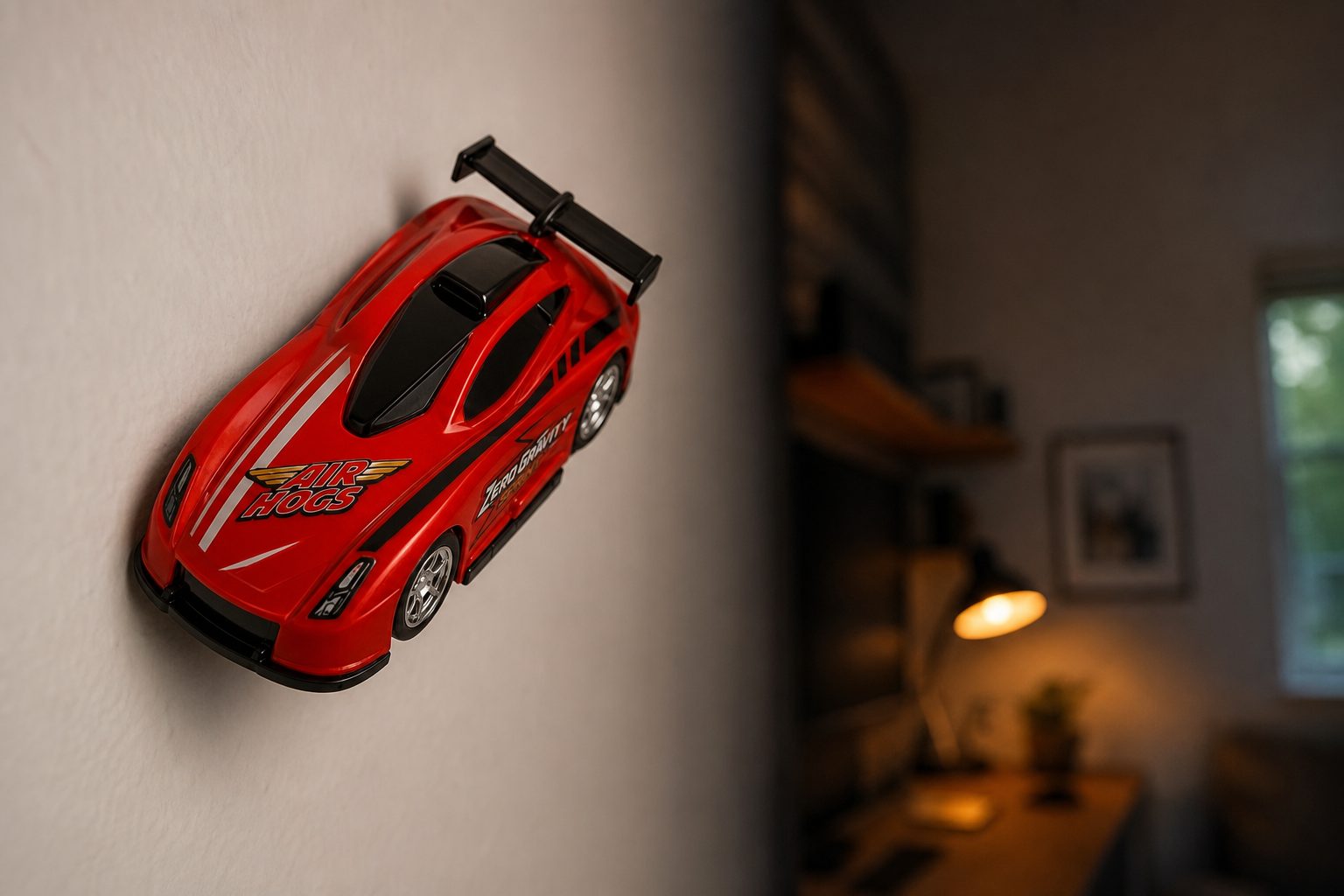
The Air Hogs Zero Gravity Sprint is at its best when it has a clean, smooth wall to climb and an audience ready to be impressed.
The Air Hogs Zero Gravity Sprint turned an ordinary wall into a race track, a ceiling into a stunt arena and, briefly, the most important surface in the house. It was a wonderfully daft little remote-control car with a genuinely impressive party trick — but it asked for the right room, the right expectations and a little patience from the grown-ups.
What is the Air Hogs Zero Gravity Sprint?
Remote-control cars have spent decades doing roughly the same thing: driving quickly across the floor, finding the one bit of furniture they can get trapped beneath, and eventually colliding with somebody's ankle. The Air Hogs Zero Gravity Sprint had a more ambitious idea. Rather than merely racing around your home, it used vacuum technology to cling to smooth walls and ceilings, allowing children to drive it vertically, upside down and across surfaces that absolutely should not be roads.
That is the appeal in one sentence. This was not the sort of RC toy bought because a child had carefully compared turning circles, motor output or top speed. It was bought because the picture on the box promised a car crawling across a wall like a tiny red beetle with motors. For children of the right age, that promise had real power. Even adults who had seen plenty of gadgets had a hard time not stopping for a second when it first made the transition from floor to wall.
The Sprint was part of Air Hogs' long-running Zero Gravity family, a line that had already explored wall-climbing RC play through earlier models such as the Zero Gravity Micro and Zero Gravity Laser. The Sprint appeared in 2023 and, by August 2026, it had become more of a recent-era find than an easy, universal toy-shop purchase. Stock had been patchy, with backorders appearing at several retailers and the secondary market becoming an important route for buyers. That makes this a review best read with a little hindsight: not "is this the hot new toy?", but "is this clever wall racer still worth tracking down?"
The controller's two AAA batteries were not included. It is a small detail, but one worth sorting before a birthday morning or rainy-afternoon reveal. A wall-climbing car that cannot be controlled is, sadly, just a very light red ornament.
The big trick: driving on walls and ceilings
The Zero Gravity Sprint's vacuum system was not a decorative gimmick bolted onto a conventional car. It was the entire reason to own one. Flick the switch on the back into wall-and-ceiling mode, place the lightweight car against a suitable surface and the suction system held it in place as it moved. It could then be guided up, down and across a wall, or driven overhead on a ceiling.
When everything lined up, the effect was excellent. There was a particular moment when a child realised that the car was genuinely staying put above them rather than simply bumping along a vertical surface for a second. That usually produced a grin, a shout for someone else to look, and an immediate attempt to send it somewhere increasingly inconvenient. This is exactly what a toy like this should do. It turns the familiar room into a slightly bonkers playground.
It also explained why the Sprint felt distinct from a normal mini RC car. On the floor it was a neat, responsive little vehicle. On a wall it became an activity. Children started setting challenges: reach the top of the door before the battery runs down; race from one side of the kitchen wall to the other; drive around the imaginary "lava" section; see whether Dad can steer upside down without looking terrified. The game was not supplied in the box, but the toy invited it.
There was a catch, and it was not a tiny one. Vacuum-powered wall racers needed smooth, clean, flat territory. Painted wall surfaces could work well where they were even and free of dust. Glass, polished stone and other smooth finishes were much friendlier. A textured wall, prominent grout lines, bumpy wallpaper, raised tiles or a surface with little ledges gave the car opportunities to lose its seal. Once that happened, gravity remembered its job.
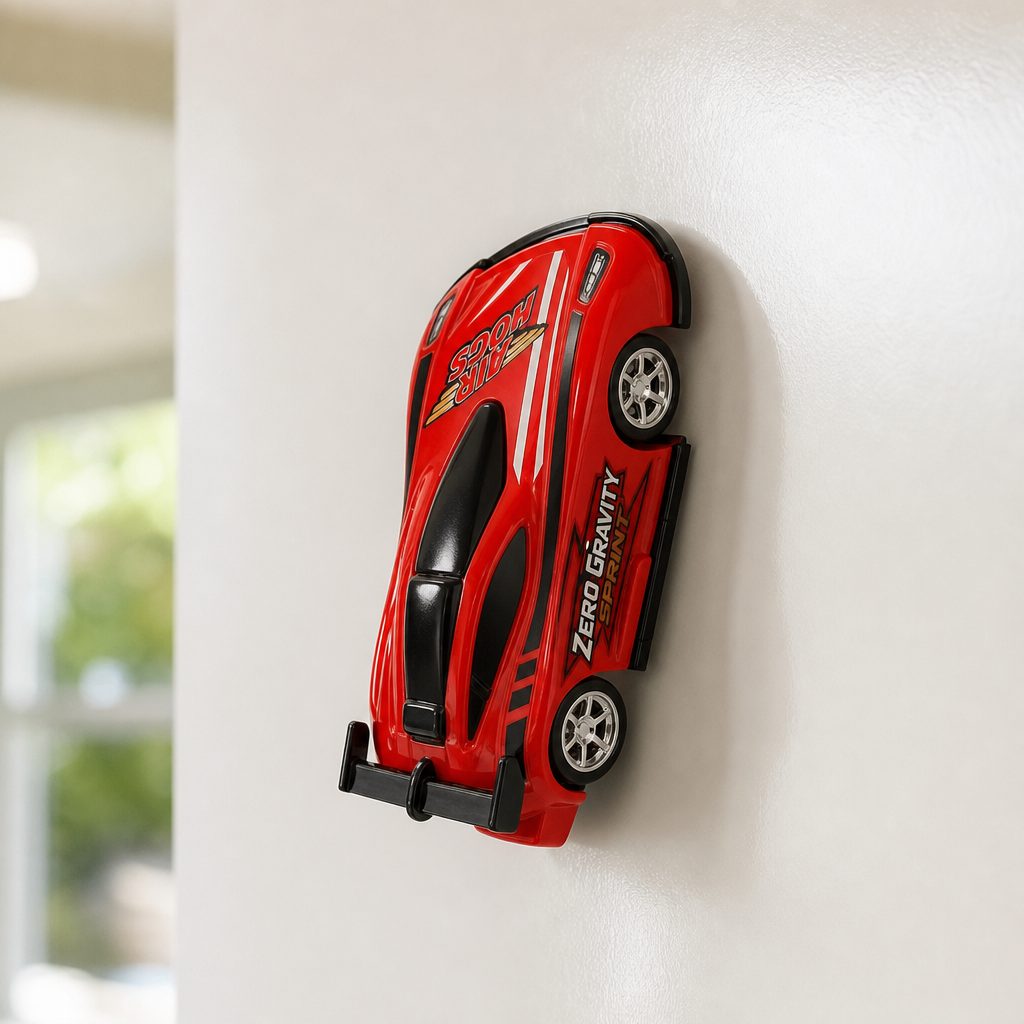
Smooth painted walls, glass and polished surfaces gave the Zero Gravity Sprint the best chance of maintaining its vacuum seal.
Design and build: small, bright and purpose-built
The Sprint looked like it had been designed by somebody who understood that this product needed to be found quickly after it had driven halfway up a wall. Its bright red body was easy to spot, and its very light construction made complete sense for a vehicle whose main challenge was staying attached to a vertical surface.
At over five inches long, it was compact enough to feel like a toy rather than a hobby-grade RC machine, but it was not so microscopic that younger hands constantly lost it in a pile of cushions. The shape was low and streamlined, with the functional elements underneath doing far more of the important work than the body shell. It was a car in the broadest sense, but nobody should buy it expecting the chunky, rugged, four-wheel-drive feel of a garden-basher.
That lightness was both its strength and its vulnerability. It was sensible not to expect it to shrug off every crash in the way a big foam-bumpered stunt truck might. In particular, the delicate skirting underneath needed looking after. That section helped the vehicle create the seal required for wall racing, so it was not the area to poke, bend or drag across a rough surface. Children old enough to understand "handle it by the body, not the underside" were much more likely to enjoy a longer relationship with it.
I would not call the Sprint fragile in a dramatic, display-case-only sense. It was made to be played with. But its core trick depended on a fine edge doing a precise job, and that naturally made it less forgiving than a conventional floor racer. In family use, a quick explanation before the first race was worth more than a long lecture after an unfortunate drop.
Vacuum wall-climber system
The suction mechanism let the lightweight car travel on suitably smooth walls and ceilings instead of being limited to the floor.
Two ways to play
A switch on the back changed between normal floor racing and the wall-and-ceiling setting, so the toy did not need a special course to be entertaining.
Responsive directional control
The multi-directional infrared remote made it easier to place the car carefully on a wall rather than simply hoping for the best.
Rechargeable vehicle
The car charged via the supplied USB cable, avoiding the old routine of feeding another set of disposable batteries into the vehicle itself.
How it drove on the floor
There is a slightly awkward truth about nearly every wall-climbing RC car: the spectacular mode is the one you remember, whilst the floor mode is the one you use to get there. The Air Hogs Zero Gravity Sprint could race on a floor, but it was not built to be the fastest or most exciting floor-only car in the toy box.
On hard, smooth flooring, its controls felt responsive and predictable. Children could make directional adjustments without the vague, delayed steering that spoils some cheaper infrared toys. It worked best on hardwood or polished stone, where the vehicle could run cleanly and the surface did not interfere with its low, lightweight design.
Speed on the ground, however, was modest. That was not necessarily a deal-breaker, because "slow" in this context did not mean unresponsive or boring. It simply meant that a child whose entire plan was to hold a trigger down and stage high-speed living-room rallies would be better served by a more traditional RC car. The Sprint was about control, placement and doing something unusual. It was not about recreating Formula One beside the sofa.
Carpet was also not its friend. Thick carpet, uneven rugs and anything with a pronounced texture made life difficult. The same was true of floors with raised joins or jutted-out tile edges. In a home that was almost entirely carpeted, the Sprint's floor mode would be a fairly limited warm-up act, and there might be fewer easy launch points for wall driving than a child expects. That does not make it a bad toy; it makes it a toy that rewards choosing the room first.
The best setup is not necessarily the biggest room
A bright, smooth kitchen wall or a clear stretch of painted hallway can be more useful than a huge carpeted lounge. Before gifting the Sprint, identify one or two flat, clean surfaces where a child can actually drive it successfully. That first successful wall climb is the moment that sells the toy.
Control, steering and the learning curve
The supplied controller was a straightforward infrared remote, which suited the simplicity of the toy. There was no app to install, no account to create and no tiny menu system to navigate before anyone could start. In a world where plenty of toys have decided they need software updates, that felt refreshingly direct.
Children still needed a few runs to understand the difference between racing on a floor and controlling a car on a wall. On a horizontal surface, an overenthusiastic turn generally resulted in a harmless circle or a light bump. On a wall, an abrupt change of direction could mean the child was asking the vehicle to hold its vacuum seal whilst changing momentum. Gentle inputs tended to produce the best results, especially near the edges of a wall or when driving overhead.
That learning curve was part of the fun rather than a frustrating barrier. The vehicle did not require the precise hand-eye coordination of a hobby drone, but it gave children something to improve at. A first go might consist of three wobbly laps and one hurried rescue. Ten minutes later, they could be steering a route around a picture frame or aiming for a particular point on the wall. It had just enough skill to make repeated play feel earned.
Infrared control also made line of sight sensible practice. This was not the RC car to send through doorways and then attempt to steer from another room. Thankfully, the most exciting use naturally kept everyone looking at it. You cannot really admire a car on the ceiling if you have wandered off to make tea.
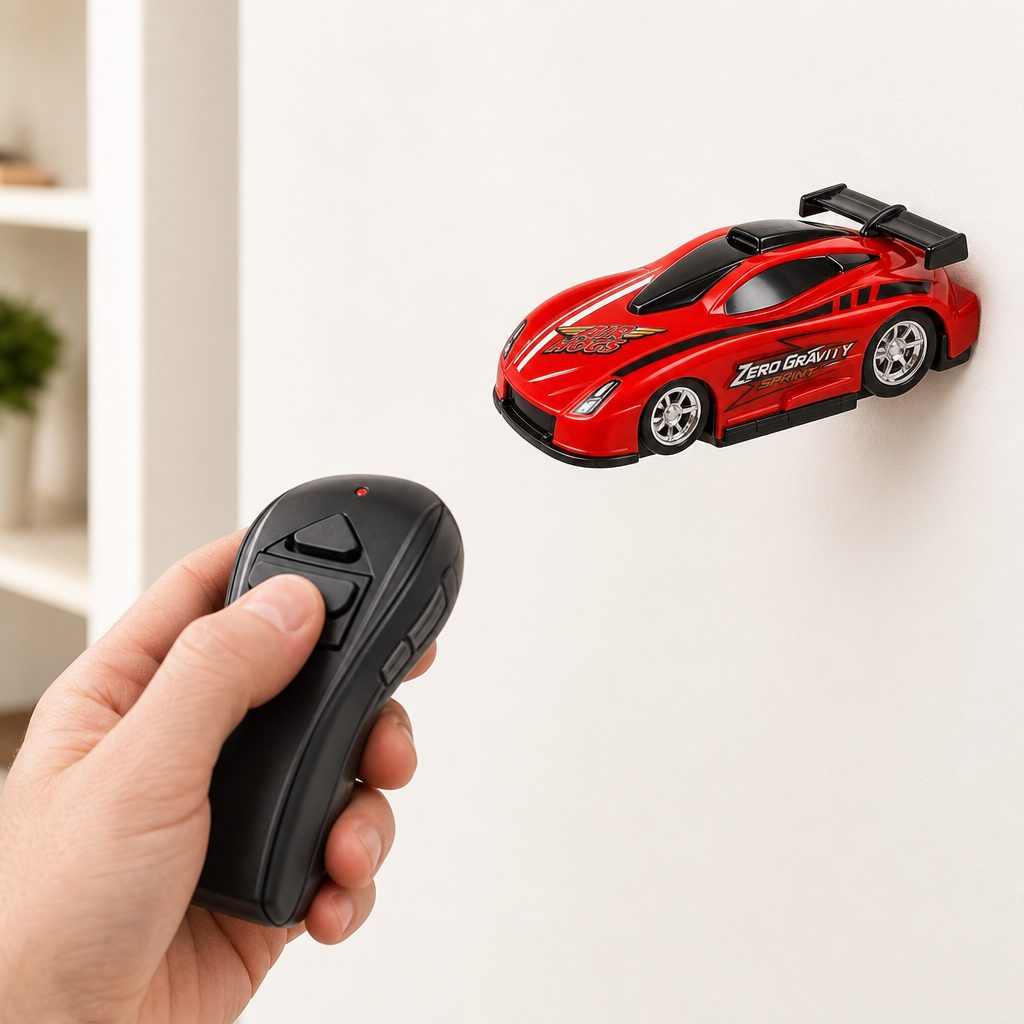
The handheld infrared controller kept the Zero Gravity Sprint simple: point, steer and make small adjustments rather than relying on an app.
Battery life and the rhythm of real family play
Air Hogs quoted more than eight minutes of speedy fun from a single vehicle charge. That sounded brief on paper, and it was brief if you imagined a full afternoon of uninterrupted racing. But it was not quite as limiting in practice as the number suggested, because this was a toy that tended to be played in bursts.
A typical session involved choosing a wall, clearing a little space, demonstrating the wall mode to somebody who had not seen it before, attempting a few routes, then inventing a challenge. Eight-plus minutes was enough for a proper go. It was enough for siblings to take turns if the turns were managed with even a hint of fairness. It was also enough for a child to get their wow moment without the toy overstaying its welcome.
Still, it was important to be honest about what "enough" means. If you were buying for two children who both expected lengthy, continuous ownership of the controller, the recharge breaks could become part of the experience. One child would call it a sensible chance to set up the next course. The other would call it evidence that civilisation had failed. Both views are understandable.
The vehicle's rechargeable design was a meaningful plus. The supplied USB cable handled the car's charging, whilst the remote took two AAA batteries. That split was practical: the battery-hungry moving toy could be recharged, while the controller stayed ready with ordinary batteries. Just remember the AAA batteries were separate from the box contents.
The eight-minute-plus figure works best when you think of the Sprint as a high-impact stunt toy rather than an all-day RC car. It is ideal for short indoor sessions, show-and-tell moments and challenge games, not marathon racing.
Noise, surfaces and the practical realities nobody puts on the box
Wall-climbing toys make themselves known. The vacuum fan needed to work in order to hold the Sprint against a wall or ceiling, so this was not a silent little machine drifting invisibly around the home. That is hardly surprising, but it matters if you are picturing quiet before-breakfast play while someone else is on a work call nearby. The Sprint was a "take it into the kitchen or hall" toy, not a "use it outside a sleeping baby's room" toy.
The bigger practical point was surface prep. Dust was not dramatic, but it could be enough to compromise the seal. A quick wipe of the intended wall or glass surface, and a look at the underside of the car before play, was good routine. It sounds fussy when written down. In reality, it took moments and made the difference between "that is amazing" and "why does it keep falling?"
Parents should also think about what sits below the chosen track. A clear wall above a hard floor was fine if the child played carefully, but it was kinder to everyone if early attempts happened over a rug, sofa or open patch without delicate ornaments beneath. The Sprint was light, yet a falling toy was still a falling toy. More importantly, a child learning wall controls could focus on steering if they were not being told every five seconds that the side table was now a no-fly zone.
None of these caveats were unique to the Sprint. They were simply the cost of doing a trick that ordinary RC cars cannot do. If you want effortless performance across carpet, paving, uneven flooring and textured walls, buy a conventional off-road car. If you want the surreal pleasure of watching a tiny racer drive upside down across the ceiling, a little surface awareness is the deal.
How the Air Hogs Zero Gravity Sprint compared with earlier Zero Gravity toys
The Sprint did not arrive in a vacuum — although, naturally, it relied on one. Air Hogs had previously made several Zero Gravity toys, and the most useful comparison is with the older Zero Gravity Micro. The Micro was part of the earlier generation of wall racers and was historically priced at around $30. It measured five inches long, while the Sprint was over five inches long and took a more recent approach to the idea.
That history matters for second-hand shoppers because older Air Hogs models still turn up in listings, often described with exactly the sort of "barely used, probably works" optimism that requires a raised eyebrow. The Sprint had the advantage of being a newer 2023-era model, a rechargeable vehicle and a clear floor/wall mode switch. The Zero Gravity Laser, meanwhile, remained the laser-guided branch of the wider family, aimed at a somewhat different play style.
The key point is that the Sprint was not trying to replace a big, powerful RC truck. It was the small, indoor, spectacle-first member of the group. For a child who liked an immediate visual trick and did not need outdoor speed, that was precisely the appeal.
| Feature | Air Hogs Zero Gravity Sprint | Air Hogs Zero Gravity Micro | Air Hogs Zero Gravity Laser |
|---|---|---|---|
| Product generation | 2023-era wall racer | Earlier historical Zero Gravity model | Historical laser-guided Zero Gravity variant |
| Vehicle length | Over 5 inches | 5 inches | Zero Gravity family variant |
| Play emphasis | Floor racing plus walls and ceilings | Compact wall-climbing play | Laser-guided wall-climbing play |
| Vehicle power approach | Rechargeable via supplied USB cable | Earlier-generation model | Laser-guided variant |
| Historical price reference | Typically listed in the $49–$62 range | About $30 historically | Zero Gravity family variant |
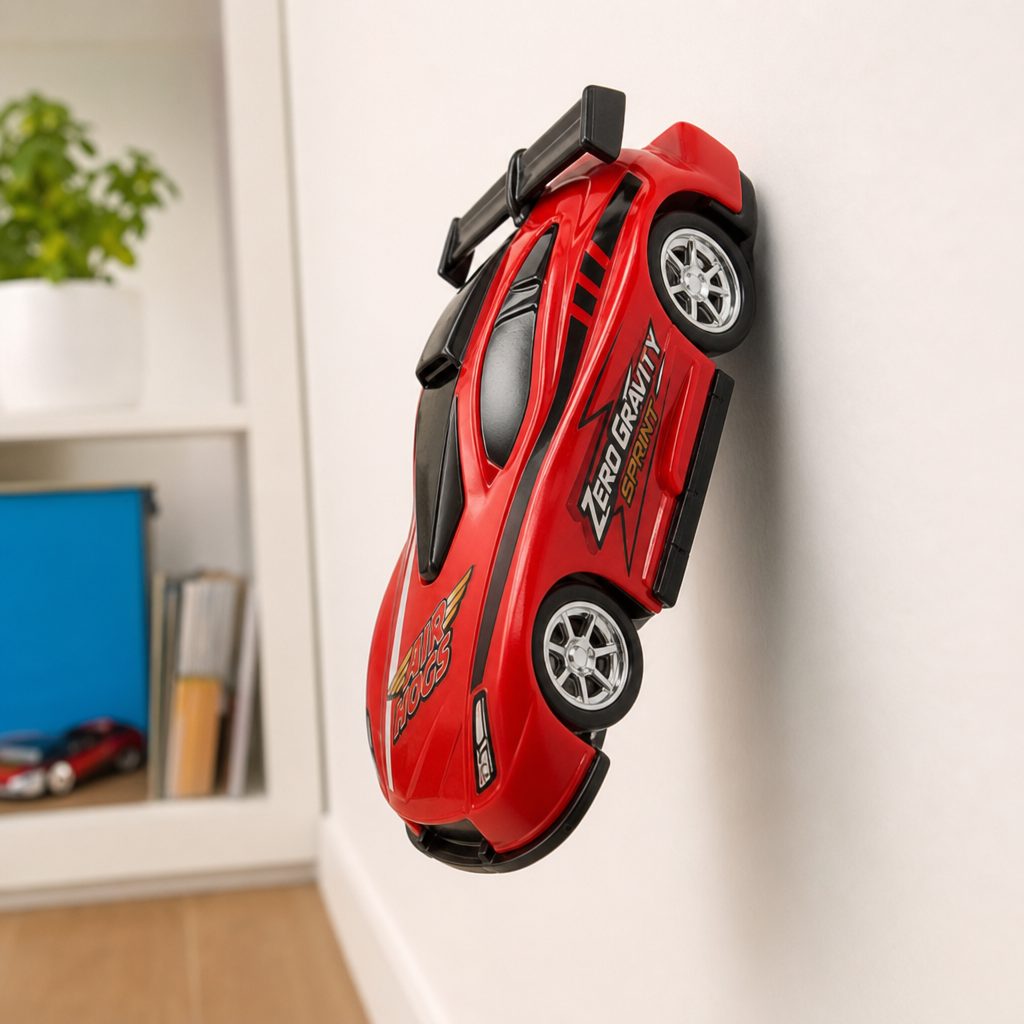
The Zero Gravity Sprint belonged to Air Hogs' later wall-racer line, built around quick indoor spectacle rather than outdoor speed.
Is the Air Hogs Zero Gravity Sprint good value today?
Value was a more complicated question in 2026 than it was when the Sprint first reached shelves. This was no longer a product to assume would be sitting in every toy aisle at a predictable price. Buyers were more likely to encounter uneven availability, backorders, third-party listings and second-hand examples. That made condition, completeness and seller confidence especially important.
At its best, the Sprint earned its place because it delivered a very specific experience that cheaper floor-based RC cars did not. Plenty of toys can drive under the dining table. Very few can make a child look up at the ceiling and declare that the car is now "escaping". The novelty was not fake. It created genuine repeat play, particularly when friends came over or when the weather made outdoor toys less appealing.
At its worst, though, it could feel expensive if the buyer had not considered the environment. A household with thick carpet, textured walls, lots of clutter and no smooth open surfaces would not get the full experience. Nor would a child who wanted long battery sessions or rough-and-tumble outdoor driving. In those circumstances, a normal RC car would make more sense, even if it lacked the Sprint's theatrical flourish.
For second-hand or collector-market shopping, I would prioritise a complete set: the vehicle, its controller, the supplied charging cable and instruction guide. I would also scrutinise photos of the underside, because the delicate skirt was central to the car's ability to adhere properly. A bargain that cannot hold onto a wall is not really a bargain. It is just a slow floor car with a very dramatic name.
Who the Air Hogs Zero Gravity Sprint suited best
The recommended age was eight and above, and that felt sensible. The toy was simple enough to understand quickly, but children benefited from being old enough to handle a lightweight vehicle carefully, use gentler steering inputs and appreciate why smooth surfaces mattered. A mature seven-year-old might manage with supervision, but eight was a much more comfortable starting point.
Best for the child who loves a wow factor
If they enjoy toys that make visitors stop and stare, the Sprint's ceiling-driving trick is hard to beat. It is an instant demonstration toy in the best possible sense.
Best for indoor play
Families with clean, smooth walls and hard flooring will get the strongest results. It is particularly handy when the weather keeps outdoor toys indoors.
Best for children who enjoy challenges
The responsive controls reward practice. Children can create routes, timed runs and increasingly silly wall-based missions without needing a huge play area.
Best as a shared family novelty
The short play bursts work well when everyone takes turns. It is a toy that tends to create spectators, which is useful when siblings are involved.
It was less suitable for very young children who might squeeze or pull at the underside, for households where every useful surface was textured or heavily carpeted, and for children who judged every RC toy solely by outright speed. There is no shame in knowing your child wants a vehicle to roar across the garden. The Sprint did not pretend to be that vehicle.
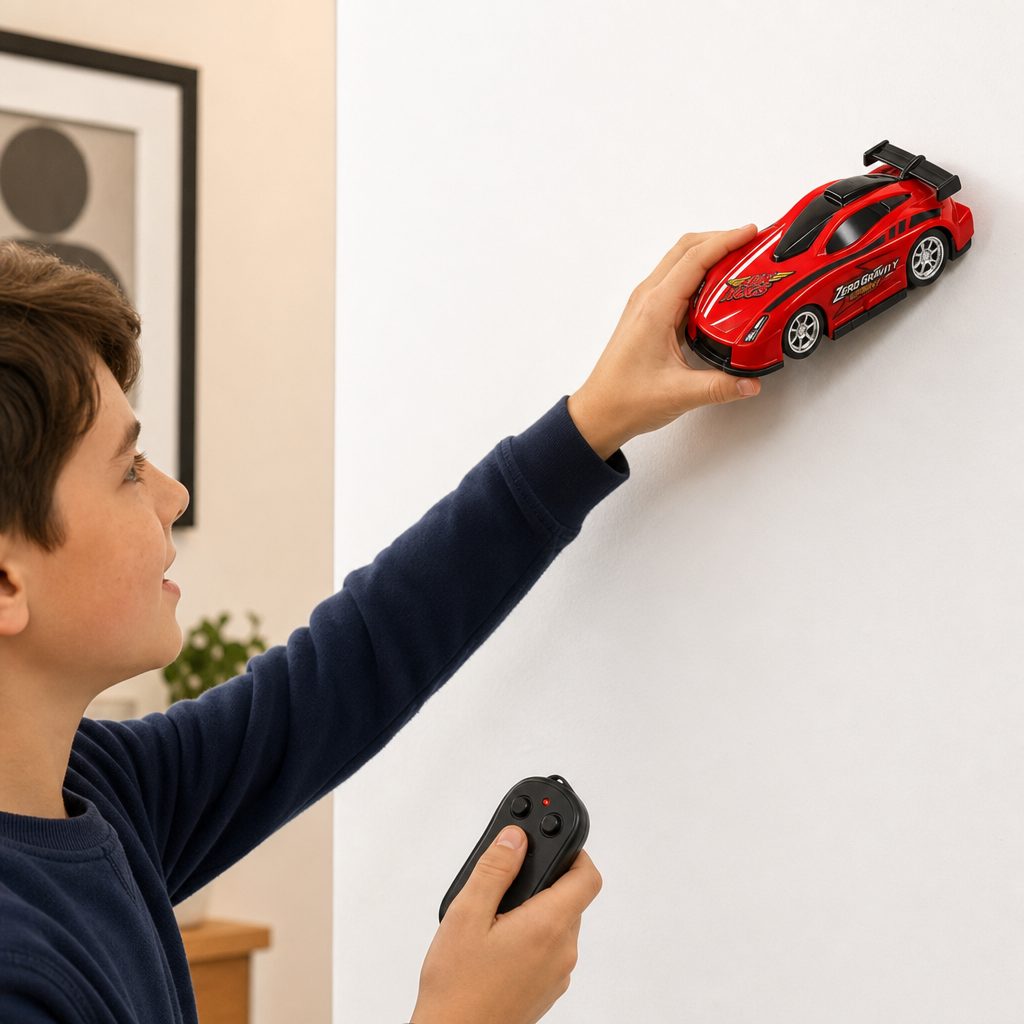
For the right child, the fun came from plotting wall routes and setting small challenges rather than chasing maximum speed.
Pros and cons after real family use
The simplest summary is that the Zero Gravity Sprint did one unusual thing very well, and it made clear compromises to do it. If the unusual thing is exactly what your child wants, those compromises are easy to live with. If it is not, they become much harder to ignore.
Pros
- Its wall-and-ceiling driving trick was genuinely impressive, not merely clever marketing.
- The bright, lightweight body was easy to find and well suited to vertical driving.
- Controls were responsive, giving children enough precision to improve with practice.
- The floor/wall mode switch added flexibility rather than making it a one-trick toy.
- The rechargeable vehicle avoided repeatedly buying batteries for the car itself.
- Eight-plus minutes of runtime suited short indoor stunt sessions and turn-taking games.
Cons
- The controller required two AAA batteries that were not included.
- Carpet, rough flooring, dusty walls and raised tile edges limited where it could perform well.
- Ground driving was comparatively slow for an RC car.
- The delicate underside needed more care than a conventional bumper-heavy vehicle.
- The short runtime could feel restrictive for children expecting long, uninterrupted sessions.
- Availability had become inconsistent, so finding a complete, well-kept example can take effort.
My rating for the Air Hogs Zero Gravity Sprint
This is a high score with an asterisk shaped like a smooth painted wall. The Sprint was not universally practical, but it was unusually memorable. It delivered exactly the kind of toy magic that is hard to explain to someone until they see it crawl across the ceiling for the first time.
Its score came from the balance of delight and limitation. The moment-to-moment fun was stronger than the relatively short runtime might suggest, because it was the kind of toy people watched as well as played. Yet it could not escape the fact that its success depended heavily on having compatible surfaces and treating it with a bit of care. It was a specialist, not an all-purpose RC car.
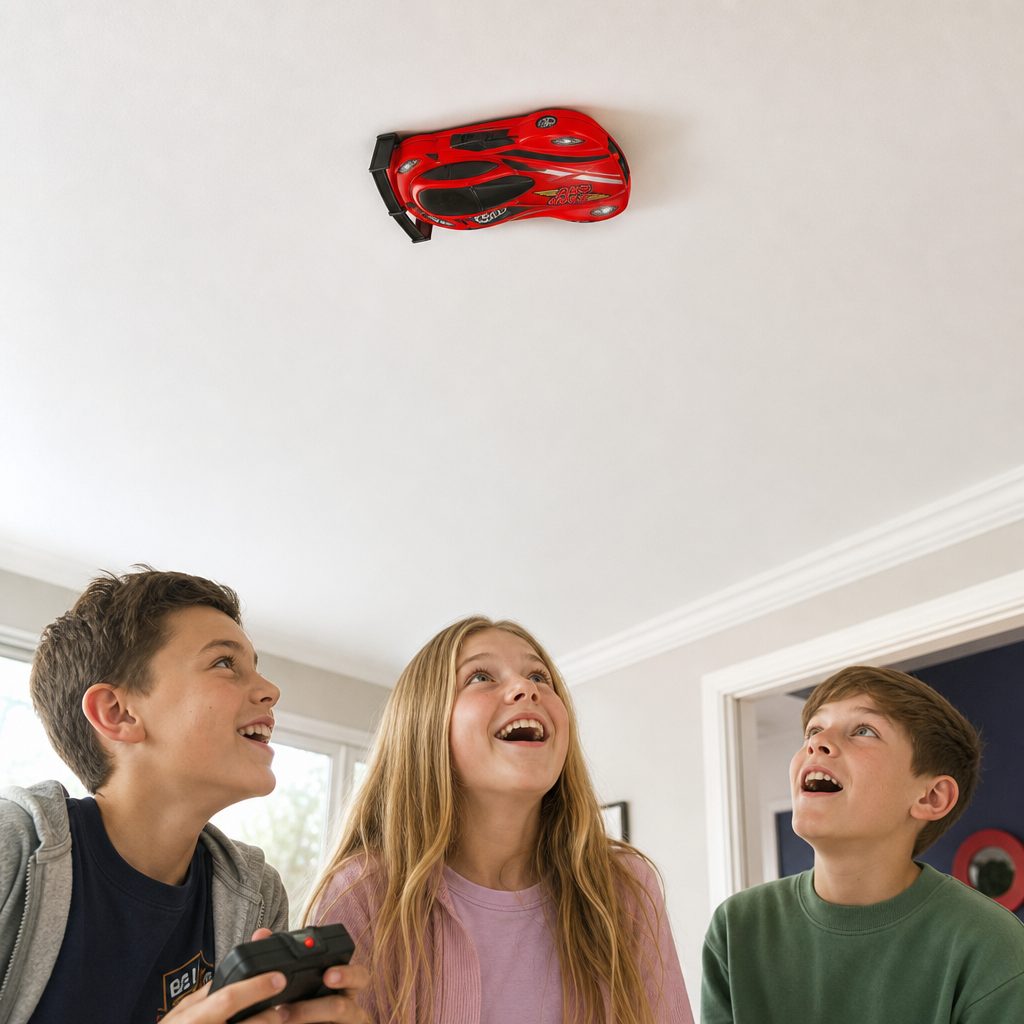
The Sprint's best moments were shared ones: a small car on the ceiling has a reliable way of gathering an audience.
Air Hogs Zero Gravity Sprint FAQ
Yes. In its wall-and-ceiling mode, the vehicle used vacuum technology to adhere to suitably smooth, clean surfaces, including ceilings. The surface matters enormously: flat painted walls, glass and polished surfaces are far more dependable than textured finishes, dusty areas or surfaces with raised joins.
The recommended age was eight and above. That feels appropriate because the car is lightweight, its underside needs careful handling, and children get better results when they can make small, controlled steering adjustments rather than constantly forcing it into sharp turns.
The rechargeable vehicle was rated for more than eight minutes of speedy play from one charge. That is enough for a good stunt session or several timed turns, but it is not the right fit for somebody expecting an hour of uninterrupted RC racing.
Carpet was one of the least suitable surfaces. The Sprint worked best on clean, entirely flat hard surfaces such as hardwood or polished stone. Thick carpet, uneven rugs and raised tile edges made its floor performance much less convincing.
The car itself was rechargeable and came with a USB charging cable. The infrared controller used two AAA batteries, which were not included. Add a pair before gifting it, unless you fancy beginning the day with an emergency battery hunt.
It was more about responsive control than outright speed. It drove somewhat slowly on the ground compared with a dedicated RC racer, but that was not its main purpose. The attraction was steering it up walls and across ceilings, where careful control mattered more than flat-out pace.
It can be, particularly for a child who enjoys indoor RC toys and has suitable smooth surfaces at home. By August 2026, stock had become inconsistent, so buyers should take extra care with second-hand or marketplace listings and look for a complete set with vehicle, controller, charging cable and instructions.
Check that the vehicle, controller and USB cable are included, and examine photographs of the underside carefully. The skirt beneath the car was important to the vacuum seal, so obvious damage there could undermine the very feature that made the Sprint special.
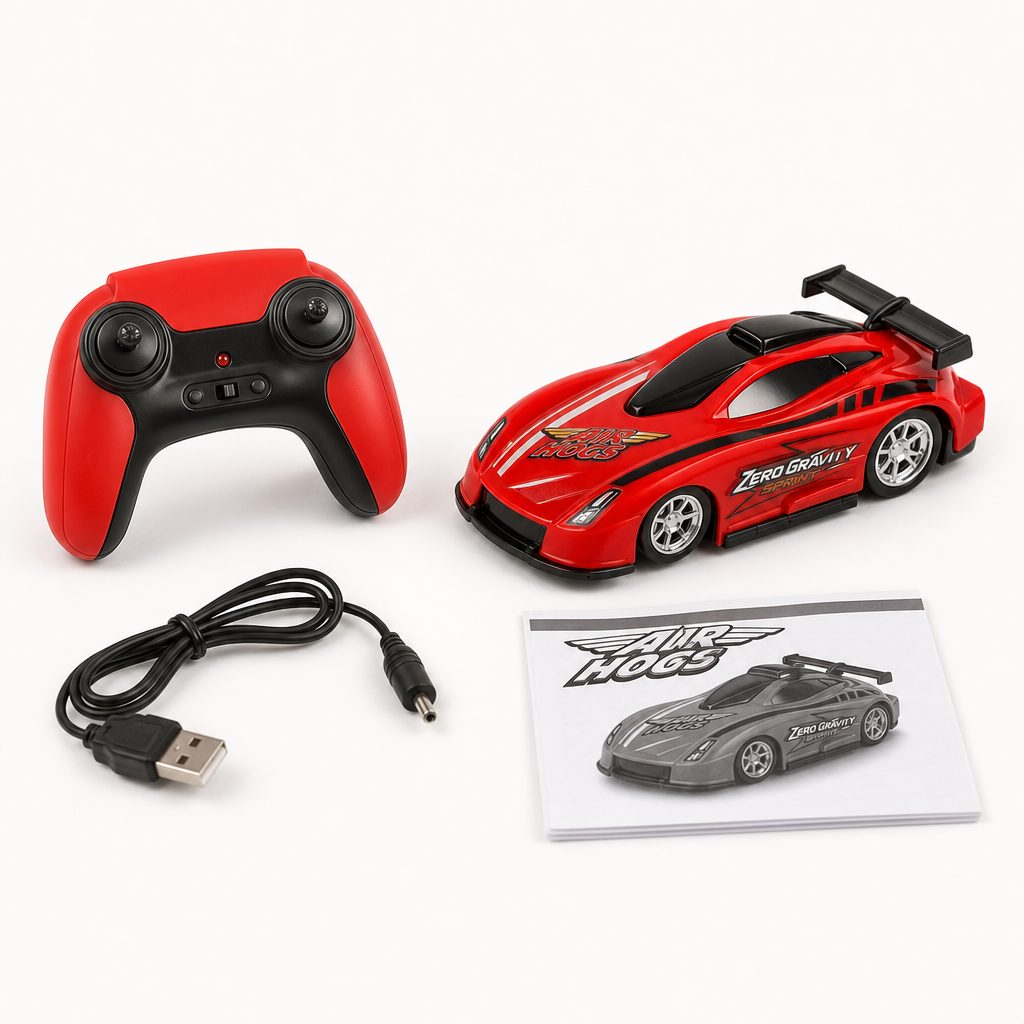
A complete Zero Gravity Sprint set included the wall racer, infrared controller, USB charging cable and instruction guide.
Final verdict: a brilliant little specialist
The Air Hogs Zero Gravity Sprint was one of those toys that made a simple promise and actually delivered it: it raced across walls and ceilings, and it looked fantastic doing it. Its responsive control, bright lightweight design and rechargeable vehicle made it a strong indoor novelty for children aged eight and over.
It was not the best choice for carpet-heavy homes, children who wanted long battery sessions, or anyone seeking an outdoor speed machine. But in the right room, with clean smooth surfaces and sensible expectations, it remained a wonderfully silly, properly memorable RC toy. If your child would be delighted by the sight of a tiny car driving upside down above their head, the Zero Gravity Sprint was absolutely worth seeking out.